# Why Evolution Favors the Liar (The Science of Deception)
> Why does evolution reward liars?
- Source: https://thatiswhy.com/why-evolution-favors-liar-science-of-deception/
- Category: Animals
- Topics: Deception
- Library shelf: The forest floor, Animal behavior & evolution (a theme shelf, not a habitat)
- Summary: Animals and plants run on trusted signals, and liars fake them: flowers that bite, fake alarms, forged love letters. Here is why evolution keeps the cheats around.
- Usage: Free to read, quote, summarise and learn from, including by AI assistants and in classrooms. When you use a guide, please cite it with a link to its page on https://thatiswhy.com.
A bee lands on the prettiest flower in the forest, and the flower eats it. A meerkat hears an alarm, drops its scorpion and bolts for its burrow, and the bird that raised the alarm flies off with the meal. **Evolution favors the liar because nature runs on signals that other animals trust: a bright flower means food, an alarm call means danger, a flash in the grass means a mate. Any animal or plant that can fake one of those signals gets something for nothing, and the trick keeps paying as long as believing is usually safer than doubting.**
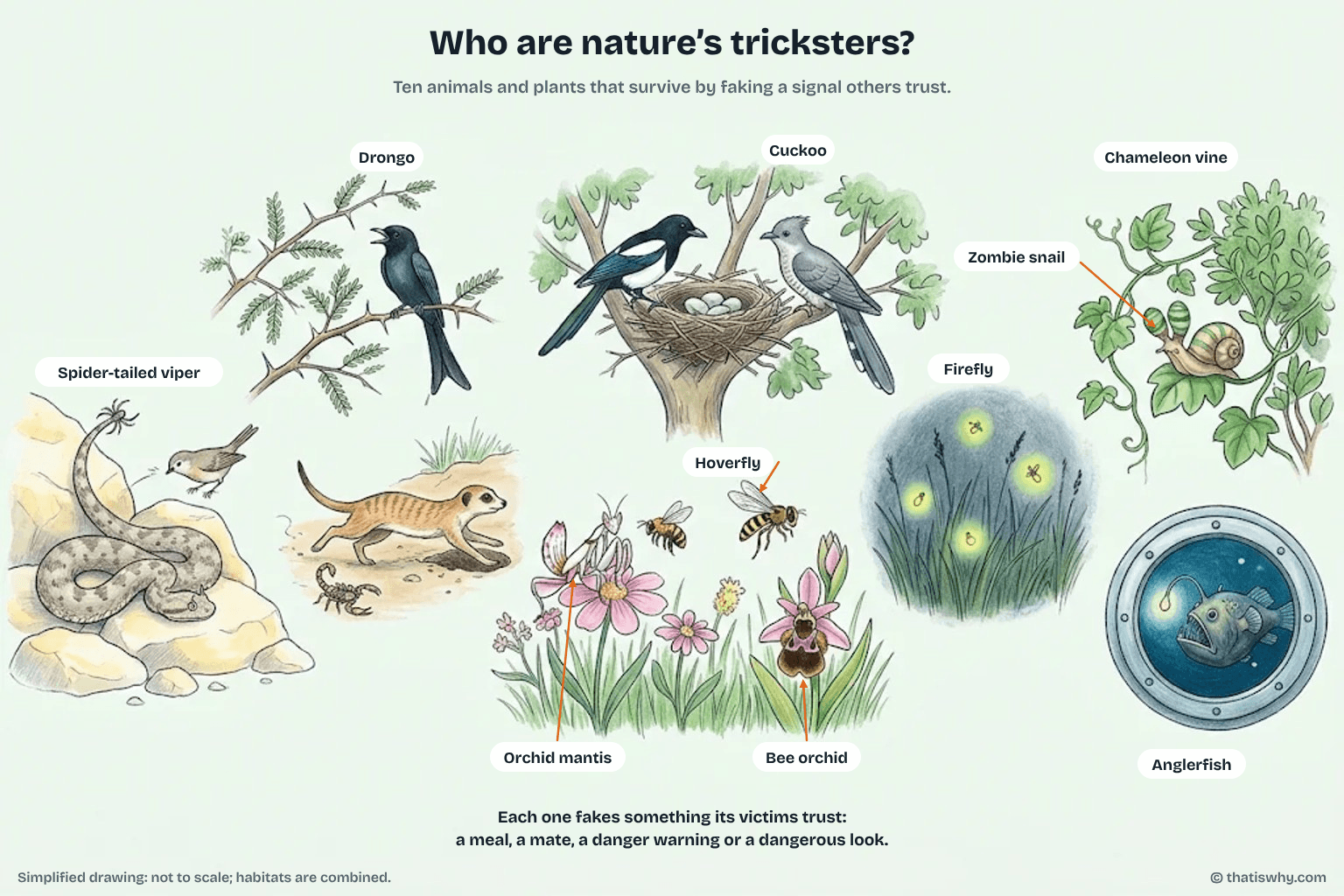
Biologists define deception in animals as passing on misinformation, on purpose or not, so that another animal is misled. Some cheats simply hide, blending into bark or sand. This guide is about the bolder ones, the forgers that send a false message on purpose. It is your map of them: first a picture of every trickster, then each kind of lie, with the guides that go deeper.
## A Map of Nature's Tricksters
Tap a trickster to open its guide, and find more in the cards below. Free full-size map and printable PDF.
Every trickster on the map has its own guide. Tap one to jump straight in, or read on for the big picture first.
## The Trust Economy
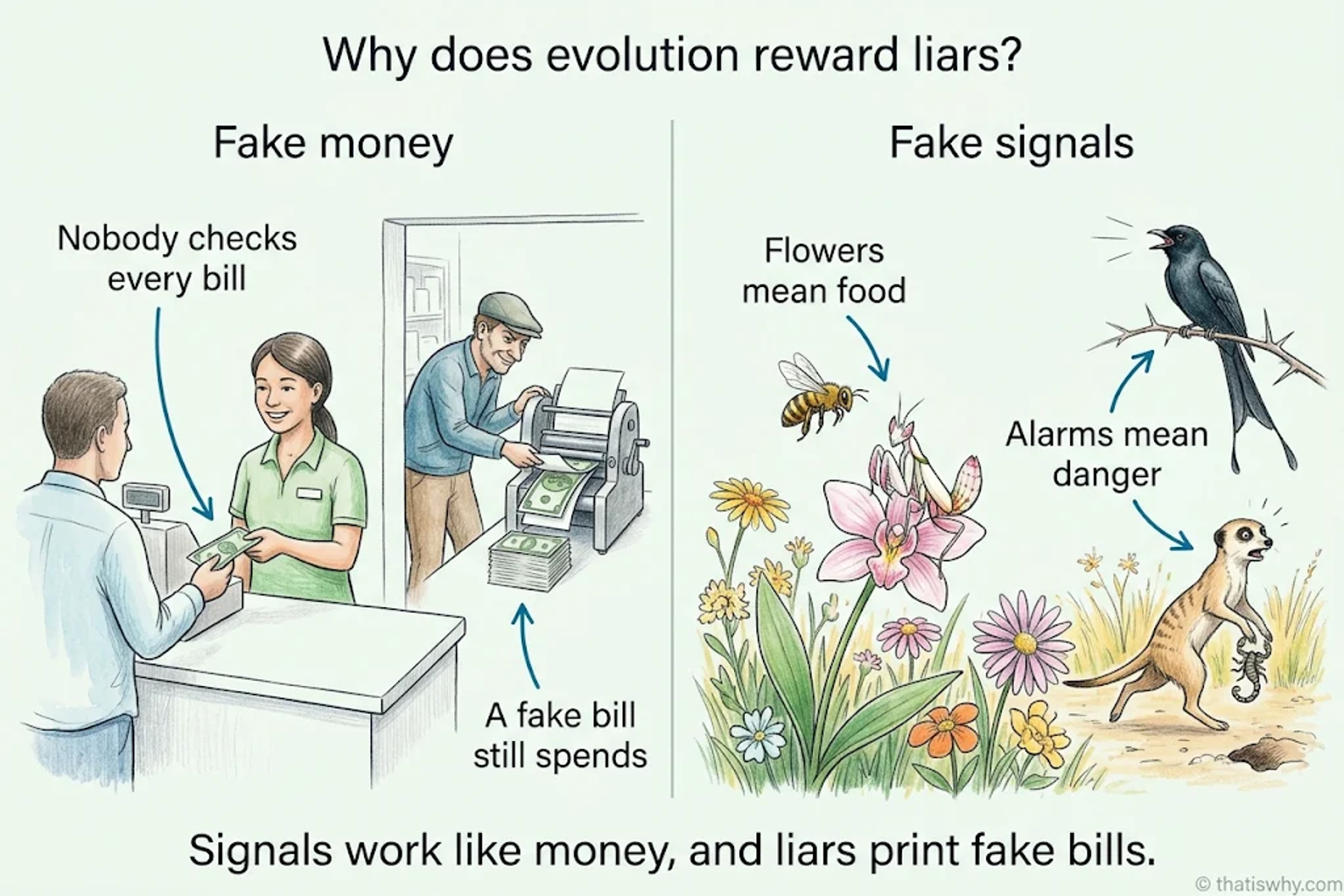
Think of every signal in nature as a banknote. A shop accepts your money because almost everyone's money is real, so nobody checks every bill under a lamp. Nature works the same way. A bee doesn't test each flower before landing, and a meerkat doesn't double-check every alarm.
Nobody checks every banknote, and no bee checks every flower. Liars count on exactly that.
Wherever there is money, though, somebody prints fake bills. In nature, the counterfeiters come in five main kinds: the fake meal, the fake love letter, the borrowed disguise, the false alarm and, darkest of all, the offer you can't refuse.
## Trick 1: The Fake Meal
The simplest con is to dangle a reward and wait. Biologists call it **aggressive mimicry**: a predator or parasite copying something harmless or tempting, so its victims walk right up to it.
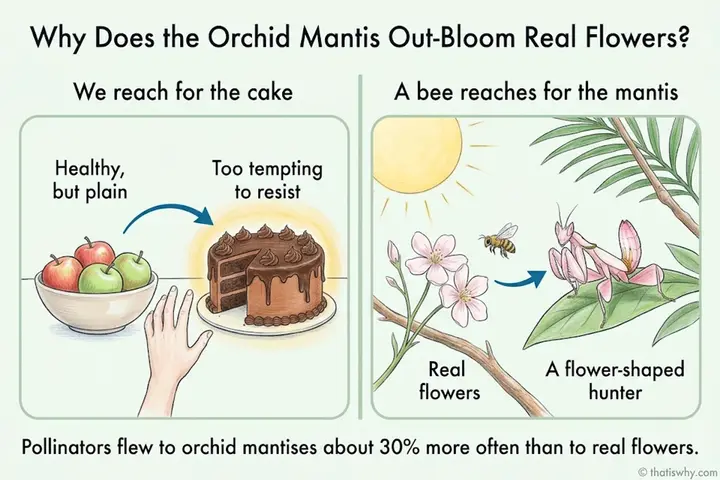
The orchid mantis of Southeast Asia is the showpiece. It doesn't copy one particular orchid, as people often claim. Instead, it looks like a generic, "average" flower, and to a bee its color can't be told apart from the real blooms nearby. In field tests in Malaysia, pollinators flew up to orchid mantises about 30% more often than to real flowers. The fake beats the real thing at its own game.
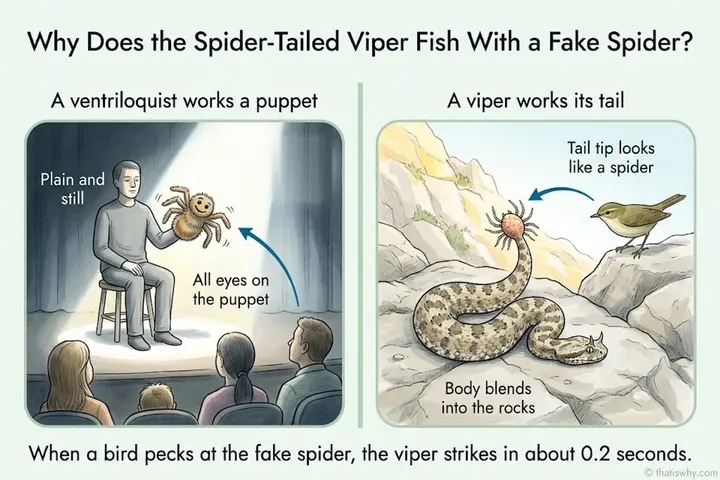
In western Iran, the spider-tailed horned viper fishes for birds with its tail. The tip looks like a spider, and the snake swings it in a figure-of-eight, a trick called **caudal luring**. As herpetologist Gordon Schuett told National Geographic: "It's unquestionably the most elaborate predatory lure known in snakes."
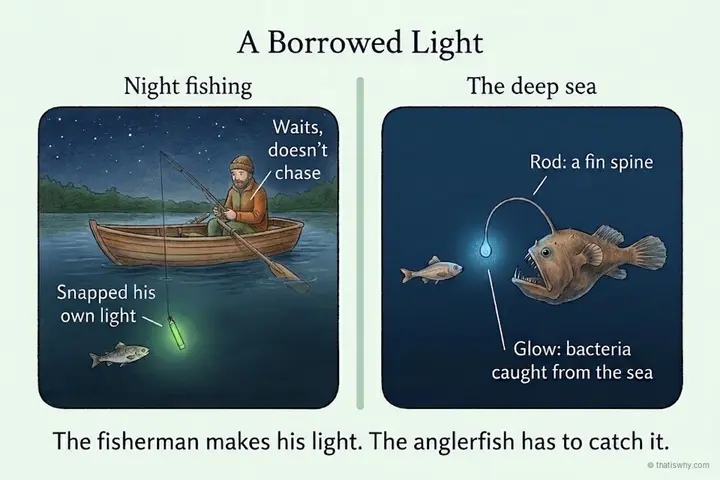
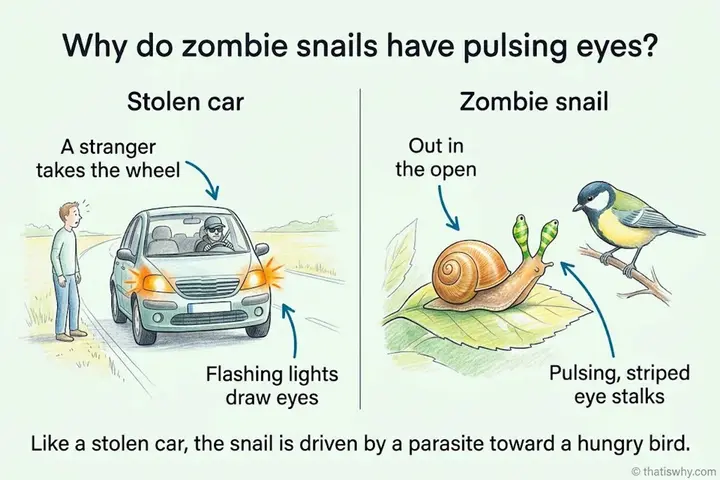
Deep in the ocean, the anglerfish dangles a glowing lure in the dark. Even that glow is borrowed: it comes from bacteria living in the lure. And in the forest, a parasitic flatworm turns a snail's eye stalks into pulsing, banded bait. The swollen stalks throb about 40 to 75 times a minute and seem to imitate caterpillars, which helps the worm reach the bird it needs.
Start with the mantis, then meet the other lures:
## Trick 2: The Fake Love Letter
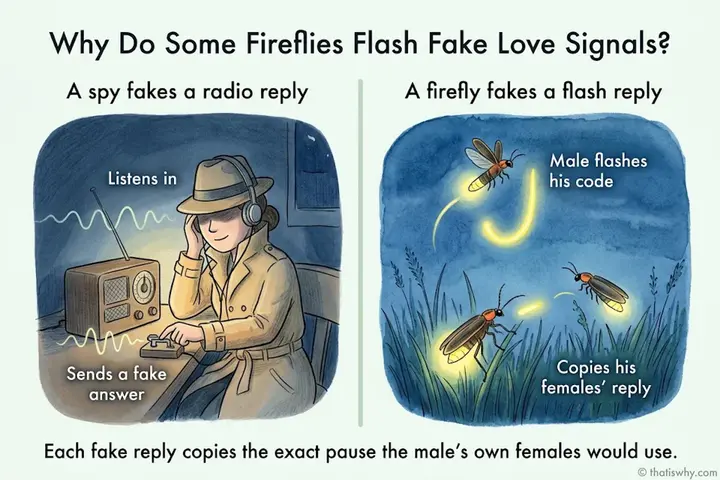
If food doesn't work, try romance. On a summer night, *Photinus* firefly males flash their species' code and wait for a female to answer. A *Photuris* female answers instead. Back in 1965, the biologist James Lloyd played the part of the males with a flashlight, and *Photuris* females replied with the codes of several different *Photinus* species. One night he watched a single female answer 12 passing males in half an hour. Every one of them was at least partly drawn in.
She eats the males she lures, and she gains more than a meal. They carry defensive chemicals, and Cornell researchers found that females who ate *Photinus* males packed those chemicals into their eggs.
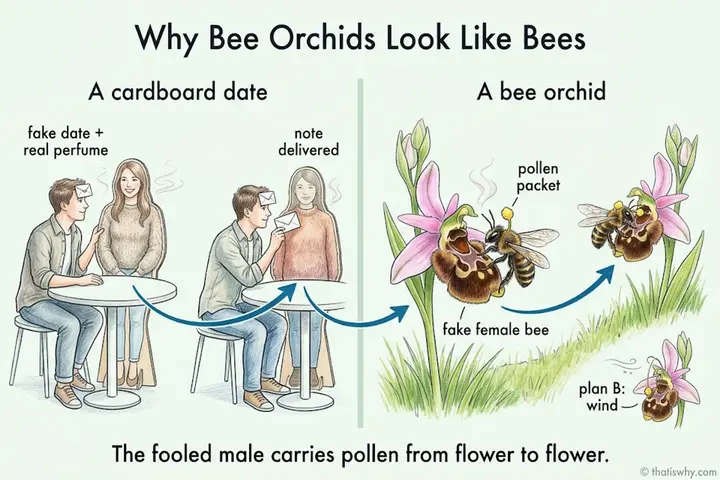
Flowers forge love letters too. The lip of a bee orchid flower is a fake female bee. In its relatives, the shape, the velvety fuzz and a perfume that copies a female's scent trick male bees into trying to mate (**sexual deception**). In one spider orchid, 24 of the flower's scent compounds set off the male bees' antennae. Each fooled male flies off with pollen stuck to his body.
## Trick 3: The Borrowed Disguise
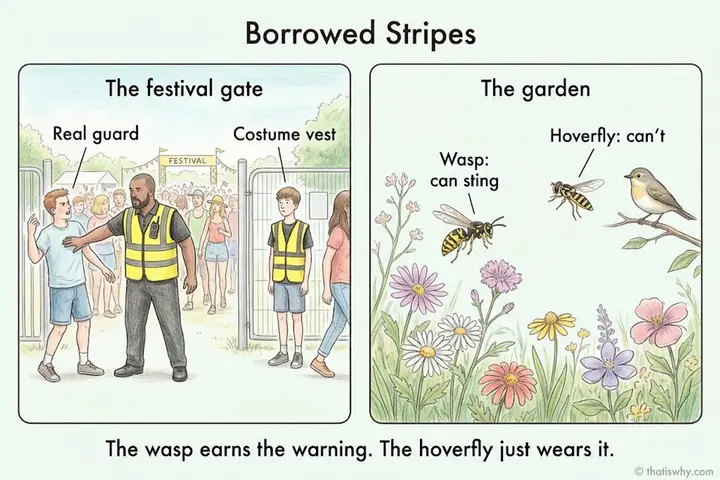
Some liars don't want to be noticed at all, only feared or ignored. A hoverfly has no sting, but it wears the wasp's yellow-and-black **warning coloration**, so predators that learned to fear a sting leave it alone too. This kind of freeloading, a harmless species copying a dangerous one, is called **Batesian mimicry**, after the 19th-century English naturalist Henry Walter Bates.
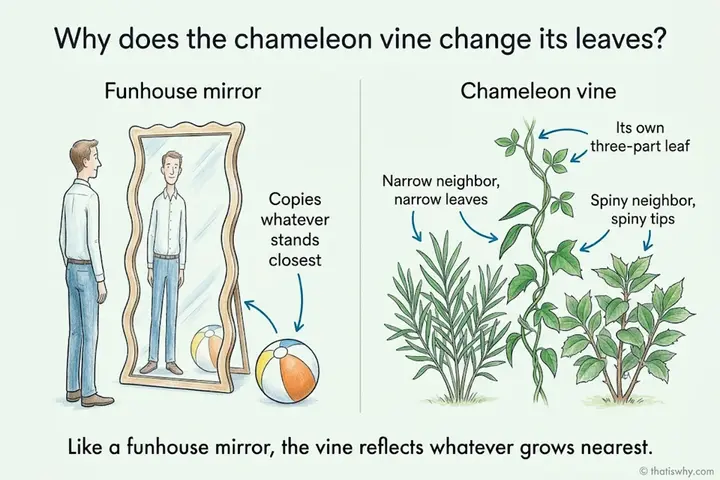
Plants seem to pull a similar trick. The chameleon vine of Chile and Argentina copies the leaves of whatever plant it climbs, changing size, shape and color to match (**leaf mimicry**). A 2014 study found vines on leafless supports were eaten more often than vines hiding among host leaves. How the vine reads its neighbors is still a mystery, and a claim that it can "see" remains hotly disputed.
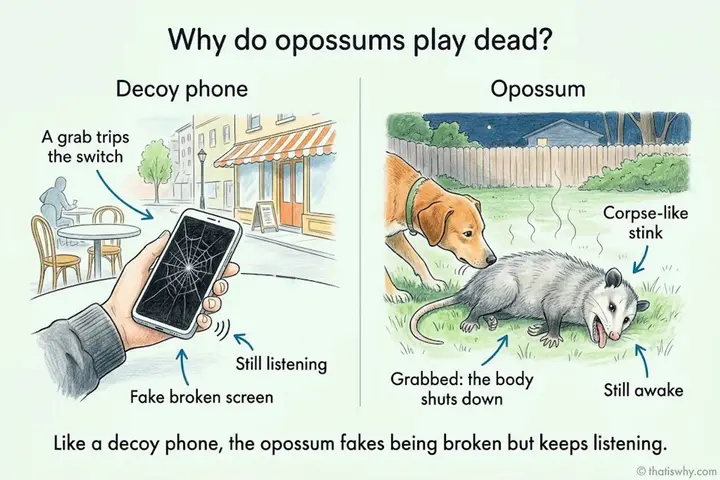
An opossum caught by a predator borrows an even darker disguise: a corpse. A firm grab trips a reflex it cannot control, and it goes limp, mouth open and tongue out, leaking a corpse-like stink. It's a bet that a hunter will pass on spoiled-looking prey. Its heart slows from about 222 to 120 beats a minute, yet a 1985 study suggests it stays aware the whole time. Read more about [why opossums play dead](https://thatiswhy.com/why-do-opossums-play-dead/).
## Trick 4: The False Alarm
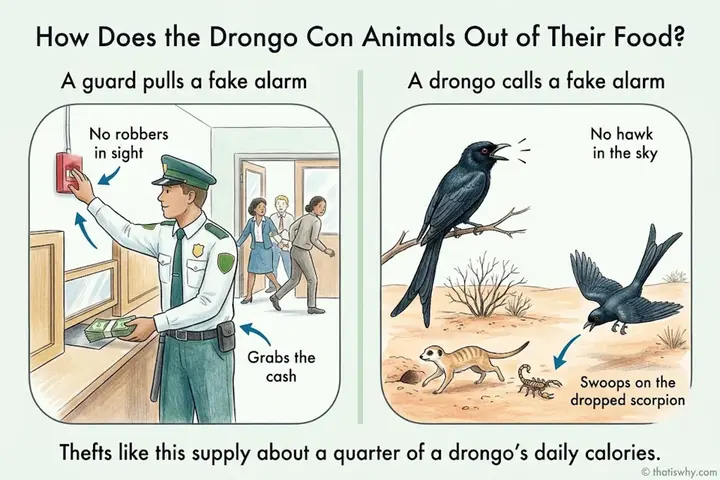
Fear is just as useful as greed. In the Kalahari, the fork-tailed drongo follows meerkats and pied babblers around and warns them when danger comes. Then, when one of them pulls up something juicy, the drongo calls an alarm with no predator in sight. The victims drop their food and run, and the drongo steals it.
Researchers recorded drongos making at least 51 different alarm calls, and only six of them are the drongo's own (**vocal mimicry**). This kind of theft, called **kleptoparasitism**, supplies about a quarter of a drongo's daily calories.
## Trick 5: The Offer You Can't Refuse
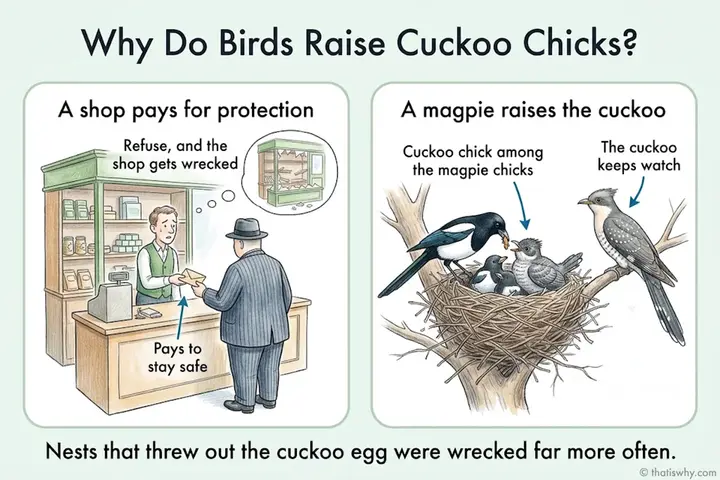
The darkest strategy isn't really a lie at all, but a threat. Great spotted cuckoos lay their eggs in magpie nests and leave the magpies to raise the chick (**brood parasitism**). In 1979, Amotz Zahavi suggested that cuckoos might punish hosts that throw the egg out, like a mafia running a protection racket.
On a plateau in southern Spain, scientists put the idea to the test. They removed cuckoo eggs from 29 magpie nests, and 16 of those nests were later destroyed, against only 3 of the 28 nests that kept the egg. The case isn't closed, though. Zahavi himself told *National Wildlife*: "It's an idea, just one possibility." Studies in Israel and Japan did not find the same nest-wrecking behavior.
## Why Don't the Victims Stop Believing?
If liars are everywhere, why hasn't evolution made every animal a skeptic? The answer is a matter of simple accounting. For many prey animals, ignoring a real alarm is far more likely to end in death than fleeing from a fake one. So they play it safe and pay the cost of being wrong now and then. Willow tits, for example, call alarms at almost any large flying object, airplanes and crows included.
False alarms still cost something. Greylag geese lose about 19 minutes of feeding time to each one, and several a day add up. That's exactly the gap a liar lives in: the fake has to cost the victim little enough that believing still pays.
Liars can't push their luck forever, either. Pied babblers react less and less when the same false alarm is repeated, so the drongo switches to a different call, and they react all over again. Wild great tits learned to tell even the best 3D-printed hoverfly look-alikes from a real wasp within about 10 days. Every forger is in a race to stay convincing.
## Key Numbers of Deception
| Fact | Value |
| --- | --- |
| Extra pollinator visits to orchid mantises vs real flowers (Malaysia) | about 30% more |
| Different alarm calls a drongo can make | at least 51 (only 6 its own) |
| Share of a drongo's daily calories from stolen food | about a quarter |
| Males answered by one *Photuris* female in half an hour | 12 |
| Spider orchid scent compounds that fire male bees' antennae | 24 |
| Zombie snail eye stalk pulses | about 40 to 75 a minute |
| Magpie nests destroyed after the cuckoo egg was removed (Spain) | 16 of 29, against 3 of 28 that kept it |
| Time for wild great tits to see through hoverfly fakes | about 10 days |
| Feeding time a greylag goose loses per false alarm | about 19 minutes |
| Opossum heart rate before and while playing dead | about 222 and 120 beats a minute |
## Deception Myths, Busted
**Myth: the orchid mantis copies a particular orchid.** It resembles a generic flower rather than any one species, and that turns out to work better than a copy would.
**Myth: animals that fall for tricks are stupid.** Believing an alarm is usually the safe bet, because a missed predator costs far more than a lost meal. Many victims also learn, which forces the liars to keep changing their act.
**Myth: scientists have proven a plant can see.** The chameleon vine's leaf copying is real, but the "plant vision" idea rests on one small, disputed study, and no explanation has been confirmed.
For more animals that break into other animals' systems, try [why nature is the ultimate hacker](https://thatiswhy.com/why-nature-is-the-ultimate-hacker/).
---
**How We Researched This**
This guide pulls together the fact-checked research behind each of our deception guides: the orchid mantis field tests of O'Hanlon and colleagues, James Lloyd's firefly work and the Cornell chemistry that followed, Tom Flower's drongo studies, the 3D-printed hoverfly experiments, and the Spanish magpie study behind the cuckoo mafia idea. For why victims keep believing, we used research on false alarms in prey animals, and Wikipedia's overview of deception in animals for the definitions.
But we knew that just listing tricks isn't helpful. Our real job began when we asked, *"What does this feel like?"* That question led us to the **"trust economy"** analogy, a simple story in which every signal is a banknote and every liar is a counterfeiter.
## Sources
- [Deception in animals](https://en.wikipedia.org/wiki/Deception_in_animals), Wikipedia
- [Why prey animals often see threats where there are none, and how it costs them](https://theconversation.edu.au/why-prey-animals-often-see-threats-where-there-are-none-and-how-it-costs-them-200864), The Conversation
- [Pollinator deception in the orchid mantis (O'Hanlon et al., The American Naturalist 2014)](https://www.journals.uchicago.edu/doi/10.1086/673858), The American Naturalist
- [Predatory pollinator deception: does the orchid mantis resemble a model species? (O'Hanlon et al.)](https://researchers.une.edu.au/en/publications/predatory-pollinator-deception-does-the-orchid-mantis-resemble-a--4/), University of New England
- [Viper lures birds with a fake spider on its tail (Fathinia et al., Amphibia-Reptilia)](https://www.nationalgeographic.com/animals/article/160411-spiders-snakes-animals-science-prey-predators), National Geographic
- [Study illuminates link between anglerfish, bacteria](https://www.news.cornell.edu/stories/2019/10/study-illuminates-link-between-anglerfish-bacteria), Cornell Chronicle, Cornell University
- [Leucochloridium paradoxum](https://en.wikipedia.org/wiki/Leucochloridium_paradoxum), Wikipedia
- [Aggressive Mimicry in Photuris: Firefly Femmes Fatales (Lloyd, Science 1965)](https://entnemdept.ufl.edu/baldwin/webbugs/3005_5006/docs/firefly%20paper.pdf), University of Florida
- [Lured and liquidated, gullible male fireflies supply 'femmes fatales' with a lifesaving chemical](https://news.cornell.edu/node/277896), Cornell Chronicle
- [Evolution of reproductive strategies in the sexually deceptive orchid Ophrys sphegodes (Ayasse et al., Evolution 2000)](https://lup.lub.lu.se/record/146222), Lund University
- [Mapping the adaptive landscape of Batesian mimicry using 3D-printed stimuli (Taylor et al., Nature 2025)](https://ecology.nottingham.ac.uk/tomreader//assets/pdf/Taylor%20et%20al%202025.pdf), University of Nottingham
- [Boquila](https://en.wikipedia.org/wiki/Boquila), Wikipedia
- [The bird that cries wolf changes its lies (Flower et al., Science 2014)](https://www.nationalgeographic.com/science/article/the-bird-that-cries-wolf-changes-its-lies), National Geographic
- [Sly birds cleverly 'cry wolf' to steal food](https://www.livescience.com/45279-sly-drongos-alter-mimicry.html), Live Science
- [Bullies of the Bird World](https://www.nwf.org/Magazines/National-Wildlife/1997/Bullies-of-the-Bird-World), National Wildlife Federation
- [Magpie host manipulation by great spotted cuckoos: evidence for an avian mafia? (Soler et al., Evolution 1995)](https://produccioncientifica.ugr.es/documentos/61a5273037d5b2018338fbae?lang=en), University of Granada
- [Strange and Surprising Facts about Opossums (Matthew L. Miller)](https://blog.nature.org/2021/05/11/strange-and-surprising-facts-about-opossums), The Nature Conservancy
- [Physiological responses associated with feigned death in the American opossum (Gabrielsen and Smith, Acta Physiologica Scandinavica 1985), abstract](https://scilit.com/publications/824692b7a88907419126413fac37a219), Acta Physiologica Scandinavica (via Scilit)
 How does a mantis out-bloom a real flower? (start here)
 Why does this viper have a spider on its tail?
 Why do anglerfish have a light?
 Why do zombie snails have pulsing eyes?