Why Zombie Snails Have Pulsing Disco Eyes
The Neon Sign in the Forest
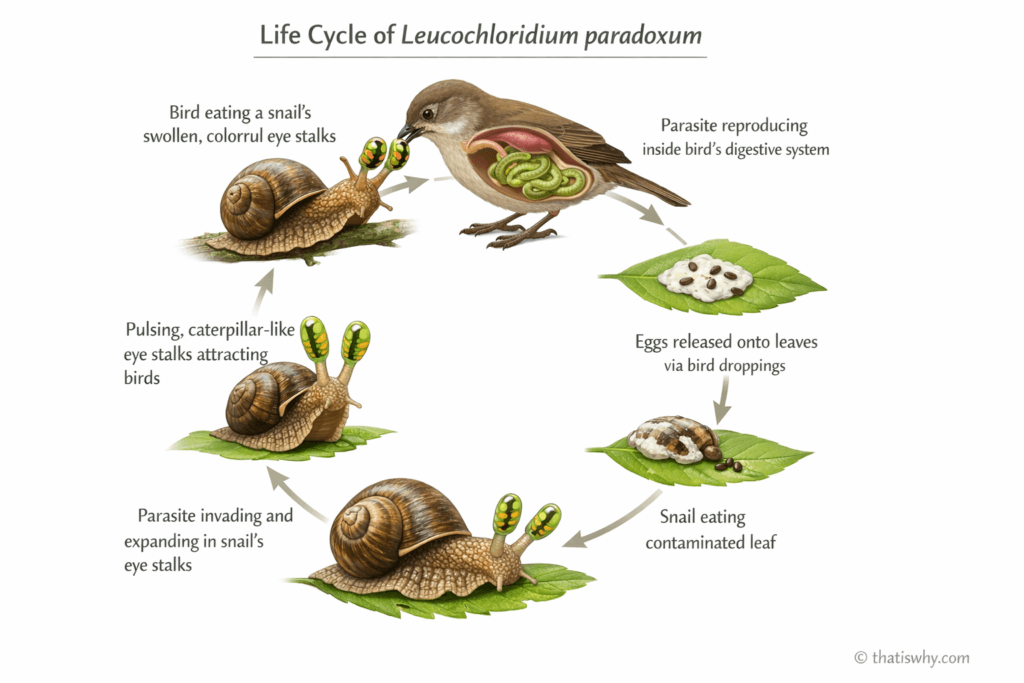
Why do snail eyes pulse? When you see a snail with swollen, pulsing, colorful tentacles, it has been infected by a parasitic flatworm called Leucochloridium paradoxum. The worm invades the snail’s eye stalks and creates a pulsing display that mimics a caterpillar, tricking birds into eating the snail so the parasite can reproduce inside the bird’s gut.
That is the science. But seeing it in person is disturbing because it breaks every rule of snail behavior.
Snails are creatures of the shadows. They evolved to avoid two things: dehydration and predators. That’s why you usually find them under logs or deep in the mulch. They stick to the dark, damp corners of the world to stay safe.
But a “zombie snail” does the exact opposite. It abandons the safety of the ground and climbs to the highest, most exposed leaf it can find. It sits in the blazing sun, totally vulnerable. And instead of retracting into its shell, it waves its swollen, pulsing eyes around like a flag.
It looks like a neon sign. But in reality, it is a Stolen Car being driven by a maniac.
The Hostile Takeover
To understand why a snail would act this way, you have to stop looking at it as an animal. It’s not an animal anymore. It’s a vehicle.
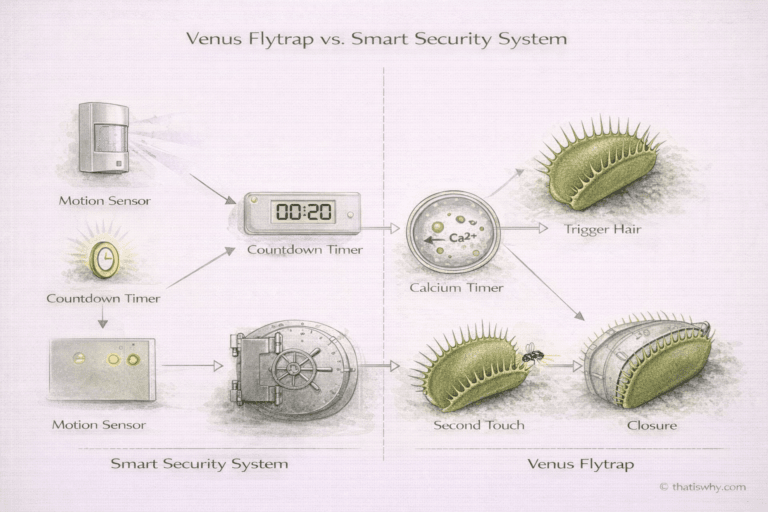
Think of the snail as a Stolen Car. Under normal circumstances, the snail is the driver. It has simple goals: stay moist, eat leaves, and avoid being seen. It drives carefully.
But this snail made a mistake. A few weeks ago, it ate a leaf contaminated with bird droppings. Hidden in that dirt were the microscopic eggs of a parasitic flatworm.
That worm is the carjacker. Once it hatches, it kicks the snail out of the driver’s seat and takes the wheel. And this new driver is reckless.
The worm doesn’t care if the car gets totaled. It has a very specific destination in mind: A bird’s stomach. The bird’s gut is the only place the worm can breed.
The problem is, birds hate snails. Snails are crunchy, slimy, and usually hiding in the dirt. Birds want caterpillars—juicy, colorful grubs that hang out on high branches.
So, the carjacker realizes he can’t just drive the snail to the bird. He has to trick the bird. He has to modify the car to look like something delicious.
Hacking the Mainframe
The first thing the carjacker does is reprogram the navigation system.
Snails are born photophobic—they are terrified of light. Their entire survival strategy is based on staying in the dark garage of the forest floor. Sunlight is the enemy.
But the parasite hacks the mainframe. It releases a chemical cocktail that flips a switch in the snail’s brain, turning it photophilic. Suddenly, the snail loves the light.
It stops hiding. It abandons the safety of the dirt and starts sprinting (at snail speed) toward the brightest, highest leaf it can find. The carjacker is effectively driving the stolen vehicle out of the garage and parking it in the middle of a busy highway.
The Bait and Switch
Once the car is parked in the spotlight, the worm puts on the flashers.
The parasite pushes huge, colorful brood sacs—tubes filled with hundreds of larvae—up through the snail’s neck and forces them inside the translucent eye stalks. It stretches the skin until it’s paper-thin, creating a clear display window.
Then, it starts the engine. The brood sacs begin to pulse. They pump rapidly, about 60 to 80 times a minute.
This isn’t a twitch; it’s a performance. It is Aggressive Mimicry. The rhythm and the neon bands are perfectly calibrated to look like a wriggling caterpillar. To a passing bird, this doesn’t look like a gross snail anymore. It looks like a delicious, dancing grub.
The worm has successfully customized the car. It has turned a boring, brown sedan into a flashy neon sports car that screams, “STEAL ME.”
The Great Escape
Eventually, the marketing works. A hungry bird spots the “caterpillar” dancing on a leaf and swoops down to claim its prize.
This is the moment the parasite has been waiting for. The bird rips the swollen eye stalks right off the snail’s face and swallows them whole. The vehicle has been stripped for parts, but the driver has successfully reached his destination.
Inside the bird’s gut, the larvae break free. They grow into adults, breed, and lay thousands of eggs. And the crazy part? They don’t hurt the bird at all. To them, the bird isn’t a victim; it’s just a luxury hotel and a free plane ticket.
The final step is the drop-off. The bird flies miles away and poops the eggs out onto a leaf. A new, unsuspecting snail comes along, eats the leaf, and unknowingly swallows the keys to its own destruction.
The cycle restarts.
The Fleet of Stolen Cars
This idea of a hijacker taking the wheel isn’t limited to snails. It turns out, nature is full of stolen vehicles.
Biologists call this the “Extended Phenotype”—when a parasite’s genes reach out and control the body of its host.
The Weaponized Truck (Rabies) You see this with Rabies. The virus needs to spread via saliva, but it can’t walk. So, it hacks a dog’s brain. It makes the dog aggressive and terrified of water (so it won’t swallow the infected saliva). It turns a loyal pet into a weaponized truck, driven by a virus that just wants to crash into other cars.
The Kamikaze Uber (Toxoplasmosis) There is a parasite called Toxoplasma gondii that needs to get into a cat’s stomach. It starts by infecting a mouse. It chemically deletes the mouse’s fear of cat urine and actually makes it attracted to the smell. The mouse becomes a willing Uber driver, delivering the parasite directly to the predator’s door.
A Fate Worse Than Death
Before you feel too bad for the snail, we need to clear up the ending. Because honestly, the truth is worse than a total wreck.
The Myth: “The snail dies in the crash.” Most people assume the bird eats the whole snail. The Reality: Birds aren’t stupid. They know snail shells are hard and digestively useless. So, they usually just peck out the juicy eye stalks (the parts the worm occupied) and leave the rest of the car behind.
The Horror: Repairs and Reuse. Snails are incredibly resilient. After having its eyes ripped out, the snail doesn’t die. It crawls away, heals, and regenerates new eye stalks. This sounds like good news, but it’s the final trap. Once the eyes grow back, the snail is healthy enough to eat again. If it eats another infected dropping… the worm comes back.
The snail isn’t just a victim once. It is a renewable resource. It can be hijacked, crashed, repaired, and hijacked again.
The Perfect Driver
When you watch that video of the pulsing snail, it’s hard to look away. It’s hypnotic.
But remember what you are actually seeing. You are watching a stolen car being driven by a maniac.
That poor snail has been stripped of its free will. It has been chemically brainwashed to drive toward the thing that kills it (the sun) and physically transformed into bait for a predator it fears.
It is a vehicle dancing for an audience that wants to destroy it. And in the brutal efficiency of evolution, that is exactly what makes the parasite so successful. It doesn’t need to be bigger or stronger than the host. It just needs to be a better driver.
How We Researched This
To explain this nightmare, we dug into the life cycle of Digenean Trematodes (the family of flatworms this parasite belongs to). We referenced studies on Parasite-Induced Host Manipulation to understand the specific neurological shifts (photophilia) that force the snail into the sunlight.
We also wanted to clarify the difference between this and other “zombie” parasites (like the Cordyceps fungus in The Last of Us). While fungi usually kill the host to spread spores, we found that Leucochloridium is far more sinister—it keeps the host alive to use it again. That realization led us to the “Stolen Car” analogy—because sometimes, the carjacker doesn’t crash the car; he just uses it to run errands.