# Why Life Can Exist in the Crushing Depths of the Ocean
> How can life exist under that much pressure?
- Source: https://thatiswhy.com/why-life-can-exist-in-depths-of-ocean/
- Category: The Ocean
- Topics: The ocean > The deep sea > Life under pressure
- Library shelf: The abyss, Pressure, cold & the seafloor (an ocean depth zone)
- Summary: Pressure picks on three weak spots. Deep-sea fish keep gas spaces small, diving whales let their lungs fold flat, and helper molecules armor every cell.
- Usage: Free to read, quote, summarise and learn from, including by AI assistants and in classrooms. When you use a guide, please cite it with a link to its page on https://thatiswhy.com.
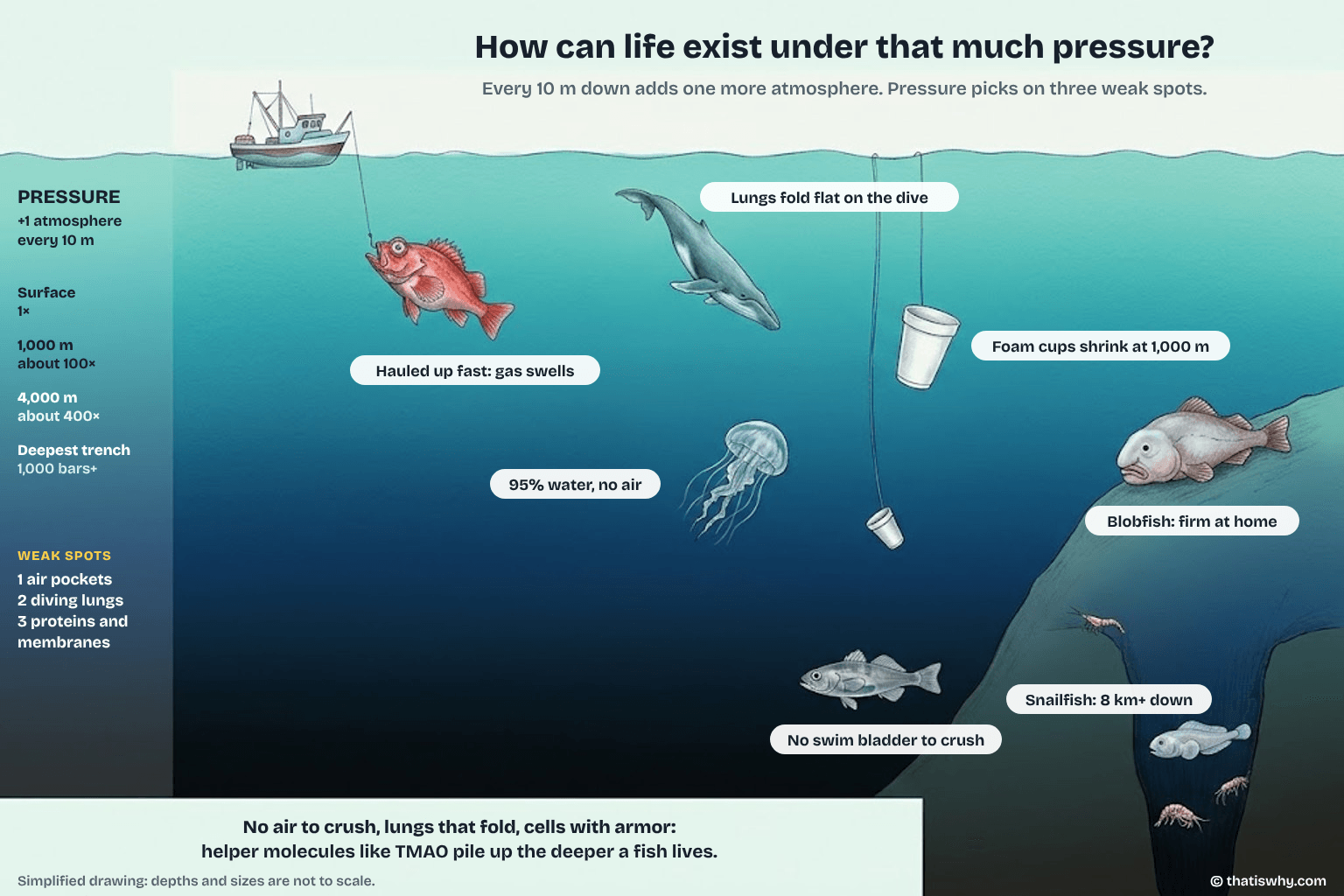
Sink a foam coffee cup to 1,000 meters and haul it back up, and it comes home shrunk, like a toy version of itself. Yet a jellyfish drifts at that depth all day and comes to no harm. **Life can exist under crushing pressure because pressure only has three weak spots to pick on: pockets of gas, the lungs of diving animals, and the proteins and membranes inside every cell. Deep-sea animals keep gas-filled spaces small or skip them entirely, diving whales let their lungs fold flat, and helper molecules keep every cell working.**
This is the main guide to life under pressure, and part of our bigger guide to [how anything survives in the deep sea](https://thatiswhy.com/unusual-adaptations-of-deep-sea-animals/). It walks you through each weak spot, the fix that beats it, and the guides that go deeper.
## Squeezed From Every Side
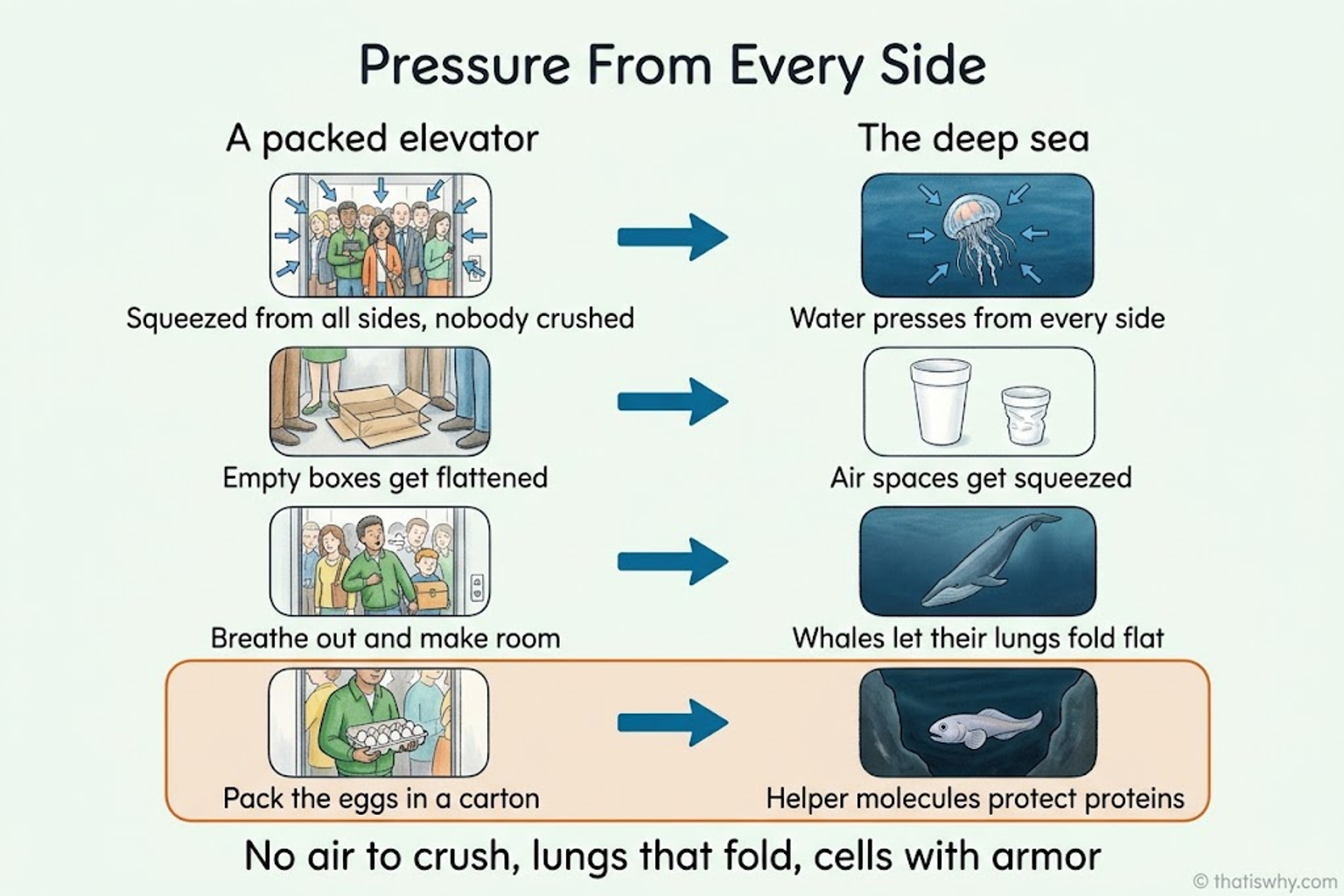
Step into an elevator at rush hour, the kind where nobody else should fit but somehow does. People press in on you from the front, the back and both sides. It's uncomfortable, but nobody gets crushed, because everyone is pushing back just as hard.
Now drop an empty cardboard box on the floor of that elevator. Nothing inside it pushes back, so it folds flat in seconds. A rider who breathes out can squeeze into a gap without harm. And the one who carries a tray of eggs gets them home safely only because they're packed in a sturdy carton.
In a packed elevator, only the empty box gets crushed. In the deep sea, empty spaces are the easy target, but even the machinery inside every cell needs protection.
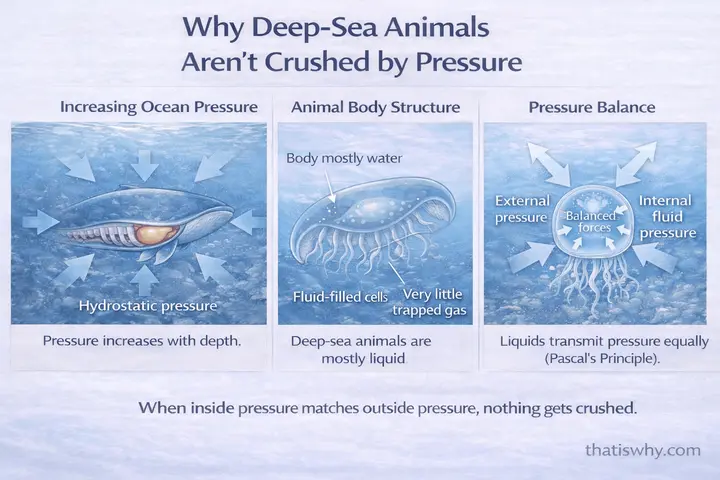
The deep sea works the same way. Water presses on an animal from every side at once, and every 10 meters down adds the weight of one more atmosphere. Bodies full of water hold up fine. Empty spaces get flattened, divers have to let their lungs give way, and the delicate machinery inside every cell needs its own protection.
## The Three Weak Spots at a Glance
Here is the whole story on one page. Tap any label to open its guide.
Tap a label to open its guide. Free full-size diagram, detailed version and printable PDF.
## Weak Spot 1: Pockets of Gas
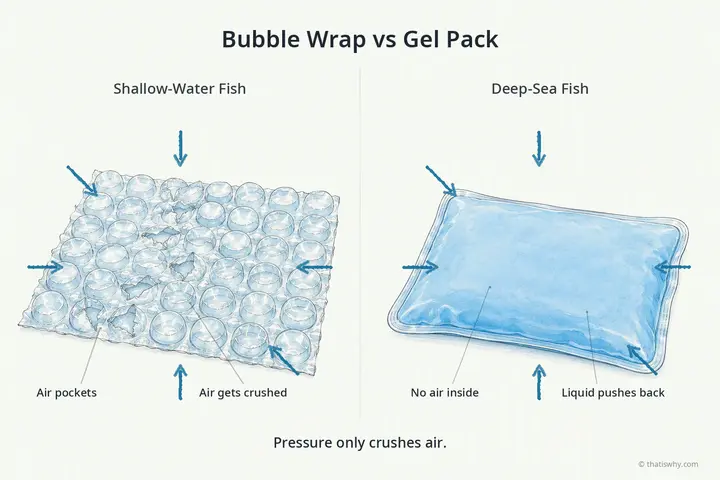
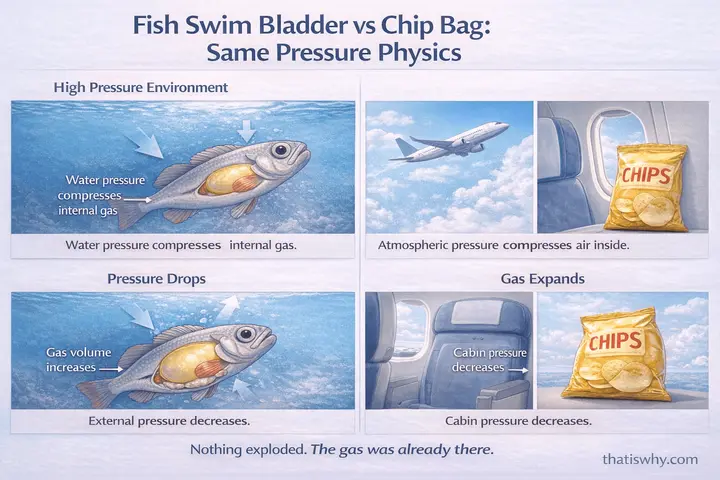
Gas is the easy target. Squeeze a gas and it shrinks; squeeze water and it barely budges. That is why NOAA scientists could lower decorated foam cups to about 1,000 meters and watch the pressure squeeze and shrink them.
Many deep-sea fish shrink the problem away. Some have small swim bladders or none at all; as marine biologists explain in The Conversation, a fish without air sacs has nothing for the pressure to crush. Others float with the help of fats and waxes instead of gas: some lanternfish line their swim bladders with wax, and some deep-sea sharks carry oil-rich livers. A jellyfish skips the whole problem, because its body is about 95% water.
Not every fish plays by that rule, though. In 2024, scientists described a rattail fish filmed at 7,259 meters with a working, gas-filled swim bladder, the deepest ever seen. That deep, the gas inside barely squeezes any further, so the bladder keeps doing its job, as long as its wall leaks very slowly.
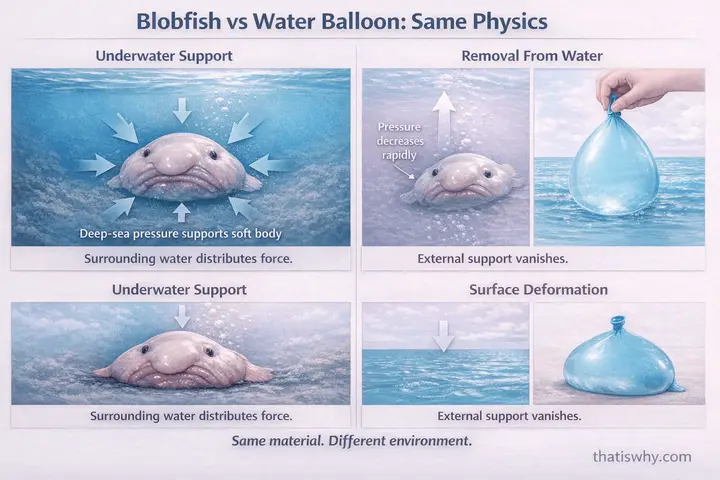
The danger comes when a fish with a gas-filled **swim bladder** changes depth too fast. Haul a rockfish up from deep water, and the falling pressure lets the gas inside expand. The result is **barotrauma**: swollen bodies, bulging eyes and stomachs pushed out. The good news is that sending the fish back down with a descending device can reverse the injury. The blobfish shows what a trip to the surface can do. Alive and at its proper pressure, it probably looks nothing like its famous melted photo; hauled up, its soft body collapses into a "blob".
Read more about gas and pressure:
## Weak Spot 2: Lungs on a Deep Dive
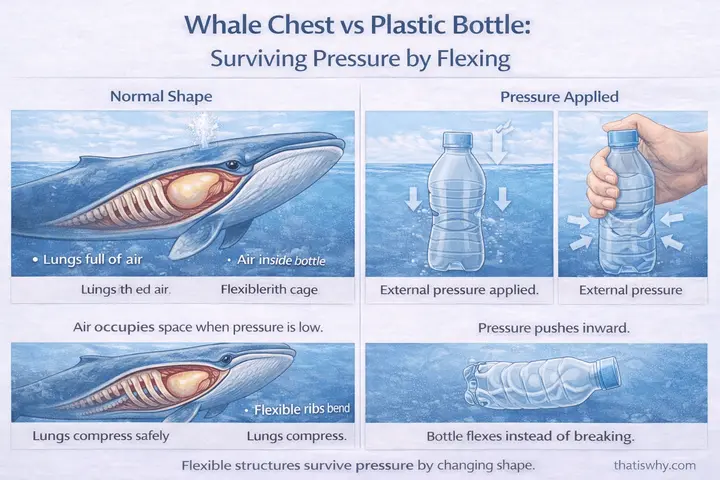
Whales have a problem fish don't: they breathe air, so they carry a lungful of it on every dive. Cuvier's beaked whales dive deeper than 2,000 meters to feed, for almost two hours at a time.
Their solution is to let the lungs give way. A whale's chest is flexible, so as the pressure climbs, its lungs can collapse safely. That collapse also limits the exchange of gas between lungs and blood, which cuts down how much nitrogen the whale takes up.
Read more about diving whales:
## Weak Spot 3: The Machinery Inside Every Cell
Here is the part that is easy to miss. Even an animal with no gas inside it still feels the squeeze, deep inside its cells. A 2020 review by biologist Paul Yancey explains that pressure disturbs many of the processes going on inside cells. It messes with the way proteins fold and makes cell membranes too stiff to work.
Deep-sea animals fight back at the molecular level. Their membranes pack in more unsaturated fats, which keep them supple. Their cells also stock up on helper molecules called **piezolytes**. The best known is **TMAO**, which counteracts many of pressure's effects on proteins, and fish and crustaceans build it up in a straight line the deeper they live.
That trend may even set a limit. Researchers worked out that a fish would need so much TMAO to protect its proteins that, at around 8,200 meters, it simply couldn't pack in any more. It's a prediction, not a proven wall, but so far it holds up: no fish has been found below about 8,400 meters. The deepest one on record is a snailfish, filmed more than 8 kilometers down, off Japan, in 2022.
## Steel Hull vs Soft Body
Engineers and evolution have solved the same problem in opposite ways. A submarine keeps a bubble of surface air inside a thick, rigid hull, and it only works as long as that hull holds. A deep-sea fish takes the opposite approach.
| | Submarine | Deep-sea fish |
| --- | --- | --- |
| Air inside | lots, at surface pressure | little or none |
| Body | rigid hull | soft, watery body |
| Inside the cells | not needed | supple membranes and TMAO |
| Strategy | hold the ocean out | let the water in |
Pressure also changes the ocean's chemistry. Deep enough, shells stop piling up on the seafloor, a story told in [why shells dissolve in the deep ocean](https://thatiswhy.com/why-shells-dissolve-in-deep-ocean/).
## Key Numbers of Life Under Pressure
| Fact | Value |
| --- | --- |
| Pressure increase | 1 atmosphere every 10 m (33 ft) |
| Pressure at 1,000 m | about 100 times the surface |
| Pressure in the deepest trench | 1,000 bars or more |
| Depth where foam cups shrank | about 1,000 m |
| Water in a jellyfish | about 95% |
| Cuvier's beaked whale dives | deeper than 2,000 m, almost two hours |
| Predicted limit for fish (from TMAO) | about 8,200 m |
| No fish found below | about 8,400 m |
| Deepest fish with a gas-filled swim bladder | 7,259 m |
| Deepest fish ever filmed | more than 8 km down (2022) |
## Pressure Myths, Busted
**Myth: deep-sea pressure flattens anything alive.** Gas-filled spaces are the easy target, and many deep-sea fish keep them small or skip them. Their cells are adapted too, with supple membranes and helper molecules that protect their proteins.
**Myth: deep-sea fish explode when they reach the surface.** They don't truly explode, but gas in a swim bladder expands as the pressure drops, which can swell the body and push the stomach out.
**Myth: fish can live anywhere in the ocean.** So far, no fish has been found below about 8,400 meters. Researchers predict a limit of around 8,200 meters, set by how much TMAO a fish can carry, though that is a prediction, not a proven wall.
For the rest of the deep-sea story, head back to [how anything survives in the deep sea](https://thatiswhy.com/unusual-adaptations-of-deep-sea-animals/), or find out [why the deep sea is so good at hiding](https://thatiswhy.com/why-deep-sea-perfected-stealth/).
## Sources
- [How does pressure change with ocean depth?](https://oceanservice.noaa.gov/facts/pressure.html), NOAA National Ocean Service
- [Styrofoam cups shrunk by deep-sea pressure](https://oceanexplorer.noaa.gov/explorations/12midatlantic/logs/sept30/media/cups.html), NOAA Ocean Exploration
- [Curious Kids: how do creatures living in the deep sea stay alive given the pressure?](https://theconversation.com/curious-kids-how-do-creatures-living-in-the-deep-sea-stay-alive-given-the-pressure-111940), The Conversation
- [Jellyfish](https://www.nationalgeographic.com/environment/article/ocean-jellyfish), National Geographic
- [World's ugliest animal contest took a blobfish out of water](https://www.sciencenews.org/blog/gory-details/worlds-ugliest-animal-contest-took-blobfish-out-water), Science News
- [What is barotrauma?](https://recfin.org/resources/barotrauma), RecFIN
- [Inflation and deflation pressure-volume loops in anesthetized pinnipeds confirms compliant chest and lungs (Fahlman et al., 2014)](https://www.frontiersin.org/articles/10.3389/fphys.2014.00433/full), Frontiers in Physiology
- [Cellular responses in marine animals to hydrostatic pressure (Yancey, 2020)](https://doi.org/10.1002/jez.2354), Journal of Experimental Zoology Part A (abstract)
- [Marine fish may be biochemically constrained from inhabiting the deepest ocean depths (Yancey et al., 2014)](https://ui.adsabs.harvard.edu/abs/2014PNAS..111.4461Y/abstract), PNAS (abstract)
- [In situ observation of a macrourid fish at 7259 m in the Japan Trench: swimbladder buoyancy at extreme depth (2024)](https://pubmed.ncbi.nlm.nih.gov/38230425/), PubMed (abstract)
- [Buoyancy in marine fishes: direct and indirect role of lipids (Phleger, 1998)](https://academic.oup.com/icb/article/38/2/321/213896), Integrative and Comparative Biology (abstract)
- [Scientists discover how low fish can go](https://niwa.co.nz/news/scientists-discover-how-low-fish-can-go), NIWA
- [Scientists break new record after finding world's deepest fish](https://uwa.edu.au/news/article/2023/april/scientists-break-new-record-after-finding-worlds-deepest-fish), The University of Western Australia