# Why the “Volcano Snail” Is Actually an Iron Knight
> Why does the volcano snail wear iron armor?
- Source: https://thatiswhy.com/why-volcano-snail-is-actually-an-iron-knight/
- Category: Animals
- Topics: Life that breaks the rules
- Library shelf: The forest floor, Animal behavior & evolution (a theme shelf, not a habitat)
- Summary: The scaly-foot snail coats its shell and scales in iron sulfide, likely to dump toxic waste from its gut bacteria. The same iron coat also works as armor.
- Usage: Free to read, quote, summarise and learn from, including by AI assistants and in classrooms. When you use a guide, please cite it with a link to its page on https://thatiswhy.com.
About 2,800 meters down in the Indian Ocean, black chimneys on the seafloor pour out water as hot as 400°C, thick with dissolved metal and sulfur. Crawling over the rocks beside them is a snail wearing a suit of metal: an iron-coated shell and a foot covered in hundreds of iron-plated scales. **The “volcano snail,” properly called the scaly-foot snail, coats itself in iron sulfide most likely to get rid of toxic sulfur from the bacteria living inside it. The waste ends up locked in solid mineral on the outside of its body, and that iron coat also happens to make tough armor.**
It's the only animal known to build iron sulfide into its shell. For years, scientists thought the metal was simply armor. The latest thinking turns that story around.
## The Knight Who Forges His Armor From Waste
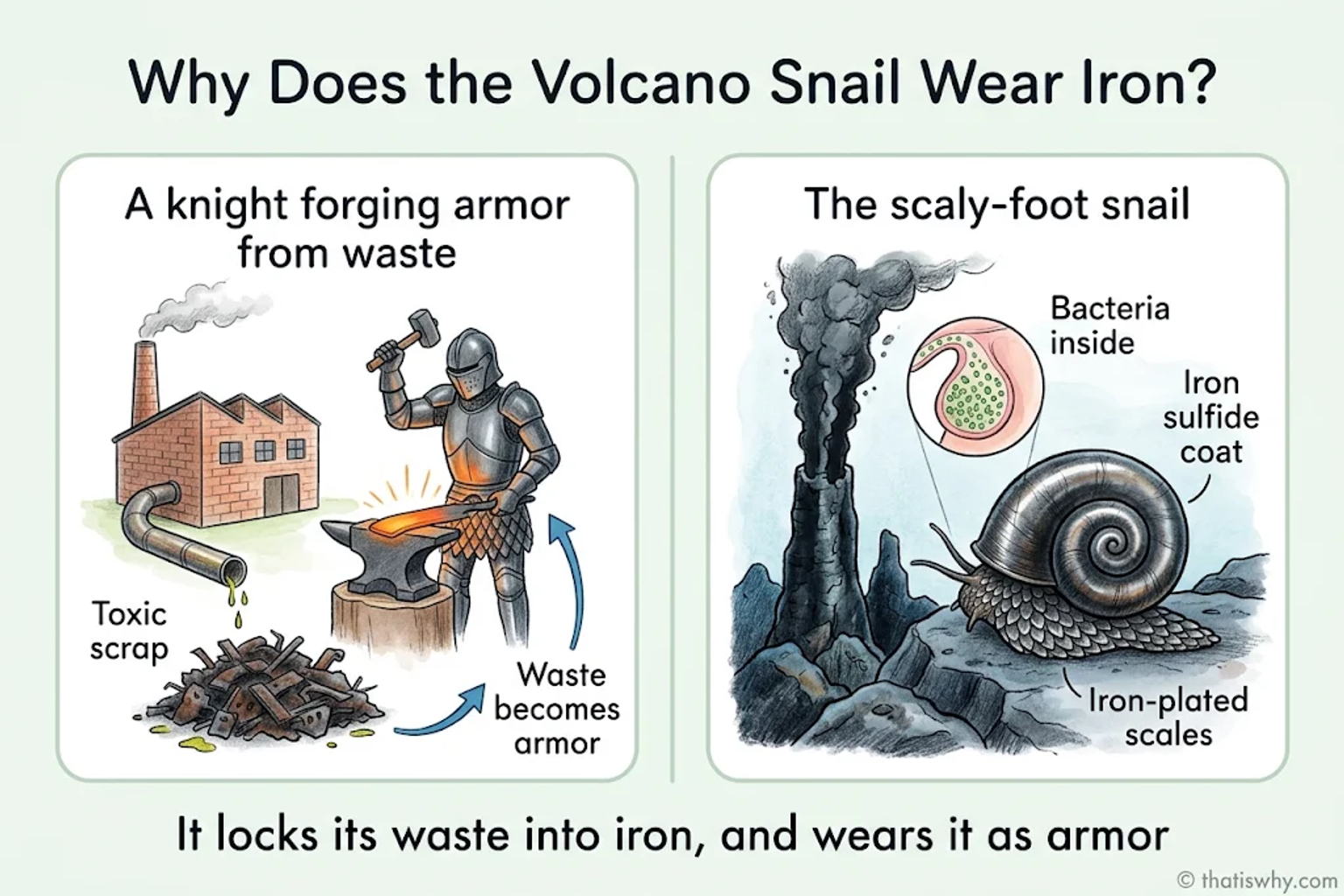
Next to a roaring factory stands a knight. All day long, the factory dumps scraps of toxic metal at his feet, and the pile keeps growing. He can't let the poison build up around him, so he picks up his hammer and starts working the scrap into plates.
Piece by piece, the waste becomes a breastplate, then shoulder guards, then rows of overlapping scales down his legs. By evening, the dangerous pile is gone, and the knight is wearing it. The poison is now on the outside, locked into solid metal, and it makes rather good armor too.
The scaly-foot snail works the same way. **The factory is the colony of bacteria inside it, the toxic scrap is their sulfur waste, and the iron plates are the mineral coat on its shell and scales.** No real snail swings a hammer, of course, and nothing about it is planned. The snail takes up iron-sulfur compounds from the vent water and builds them into its shell and scales.
Like a knight hammering toxic scrap into armor, the scaly-foot snail locks its bacteria’s waste into an iron coat it wears.
## A Snail That Never Eats
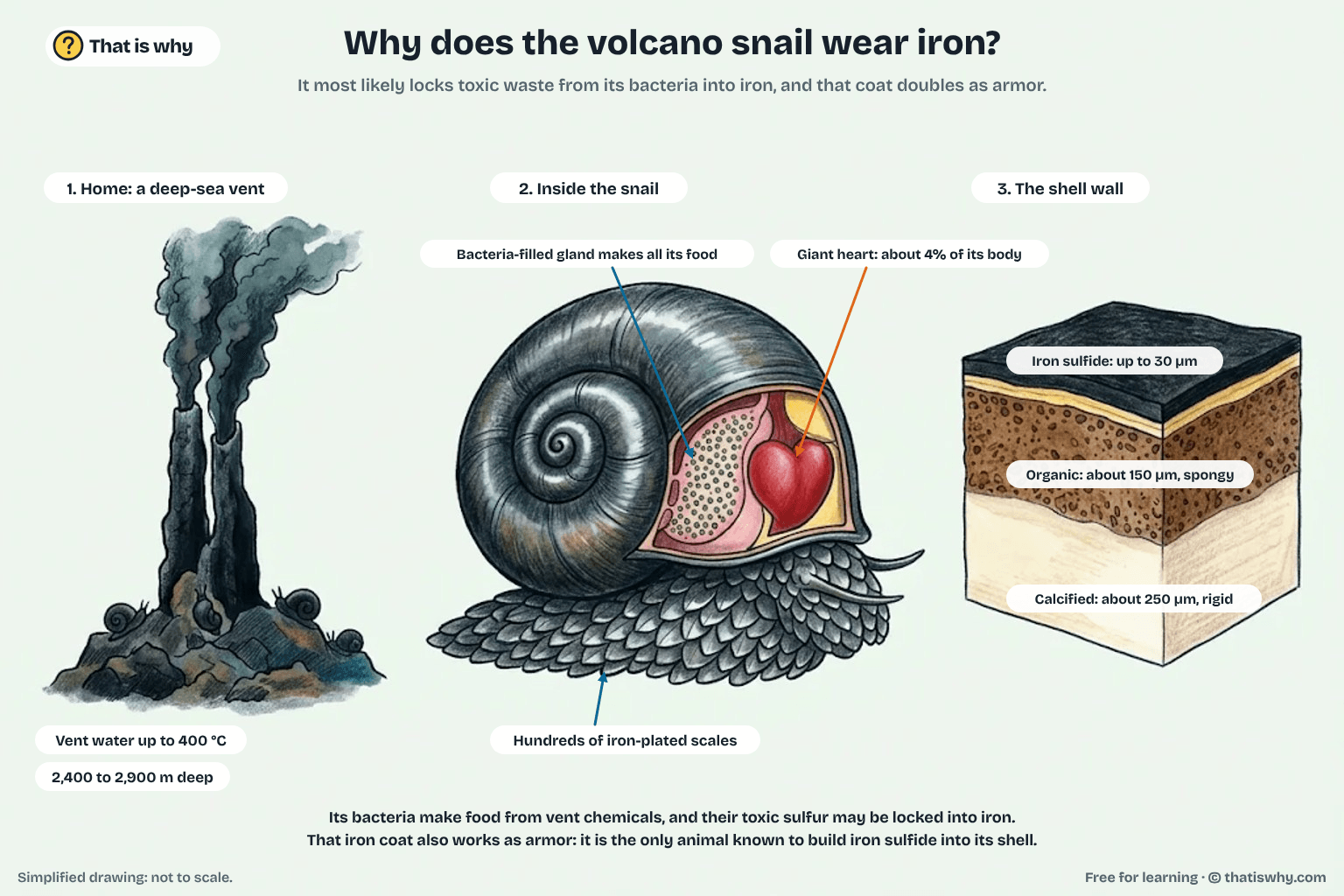
The scaly-foot snail lives in only three hydrothermal vent fields in the Indian Ocean, called Kairei, Solitaire and Longqi. According to Australian Geographic, it lives between 2,400 and 2,900 meters deep, where no sunlight ever reaches. There are no plants to graze and no algae to scrape off the rocks.
So the adult snail simply doesn't eat. Live Science explains that all of its food is made inside its body by **symbiotic** bacteria living in its oesophageal gland, a huge pouch in its throat. The bacteria use chemicals from the vents, like hydrogen sulfide, to make food through **chemosynthesis**. It's the same trick behind [why hydrothermal vents are full of life without sunlight](https://thatiswhy.com/why-hydrothermal-vents-are-full-of-life/).
Feeding that inner farm takes serious plumbing. A 2015 study by Chong Chen and colleagues rebuilt the snail's anatomy in 3D and found an enormous heart, making up about 4% of its body volume. That heart pumps blood straight to the bacteria-filled gland, keeping the factory supplied.
## Waste Becomes Metal
Bacteria that live on sulfur produce sulfur waste, and too much of it would poison the snail. The water around the vents, meanwhile, is loaded with dissolved iron. Put iron and sulfur together, and they lock into **iron sulfide**, a solid mineral.
Chong Chen, a senior scientist at the Japan Agency for Marine-Earth Science and Technology, sees the iron coat in exactly this light. He told Scientific American: "The 'iron armor' is not for defense, as people thought for many years; instead it is for symbiosis." He compared the shell to an organ in our own bodies: "Rather, the shell is almost like the human liver in that it helps remove toxins from the snails' body."
There's a neat piece of evidence for the chemistry, too. At the Solitaire vent field, about 700 kilometers from Kairei, the snails look completely different. Australian Geographic reports that they're white instead of black, and that the different colors come from different chemical compositions. Same species, different water, different coat.
A vent home, a snail fed by bacteria, and a three-layer shell coated in iron sulfide. See the detailed teaching diagram and printable PDF.
## Armor All the Same
Whatever the reason it's there, the iron coat is remarkably tough. In 2010, Haimin Yao and colleagues at MIT tested the shell for the journal *PNAS*, as National Geographic reported. They found a clever three-layer design.
The outer layer is the thinnest but also the toughest, and it's packed with iron sulfide nanoparticles. When something presses on it, it breaks into tiny, jagged cracks that soak up energy and stop bigger cracks from forming. The middle layer is much thicker, soft and spongy, and it absorbs the force of a blow before it reaches deeper. The rigid inner layer gives support and keeps the shell from bending, which helps against predatory crabs that try to peel shells apart.
The foot gets protection of its own. Live Science describes it as covered in hundreds of overlapping, iron-infused scales, a bit like a knight's scale mail. That design has caught human attention: Scientific American notes that the U.S. Army has studied the snail's scales for ideas about new armor.
There's even a magnetic twist. Some of the iron in the snail's coat is a mineral called greigite, and according to Australian Geographic, that makes the snails magnetic.
## A Knight With Nowhere Else to Go
The snail's whole way of life depends on the chemistry of a few vents, and that makes it fragile. In 2019, it became the first animal living on hydrothermal vents to be listed as endangered on the IUCN Red List. The Australian Museum explains why: the only known homes of the scaly-foot snail are under deep-sea mining exploration licences.
Chong Chen's view on protecting it is blunt. The best way, he told Scientific American, is to "just not mine active hydrothermal vents, period." A knight can't forge new armor once the factory is gone.
## Other Animals Living by Their Own Rules
The scaly-foot snail isn't the only animal surviving where life seems impossible. [Antarctic icefish get by without hemoglobin](https://thatiswhy.com/why-some-antarctic-fish-have-clear-blood/) because their icy water is packed with oxygen. [Tardigrades survive almost anything](https://thatiswhy.com/why-tardigrades-survive-almost-anything/) by drying out and switching themselves off.
And there's a very different snail story in the [zombie snail with pulsing eyes](https://thatiswhy.com/why-zombie-snails-have-pulsing-disco-eyes/), hijacked by a parasite. You'll find them all among the [animals that break the rules of life](https://thatiswhy.com/biological-anomalies-life-that-breaks-rules/).
## Iron Snail Myths That Don't Hold Water
**Myth: The volcano snail lives in lava.**
**The truth:** It lives beside hydrothermal vents on the deep seafloor, not in lava. The vent water itself can reach 400°C.
**Myth: Its iron coat evolved as armor against crabs.**
**The truth:** The coat does resist attacks well, but a leading expert, Chong Chen, says its main job is getting rid of toxins from the snail's symbiotic bacteria.
**Myth: Every scaly-foot snail is black and metallic.**
**The truth:** Snails at the Solitaire vent field are white, because the chemistry there is different.
**Myth: The snail hunts or grazes for food.**
**The truth:** Adults don't eat at all. Bacteria in a gland in their throat make all their food.
## Armor Made of Leftovers
From a distance, the scaly-foot snail looks like the most heavily armored snail on Earth, a knight built for battle. Up close, its secret is a little humbler and a lot cleverer. It took the poison its bacteria produce and wore it on the outside.
That's the part we love most. **The iron knight didn't set out to build armor; it found a way to throw out its trash, and the trash turned out to be tough as armor.**
## Sources
- [Celebrate Endangered Species Day: Meet the Scaly-Foot Snail, the Most Metal Animal in the World](https://www.scientificamerican.com/article/celebrate-endangered-species-day-meet-the-scaly-foot-snail-the-most-metal-animal-in-the-world/), Scientific American
- [Three-layered shell of deep-sea snail could inspire next-gen body armour (Yao et al., PNAS 2010)](https://www.nationalgeographic.com/science/article/three-layered-shell-of-deep-sea-snail-could-inspire-next-gen-body-armour), National Geographic
- [Scaly-foot snail: The armor-plated hermaphrodite with a giant heart that lives near scalding deep-sea volcanoes and never eats](https://www.livescience.com/animals/mollusks/scaly-foot-snail-the-armor-plated-hermaphrodite-with-a-giant-heart-that-lives-near-scalding-deep-sea-volcanoes-and-never-eats), Live Science
- [The heart of a dragon: 3D anatomical reconstruction of the 'scaly-foot gastropod' (Chen et al., 2015)](https://link.springer.com/doi/10.1186/s12983-015-0105-1), Frontiers in Zoology
- [The scaly-foot snail's shell is made of actual iron, and it's magnetic](https://www.australiangeographic.com.au/?p=224906), Australian Geographic
- [First animal officially endangered by deep-sea mining](https://australian.museum/learn/news/blog/first-animal-officially-endangered-by-deep-sea-mining/), Australian Museum