# Why the Venus Flytrap Can Count
> Can a Venus flytrap count?
- Source: https://thatiswhy.com/why-venus-flytrap-can-count/
- Category: Animals, Plants & Forests
- Topics: Trees and plants; Trees and plants > Plants that act like animals
- Library shelf: The canopy, Plants, insects & land life (a theme shelf, not a habitat)
- Summary: How does a plant count without a brain? Discover the "Smart Security System" of the Venus Flytrap and the math it uses to avoid false alarms.
- Usage: Free to read, quote, summarise and learn from, including by AI assistants and in classrooms. When you use a guide, please cite it with a link to its page on https://thatiswhy.com.
**How do Venus Flytraps count?** The Venus Flytrap uses a counting system to avoid false alarms. It needs two touches of its trigger hairs within about 30 seconds to close. This shows the plant has a short-term memory, encoded not in a brain but in a buildup of calcium that fades over time.
That is the science, but seeing it happen feels like magic.
If you poke a Venus Flytrap once, nothing happens. You can poke it, wiggle your finger, and tease it. It just sits there, frozen. But if you poke it twice, the trap slams shut with a *snap*.
This isn't a simple reflex; it’s a calculation. To do this, the plant had to do something that should be impossible for a vegetable: **It had to count.**
How can a plant count to two when it has no brain and no neurons? Yet the Venus Flytrap can calculate, remember and make life-or-death decisions in real time. It isn't just a plant; it is a green computer running a survival algorithm.
And it doesn't stop at two: it keeps counting all the way to five.
---
## The Smart Security System
To understand why the plant needs to count, you have to see it as a Smart Security System.
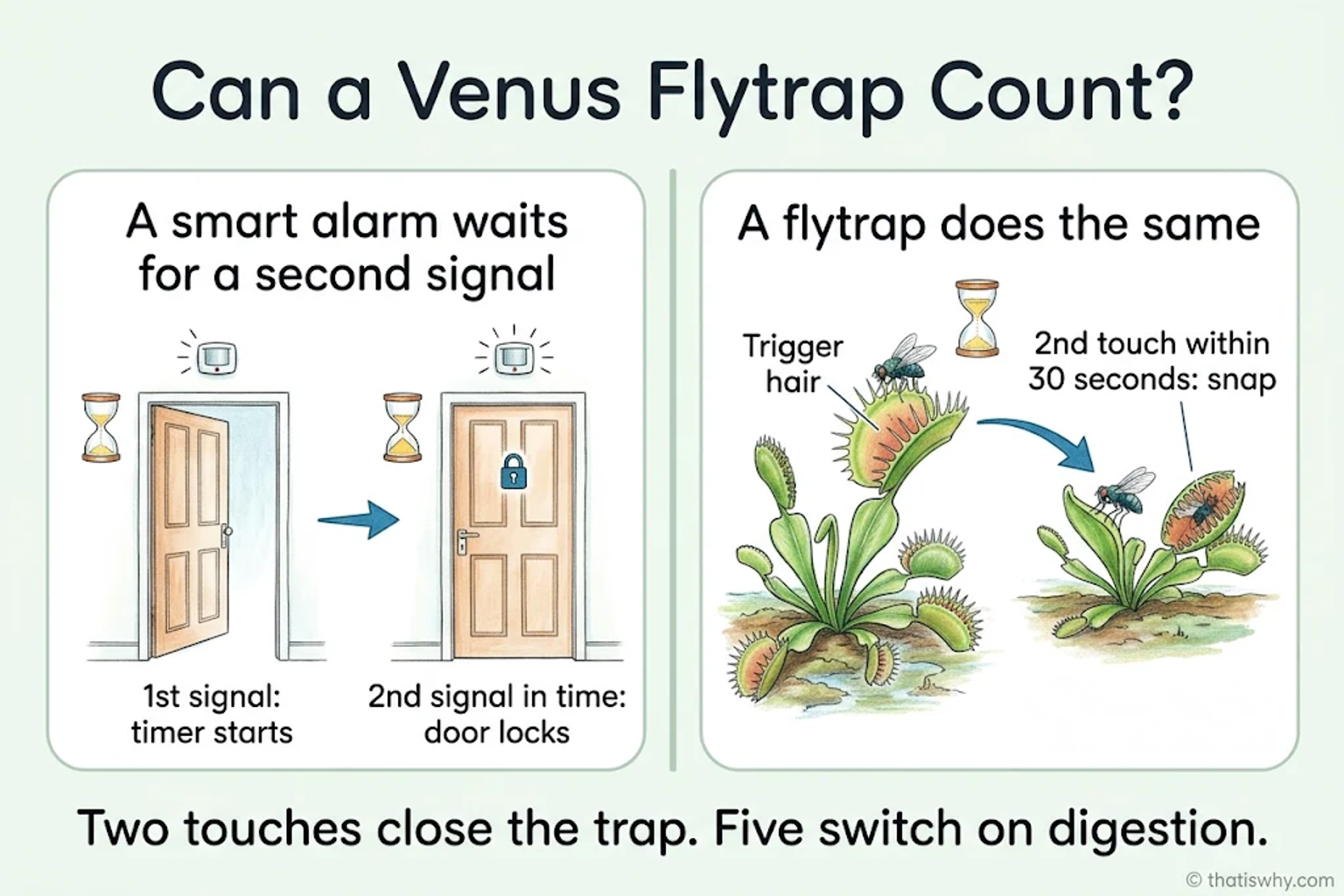
A smart alarm waits for a second signal before it locks the door; a flytrap waits for a second touch before it snaps.
The Flytrap lives in swampy, nutrient-poor soil, so it is biologically broke, and digesting a meal is incredibly expensive. Closing the trap and making its nitrogen-rich digestive enzymes is expensive. If the plant closes on a false alarm, like a raindrop or a fallen twig, it wastes that effort for nothing.
So, the plant installed a **Smart Security System.**
Think of the trap as a high-tech vault door protecting the plant's energy reserves. It is programmed with a fail-safe. It will never, ever close on a single signal. It requires a specific security code to confirm the target is real. That code is the number **two**.
---
## Touch 1: The Motion Sensor
Inside the trap, there are tiny trigger hairs that act like tripwires. When a bug brushes against one, it sends an electrical spike across the leaf.
This is **Touch 1**, and in our analogy, the motion sensor just tripped. The security system wakes up and asks: *"Was that a fly, or was it just a raindrop?"*
Crucially, the door *does not close*. The plant isn't stupid, so it waits and sets a chemical timer. When the hair is touched, a wave of calcium rises in the trap's cells, peaks within seconds, and has largely died away after a minute. Think of this like flipping an hourglass. The sand (calcium) starts draining right away. The system gives the intruder about **30 seconds** to prove it is real.
If nothing happens in that window, the hourglass runs out and the system resets. The plant literally "forgets" the touch ever happened.
---
## Touch 2: The Lockdown
But if the intruder is a real bug, it won't stop moving. It will brush against a second hair.
This is **Touch 2**, and if it happens while the timer is still running, the security system confirms the target. *"Confirmed: this one is food."*
The calcium from the second touch piles on top of what is left from the first, crosses a threshold, and the trap snaps shut in the blink of an eye. At the same moment, the plant ramps up the touch-and-wound hormone jasmonic acid. The door is locked, and the intruder is caged.
This is a brilliant piece of coding. A single bump, like a raindrop, only flips the hourglass once. Only a living, struggling creature triggers the double-tap. The plant filters out the noise and only spends energy on the signal.
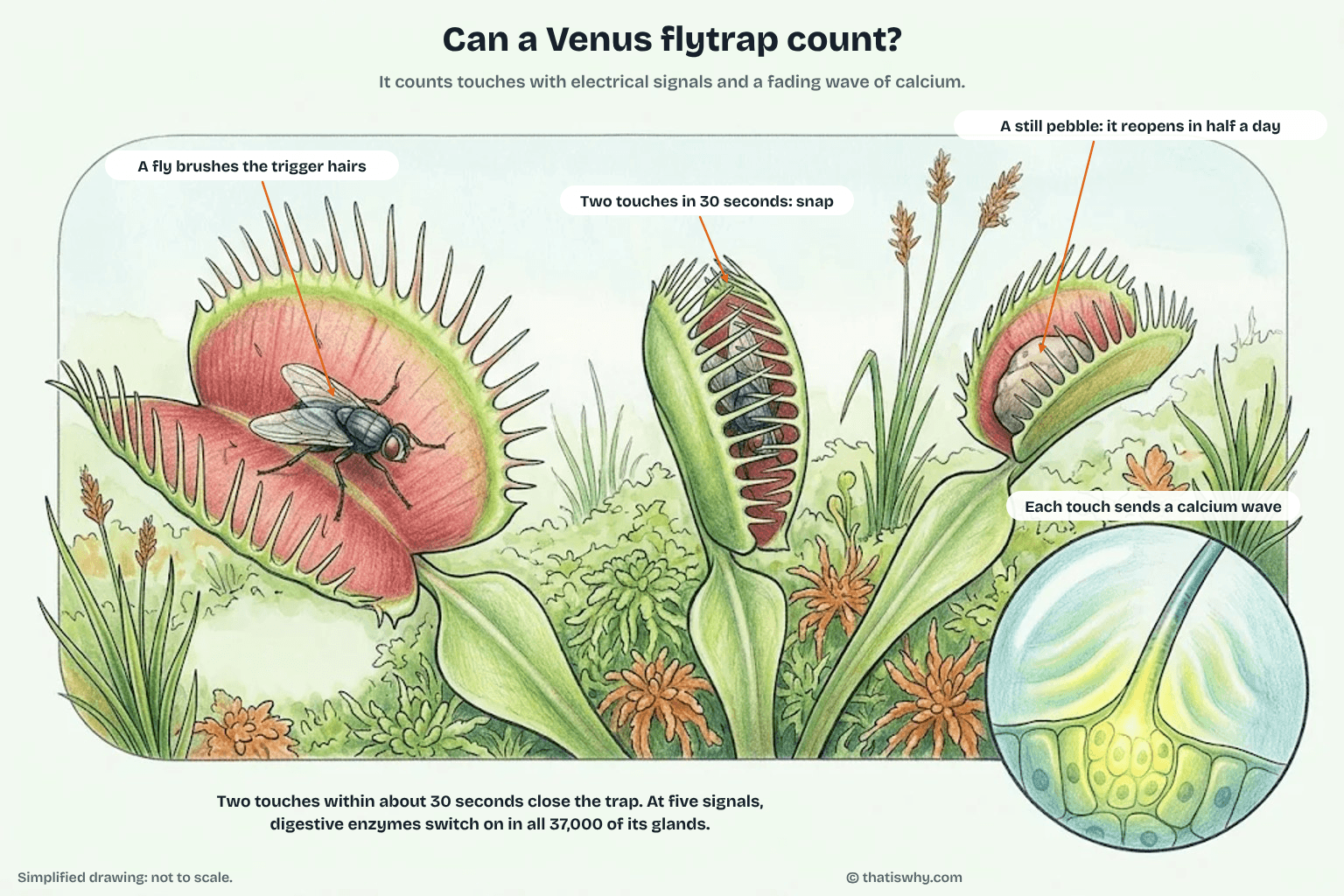
Each touch sends a calcium wave: two close together snap the trap, five switch on digestion, and a still pebble is let go. See the detailed teaching diagram and printable PDF.
---
## Touch 5: The Biometric Scan
But the math doesn't stop there. The door is locked, but the plant still hasn't turned on the "gas": its digestive enzymes. That's because chemical digestion is energetically expensive. What if the trap closed on a dry leaf, or on a stone? If the plant floods the trap with costly enzymes over a rock, it burns energy for zero return.
So, it waits for the panic. As the trapped bug struggles to escape, it bumps into the trigger hairs again and again, some 60 signals an hour, and the plant keeps count for at least four hours. At five signals, it switches on the genes for digestive enzymes in all 37,000 of its glands, along with the transporters it needs to absorb the meal.
The more signals it counts beyond five, the more digestive slurry it pours in. If the trap closes on something that stays still, like a stone, it never reaches five. After about half a day, the trap simply opens again.
---
## Green Nerves
The craziest part of this story isn't the math; [it’s the machinery](https://thatiswhy.com/why-nature-is-the-ultimate-engineer/).
When a hair is touched, the plant turns the movement into an electrical signal called an **Action Potential**, a spike of voltage across its cells. It is the same kind of signal that nerve cells use in animals, including us.
Yet the Venus Flytrap has no nerves and no brain. It counts with electricity and a calcium clock. It is essentially a biological computer running "If/Then" logic, using calcium instead of silicon.
The flytrap isn't the only plant that handles information without a brain. A Sensitive Plant can learn to ignore a harmless drop and keep that lesson for weeks, which is why scientists say [the sensitive plant can remember](https://thatiswhy.com/why-sensitive-plant-can-remember/). Another hunter needs no moving parts at all, which is [why pitcher plants are so slippery](https://thatiswhy.com/why-pitcher-plants-are-so-slippery/) to the ants that visit them.
---
## Flytrap Myths
**Myth #1: "One touch is enough to make it snap."**
**The Truth:** One signal does nothing. The trap needs a second touch within about 30 seconds, or the first one is erased from its short-term memory.
**Myth #2: "Once it closes, it starts digesting."**
**The Truth:** Closing and digesting are separate decisions. Digestive enzymes only switch on at five signals, so a trap that closes on something still opens again after about half a day.
**Myth #3: "To count, it must have nerves."**
**The Truth:** The flytrap has no nerves and no brain. It uses electrical action potentials, the same kind of signal animal nerve cells use, plus a rising and fading level of calcium.
---
## The Green Accountant
When you watch a Venus Flytrap snap shut, it looks like an angry predator attacking its prey.
But now you know the truth. It isn't anger; it’s accounting. The plant is running a brutal economic audit on every single thing that touches it. The security system counts the inputs, calculates the energy cost, and decides if the investment is worth the return.
It counts to two to filter out false alarms. It counts to five before it pays for digestion. It is a master of efficiency, proving that you don't need a brain to be a genius. You just need a good security system and the ability to do the math.
---
**How We Researched This**
To explain this biological algorithm, we looked at the 2016 study by [Rainer Hedrich's team at the University of Würzburg](https://www.biozentrum.uni-wuerzburg.de/en/bot1/forschung/alumni/prof-dr-rainer-hedrich/), which counted the action potentials (voltage spikes) each touch creates, their 2020 follow-up that made calcium glow inside the trap, and *Scientific American*'s report on the counting plant.
But we knew that just citing voltage spikes isn't helpful. Our real job began when we asked, *"What does this feel like?"* That question led us to the **"Smart Security System"** analogy—a simple story to make the complex chemistry of calcium memory and decision thresholds feel intuitive.
## Sources
- [Plants can do maths (Böhm et al., Current Biology 2016)](https://www.uni-wuerzburg.de/en/news-and-events/news/detail/news/plants-can-do-maths-1/), University of Würzburg
- [The Venus flytrap can count past 2](https://www.scientificamerican.com/blog/artful-amoeba/the-venus-flytrap-can-count-past-2), Scientific American
- [How the Venus flytrap counts (Nature Plants 2020)](https://www.biozentrum.uni-wuerzburg.de/en/news/archive/news-single/news/how-the-venus-flytrap-counts-1/), Biocenter, University of Würzburg