# Why Vampire Squid Eat Marine Snow Instead of Blood
> What does a vampire squid eat?
- Source: https://thatiswhy.com/why-vampire-squid-eat-marine-snow/
- Category: The Ocean
- Topics: The ocean > The deep sea; The ocean
- Library shelf: The midnight zone, Deep-sea life & bioluminescence (an ocean depth zone)
- Summary: The vampire squid doesn't drink blood. It eats marine snow, the dead bits, poop and mucus sinking from above, caught on a sticky thread and rolled into balls.
- Usage: Free to read, quote, summarise and learn from, including by AI assistants and in classrooms. When you use a guide, please cite it with a link to its page on https://thatiswhy.com.
Its scientific name, *Vampyroteuthis infernalis*, translates as "vampire squid from Hell." It has dark skin, a cape of webbing stretched between its arms and a pair of red eyes, hanging in black water hundreds of meters down. Everything about it says monster. **But the vampire squid doesn't drink blood, and it isn't even a true squid. It eats marine snow, the dead bits, poop and mucus that sink from the sunlit water above, catching them on a long sticky thread and rolling them into balls of slime.**
So the scariest name in the ocean belongs to a gentle scavenger of crumbs. To see why that's such a clever way to live, we need to head downstairs, under a very busy restaurant.
## The Quiet Spider in the Basement
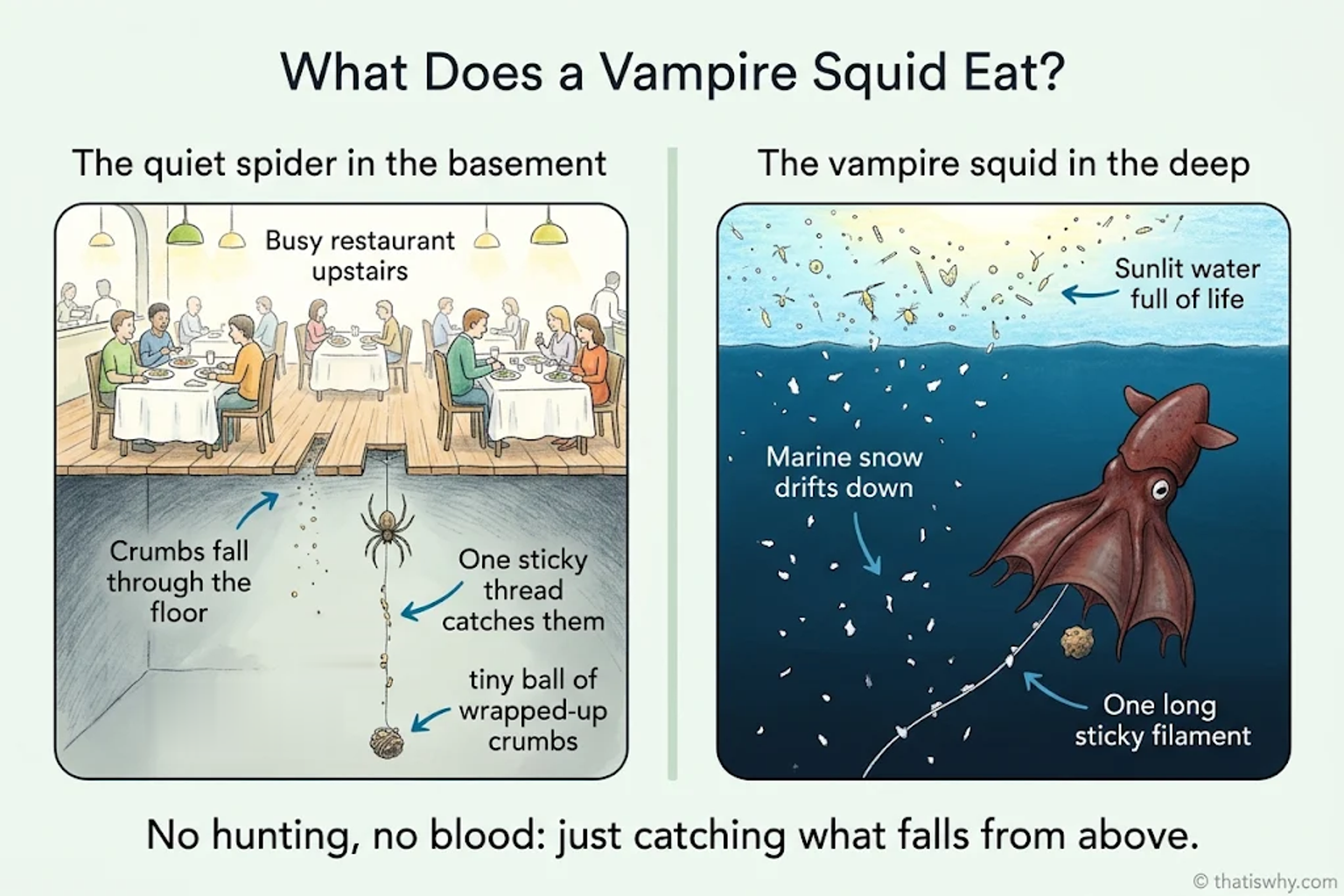
Upstairs, the dining room never closes. Plates clatter, bread gets torn, and all night long a fine dusting of crumbs slips through the cracks in the old floorboards. Down in the basement, the air is stale and thin, so stuffy that hardly anything else wants to live there. And in the corner, right under the busiest gap in the floor, hangs one very calm spider.
This spider doesn't bother weaving a big web, and it never chases a fly. Instead, it lets out a single long, sticky thread and waits for crumbs to settle on it. Every so often it reels the line back in, gathers up the catch, wraps it into a tiny ball and eats it. Then the thread goes back out, and the waiting starts again.
That is the vampire squid's whole life, almost exactly. The busy restaurant is the sunlit surface of the ocean, crowded with plankton that live, eat and die. The crumbs are **marine snow**, a slow shower of dead plants and animals, droppings and dust that drifts down into the deep. The stuffy basement is a layer of water with so little oxygen that few other animals can survive there. And the spider's sticky line is the squid's own long fishing thread. (Real spider silk is remarkable stuff, by the way, and we explore [why it's stronger than steel](https://thatiswhy.com/why-spider-silk-is-stronger-than-steel/) in its own guide.)
No real restaurant would serve this menu, though. Marine snow includes droppings, sand, soot and dust along with the dead bits of plankton, and it doesn’t drop in a second like a crumb. NOAA notes that some flakes fall for weeks before they reach the ocean floor. The spider just has to be patient, and the vampire squid is very, very patient.
A spider under a busy restaurant floor and a vampire squid under the busy surface ocean: both just catch what falls.
## How to Fish for Snowflakes With a Sticky Thread
For about a hundred years after the first one was hauled up from the deep, nobody knew what this animal ate. Dead specimens arrived in nets with stomachs holding what MBARI describes as bits of tiny shrimp-like animals, algae and "lots of slimy goo." That wasn't much of a clue, so two scientists at the Monterey Bay Aquarium Research Institute (MBARI), Henk-Jan Hoving and Bruce Robison, went looking for a better one.
They had a treasure trove to dig through. Between 1992 and 2012, the institute's remotely operated vehicles, robot submarines driven from a ship, had filmed 170 vampire squid in the dark water of Monterey Bay. About a third of them were caught on camera doing the same odd thing: drifting perfectly still, with one long, thin thread stretched out into the water.
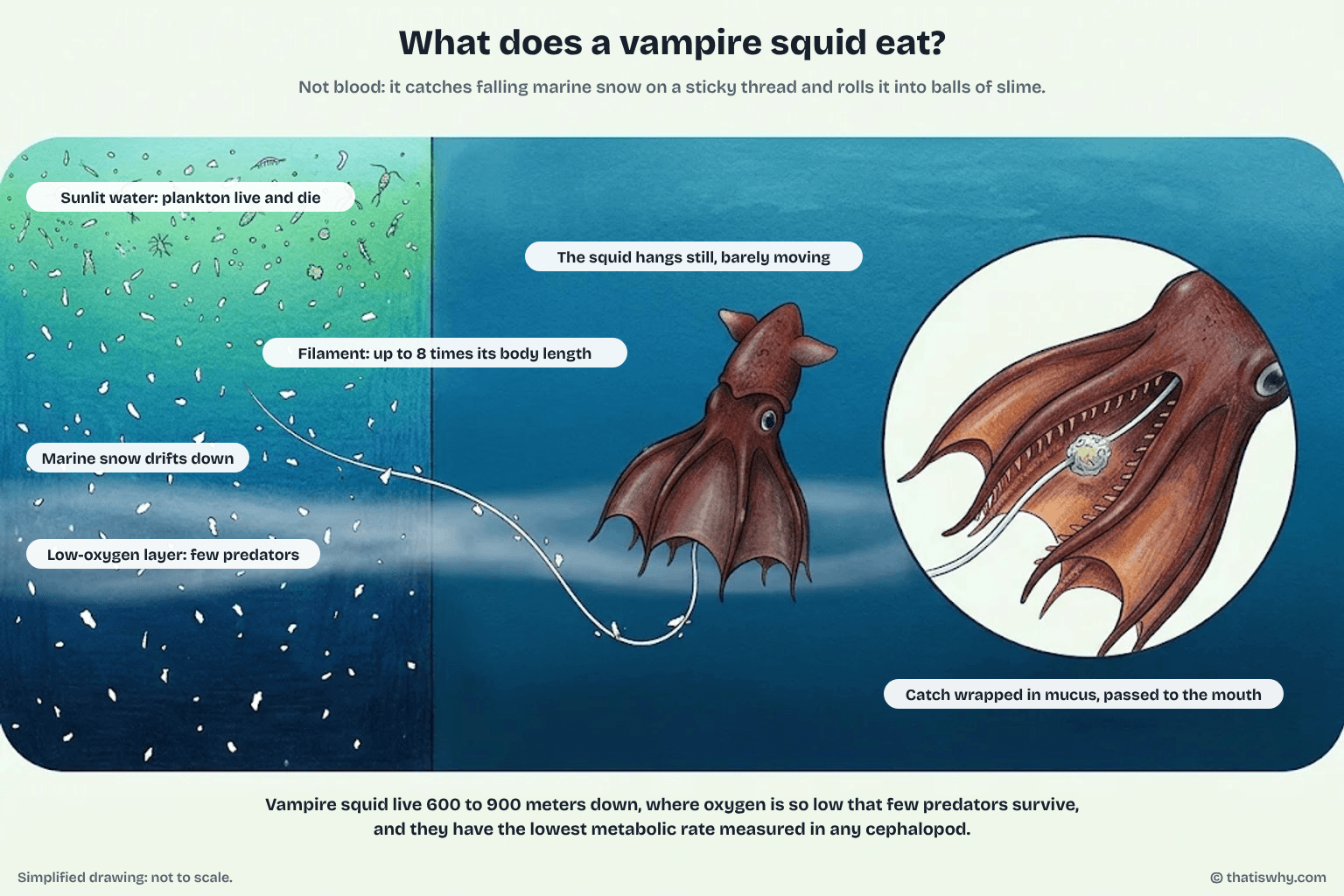
That thread is a **retractile filament**, a kind of extendable fishing line that pulls back into a pocket between the arms. Vampire squid have two, and they can push one out to as much as **eight times the length of their own body**. On an animal about the size of a football, that's a seriously long line. It's covered in tiny hairs and packed with nerves that make it exquisitely sensitive to touch.
Now comes the clever part. When a flake of marine snow brushes the filament, it sticks. The squid slowly draws the thread back in through its arms, which can take up to five minutes. Along the way, the catch gets wiped off and wrapped in mucus that oozes from glands in the suckers. Little fingerlike flaps called cirri then shuffle the sticky bundle along the arms toward the mouth, and the squid swallows its slime ball whole.
When the researchers opened up stomachs, the menu matched the video. They found clumped-together bits of tiny crustaceans called copepods, poop pellets, single-celled algae called diatoms and radiolarians, and even a few fish scales, mostly bundled up in mucus. Of 43 vampire squid pulled up in nets, 36 had food in their stomachs, and it was ocean leftovers, not freshly caught prey.
The team called the vampire squid a **detritivore**, an animal that eats dead and decaying material. In their paper, they called its way of feeding "unlike any other cephalopod", and they meant it. Octopuses and squid are hunters that grab live prey. Their spookiest-looking cousin quietly sweeps up after everyone else.
One long sticky filament, a slow shower of marine snow, and a squid that barely moves in water few predators can stand. See the detailed teaching diagram and printable PDF.
## Living on Leftovers Where the Oxygen Runs Out
So why would any animal settle for poop and snot when its relatives are out catching fresh shrimp? The answer is a budget, and the vampire squid runs the tightest one in its family.
In Monterey Bay, MBARI's cameras found vampire squid between 600 and 900 meters down, inside an **oxygen minimum zone**. That's a layer of the ocean where dissolved oxygen drops below about half a milliliter per liter of water, and the squid hang right around 0.4. Most animals can't keep their engines running in water that thin, so predators are few. Meanwhile, marine snow keeps sifting down through the layer all the same.
The vampire squid has rebuilt its whole body to fit that emptiness. It has the lowest mass-specific metabolic rate measured in any cephalopod, which means it burns less energy per gram of body than any other cephalopod measured. Its jelly-soft body is neutrally buoyant, so it floats in place without swimming. And because the food comes to it, it never has to chase anything at all.
Hoving summed up the payoff: "Because of its unique adaptations, the vampire squid is able to permanently and successfully inhabit the center of the oxygen minimum zone, an otherwise hostile environment where the vampire squid’s predators are few, and its food is abundant." That's the big rule hiding under the spooky name. In evolution, you don't have to be the strongest or the fastest. You can win by moving into the room nobody else can bear, and living cheaply enough that crumbs become a feast.
## Other Deep-Sea Diners Who Wait for Dinner to Fall
The vampire squid isn't alone in looking up for its next meal. Plants can't grow without sunlight, so much of the food in the dark ocean has to sink from above. NOAA says many animals in the dark ocean filter marine snow out of the water or scavenge it from the seabed. Our guide to [how anything survives the deep sea](https://thatiswhy.com/unusual-adaptations-of-deep-sea-animals/) shows how that slow shower shapes life from the twilight zone to the trenches.
Now and then, the snow turns into a blizzard. When a whale dies and sinks, it delivers a mountain of food in one go, and [a single whale fall can feed a whole community for decades](https://thatiswhy.com/why-dead-whale-creates-whale-fall/). For a deep-sea animal, that's like a delivery truck crashing through the basement wall.
Living on a tight energy budget has other surprising side effects too. Cold water and slow lives are part of the story of [why some deep-sea creatures grow into giants](https://thatiswhy.com/why-deep-sea-creatures-grow-into-giants/). And not every deep-sea diner is so gentle: hunters that swallow glowing prey need [red or black stomachs to hide the light of their meal](https://thatiswhy.com/why-transparent-deep-sea-animals-have-red-stomachs/).
## Myths About the Vampire Squid From Hell
**Myth: The vampire squid drinks blood.**
**The truth:** It doesn't drink blood at all. The researchers found that it feeds on drifting leftovers, not live prey. Its name comes from its dark skin, the webbing between its arms and its red eyes, all supposedly a vampire's look. If you want a real bloodsucker of the living world, meet [the dodder vine, a plant that drains its hosts](https://thatiswhy.com/why-dodder-vine-is-natures-vampire/).
**Myth: It's just a strange kind of squid.**
**The truth:** It isn't a squid or an octopus. The German scientist Carl Chun first described it in 1903. Today it sits in its own order, the Vampyromorphida, with features of both groups. MBARI calls it a "living fossil."
**Myth: Like other cephalopods, it squirts ink to escape.**
**The truth:** The vampire squid has no ink sac. When threatened, it can release a cloud of glowing mucus, a burst of **bioluminescence** (light made by a living thing) that can glow for up to 10 minutes, or flip its webbed arms up over its body into what scientists call the "pineapple posture." That's one of many ways [deep-sea animals use their own light](https://thatiswhy.com/why-do-deep-sea-animals-glow-in-the-dark/).
**Myth: It's a fierce deep-sea predator.**
**The truth:** It's a soft, slow drifter with a weak-muscled, gelatinous body. Its long filaments may also help it sense danger nearby, but their main known job is collecting snow.
## The Gentlest Monster in the Dark
So let's go back to that terrifying name, the vampire squid from Hell. It has dark skin, a cape-like cloak and red eyes, and for its size, its eyes are the largest of any animal on Earth. It sounds like something that should be stalking you through the dark.
Instead, it's the quiet spider in the basement. It hangs motionless in water too stuffy for its enemies, lets out one long sticky thread, and waits for the leftovers of the sunlit world to drift down to it. Then it rolls them into a ball of slime and eats them, one patient snowflake at a time.
We find that a lovely twist. The animal with the scariest name in the ocean survives by being the calmest, cheapest and most patient creature in the room.
## Sources
- [Vampire squid: detritivores in the oxygen minimum zone (Hoving and Robison, Proceedings of the Royal Society B 2012)](https://pmc.ncbi.nlm.nih.gov/articles/PMC3479720), PubMed Central (US National Library of Medicine)
- [MBARI researchers discover what vampire squids eat (it's not what you think)](https://www.mbari.org/news/mbari-researchers-discover-what-vampire-squids-eat-its-not-what-you-think/), Monterey Bay Aquarium Research Institute (MBARI)
- [Vampyroteuthis infernalis](https://animaldiversity.org/accounts/Vampyroteuthis_infernalis), Animal Diversity Web, University of Michigan
- [Introducing Vampyroteuthis infernalis, the vampire squid from Hell](https://www.thecephalopodpage.org/vsfh.php), The Cephalopod Page
- [Vampire Squid](https://aquariumofpacific.org/onlinelearningcenter/species/vampire_squid), Aquarium of the Pacific
- [What is marine snow?](https://oceanservice.noaa.gov/facts/marinesnow.html), NOAA National Ocean Service