# Why Transparent Deep-Sea Animals Have Red Stomachs
> Why do see-through animals have red stomachs?
- Source: https://thatiswhy.com/why-transparent-deep-sea-animals-have-red-stomachs/
- Category: The Ocean
- Topics: The ocean > The deep sea > Light and hiding in the deep
- Library shelf: The twilight zone, Light, sound & camouflage at depth (an ocean depth zone)
- Summary: See-through deep-sea animals have red or black stomachs to hide glowing prey. Without that blackout lining, a swallowed glowing meal would shine through and give them away.
- Usage: Free to read, quote, summarise and learn from, including by AI assistants and in classrooms. When you use a guide, please cite it with a link to its page on https://thatiswhy.com.
Transparent deep-sea animals often have red or black stomachs for a simple reason: to hide the light from glowing prey. If a clear predator eats a bioluminescent organism, that glow could shine through its body and reveal its position. Red pigments absorb the light, acting like a natural blackout curtain.
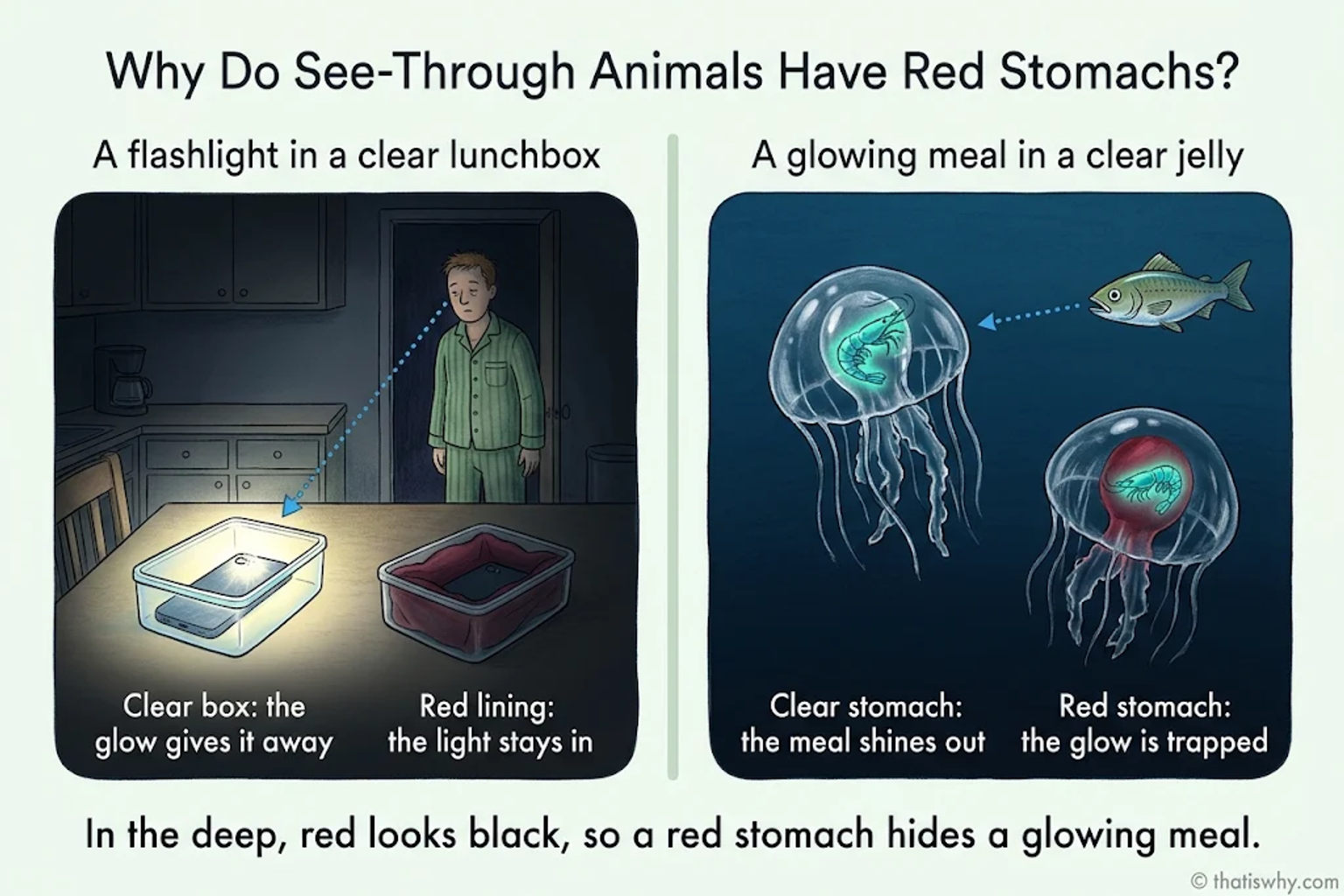
Place a phone inside a clear plastic lunchbox in a dark kitchen and switch on its flashlight.
The clear box gives itself away the moment the light comes on. Line it with red, and the glow stays inside.
The container itself is transparent, yet the moment the light switches on the entire box becomes obvious. The glow spreads through the plastic and suddenly the shape of the box is impossible to miss.
Transparent predators in the deep ocean face the same challenge.
Many animals in the twilight zone rely on transparency to stay hidden. Their bodies allow light to pass through with very little disturbance, which makes them extremely difficult to see against the surrounding water. That optical trick, explained in our previous guide **[Why Some Deep-Sea Animals Become Invisible](https://thatiswhy.com/why-some-deep-sea-animals-become-invisible/)**, works well until the animal catches something to eat.
If that prey produces bioluminescent light, the glow does not stop after it is swallowed.
Instead, it can shine from inside the predator’s body, turning a nearly invisible hunter into a drifting beacon in the dark ocean.
Evolution solved this problem by turning the digestive system into a blackout curtain.
---
## Why a Red Stomach Works Like a Blackout Curtain
Think again about the lunchbox with your phone flashlight inside.
If the box were perfectly clear, the glow would spill through the plastic and reveal the whole container. The only way to stop that glow would be to place something inside that absorbs the light before it escapes.
That is exactly what the red stomach does. At first it seems like a strange color choice. If the goal is to hide light, why evolve a red organ instead of a black one?
The answer comes from the way light behaves in the ocean.
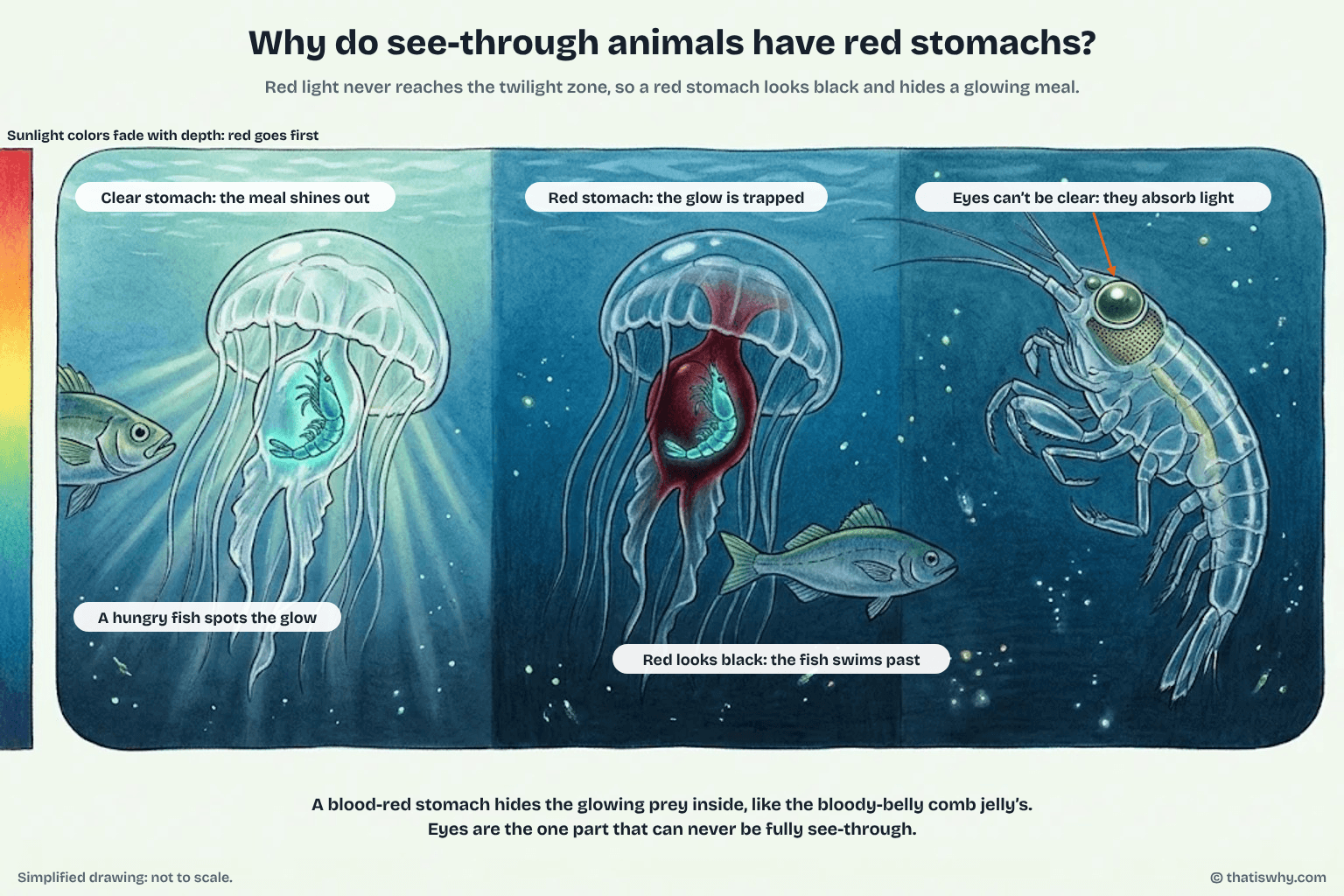
As sunlight travels downward, the colors disappear one by one. Red light fades first, and by about 100 meters deep it no longer gets through. By the time you reach the twilight zone, almost all that remains is dim blue light filtering from the surface.
In a world filled mostly with blue light, a red surface has nothing to reflect. Instead of looking red, it simply looks dark.
For a transparent predator, that creates a useful shortcut. A stomach filled with red pigments behaves like a natural blackout curtain inside the body. When a glowing shrimp or copepod is swallowed, the pigments absorb most of that blue-green light before it can escape.
The lunchbox stays dark, even though the flashlight inside is still on. From the outside, the predator continues drifting through the water almost invisible, even while digesting a glowing meal.
A red stomach looks black in blue twilight and traps the glow of dinner, while the eyes stay the one part that can't be clear. See the detailed teaching diagram and printable PDF.
---
## Case Study: The Bloody-Belly Comb Jelly
A good example of this solution drifts through the twilight zone between about 250 and 1,500 meters deep. It is called the [bloody-belly comb jelly](https://www.mbari.org/animal/bloody-belly-comb-jelly), and it grows up to 16 centimeters long.
Its name gives the secret away. Right in the middle of the animal sits a blood-red stomach, the one part that refuses to be subtle.
On the surface that looks like terrible camouflage. In the deep, it is a clever disguise. The Monterey Bay Aquarium Research Institute (MBARI) sums it up in one line: "The blood-red stomach disguises the glowing prey inside."
Without that pigment, the comb jelly would face the same problem as the phone flashlight shining inside the clear lunchbox. Every glowing meal could light it up from the inside and reveal its position to anything hungry nearby.
The red stomach prevents that from happening. Since almost no red light reaches those depths, the red looks dark, and the glow of dinner stays locked inside.
It isn't the only one. The Woods Hole Oceanographic Institution notes that many deep-sea animals, including some jellyfish, have red pigment around their stomachs to keep their prey's light from escaping.
---
## The Other Opaque Problem: Why Eyes Cannot Be Transparent
The red stomach solves the glowing lunch problem, but it is not the only place where transparency runs into limits.
Eyes create another one of those limits. Think again about the clear lunchbox with the phone flashlight inside. Even if the walls of the box remain nearly invisible, anything dark inside would still reveal that something is there.
For transparent animals, the eyes play a similar role.
Seeing always requires absorbing light. The retina captures incoming light and turns it into signals the brain can read. If the eye were perfectly transparent, the light would simply pass through and the animal would see nothing.
So the eyes can never disappear completely.
The crystal amphipod, *Cystisoma*, shows one clever way around the problem. This see-through crustacean can grow as long as a human hand, and it is so clear that even its gut is see-through. Its weak spot is its eyes. They are massive and cover up to a third of its body, and they look almost straight up, toward the faint light from the surface.
Huge dark eyes would normally be a giveaway, so *Cystisoma* cheats. Its retinas are spread out into a thin sheet of tiny dots, which shrinks the shadow it casts below. The animal stays clear, while the one part that cannot be invisible is made as faint as possible.
Creatures like *Cystisoma* are good reminders that life in the deep ocean often solves problems with unusual designs. Many of those strange solutions appear in species that seem to break the usual rules of anatomy, which is why we explore them further in **[Biological Anomalies: Life That Breaks the Rules](https://thatiswhy.com/biological-anomalies-life-that-breaks-rules/)**.
---
## The Deeper Principle: When Camouflage Must Work From the Inside
By the time a transparent predator swallows glowing prey, the camouflage problem has moved inside the body.
The animal may already match the surrounding water so closely that predators cannot see its outline. Light can pass through the body with barely any distortion.
But bioluminescent prey changes the situation.
Instead of light coming from outside, the light now comes from within. A glowing shrimp inside a transparent body would shine outward in every direction, revealing the predator drifting in the water.
The red stomach solves that problem by turning the inside of the body into a light trap.
Instead of allowing the glow to leak outward, the pigments inside the digestive tract absorb it before it reaches the transparent tissues around it. From the outside, the animal continues drifting through the water with almost no visible trace.
What looks like a simple color change is really a continuation of the same strategy used across the deep ocean.
Creatures survive crushing pressure by filling their bodies with fluid that moves with the surrounding water. They stabilize their proteins so chemistry continues under enormous pressure. They shape their bodies to match the strange physics of the ocean around them.
The red stomach simply extends that idea one step further.
Even the light produced inside the body must be managed carefully if the animal wants to remain unseen.
In the twilight zone, survival often depends on controlling the smallest details. When predators are scanning the water for the faintest shimmer or flash, the difference between being invisible and being noticed can be nothing more than a meal glowing quietly inside your stomach.
---
## Three Common Myths About Transparent Deep-Sea Animals
**Myth #1 — Transparency Hides Everything Inside the Body**
It is easy to imagine that a transparent animal hides everything inside its body.
But transparency can create the opposite problem.
Think again about the clear lunchbox with the phone flashlight inside. The container itself may be transparent, yet the moment the flashlight turns on the glow spreads through the plastic and reveals the entire box.
Transparent animals face the same risk when they swallow glowing prey.
**Truth — Internal Light Must Be Contained**
Many small deep-sea animals produce bioluminescent light. When a transparent predator eats one of these creatures, the glow can continue inside the stomach.
Without protection, that light would spread through the transparent body and reveal the predator’s position. The red stomach acts like a lining inside the lunchbox, absorbing the light before it escapes.
---
**Myth #2 — A Red Organ Should Be Easy to See**
On the surface, red is one of the most noticeable colors in nature. It might seem strange that an animal trying to stay hidden would evolve a bright red stomach.
**Truth — Red Appears Dark in the Deep Ocean**
As sunlight travels downward through seawater, red wavelengths disappear first. By the time you reach the twilight zone, the ocean is filled mostly with dim blue light.
Without red light to reflect, a red surface appears dark. In that environment, a red stomach functions almost exactly like a black one, trapping light instead of reflecting it.
---
**Myth #3 — Transparency Works by Itself**
A clear body might seem like a perfect camouflage strategy.
**Truth — Transparency Works as Part of a System**
Deep-sea animals remain hidden because several adjustments work together.
The body allows outside light to pass through, the stomach absorbs the glow of swallowed prey, and the eyes are shaped and positioned to minimize the dark surface that could reveal the animal.
Each change removes another clue that predators might use to detect a creature drifting through the dim twilight of the open ocean.
---
**How We Researched This**
To explain why transparent deep-sea animals evolve red stomachs, we reviewed research in marine optics, deep-sea ecology, and bioluminescence. Much of the scientific understanding comes from studies of how light travels through seawater and how transparent organisms control scattering, reflection, and internal light.
The red stomach comes from MBARI's notes on the [bloody-belly comb jelly](https://www.mbari.org/animal/bloody-belly-comb-jelly) and the Woods Hole Oceanographic Institution's [A Flash in the Gut](https://www.whoi.edu/ocean-learning-hub/multimedia/a-flash-in-the-gut/). The fading of red light with depth comes from [NOAA Ocean Exploration](https://oceanexplorer.noaa.gov/facts/red-color.html). For *Cystisoma*, we used MBARI's [crystal amphipod](https://www.mbari.org/animal/crystal-amphipod/) page and the Smithsonian's [Giant Eyes](https://ocean.si.edu/holding-tank/images-hide/giant-eyes) note, which shows that even its gut is see-through.
But describing optical measurements alone does not make the idea intuitive. Our real job began when we asked a simpler question: what would this problem look like in everyday life? That question led us to the **phone flashlight in a clear lunchbox analogy**, which makes the central challenge these animals face more intuitive.
## Sources
- [Hidden in plain sight: the ecology and physiology of organismal transparency (Johnsen, 2001)](https://biodiversitylibrary.org/part/31411), The Biological Bulletin (Biodiversity Heritage Library)
- [Midwater ocean creatures use nanotech camouflage (Bagge et al., 2016)](https://today.duke.edu/2016/11/midwater-ocean-creatures-use-nanotech-camouflage), Duke University
- [Bloody-belly comb jelly](https://www.mbari.org/animal/bloody-belly-comb-jelly), MBARI
- [A Flash in the Gut](https://www.whoi.edu/ocean-learning-hub/multimedia/a-flash-in-the-gut/), Woods Hole Oceanographic Institution
- [Why are so many deep-sea animals red in color?](https://oceanexplorer.noaa.gov/facts/red-color.html), NOAA Ocean Exploration
- [Crystal amphipod](https://www.mbari.org/animal/crystal-amphipod/), MBARI
- [Giant Eyes](https://ocean.si.edu/holding-tank/images-hide/giant-eyes), Smithsonian Ocean