# Why Some Deep-Sea Animals Become Invisible
> How can an animal be see-through?
- Source: https://thatiswhy.com/why-some-deep-sea-animals-become-invisible/
- Category: The Ocean
- Topics: The ocean > The deep sea > Light and hiding in the deep
- Library shelf: The twilight zone, Light, sound & camouflage at depth (an ocean depth zone)
- Summary: Deep-sea animals turn transparent by bending light almost exactly as seawater does. With little pigment and watery tissue, light passes straight through them.
- Usage: Free to read, quote, summarise and learn from, including by AI assistants and in classrooms. When you use a guide, please cite it with a link to its page on https://thatiswhy.com.
Deep-sea animals become transparent by matching how seawater bends light. Their bodies contain very little pigment and are made mostly of water, allowing light to pass through with minimal scattering. When light moves through their tissues almost the same way it moves through seawater, their outline fades.
In the dim waters of the ocean’s twilight zone, there is just enough light to reveal a silhouette but not enough to reveal color. In that environment, some animals survive by letting light pass straight through their bodies.
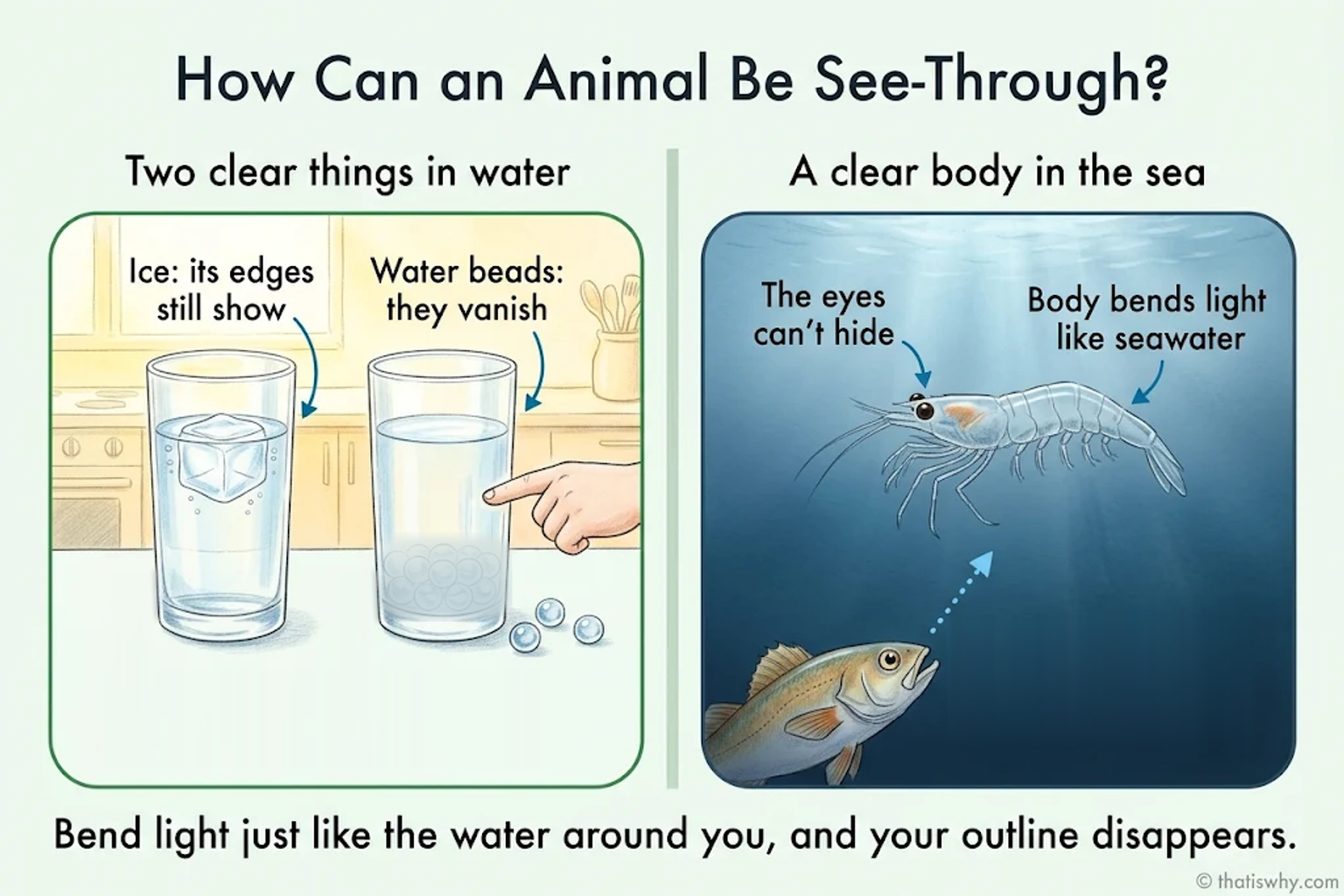
Look at an ice cube in a glass of water.
Both the ice and the water are clear, yet you can still see the cube. Ice bends light a little differently from liquid water: its refractive index is about 1.31, while water sits at about 1.33. That tiny mismatch, plus any cracks and trapped air bubbles, is enough to draw faint bright edges around the cube.
Ice is a near match for water, so its edges still show. Water beads match it almost perfectly, so they vanish.
Now drop a handful of clear water beads, the soft gel balls sold for flower vases, into a second glass. Their refractive index is very close to that of water, about 1.33. Light passes from the water into the beads and out again without bending or bouncing back, and the beads simply vanish.
Many animals in the twilight zone rely on that same principle. Instead of hiding with color or patterns, they allow light to pass through their bodies with almost no disturbance.
In a place where predators scan the water for silhouettes, that optical trick can make the difference between being seen and disappearing into the ocean itself.
This idea also reflects a broader rule of the deep, explored in **[Why Life Can Exist in the Crushing Depths of the Ocean](https://thatiswhy.com/why-life-can-exist-in-depths-of-ocean/)**. Life down there often survives by becoming more like the environment around it. The same principle that lets watery bodies shrug off immense pressure, explained in **[Why Don’t Deep-Sea Animals Get Crushed?](https://thatiswhy.com/why-dont-deep-sea-animals-get-crushed/)**, also lets some creatures vanish in plain sight.
---
## Why “Clear” Does Not Automatically Mean Invisible
Transparency alone does not guarantee invisibility.
Most clear objects remain visible because they bend light differently than the material around them. When light crosses from one substance into another that slows it down slightly, its path changes. That small shift creates edges and distortions that our eyes can detect.
You see this every time you place a clear straw in a glass of water. The straw is transparent, yet its outline remains obvious because the plastic bends light differently than the surrounding liquid.
The ice cube works the same way, only with a much smaller mismatch.
In physics this property is called the [**refractive index**](https://refractiveindex.info/), which describes how fast light travels through a material. Light reflects wherever two materials with different refractive indices meet. Seawater's refractive index is about 1.33, so a see-through animal needs its body to be close to that number.
For animals trying to disappear in the ocean, this detail becomes critical. If their tissues bend light even slightly differently than seawater, the animal appears as a faint shimmer.
Transparent animals therefore face a precise requirement.
Their tissues must allow light to pass through almost exactly as it passes through seawater. When that optical match becomes close enough, the boundary between animal and ocean begins to fade.
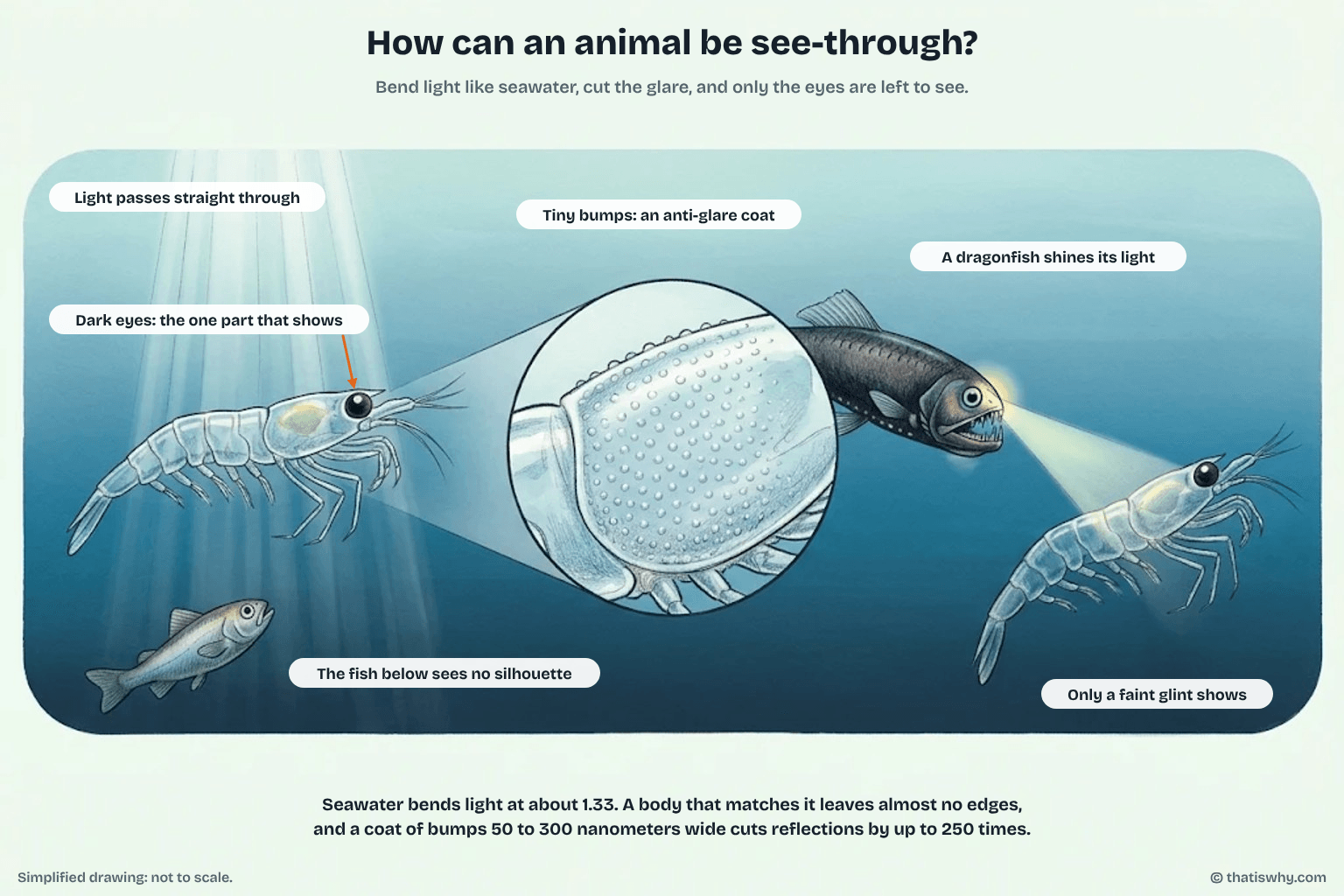
Light passes straight through, the anti-glare coat kills the shine, and only the dark eyes are left to see. See the detailed teaching diagram and printable PDF.
---
## The Invisible Skin: Preventing Reflections
Matching seawater’s refractive index removes the silhouette, but another problem remains. Light can still reflect off the surface.
Even transparent materials reveal themselves when light glints off them. For animals trying to disappear in open water, that flash can give them away. Many transparent creatures solve this with microscopic surface structures.
Researchers at Duke University and the Smithsonian studied seven species of see-through crustaceans called hyperiid amphipods, living in the twilight zone. Their bodies are covered in a coating of tiny spheres, each 50 to 300 nanometers across, smaller than the wavelength of light, which appear to be living bacteria. One of them, *Cystisoma*, which can reach six inches long, grows brush-like structures on its legs that do the same job.
These coatings can cut reflections by as much as 250 times. "This coating of little spheres reduces reflections the same way putting a shag carpet on the walls of a recording studio would soften echoes," said lead researcher Laura Bagge. Similar bumpy surfaces are known from moth eyes and are used in anti-reflective window glass.
Why go to all this trouble? Because transparent animals face predators with bioluminescent searchlights, such as dragonfish, whose light would otherwise make a clear body flash brightly.
---
## The Eye Problem: The One Thing Transparency Cannot Hide
Transparency works across most of the body, but the eyes create a problem.
Seeing always requires absorbing light. The retina must capture incoming photons to form an image. If the eye were perfectly transparent, the light would simply pass through without being detected. For animals trying to disappear, this creates a compromise.
The body can allow light to pass through almost perfectly, but the eyes must remain dark enough to capture that light.
The result is a body that can nearly disappear, interrupted only by the dark points of its eyes.
The crystal amphipod, *Cystisoma*, has a clever way to soften that weak spot. Its eyes are massive, covering up to a third of its body, but its retinas are spread out into a thin sheet of tiny dots. That shrinks the shadow the eyes cast below, so even the one part that can never be clear is made as faint as possible.
---
## The Trade-Off: Transparency Ends When You Eat
Transparency works well until the animal eats.
The moment a transparent predator swallows something opaque, the illusion begins to break. A shrimp or small fish can appear as a dark shape inside an otherwise invisible body. How some see-through animals hide their dinner is a story of its own, told in our guide to [why see-through deep-sea animals have red stomachs](https://thatiswhy.com/why-transparent-deep-sea-animals-have-red-stomachs/).
---
## The Deeper Principle: Becoming the Water
Think again about the ice cube in the glass of water.
You notice the cube because it bends light slightly differently than the surrounding liquid. Your eyes are detecting the mismatch.
Transparent animals spend their entire biology reducing that mismatch.
They remove pigments, simplify dense tissues, and allow light to pass through their bodies almost exactly as it would through seawater.
When that optical match becomes close enough, the boundary between animal and ocean fades.
Transparency follows the same rule. The closer an organism matches the physical behavior of seawater, the harder it becomes to see where the animal ends and the ocean begins.
---
## Three Myths About Transparency in the Deep Ocean
**Myth #1 — Transparent Animals Are Completely Invisible**
**Truth — Transparency Removes the Silhouette**
Even transparent animals can still be detected. Reflections can create faint glints, especially when a predator shines its own light on them, and eyes and food in the gut stay visible.
Think again about the ice cube. A small mismatch is still enough to reveal its edges.
Transparency works by removing the strong outline predators search for. When light passes through the body almost exactly as it passes through seawater, the silhouette fades.
---
**Myth #2 — Being Clear Is Enough**
**Truth — The Trick Is Matching Seawater**
Many clear materials remain easy to see.
A clear straw in a glass of water stays visible because the plastic bends light differently than the surrounding liquid. Transparent animals succeed because their tissues bend light almost exactly the way seawater does. When that optical match becomes close enough, the boundary between body and ocean disappears.
---
**Myth #3 — Transparency Works Best in Total Darkness**
**Truth — Transparency Works in the Twilight Zone**
It might seem that invisibility would matter most in the darkest parts of the ocean. But transparency pays off where faint light from above can still reveal a silhouette, in the twilight zone. By letting that light pass through their bodies, these animals remove the outline predators normally detect.
---
**How We Researched This**
To explain deep-sea transparency, we used Sönke Johnsen's 2001 review of transparency in the *Biological Bulletin*, which shows it is mostly a trait of open-water animals, a 2024 review in *Frontiers in Ecology and Evolution* on refractive index and reflection, and the 2016 Duke and Smithsonian study of anti-reflective coatings on hyperiid amphipods. The refractive indices of ice and water come from the reference tables summarized on [Wikipedia](https://en.wikipedia.org/wiki/Optical_properties_of_water_and_ice), the vanishing water beads from a [Texas A&M physics demonstration](https://physics.tamu.edu/invisible-water-balls-index-matching-handled-by-osa), and the eyes of *Cystisoma* from [MBARI](https://www.mbari.org/animal/crystal-amphipod/).
But explaining the physics of transparency requires more than optical measurements. Our goal was to make the mechanism intuitive, which is why we used the "**ice cube analogy**": an object shows up the moment it bends light differently from what surrounds it.
---
## Sources
- [Midwater ocean creatures use nanotech camouflage (Bagge et al., Current Biology 2016)](https://today.duke.edu/2016/11/midwater-ocean-creatures-use-nanotech-camouflage), Duke University
- [Hidden in plain sight: the ecology and physiology of organismal transparency (Johnsen, 2001)](https://biodiversitylibrary.org/part/31411), The Biological Bulletin (Biodiversity Heritage Library)
- [Optical properties of water and ice](https://en.wikipedia.org/wiki/Optical_properties_of_water_and_ice), Wikipedia
- [Invisible water balls (index matching)](https://physics.tamu.edu/invisible-water-balls-index-matching-handled-by-osa), Texas A&M University, Department of Physics & Astronomy
- [Crystal amphipod](https://www.mbari.org/animal/crystal-amphipod/), MBARI
- [Staring into a crystal ball: understanding evolution and development of in vivo aquatic organismal transparency (Hotta et al., 2024)](https://www.frontiersin.org/journals/ecology-and-evolution/articles/10.3389/fevo.2024.1428976/pdf), Frontiers in Ecology and Evolution