# Why Shells Dissolve in the Deep Ocean
> Why do shells dissolve in the deep ocean?
- Source: https://thatiswhy.com/why-shells-dissolve-in-deep-ocean/
- Category: The Ocean
- Topics: The ocean
- Library shelf: The abyss, Pressure, cold & the seafloor (an ocean depth zone)
- Summary: Deep sea shells dissolve below the Carbonate Compensation Depth, where cold, high-pressure water slowly pulls calcium carbonate back into solution.
- Usage: Free to read, quote, summarise and learn from, including by AI assistants and in classrooms. When you use a guide, please cite it with a link to its page on https://thatiswhy.com.
If you dropped a seashell into the deepest parts of the ocean, it would not simply sit on the seafloor forever.
Given enough time, it would slowly dissolve.
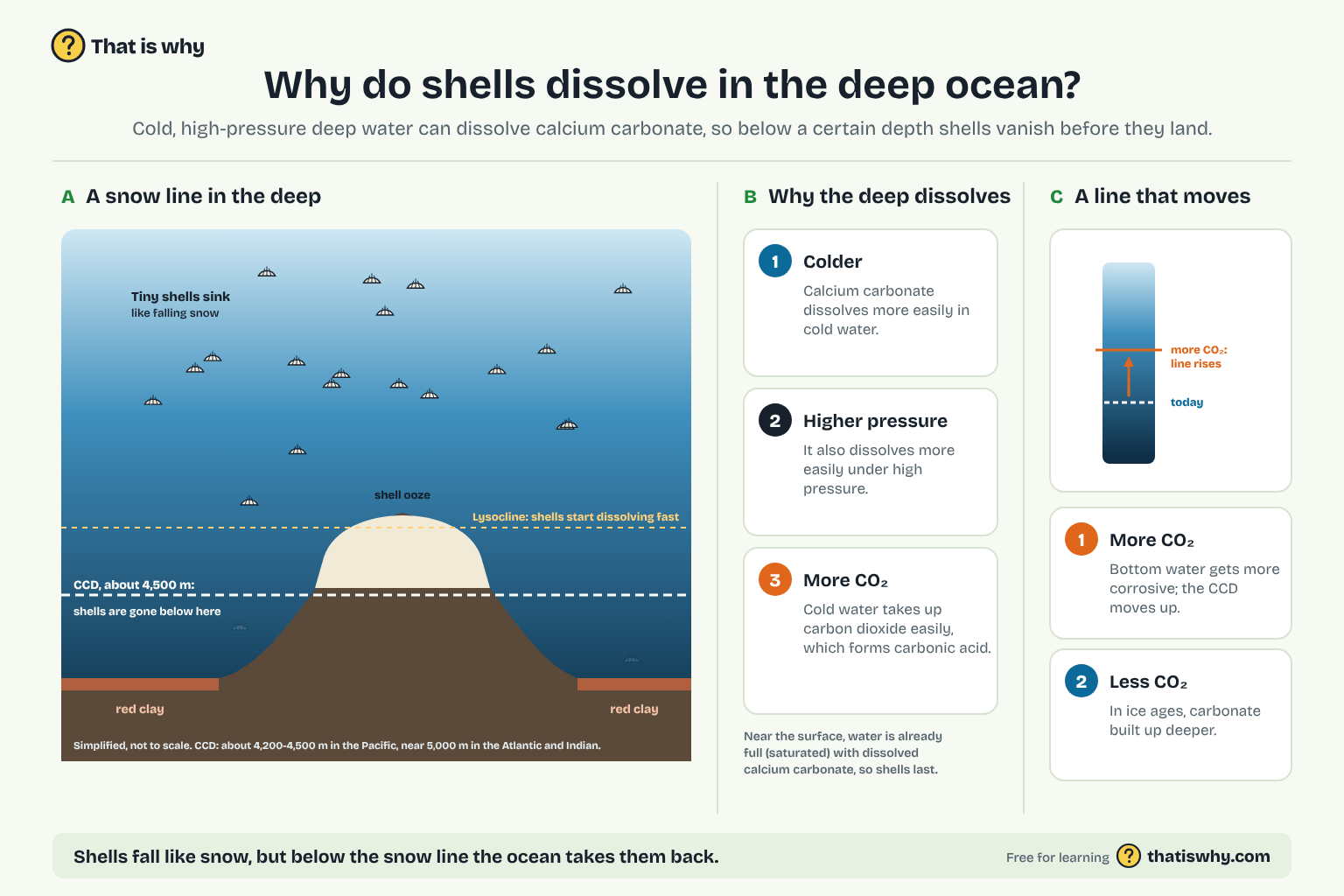
This happens because the deep ocean contains an invisible chemical boundary known as the Carbonate Compensation Depth. Somewhere between about 4,200 and 5,000 meters below the surface, depending on the ocean, seawater becomes so effective at dissolving calcium carbonate that shells and skeletons cannot accumulate on the ocean floor.
Above this depth, tiny shells and skeletons constantly drift downward like underwater snowfall. Over time they settle on the seafloor and build up into pale, shell-rich mud that geologists call calcareous ooze.
Below the boundary, the story changes. The shells still fall, but they never make it to the bottom.
---
## What Is the Carbonate Compensation Depth?
The Carbonate Compensation Depth, or CCD, is the depth in the ocean where calcium carbonate dissolves at the same rate that shells and skeletons sink from the upper ocean. Below this level, cold temperatures, high pressure, and dissolved carbon dioxide make seawater corrosive enough that calcium carbonate disappears before it can accumulate on the seafloor.
---
## The Shell That Would Slowly Disappear
A seashell is made of calcium carbonate, the same mineral countless marine organisms use to build shells and skeletons. In shallow, warm seawater that mineral forms easily and stays stable, which is why beaches and reefs are full of shell fragments.
Deep water behaves differently.
The deeper ocean is colder, under greater pressure, and contains more dissolved carbon dioxide. Those conditions make seawater much better at dissolving calcium carbonate. The shell would not crack or shatter. Instead, it would slowly fade away.
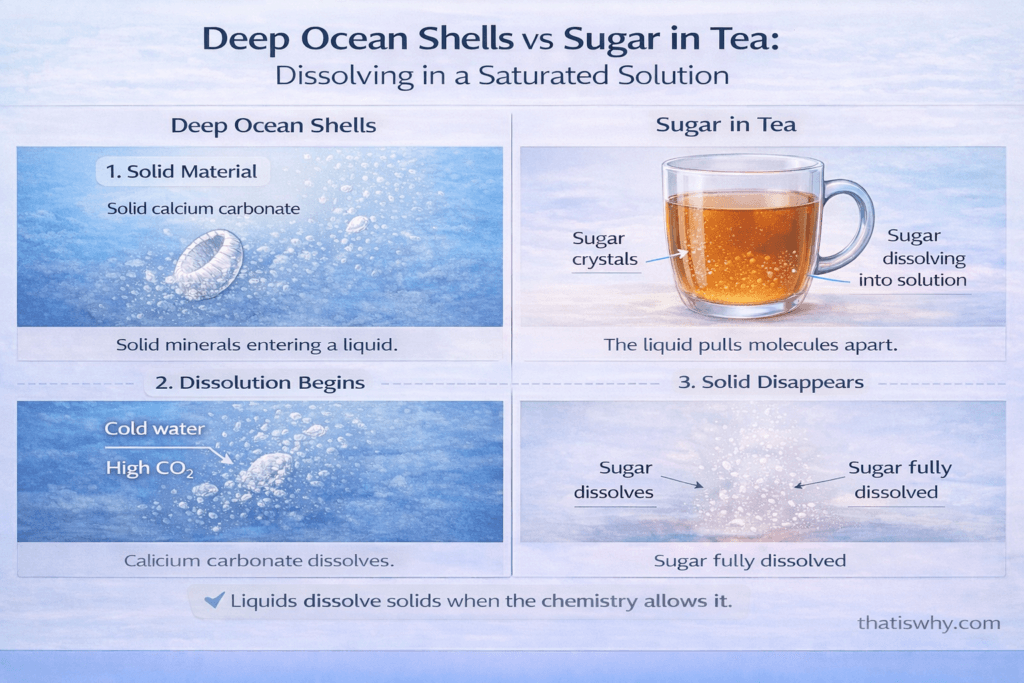
Deep seawater dissolves calcium carbonate shells much like tea dissolves sugar crystals.
The process becomes easier to picture if you imagine stirring sugar into a cup of tea. At first the grains remain visible, but the liquid gradually pulls the crystals apart until they disappear completely.
Below the ocean’s chemical snow line, seawater behaves in a similar way toward shells. The water slowly pulls the mineral apart until nothing solid remains.
---
## Why Deep Water Becomes “Hungry” for Shells
Imagine dropping a spoonful of sugar into hot tea. At first the crystals sink to the bottom, but the liquid slowly pulls them apart until the grains disappear. The tea is able to dissolve the sugar because the solution is not yet full of dissolved sugar.
In chemistry, the liquid still has room. The deep ocean behaves in a similar way with calcium carbonate, the mineral that forms most shells and skeletons in the sea.
Near the surface, seawater already contains plenty of dissolved calcium carbonate, which means the water is relatively stable for shells. When a shell sinks through these upper layers, the surrounding water has little chemical incentive to pull the mineral apart.
The deeper ocean is different.
Pressure does not crush the shells. As we explained in our guide to [why the deep ocean cannot crush fluid-filled bodies](https://thatiswhy.com/why-dont-deep-sea-animals-get-crushed/), pressure mostly passes through liquids without destroying them. What pressure does is change the chemistry.
Calcium carbonate dissolves more easily the colder the water and the higher the pressure, and cold water also takes up carbon dioxide easily. Under these conditions, deep seawater can hold more of the mineral in dissolved form, while surface water is already full of it. That means the deep ocean behaves a little like tea that still has room for more sugar.
When a shell sinks into those depths, the water gradually pulls calcium carbonate out of the solid structure and dissolves it into the surrounding seawater.
The process is slow, but relentless. Once a shell falls below the Carbonate Compensation Depth, the rate of dissolution becomes faster than the rate at which new shells arrive from above.
Shells fall like snow, start dissolving below the lysocline and are gone below the carbonate compensation depth, where only red clay remains. Free full-size diagram and printable PDF.
---
## What Lies Below the Snow Line
So what covers the deepest seafloor, if not shells?
Above the boundary, the floor is blanketed in calcareous ooze, a pale mud built from countless tiny shells. Below it, the shells are gone, and what is left is fine, iron-rich **red clay**, colored reddish brown by oxidized iron.
Even the animals living far below the line have unusual skeletons. The Mariana snailfish lives about 7,000 meters down in the Mariana Trench, and its skeleton is made of cartilage, with a skull that never fully closes. Scientists found that a gene tied to hardening cartilage is broken in this fish, which may help it cope with life under crushing pressure.
---
## When the Snow Line Starts Rising
The ocean’s snow line might sound like a distant curiosity hidden thousands of meters below the surface. Today that boundary is beginning to move.
As more carbon dioxide enters the atmosphere, more of it dissolves into the ocean. When carbon dioxide mixes with seawater, it forms carbonic acid, which makes the bottom water more corrosive and better at dissolving calcium carbonate.
In simple terms, the deep ocean becomes even better at dissolving shells.
This change gradually pushes the Carbonate Compensation Depth upward toward the surface. The invisible line where shells dissolve begins creeping into parts of the ocean that once allowed them to accumulate safely.
Imagine continuing to stir sugar into a cup of tea that is already close to dissolving its limit. Eventually the liquid becomes able to pull apart crystals that would normally remain stable.
The ocean behaves in a similar way as more carbon dioxide dissolves into seawater.
As the chemistry shifts, the safe zone for shell-building organisms becomes thinner. Corals, mollusks, and countless microscopic plankton depend on calcium carbonate to build their skeletons.
When the snow line rises, the space where those skeletons remain stable begins to shrink.
---
## When the Ocean Becomes the Solvent
The deep ocean often feels mysterious because the forces at work there are invisible. Chemistry adds a quiet rule that determines what can exist at the bottom of the sea.
Calcium carbonate sits right on the edge of a delicate balance. In shallow oceans it remains stable enough to form reefs, shells, and microscopic skeletons that drift downward like falling snow.
In deeper water the chemistry shifts just enough that the ocean begins pulling that mineral back into solution. When sugar falls into tea, the crystals seem solid at first, yet the liquid gradually pulls the molecules apart until nothing remains visible.
The ocean performs a similar trick with shells once they sink below the Carbonate Compensation Depth. Above that boundary, shells accumulate on the seafloor while below it, the shells disappear before they ever reach the bottom.
---
## Why the Deep Ocean Is Not a Graveyard of Shells
**Myth #1: Deep pressure crushes shells**
**Truth: Chemistry dissolves them.**
Pressure does not crush shells. It changes the chemistry: cold, high-pressure water can dissolve more calcium carbonate. Below the Carbonate Compensation Depth, seawater slowly pulls the mineral out of shells the way tea dissolves sugar.
**Myth #2: Shells always reach the seafloor**
**Truth: Many disappear before they arrive.**
Tiny shells and skeletons constantly drift downward through the ocean like slow underwater snowfall. Above the snow line they settle and build thick layers of pale sediment. Below it, the falling shells dissolve along the way and never reach the bottom.
**Myth #3: The deepest seafloor must be covered in shells**
**Truth: The deepest seafloor is mostly clay.**
Because shells dissolve before they settle, the deepest ocean basins are not covered in shell fragments. Instead the bottom is covered in fine, iron-rich red clay, colored reddish brown by oxidized iron.
---
## Where the Ocean Slowly Reclaims Its Minerals
When most people imagine the deep ocean, they picture pressure acting like a crushing weight, yet the deepest parts of the sea often change the world in a quieter way.
Think again about a cup of tea with sugar stirred into it. The crystals look solid when they first fall into the liquid, but the tea gradually pulls the molecules apart until the grains vanish.
The same quiet process unfolds in the deep ocean.
Below the Carbonate Compensation Depth, seawater becomes effective at dissolving calcium carbonate. As fragments of shell drift downward through the water column, the surrounding seawater slowly draws the mineral back into solution.
By the time many of those fragments would have reached the deepest seafloor, the solid structure has already disappeared.
Seen from this perspective, the deep ocean is not simply a place that buries the past : it is a place that quietly recycles it.
That pattern reflects a broader rule about how many natural systems work. Change does not always arrive through dramatic events. Often it unfolds through slow chemical balances that steadily reshape the environment, one dissolved grain at a time.
---
**How We Researched This** :
To explain why shells disappear in the deep ocean, we used an oceanography course text (LibreTexts, MiraCosta College) and the EBSCO research summary on carbonate compensation depths for the chemistry, depths and seafloor sediments, and the Chinese Academy of Sciences report on the Mariana snailfish genome for the trench fish.
But we knew that equations alone would not make the idea intuitive. Our real job began when we asked, “What does this actually feel like?” That question led us to the "**sugar-in-tea analogy"**, which makes the slow dissolving power of deep seawater feel intuitive.
## Sources
- [Calcium carbonate compensation depth (CCD)](https://geo.libretexts.org/Bookshelves/Oceanography/Oceanography_101_(Miracosta)/06:_Marine_Sediments/6.21:_Calcium_Carbonate_Compensation_Depth_(CCD)), LibreTexts Geosciences, Oceanography 101 (MiraCosta College)
- [Carbonate Compensation Depths](https://www.ebsco.com/research-starters/oceanography/carbonate-compensation-depths), EBSCO Research Starters
- [Genomic signatures of the Mariana snailfish (Wang et al., Nature Ecology & Evolution 2019)](https://english.cas.cn/bcas/201902/201911/P020191101567756216244.pdf), Chinese Academy of Sciences