# Why Pitcher Plants Are So Slippery to Insects
> How do pitcher plants trap insects?
- Source: https://thatiswhy.com/why-pitcher-plants-are-so-slippery/
- Category: Plants & Forests
- Topics: Trees and plants > Plant tricks; Trees and plants; Nature as engineer
- Library shelf: The canopy, Plants, insects & land life (a theme shelf, not a habitat)
- Summary: A pitcher plant's rim spreads rain, dew and nectar into a thin film of water. Insects' feet aquaplane on it and slide in, but only while it's wet.
- Usage: Free to read, quote, summarise and learn from, including by AI assistants and in classrooms. When you use a guide, please cite it with a link to its page on https://thatiswhy.com.
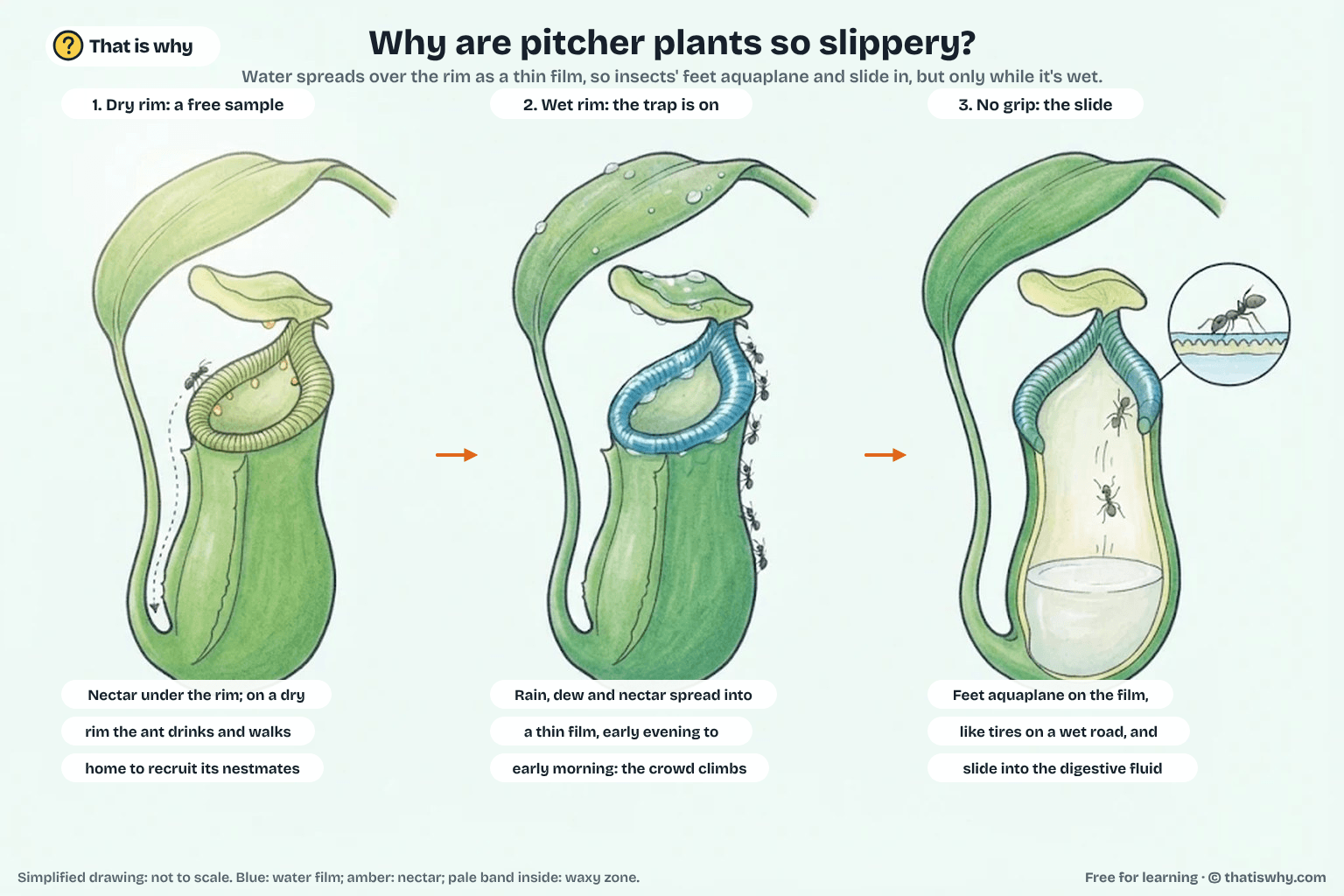
An ant marches up the side of a green, vase-shaped leaf in a Borneo swamp forest, following the smell of something sweet. It reaches the shiny striped rim, takes one more step, and its feet simply stop working. **Pitcher plants trap insects with a rim that loves water. Rain, dew and the plant's own nectar spread across it as a thin, even film, and an insect's sticky footpads aquaplane on that film like tires on a wet road, sliding straight into the pool of digestive fluid below. When the rim dries out, the same insects walk across it safely.**
That last part is the real twist in this story. One of the cleverest traps in the forest takes hours off every day, and the reason turns out to be brilliant.
## The Floor Nobody Puts a Sign On
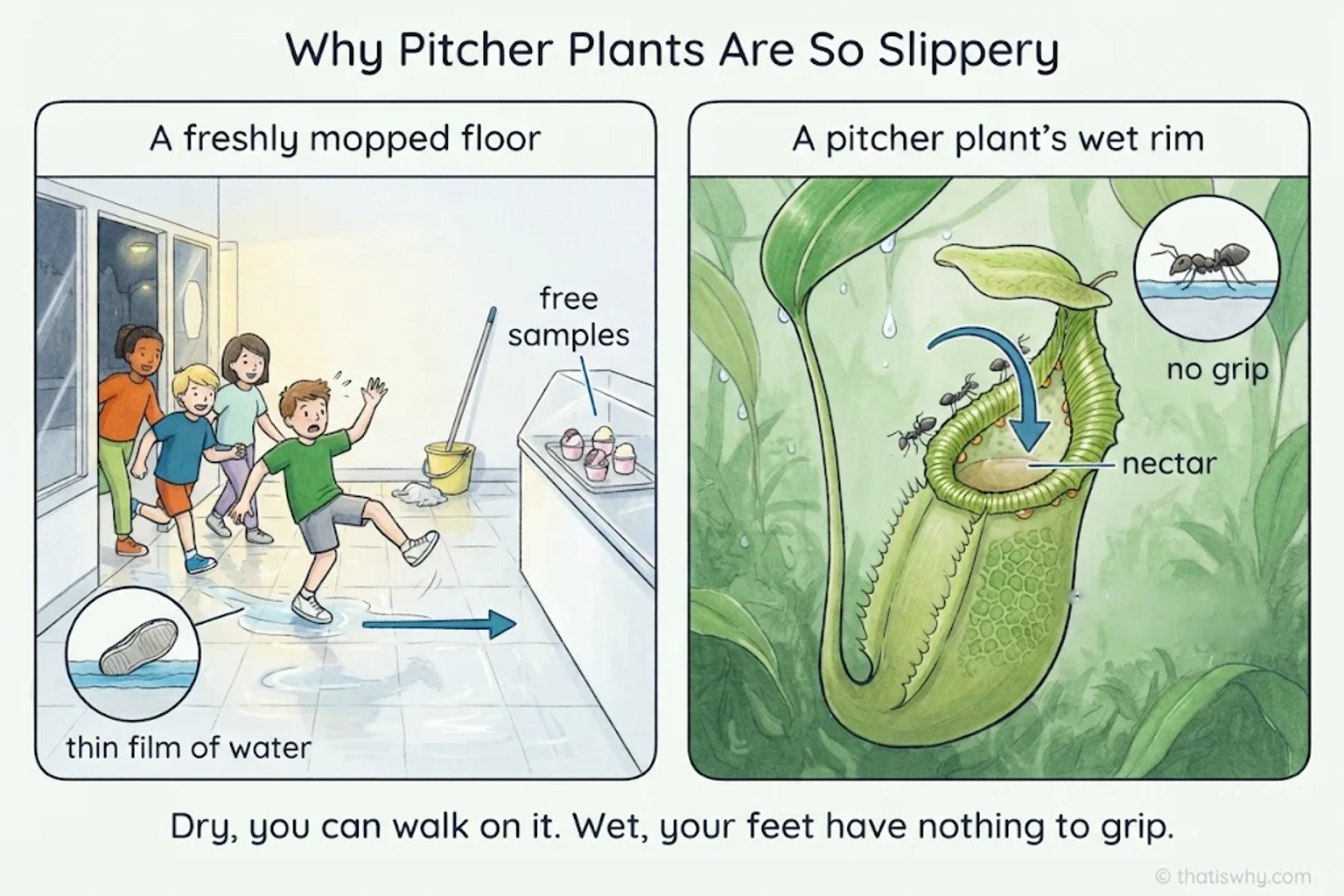
It's closing time at a little ice cream shop. A tray of free samples still sits at the end of the counter, and the cleaner has just run a mop over the tiles until they gleam. Then the door swings open, a group of friends rushes in for the samples, and the first sneaker to hit the wet tiles keeps going.
A mopped floor isn't slippery because it's smooth. It's slippery because a thin layer of water now sits between your sole and the tile, and your shoe can no longer touch the floor itself. Earlier that afternoon, on the same dry tiles, you could have walked to that tray in socks. That's exactly what one of those friends did at lunchtime, before texting the whole group about the free samples.
That's exactly how a pitcher plant's rim works, except the plant mops its own floor, and it never puts out a yellow warning sign. The shop wants every customer to stay on their feet. The pitcher wants the opposite, and the free samples are the bait.
A freshly mopped floor and a pitcher plant's wet rim play the same trick: a thin film of water leaves your feet nothing to grip.
## How Pitcher Plants Trap Insects on a Wet Rim
A tropical pitcher plant, *Nepenthes*, grows leaves that end in a jug, holding a pool of digestive fluid. It's a **carnivorous plant**, a plant that catches animals for food, and that habit lets it live in nutrient-poor places where other plants struggle to grow. The jug's lip is a ribbed collar called the **peristome**, and just beneath its inner edge sit glands that ooze sweet nectar.
For a long time, botanists didn't think the rim mattered much. Earlier investigators described it as a safe foothold, and they worked mostly with dried specimens or greenhouse plants. Nobody had watched these plants on a wet night in the jungle.
So Walter Federle and Holger Bohn went to the peat swamp forests of Brunei, in northwest Borneo, to watch ants on *Nepenthes bicalcarata*. They came back to their study site just after a downpour and found a massacre in progress. Every ant that stepped onto a pitcher's rim slipped helplessly into the fluid below.
### A Leaf That Drinks the Rain
Here's what makes that rim so strange. Most leaves repel water, so rain beads up and rolls off, the trick behind [why water rolls off lotus leaves](https://thatiswhy.com/why-water-rolls-off-lotus-leaves/). The peristome does the reverse. When Federle dripped water onto a dry rim, it spread out in seconds into a film over the whole surface, helped along by fine ridges running across the rim.
That film is the mop water. An ant's feet carry soft, sticky pads that can grip astonishingly smooth surfaces, but on the wet rim they can't get close enough to the plant to hold on. They glide on water instead, a slip called **aquaplaning**, the same thing a car tire does on a flooded road. In their tests, most ants on a wet rim shot straight over the edge into the fluid, and the capture rate tripled compared with a dry rim.
### The Night Shift
The real surprise came with the sensors. Federle and Bohn went back to Brunei with a third colleague and wired up the rims of a second species, *Nepenthes rafflesiana*, to log their wetness around the clock. The pattern held whether it rained or not. For most of the day the rims stayed dry and caught nothing, but from early evening to early morning they were wet and deadly.
Even the nectar helps with the mopping. It's *hygroscopic*, meaning it pulls moisture out of the air, so the sugary rim stays wet for longer. The pitchers also make more nectar in the evening. The free-sample tray, it turns out, is also the bucket of mop water.
Dry rim, wet rim, no grip: how a pitcher plant turns a film of water into a trap. See the detailed teaching diagram and printable PDF.
## Why a Trap That Switches Off Catches More Ants
All of this leaves a puzzle. A trap that sits harmless for hours seems like a bad trap. Ulrike Bauer, one of the scientists behind the sensors, put the puzzle plainly: "The plant's key trapping surface is extremely slippery when wet but not when dry." Her team at the University of Bristol found the traps stayed "switched off" for up to eight hours on dry days.
The answer is in who the customers are. Ants are social insects, and a lone scout that finds sweet nectar runs home and recruits a crowd. On a dry rim, that scout drinks, walks away safely and leaves a trail back to the nest. Later the rim gets wet, and the whole crowd of followers goes over the edge in one sweep, just like the friends who got that lunchtime text.
To test the idea, the researchers rigged hospital drips to keep one pitcher wet nonstop on each of 23 wild plants in Borneo, and they left a second pitcher on each plant to the weather. Over several weeks, the always-wet pitchers caught 136 ants. The ones that took breaks caught 339, mostly in a few big massacres. **The lazy trap caught more than twice as many ants.**
This is the part that still makes us grin. Evolution doesn't reward a trap for catching every single visitor. It rewards the total meal, and sometimes the smartest move is letting the messenger go home to spread the news.
## Rain Drops, Springboards and a Slippery Coating
Pitcher plants have more than one wet-weather trick. A species called *Nepenthes gracilis* uses its lid. Ants feeding on nectar under that lid walk around safely in calm weather, but when rain drops hit it, the lid flicks like a diving board. Researchers from the University of Cambridge simulated rain with a hospital drip and found that about 40% of the ants got trapped once the drops began to fall.
Engineers have borrowed the rim's idea, too. A team led by Joanna Aizenberg at Harvard's Wyss Institute noticed that the pitcher doesn't fight liquids with air pockets, the way the lotus does. It locks in a layer of liquid, so the liquid itself becomes the slippery surface. Their coating, called SLIPS, soaks a porous material in a lubricating fluid, and it sheds just about any liquid, including blood and oil. It's a neat case of **biomimicry**, copying designs from living things, like the [tiny toe hairs that let geckos stick to walls](https://thatiswhy.com/why-geckos-stick-to-walls/), which solve the opposite problem.
The pitcher also belongs with other plants that hunt. The Venus flytrap snaps shut on its prey and then [counts the touches before it digests](https://thatiswhy.com/why-venus-flytrap-can-count/), a very different solution to the same hunger. And the pitcher's real target, the ant colony, is a puzzle of its own: the same teamwork that [makes ant colonies act like one brain](https://thatiswhy.com/why-ant-colonies-act-like-one-brain/) is what the plant exploits. For the wider story of how plants solve survival problems without moving, see [how trees engineer their way to survival](https://thatiswhy.com/how-trees-engineer-their-way-to-survival/).
## Myths That Don't Hold Water
**Myth: The rim of a pitcher plant is always slippery.**
**The truth:** The rim is slippery only when wet. On dry days it can stay harmless for up to eight hours, and that pause helps the plant catch more ants.
**Myth: Wax is what makes insects slip.**
**The truth:** Many pitchers do have a waxy inner wall whose crystals break off under an insect's feet, but the main trap is the wet rim. Insects often fall straight over the rim into the fluid without ever touching the wax.
**Myth: Pitcher plants live on mice and frogs.**
**The truth:** They mostly catch insects, especially ants. Spiders, scorpions, centipedes, the odd snail or frog and even an occasional rat do turn up, but they're the exception.
## Back on the Shiny Striped Rim
Go back to that ant on the shiny striped rim. In the afternoon, it would have sipped the nectar, turned around and headed home to tell its sisters. After dark, with the rim slick with dew and sugar water, there's no grip left for its feet at all.
**The pitcher plant doesn't chase, grab or poison anything. It sets out free samples, mops its own floor and waits for the crowd.**
## Sources
- [Pitcher plant uses rain drops to capture prey](https://www.cam.ac.uk/research/news/pitcher-plant-uses-rain-drops-to-capture-prey), University of Cambridge
- [Pitcher plants 'switch off' traps to capture more ants (Bauer et al., Proceedings of the Royal Society B 2015)](https://bristol.ac.uk/news/2015/january/ants-and-pitcher-plants.html), University of Bristol
- [Tricky pitcher plants lure ants into a false sense of security](https://www.sciencenews.org/article/tricky-pitcher-plants-lure-ants-false-sense-security), Science News
- [Pitcher plants: devious hunters (Stephanie Pain, New Scientist 2008)](https://www.zoo.cam.ac.uk/system/files/documents/PitcherPlants_modified.pdf), New Scientist, copy hosted by the University of Cambridge Department of Zoology
- [Slippery slope: Researchers take advice from carnivorous plant](https://wyss.harvard.edu/news/slippery-slope-researchers-take-advice-from-carnivorous-plant), Wyss Institute, Harvard University