# Why Do Owls Fly So Silently?
> Why are owls silent when they fly?
- Source: https://thatiswhy.com/why-owls-fly-silently/
- Category: Animals
- Topics: Nature as engineer; Animal senses
- Library shelf: The forest floor, Animal behavior & evolution (a theme shelf, not a habitat)
- Summary: Owl wings calm the air: a comb on the front edge, a velvety surface and a soft back fringe muffle the swoosh, while big wings let owls fly slowly.
- Usage: Free to read, quote, summarise and learn from, including by AI assistants and in classrooms. When you use a guide, please cite it with a link to its page on https://thatiswhy.com.
In a wildlife park near Berlin, a barn owl flew low over a patch of ground wired with 92 microphones. A kestrel and a Harris's hawk took the same route at almost the same easy pace, and the microphones caught the whoosh of their wings. When the owl passed, the highest-pitched part of its flight noise was too quiet for the whole array to measure. **Owls fly so silently because their wings are built to calm the air. A comb of tiny bristles on the front edge breaks up turbulence, a velvety surface stops feathers rubbing, and a soft fringe on the back edge muffles the swoosh, while big wings let them glide slowly.**
So an owl's quiet isn't a trick of the night. It's in the feathers themselves, and the easiest way to hear the difference is to walk into a baby's room at two in the morning.
## The Windbreaker and the Fleece Robe
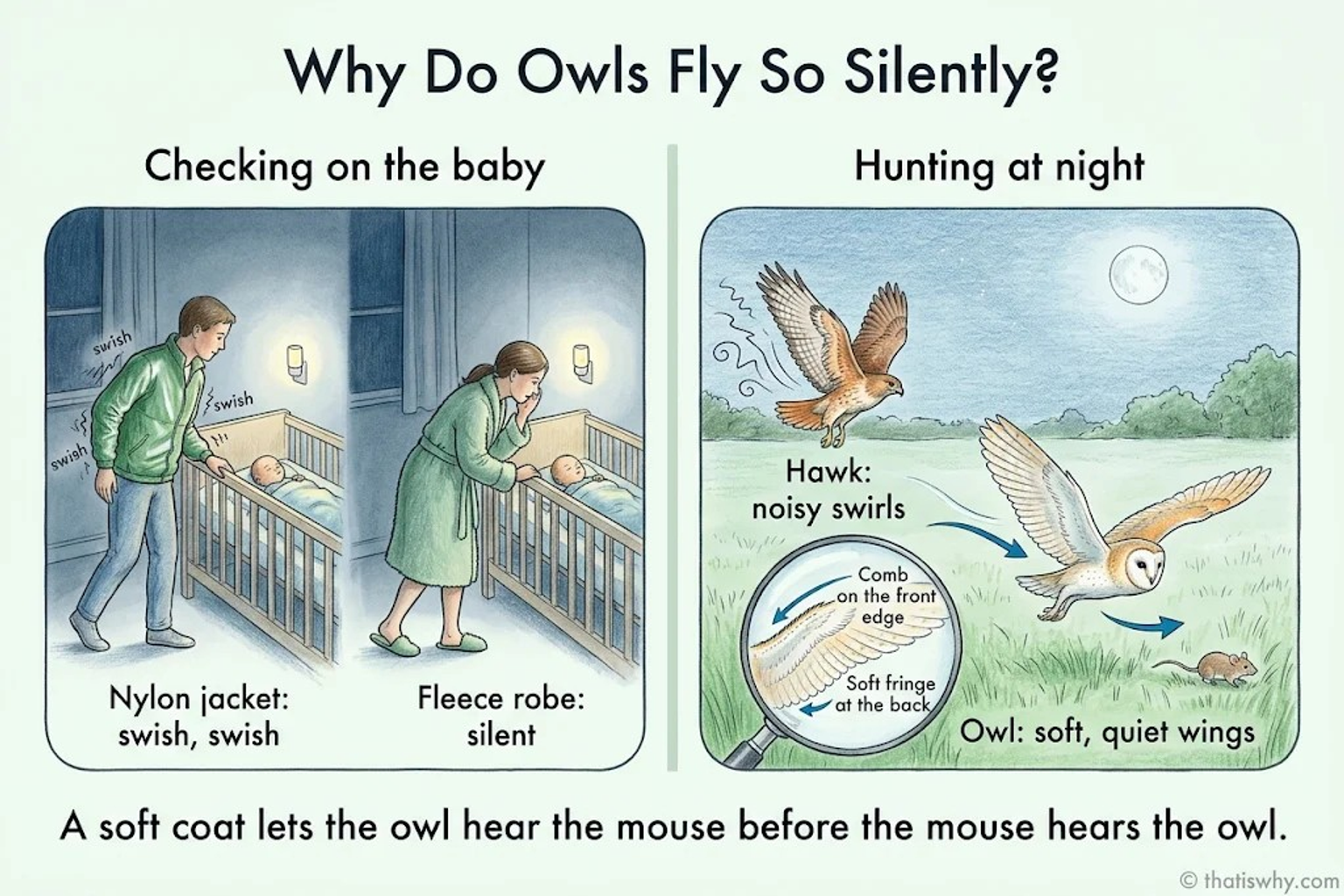
The baby has finally gone to sleep, and you need to check on her. You throw on the nearest jacket, a stiff nylon windbreaker, and creep down the hall. Every step goes *swish, swish*, the sleeves rasping against your sides and the hem flapping at your knees. By the crib, you can't even tell if she's breathing over your own racket.
So you go back and swap it for your fuzzy fleece robe. Now you drift in like fog. Soft fabric slides over soft fabric without a whisper, the fuzzy edges hang quietly, and you move slowly, because there's no hurry. In the silence, you can hear every tiny breath from the crib.
That's the owl's whole secret. Most birds fly in windbreakers. An owl flies in a fleece robe, with soft edges and a fuzzy coat on every wing, and it wins twice: the mouse below doesn't hear it coming, and the owl hears the mouse.
A robe only has to stop fabric rubbing on fabric, though. An owl's wing has a harder job, because it's slicing through air, and moving air makes noise all by itself. So the feathers do more than stay soft: they reshape the wind as it flows past.
Swap the swishing jacket for a soft robe and you can hear the baby breathe. The owl wears the robe.
## How Owls Fly Silently: A Comb, a Velvet Coat and a Fringe
Most of a wing's noise comes from **turbulence**, air that tumbles into messy swirls instead of flowing smoothly. Researchers at the University of Cambridge, led by the mathematician Nigel Peake, point out that much of that noise starts at the wing's back edge, where the air rushing over the surface has turned turbulent. It's true for a bird, a plane or a fan, and that ragged swirl leaving the wing is the swoosh you hear.
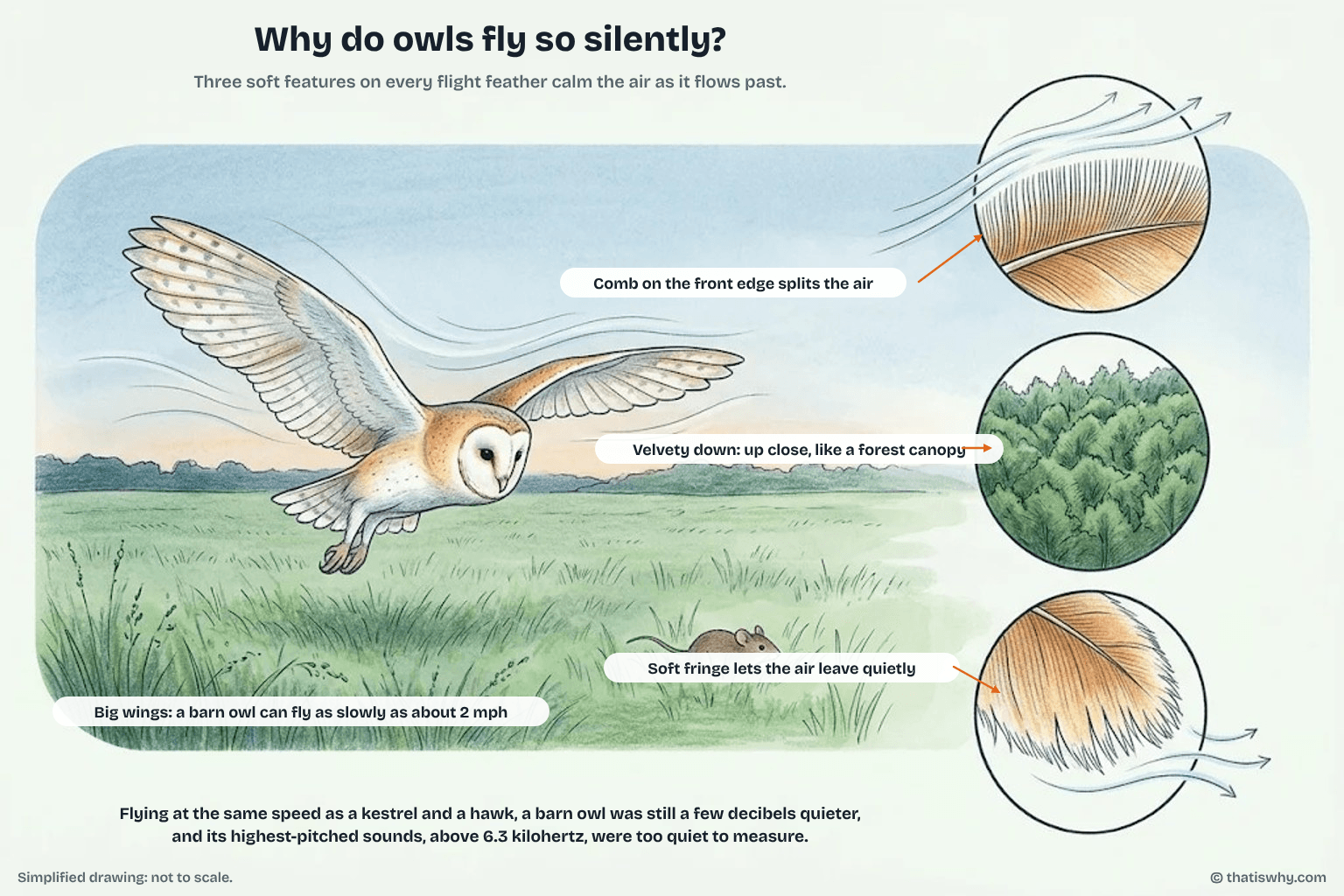
Owls attack the problem from front to back. On the leading edge of the outermost flight feather sits the **leading-edge comb**, a flexible row of evenly spaced bristles that sticks up like the teeth of a comb. Air hitting the wing gets combed before it flows over the top, and the comb breaks up turbulent air that would otherwise feed the swoosh. In a wind tunnel, a team led by Hao Liu at Chiba University in Japan found that these serrations steer the moment when smooth air turns turbulent over the top of the wing.
Behind the comb, owl flight feathers wear a downy covering that the Cambridge team likened to a forest canopy seen from above. This is the fleece robe's job: it stops feathers from rasping against each other as the wing moves. Krista Le Piane, then at the University of California, Riverside, tested that idea on 13 live barn owls. When she and Christopher Clark coated the velvet on some of their inner flight feathers with hairspray, their wings made more noise, especially on the upstroke.
Finally, the back edge of the wing ends in a soft, porous fringe, like the frayed hem of that robe. Together, the comb, the velvet and the fringe make the whole wing far quieter. "No other bird has this sort of intricate wing structure," Peake said.
Then there's the owl's pace. Owls have large wings for their body weight, which lets them fly unusually slowly, as slowly as two miles per hour for a barn owl, and glide with little flapping. Across most birds, the bigger and faster the flier, the noisier its flight.
Yet back near Berlin, the owl wasn't just winning by going slow: the kestrel and the hawk flew at almost exactly its speed, about 5 meters per second, and the owl was still a few decibels quieter. Above 1.6 kilohertz, meaning sounds vibrating more than 1,600 times a second, its advantage was clear. That's the higher-pitched hiss of flight, and above 6.3 kilohertz the owl dropped below what the microphones could measure.
A comb, a velvet coat and a soft fringe on every flight feather, plus big wings for flying slowly. See the detailed teaching diagram and printable PDF.
## Quiet Is a Hunting Tool, and Hunting Tools Have a Price
Why would evolution go to all this trouble? For a bird that hunts in the dark, sound is information, and every swoosh is information given away.
There are two ways to look at it. The *stealth* idea says owls went quiet so prey can't hear them coming. The *prey detection* idea says they went quiet so their own wings don't drown out the faint rustle of a mouse, which matters for a hunter listening hard for its dinner.
Le Piane studied the wings and feathers of 70 owl species to test which idea wins, and the answer surprised her: comb shape lined up with both. "I wasn't expecting to find support for both hypotheses," she told Audubon. Night-hunting owls tended to have wider combs than owls that hunt by day. That matters, because in general the wider the comb, the less sound a wing makes as it flaps.
Here's a clue that quiet flight is tuned to the job: some owls barely bother with it. The Tawny Fish Owl and the insect-eating Burrowing Owl have little or no comb at all.
Quiet also comes at a cost. Liu's wind-tunnel work found a trade-off: at shallow angles, below about 15 degrees, a serrated edge makes a wing perform worse than a clean one. At steeper angles, which owl wings often reach in flight, the serrations deliver quiet and good performance together. Evolution keeps a tool only where it pays its way, and the soft robe pays for an owl hunting mice at midnight.
## From Owl Feathers to Quieter Wind Turbines
Mice would love owls to be noisy, and engineers would love their machines to be quiet. Wind turbines are heavily braked to keep them quiet, which means they produce less power than they could. So the Cambridge team tried giving a blade a fuzzy coat of its own. Their first test was almost comic: they covered a blade in fabric like the material used for wedding veils, and it cut surface noise by as much as 30 decibels.
A wedding veil won't survive on a turbine, so the team then 3D-printed a plastic coating with a similar structure. On a full-sized section of turbine blade in a wind tunnel, it cut the noise by 10 decibels without any appreciable effect on the blade's aerodynamics. That's the same move nature keeps making for the engineers who study it, and our guide to [why nature is the ultimate engineer](https://thatiswhy.com/why-nature-is-the-ultimate-engineer/) is full of them. Copying nature like this is called **biomimicry**. The front edge of a wing hides other tricks, too: a tiny tornado riding the front edge of a falling seed is why [maple seeds spin like helicopters](https://thatiswhy.com/why-maple-seeds-spin-like-helicopters/) and fall so slowly.
It's the same story with [the microscopic toe hairs that let geckos stick to walls](https://thatiswhy.com/why-geckos-stick-to-walls/), which inspired grippers that hold on with no glue at all. And it's a warning too, because people once copied the woodpecker's skull for shock absorbers before finding out [woodpeckers avoid concussions by being stiff, not padded](https://thatiswhy.com/why-woodpeckers-dont-get-concussions/). The owl-inspired coating, at least, has passed its first wind-tunnel test.
Stealth is a theme all over the living world. In the ocean's darkness, animals hide from eyes rather than ears, and [the deep sea has perfected stealth](https://thatiswhy.com/why-deep-sea-perfected-stealth/) with see-through bodies, belly lights and red or ultra-black skin. On land, small mammals have their own superpowers, like the [star-nosed mole, which hunts by touch faster than eyes can see](https://thatiswhy.com/why-star-nosed-mole-sees-faster-than-sight/).
## Owl Myths That Make Too Much Noise
**Myth: Owls make no sound at all.**
**The truth:** Owls are quieter than the other birds tested, not soundless. Near Berlin, the barn owl was only a few decibels below the hawk and the kestrel, with the biggest gap in the higher-pitched part of the sound.
**Myth: Owls are quiet only because they fly slowly.**
**The truth:** Slow flight helps, but when the hawk and kestrel matched the barn owl's speed, the owl was still quieter. Its feathers do real work.
**Myth: Every kind of owl flies silently.**
**The truth:** Some owls have little or no comb, like the Tawny Fish Owl and the Burrowing Owl. Owls that hunt by day also tend to have narrower combs than night hunters.
**Myth: Silent flight is only about sneaking up on prey.**
**The truth:** It also keeps the owl's own ears clear, so it can hear a mouse rustling below. The feather evidence supports both jobs. (And if you've ever wondered why a gang of these birds gets a grand name, here's [why a group of owls is called a parliament](https://thatiswhy.com/why-group-of-owls-is-called-a-parliament/).)
## The Bird That Wears Its Own Hush
So let's go back to that field near Berlin, and those 92 microphones listening to the sky. The kestrel whooshed and the hawk whooshed, and then a barn owl slid over them, its highest notes too faint to catch.
Nothing about that was magic. A comb of bristles at the front of the wing breaks up the air, a velvet coat stops feathers from rubbing, and a soft fringe at the back lets the wind slip away quietly. Big wings let the whole bird drift slowly. It's the fleece robe in the nursery, worn by a hunter, and it lets the owl hear the mouse before the mouse ever hears the owl.
We love that a hunter built for midnight silence might one day help wind turbines spin more quietly, too.
## Sources
- [Silent Owl Flight: Bird Flyover Noise Measurements (Sarradj, Fritzsche and Geyer, AIAA 2010-3991)](https://www-docs.b-tu.de/fg-akustik/public/veroeffentlichungen/Sarradj2010c.pdf), Brandenburg University of Technology Cottbus
- [Silent flights: How owls could help make wind turbines and planes quieter](https://www.cam.ac.uk/research/news/silent-flights-how-owls-could-help-make-wind-turbines-and-planes-quieter), University of Cambridge
- [The Silent Flight of Owls, Explained](https://www.audubon.org/magazine/silent-flight-of-owls-explained), Audubon
- [The Evolution of Quiet Flight in Owls (Strigiformes) and Lesser Nighthawks (Krista Le Piane, doctoral dissertation, 2020)](https://www.escholarship.org/uc/item/2b35r9pd), University of California, Riverside (eScholarship)
- [Evidence that the Dorsal Velvet of Barn Owl Wing Feathers Decreases Rubbing Sounds during Flapping Flight (LePiane and Clark, Integrative and Comparative Biology, 2020)](https://bvbvf1.bib-bvb.de/vufind/PrimoRecord/cdi_proquest_miscellaneous_2412209779), Integrative and Comparative Biology (library record)
- [Owls' wings could hold the key to beating wind turbine noise](https://www.sciencedaily.com/releases/2017/07/170704093621.htm), ScienceDaily (IOP Publishing)