# Why the Orchid Mantis Out-Blooms Nature
> How does a mantis out-bloom a real flower?
- Source: https://thatiswhy.com/why-orchid-mantis-out-blooms-nature/
- Category: Animals
- Topics: Deception
- Library shelf: The canopy, Plants, insects & land life (a theme shelf, not a habitat)
- Summary: The orchid mantis doesn't copy one flower. It looks like an average flower, and it lures pollinators about 30% more often than real flowers do, then eats them.
- Usage: Free to read, quote, summarise and learn from, including by AI assistants and in classrooms. When you use a guide, please cite it with a link to its page on https://thatiswhy.com.
## The Flower That Bites
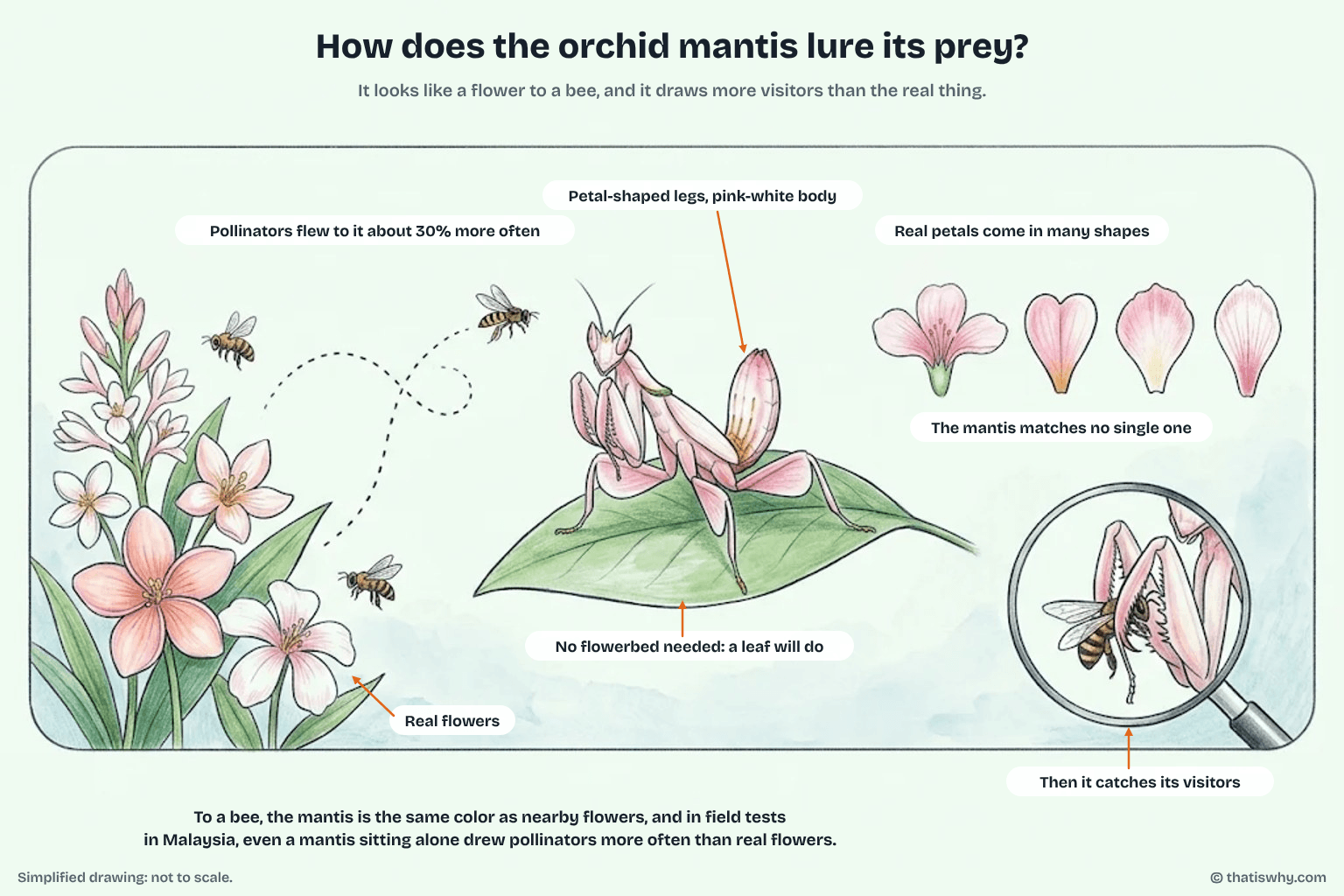
**Does the Orchid Mantis mimic a specific flower?** No. Research shows the Orchid Mantis (*Hymenopus coronatus*) resembles a generic, "average" flower rather than any one species. To a bee, its color can't be told apart from the flowers growing nearby, and in field tests it attracted pollinators about 30% more often than real flowers did.
That is the science, but to the eye, it is pure magic.
Look at a photo of this insect and it hardly seems real. It looks like something drawn for an animated film. Its legs are flattened into heart-shaped petals. Its body is creamy white with perfect gradients of pink. It is arguably the most beautiful insect on the planet.
If you were hiking in Southeast Asia, you’d probably stop to take a picture. But if you were a bee, you wouldn't just look. You’d dive straight for it, expecting the best meal of your life.
And that would be the last mistake you ever made.
We usually think of camouflage as a way to hide—like a stick bug blending into a twig. But the Orchid Mantis isn't hiding. It is doing something way more aggressive. It isn't trying to blend in; it is trying to be the center of attention.
---
## The Forbidden Candy Bar
To understand why a bee would land on a predator, it helps to know an idea called a **Super-Normal Stimulus**: a fake that is even more tempting than the real thing.
Basically, the Orchid Mantis is a **Giant Candy Bar.**
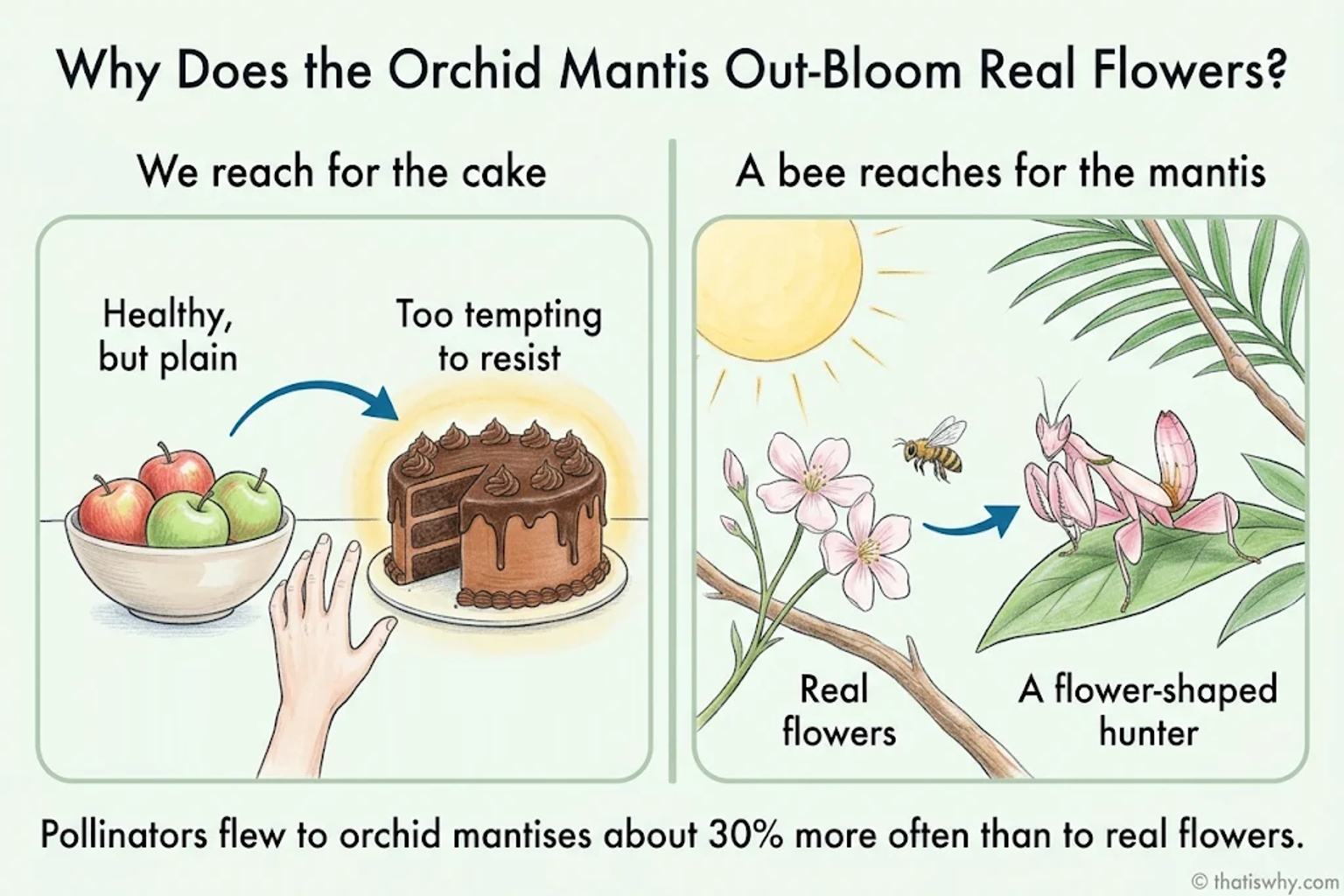
We reach past the apples for the cake; a bee flies past real flowers to the mantis.
Say you are starving, and two tables stand in front of you. On the first one sits a bowl of apples, healthy, natural and perfectly fine. On the second one sits a giant, glowing, triple-chocolate cake.
You know you should eat the apple. But your brain is hardwired to seek sugar, and the cake is an exaggeration of everything you crave. It pulls at you harder than any apple ever could, so you ignore the apple and grab the cake.
Something like that seems to be happening to the bee. The mantis doesn't just pass as a flower; it out-competes flowers. In field tests in Malaysia, pollinators flew up to orchid mantises at a higher rate than to real flowers, about 30% more often. The bee passes the real nectar to land on the killer, simply because the killer looks more like dinner.
The orchid mantis looks like an average flower to a bee and draws pollinators about 30% more often than real flowers do, then eats them. See the detailed teaching diagram and printable PDF.
---
## The Pure Chocolate Essence
For more than a century, naturalists suspected the mantis was imitating a flower, but nobody had tested it. And when scientists finally looked for the one flower it was copying, they found no strong match.
Researcher **James O'Hanlon** and his colleagues compared the shape of the mantis's petal-like legs with real petals, and its colors as bees, flies and birds would see them. The mantis fell within the range of many flowers at once. Unlike the [spider-tailed viper](https://thatiswhy.com/why-spider-tailed-viper-is-natures-greatest-puppeteer/), which copies one specific animal, the orchid mantis resembles an average, generalized flower.
Think of it this way: If you are craving chocolate, you don't really care if it's Swiss or Belgian. You just want the cocoa. The mantis has evolved to be "Pure Chocolate," a general average of what a pollinator looks for.
By not mimicking one specific flower, the mantis may appeal to many kinds of pollinators at once. It is the universal candy bar. Harmless hoverflies play the opposite game, [borrowing a wasp's yellow-and-black uniform](https://thatiswhy.com/why-hoverflies-look-like-wasps/) to scare predators away rather than lure prey in. Some real orchids run a con of their own, which is [why bee orchids look like bees](https://thatiswhy.com/why-bee-orchids-look-like-bees/): they fake a female bee to lure in males.
---
## The Green Leaf Trick
Here is the part that proves this mantis is a genius.
If you were pretending to be a flower, where would you sit? Probably in a flowerbed, right? You’d want to blend in.
Here is the surprise: in the field tests, the researchers looked at mantises sitting on their own, away from other flowers. Even alone, a mantis drew pollinators at a higher rate than real flowers did. It doesn't need a flowerbed to hide in. It can work like a single, standalone flower, the only "bloom" on the branch.
A follow-up study checked where wild mantises actually choose to sit. They showed no preference for flowers over plain leafy plants, and a mantis perched on a flower was no better at luring prey than one sitting on its own. So the green leaf works just fine as a stage.
Flowers still help in one way, though. When the researchers placed mantises in patches crowded with blooms, more flying insects came to visit them. A busy flowerbed draws a crowd, and the mantis gets a bigger audience without ever losing its disguise.
---
## The Razor-Blade Wrapper
The beauty of the Orchid Mantis is hypnotic, but the mechanics are brutal.
When the bee comes in for a landing, it thinks it has found the ultimate sugar rush. It expects soft petals, sweet nectar, and a reward for its hard work. Instead, the candy bar bites back.
When the insect gets close, the mantis grabs it and eats it. In the field tests, the mantises did exactly that: they caught the pollinators they had lured in.
It is the ultimate betrayal. The bee dies thinking it found the perfect meal, never realizing that *it* was the meal all along.
---
## We Are The Bees
Before you judge the bee for falling for a fake flower, look in the mirror. We fall for "Super-Normal Stimuli" every single day.
**Fast Food:** Think of snacks designed to be as tempting as possible. We often skip the apple for the burger. We are choosing the neon candy bar over the real food, a bit like the bee.
**Social Media:** Think of beauty filters that smooth a face beyond reality. A polished fake can grab our attention more than the real thing, the same kind of trick the mantis plays on the bee.
---
### The Killer Fairy
Because it looks like a flower, people assume this insect is gentle. Let’s set the record straight.
**Myth #1: "It eats flowers."** The name is a little misleading.
**The Truth:** It doesn't eat flowers; it eats the insects that visit them. In field tests, mantises caught the pollinators they had lured in.
**Myth #2: "It copies one kind of orchid."**
**The Truth:** Scientists found no strong match to any single flower. Its color and petal-like legs fall within the range of many flowers, like an average flower.
**Myth #3: "It only fools insects when it hides among flowers."**
**The Truth:** Even a mantis sitting on its own drew pollinators at a higher rate than real flowers did.
---
### Dressed to Kill
When you look at the Orchid Mantis, you are seeing one of nature’s most confusing paradoxes.
It is a creature built for violence, yet it is dressed in the universal symbol of peace. It is a stone-cold killer wearing a ballgown.
But that contradiction is the point. The beauty isn't there for us to admire. It’s there to exploit the deepest, most primal hunger of a bee. It reminds us that in nature, "beauty" is rarely just decoration. Usually, it’s the most dangerous weapon in the arsenal.
---
**How We Researched This**
To get the real story, we looked at the studies of **James O'Hanlon** and colleagues at Macquarie University. Their field experiments in Malaysia gave the first experimental evidence that the mantis deceives pollinators, attracting them at a higher rate than real flowers, a second study showed it resembles a generalized flower rather than one species, and a third tested where mantises choose to hunt.
But we knew that just citing behavioral studies isn't helpful. Our real job began when we asked, *"What does this feel like?"* That question led us to the **"Candy Bar"** analogy—a simple story to make the complex concept of hyper-attractive biological signals feel intuitive.
## Sources
- [Pollinator deception in the orchid mantis (O'Hanlon et al., The American Naturalist 2014)](https://www.journals.uchicago.edu/doi/10.1086/673858), The American Naturalist
- [Mimicking mantis outperforms orchids](https://www.australiangeographic.com.au/news/2013/10/mimicking-mantis-outperforms-orchids), Australian Geographic
- [Predatory pollinator deception: does the orchid mantis resemble a model species? (O'Hanlon et al.)](https://researchers.une.edu.au/en/publications/predatory-pollinator-deception-does-the-orchid-mantis-resemble-a--4/), University of New England
- [Habitat selection in a deceptive predator: maximizing resource availability and signal efficacy (O'Hanlon, Herberstein & Holwell, Behavioral Ecology 2015)](https://ideas.repec.org/a/oup/beheco/v26y2015i1p194-199..html), Behavioral Ecology (via IDEAS/RePEc)