# Why Octopuses Have Three Hearts
> Why do octopuses have three hearts?
- Source: https://thatiswhy.com/why-octopuses-have-three-hearts/
- Category: The Ocean
- Topics: The ocean
- Library shelf: The sunlight zone, Ocean life near the surface (an ocean depth zone)
- Summary: Octopuses have three hearts because their blood must cross two sets of tiny vessels: two gill hearts push it through the gills, one feeds the body.
- Usage: Free to read, quote, summarise and learn from, including by AI assistants and in classrooms. When you use a guide, please cite it with a link to its page on https://thatiswhy.com.
An octopus spots a predator and bolts, clamping down on its body so a hard jet of water shoots out behind it. In that instant, the heart that feeds its whole body stops beating. **Octopuses have three hearts because their blood has to squeeze through two sets of tiny vessels in a row: two gill hearts push it through the gills, and a third heart sends it around the body.**
Why would evolution build a heart that quits just when the animal needs it most? The answer starts with a fire crew standing at the bottom of a very long hill.
## The Fire Hose Relay
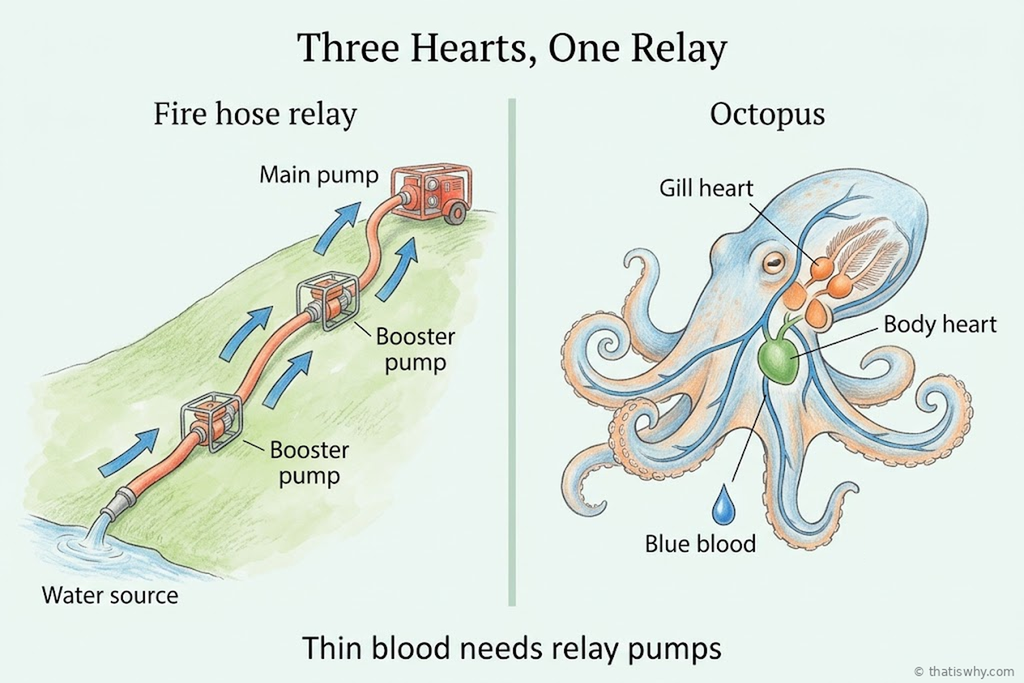
Fire crews know a stubborn truth about hoses: the longer the line, the weaker the spray. Water rubs against the walls and loses its push, so one pump at the bottom of the hill can't throw a strong stream to the top. The fix is a relay, with a second pump set partway along the line to give the water a fresh shove before the next long stretch.
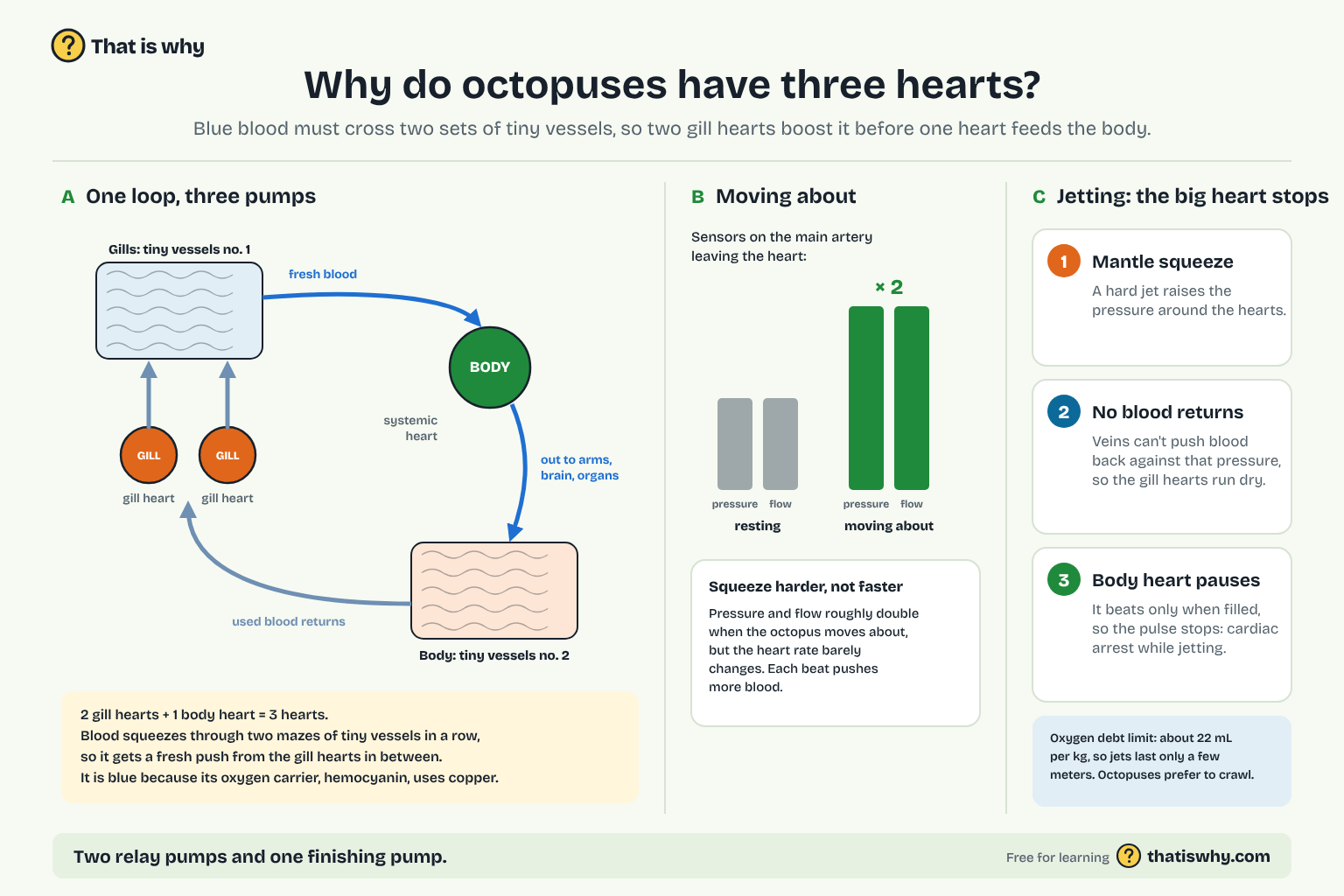
Now follow an octopus's blood on its trip around the body. Spent blood comes back from the arms and head and reaches two **gill hearts**, one beside each gill, and these are the relay pumps. They shove the blood through the gills, where it picks up oxygen. From there it flows into the **systemic heart**, the big pump at the end of the line, which fires the fresh blood out to the arms, the brain and every other organ.
Why does blood need a booster at the gills? Because the gills are packed with hairlike vessels called **capillaries**, and so is the rest of the body. The blood must wriggle through two mazes of them in a row instead of just one, and every maze eats some of its pressure.
A real relay needs a crew to run its pumps, but the gill hearts need no one. Back in 1980, the octopus researcher Martin Wells cut the nerves running to the hearts, and the two gill hearts kept beating in step anyway. They carry their own rhythm, like living muscle that never forgot the beat.
Two booster pumps and one main pump: an octopus moves its blood the way fire crews relay water up a long hill.
## Blue Blood, Hard-Working Hearts
The hose is only half of the story, because the other half is what flows through it. Our blood is red because it carries oxygen on an iron-based protein called **hemoglobin**. An octopus uses **hemocyanin**, a copper-rich protein that turns its blood blue.
Here is the scene that made researchers sit up. In a 1987 study, Wells and his colleagues fitted common octopuses (*Octopus vulgaris*) with sensors on the main artery leaving the heart, then let the animals move about freely. Blood pressure and flow roughly doubled, yet the heart rate barely changed, and it may even have slipped a little.
So where did the extra blood come from? The tissues had little room to squeeze more oxygen out of each drop, and the heart did not race. It simply squeezed harder, pushing more blood out with every single beat.
It's like a fire crew cranking the pumps up instead of adding more of them. The relay line stays the same, but every stroke moves more water to the spray, which is a wonderfully economical way to meet a sudden demand.
Two gill hearts push blue blood through the gills, then the body heart sends it around the body, and it pauses when a hard jet squeezes the mantle. Free full-size diagram and printable PDF.
## The Day the Big Heart Clocks Out
Now return to the escape. An octopus jets by clenching its mantle, the muscular cloak wrapped around its organs, and blasting water out behind it. The gills and the hearts sit inside that same cloak, so every hard squeeze raises the pressure around them.
In the hose, that squeeze is a kink. Watch the sensors during a powerful jet and the pulse in the main artery vanishes. The veins simply can't push blood back against the pressure rise inside the mantle, so the gill hearts run short of blood to push.
And here is the twist: the systemic heart contracts only when it has been filled. With nothing arriving from the gills, it waits. At the moment of maximum panic, the main pump goes quiet, and only when the jetting ends does the pulse come back. The researchers called it cardiac arrest, though crawling doesn't trigger it.
The bill for that sprint comes due fast. An octopus can run up an oxygen debt of only about 22 milliliters per kilogram of body weight, and the team judged jet-powered travel impossible beyond a few meters. Smithsonian Magazine adds that this helps explain why octopuses prefer to crawl, and why a jet is saved for emergencies.
## Why Extra Pumps Beat One Big Heart
Zoom out and the rule behind it is simple arithmetic. The oxygen reaching a muscle each minute equals the oxygen in every drop multiplied by the number of drops that arrive. Nature can raise either number, but it rarely raises both for free.
Our bodies lean on iron-rich blood and a single heart. The octopus leans on a copper-based protein and extra pumping power. Neither design is better in every setting; each one is a different answer to the same question of how to keep oxygen flowing.
Hemocyanin does have its own advantages. Smithsonian Magazine notes that this bigger protein transports oxygen efficiently in the cold, low-oxygen places many octopuses call home. That trade-off hints at why a family of soft, boneless animals ended up with such an unusual circuit.
## Blue Blood in Antarctic Water
Cold water holds plenty of oxygen, but in polar seas the oxygen binds so tightly to hemocyanin that it doesn't let go easily. National Geographic reported on a researcher who studied an Antarctic octopus, *Pareledone charcoti*, and found it carried 40 percent more hemocyanin in its blood than two warm-water octopus species. More blue protein means more oxygen can move even when each molecule lets go grudgingly.
It is another case of an animal solving the oxygen puzzle in its own way. Some Antarctic fish went to the opposite extreme and [dropped red blood altogether](https://thatiswhy.com/why-some-antarctic-fish-have-clear-blood/), while the octopus doubled down on its blue cargo.
These oddities fit a larger pattern in the sea, where the rules of breathing, pressure and temperature differ so sharply from the land that evolution keeps inventing new answers. If you want the wider tour, our guide to [why the ocean is an alien world](https://thatiswhy.com/why-ocean-is-alien-world/) is a good place to start. And the octopus's oddness doesn't stop at its plumbing: more than half of its neurons sit in its arms, which is [why octopuses are so smart](https://thatiswhy.com/why-are-octopuses-so-smart/).
## Three Hearts, Three Misunderstandings
**Myth: The third heart is a spare, in case one fails.**
**The truth:** Each heart has its own job. Two push blood through the gills, and the third sends it out to the body.
**Myth: An octopus heart stops whenever the animal moves.**
**The truth:** Moving about actually roughly doubled blood pressure and flow in the experiments. The pause came with powerful jets, when the squeezing mantle blocks blood from returning.
**Myth: Blue blood comes from some kind of dye.**
**The truth:** The color comes from copper in hemocyanin, the protein that carries the oxygen.
## The Octopus That Chose to Crawl
Return to that frightened animal and its sudden jet. The pause in its heartbeat is not a flaw, but the price of a design that works beautifully for slow, steady life: crawling over rock and feeling its way along with eight arms.
Two small relay pumps and one big finishing pump keep blue blood moving through two mazes of vessels without ever needing a heart the size of ours. Octopuses belong to a family of oddballs that also includes [cuttlefish that play moving images on their skin](https://thatiswhy.com/why-cuttlefish-dont-just-change-color/), and their circulation is just as inventive. This is the part that still surprises us: the trick was never one super heart, but a team passing the work along.
## Sources
- [Blood Flow and Pressure Changes in Exercising Octopuses (Octopus vulgaris) (Wells et al., Journal of Experimental Biology, 1987)](https://journals.biologists.com/jeb/article-abstract/131/1/175/5279/Blood-Flow-and-Pressure-Changes-in-Exercising), The Company of Biologists, Journal of Experimental Biology
- [Nervous control of the heartbeat in octopus (Wells, Journal of Experimental Biology, 1980)](https://cob.silverchair.com/jeb/article/85/1/111/22767/Nervous-control-of-the-heartbeat-in-octopus), The Company of Biologists, Journal of Experimental Biology
- [Ten Wild Facts About Octopuses: They Have Three Hearts, Big Brains and Blue Blood](https://www.smithsonianmag.com/science-nature/ten-wild-facts-about-octopuses-they-have-three-hearts-big-brains-and-blue-blood-7625828/), Smithsonian Magazine
- [Octopus Blood Is Blue, and It Helps Them Survive the Cold](https://www.nationalgeographic.com/animals/article/150312-blood-antarctica-octopus-animals-science-colors), National Geographic