# Why Maple Seeds Spin Like Helicopters
> Why do maple seeds spin?
- Source: https://thatiswhy.com/why-maple-seeds-spin-like-helicopters/
- Category: Plants & Forests
- Topics: Trees and plants > Plant tricks; Trees and plants; Nature as engineer
- Library shelf: The canopy, Plants, insects & land life (a theme shelf, not a habitat)
- Summary: A maple seed's one-sided wing spins like a helicopter rotor as it falls. The spin makes lift that slows the drop, giving the wind time to carry the seed away.
- Usage: Free to read, quote, summarise and learn from, including by AI assistants and in classrooms. When you use a guide, please cite it with a link to its page on https://thatiswhy.com.
A gust rattles an old maple, and the air fills with tiny green-brown blades. They don't simply drop: each one flips, wobbles, and then snaps into a blur, whirling down like a toy you'd pay money for. **Maple seeds spin because each one is a single wing with a heavy seed at one end, and falling air pushes that wing around like a helicopter blade. The spinning wing makes lift, boosted by a tiny tornado of air riding its front edge, which slows the fall and gives the wind time to carry the seed away from its tree.**
So the tree is launching aircraft. Strangely, the best way to understand them is to look at a helicopter at its very worst moment.
## A Helicopter With Its Engine Switched Off
A helicopter is cruising high over farmland when its engine quits. It sounds like the start of a disaster movie, but there's a built-in way out. A gadget called the *freewheeling unit* unhooks the dead engine from the main rotor, so the blades keep turning freely.
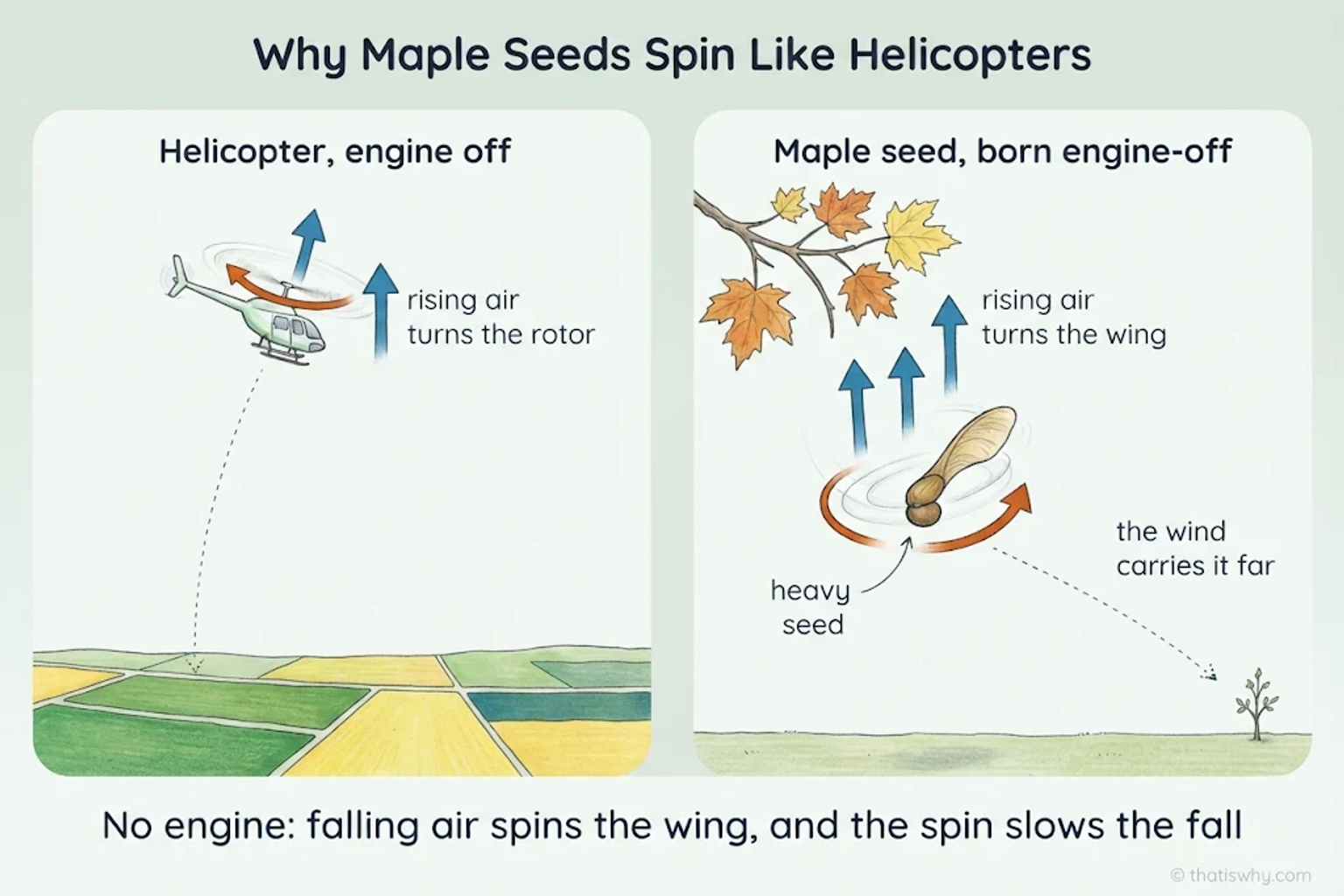
The helicopter starts to sink, and as it sinks, air rushes up through the rotor and keeps the blades spinning. The Federal Aviation Administration calls this maneuver **autorotation**: the engine is unhooked, and the blades are turned only by air flowing up through the rotor.
No engine, and the rotor still turns. That spinning rotor fights the fall, and the pilot uses the energy stored in the whirling blades to set the helicopter down softly in a field.
Now look back at the maple. Its seed is that helicopter, except it was born without an engine at all. The only thing that will ever turn its wing is the air rushing past as it falls, and that's all it needs.
The helicopter and the seed want opposite endings, though. A pilot in autorotation is hunting for one safe patch of ground, as close and as calm as possible. The maple seed wants the reverse: to stay up as long as it can, drift as far as it can, and land somewhere its parent isn't. Its whole design is a long, slow emergency landing that it hopes takes forever.
A helicopter with its engine off is spun by the air rushing up through its rotor. A maple seed is born that way, and it wants the slowest fall it can get.
## How Maple Seeds Spin Like Helicopters
Pick up one of those blades and you're holding a **samara**, a dry fruit with a papery wing attached. Maples grow them in pairs, but in sugar maples usually only one of the pair actually holds a seed. The seed itself is a fat little bump about 7 to 9 millimeters long, and the thin wing stretches out beyond it like a dragonfly's.
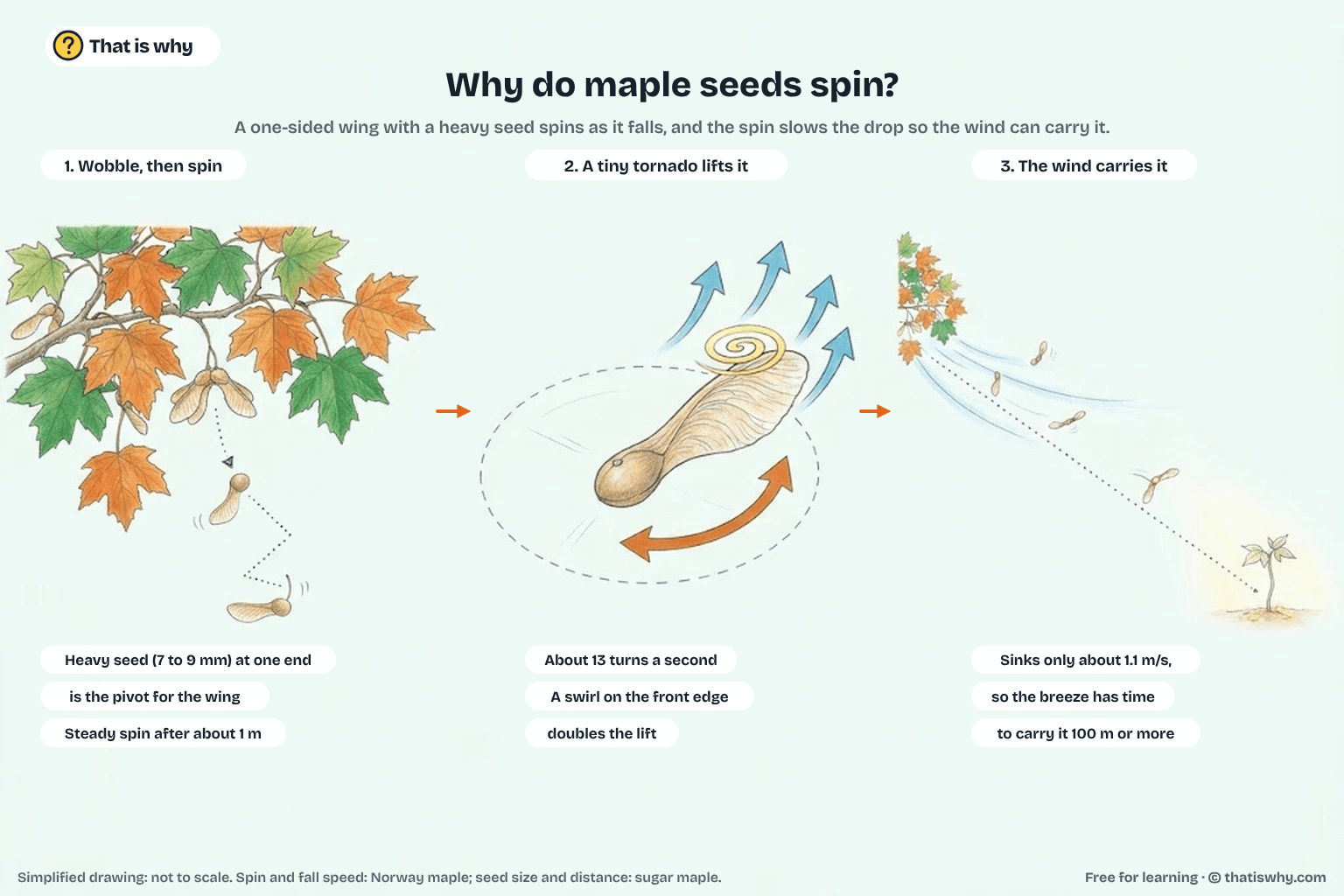
The trick starts with where the weight sits. Researchers at Virginia Tech measured Norway maple samaras and found the balance point between 24% and 30% of the way along, measured from the heavy seed end. That lopsided build gives the wing a natural pivot, right next to the seed. Let one go and it doesn't settle straight away: for roughly the first meter it wobbles through a messy transition. Then the whole thing locks into a steady spin, the long wing sweeping in circles around its heavy end.
Once it's spinning, it really goes. In still air, natural Norway maple seeds turned at about 13 revolutions every second, while sinking at just 1.1 meters per second. Do the math for a ten-meter drop, and that's more than a hundred turns before it touches the grass.
### The Tornado on the Front Edge
Spinning alone didn't explain the whole story, though. Exactly how maple seeds manage to fall so slowly had mystified scientists.
The answer came from a team at Wageningen University in the Netherlands and Caltech, led by David Lentink and Michael Dickinson. To see the air swirling around a seed, they built giant plastic ones, 5 to 10 times bigger than the real thing. Then they had a robot, adapted from a machine nicknamed "Robofly" that had helped work out the forces keeping insects aloft, spin the fake seeds through a big tank of mineral oil. A laser sheet lit up tiny glass beads floating in the oil, and a camera tracked every swirl.
What the pictures showed was wonderful. Sitting on top of the wing's front edge was a tiny, tornado-like whirl of fluid, now called a **leading-edge vortex**. That little tornado lowers the air pressure over the top of the wing, so the wing gets sucked upward, against gravity. The result is jaw-dropping: the vortex doubles the lift the seed makes compared with seeds without that swirl.
To check the oil-tank results against nature, the team built a wind tunnel, let 32 real maple seeds spin freely inside it, and used smoke to make the air visible. The same tornado showed up, riding the front edge of real wings and giving them exceptionally high lift.
A wobbly start, a steady spin with a tiny tornado on the front edge, then a long ride on the wind. See the detailed teaching diagram and printable PDF.
## Every Second in the Air Is Distance
Step back from the wing, and a simple rule falls out of all this. A tree can't walk its children anywhere. Whatever travel a seed gets, it gets during the fall, so the longer that fall lasts, the farther the wind can push it sideways. This is **seed dispersal**, the business of moving seeds away from the parent, and for a maple, every extra second of hang time is free distance.
That's why the spin is worth so much. A seed that plummets lands in the shadow of its own trunk. A seed that whirls down slowly hangs in the air like a kite without a string, and every breeze that passes nudges it a little farther. The U.S. Forest Service reports that sugar maple's large papery wings let a samara be carried at least 100 meters by the wind.
The drop tests back this up in a satisfying way. When the Virginia Tech team let natural and 3D-printed maple seeds fall in the wind outdoors, the five flights that traveled farthest were all made by real seeds. Nature's own version still beat a careful copy.
This is the part we find quietly wonderful. The maple isn't throwing its seeds hard or far. It's teaching them to take the slowest possible way down.
## The Same Tornado on a Hummingbird's Wing
Here's the twist that makes the maple story bigger than one tree. That tornado on the front edge isn't a plant invention. Insects, bats and hummingbirds use the very same leading-edge vortex when they sweep their wings back and forth to hover. Plants and animals hit on an identical aerodynamic solution by completely separate routes, a classic case of **convergent evolution**.
Engineers have noticed the trick, too. Space agencies have designed swirling parachutes to slow probes falling through the atmospheres of other planets, such as Mars, and maple seed flight might help shape them. A company even tried to build cheap spy cameras shaped like maple seeds. Copying nature's designs like this is called **biomimicry**, and it runs right through our guide to [why nature is the ultimate engineer](https://thatiswhy.com/why-nature-is-the-ultimate-engineer/).
Other plants solve the same travel problem with completely different tools. The sandbox tree skips flying altogether and [turns seed dispersal into an explosion](https://thatiswhy.com/why-sandbox-tree-turns-seed-dispersal-into-an-explosion/), blasting its seeds out of a bursting pod. Owls show off a different wing trick: [owls fly silently](https://thatiswhy.com/why-owls-fly-silently/) because a comb of tiny bristles on the front edge of each wing breaks up the rushing air. For the bigger picture of how trees handle wind, water and winter, see [how trees engineer their way to survival](https://thatiswhy.com/how-trees-engineer-their-way-to-survival/).
## Myths That Fall Flat
**Myth: The wind is what makes maple seeds spin.**
**The truth:** They spin even in perfectly still air. The air rushing past a falling seed is enough to turn its wing, the same way it turns a helicopter rotor during autorotation.
**Myth: A maple seed is basically a tiny parachute.**
**The truth:** A parachute mostly works by dragging, while a spinning maple wing makes real lift, and the leading-edge vortex on its front edge doubles that lift compared with seeds without that swirl.
**Myth: Every maple "helicopter" carries two seeds.**
**The truth:** Maple fruits grow in pairs, but in sugar maples usually only one half of the pair is filled with a seed. The other half is often just an empty wing.
## Back Under the Old Maple
Go back to that gust and the blizzard of whirling blades. Every one of them is a helicopter with its engine off, sinking on purpose and spinning because it falls. A heavy seed gives it a pivot, the air turns its wing, and a tornado the size of a fingernail clings to the front edge, pulling it upward.
The sugar maple even times the launch well: its samaras usually start falling just before the leaves do, ahead of the color show that explains [why leaves change color in the fall](https://thatiswhy.com/why-leaves-change-color-in-fall/). **The maple can't throw, can't walk and can't steer, so it builds seeds that fall as slowly as possible.** Then it simply lets go, and hands the rest of the journey to the wind.
## Sources
- [Maple Seeds and Animals Exploit the Same Trick to Fly](https://www.caltech.edu/news/maple-seeds-and-animals-exploit-same-trick-fly-1540), California Institute of Technology (Caltech)
- [Leading-edge vortices elevate lift of autorotating plant seeds (Lentink, Dickson, van Leeuwen and Dickinson, Science 2009)](https://research.rug.nl/en/publications/leading-edge-vortices-elevate-lift-of-autorotating-plant-seeds/), University of Groningen research portal
- [Wind dispersal of natural and biomimetic maple samaras (Nave et al., 2020)](https://arxiv.org/pdf/2010.12553), arXiv (Virginia Tech)
- [Sugar Maple (Silvics of North America)](https://research.fs.usda.gov/silvics/sugar-maple), USDA Forest Service
- [Helicopter Flying Handbook, Chapter 11: Helicopter Emergencies and Hazards](https://www.faa.gov/sites/faa.gov/files/regulations_policies/handbooks_manuals/aviation/helicopter_flying_handbook/hfh_ch11.pdf), Federal Aviation Administration