# Why Leaves Change Color in the Fall (and Why Some Turn Red)
> Why do leaves change color in the fall?
- Source: https://thatiswhy.com/why-leaves-change-color-in-fall/
- Category: Plants & Forests
- Topics: Trees and plants
- Library shelf: The canopy, Plants, insects & land life (a theme shelf, not a habitat)
- Summary: Trees break down green chlorophyll to save its nutrients before winter. Yellows hidden all summer show through, and many trees make new red as a sunscreen.
- Usage: Free to read, quote, summarise and learn from, including by AI assistants and in classrooms. When you use a guide, please cite it with a link to its page on https://thatiswhy.com.
On a hillside in central Massachusetts, a maple leaf has only a few weeks left on the branch. It's winding down, and soon it will let go for good. So why is this doomed leaf suddenly busy making a red pigment it never bothered with all summer? **Leaves change color in the fall because trees break down their green chlorophyll to save its nutrients before dropping the leaves for winter. The yellows and oranges were hidden under the green all along. The reds are new pigments that many trees make in autumn, most likely as a sunscreen that protects that salvage job.**
That's a lot of effort for something headed for the leaf pile. To see why it pays, start with a little house getting ready for winter.
## Taking Down the Green Curtains
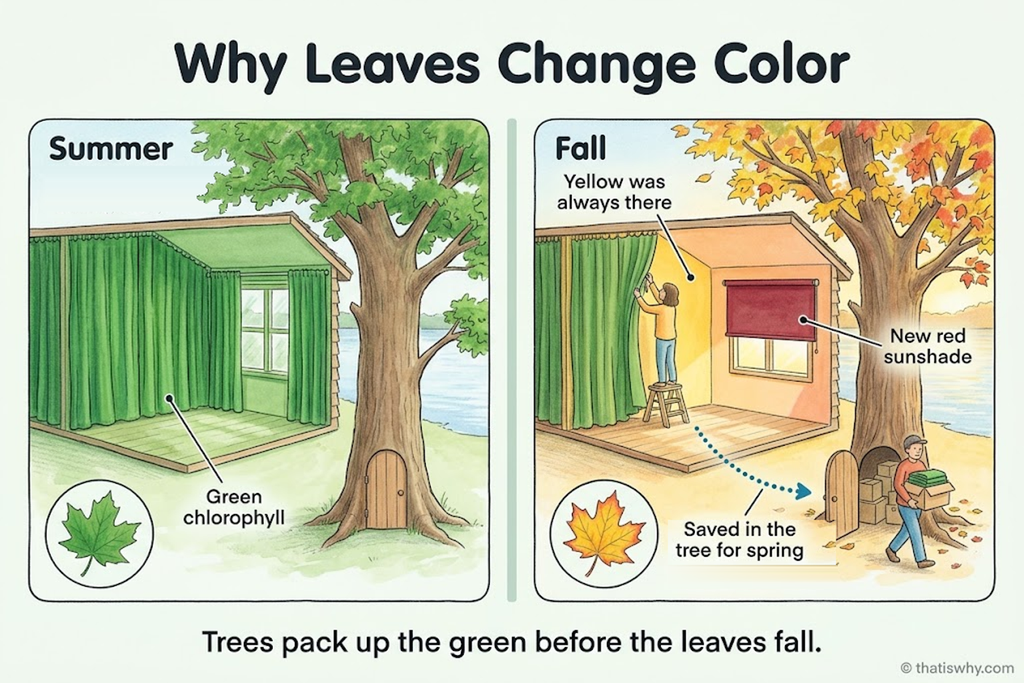
A summer cottage by a lake, the last warm week of the year. All season, heavy green curtains have hung over every wall, so thick you'd swear the whole place was built green. Now the owners are closing up. They unhook the curtains, fold the good fabric into boxes, and carry it off to store for spring.
And there, behind where the curtains hung, the walls are painted sunny yellow and orange. Nobody painted them this morning. That color was there all summer, simply covered up.
That's your leaf in October. The green curtain is **chlorophyll**, the pigment that catches sunlight for *photosynthesis*, the process that turns light, water and carbon dioxide into sugar. The yellow walls are **carotenoids**, yellow and orange pigments that sit in the leaf all year. And the packing is the real reason for autumn: the green is too valuable to leave behind.
At some cottages, the owners do one more thing while they pack. They pull down a bright red blind, so the low, glaring sun can't bake the rooms while the boxes are still being filled. That red blind is brand new, and it's the part of the story scientists still argue about.
Of course, a tree can't fold its chlorophyll neatly and carry it away. It chops the molecules into colorless pieces, ships the useful parts back into the branches, and lets the green itself simply vanish.
A tree in the fall is like a cottage closing for winter: the green comes down and is saved, the yellow was there all along, and a new red blind keeps out the glare.
## What a Leaf Packs Before It Lets Go
The countdown is set by the calendar. Britannica explains that the change is usually triggered by the shrinking days and falling temperatures of autumn. For a broad, thin leaf, a freezing winter is a losing deal, so broadleaf trees drop their leaves in a controlled way to avoid injury and save energy. And the very first thing to go, well before the leaf falls, is the green.
This is where the yellow pulls its quiet trick. A team of autumn-color experts, writing in *Trends in Ecology and Evolution*, put it plainly: carotenoids are present in leaves all year round, masked by the green of chlorophyll. As the chlorophyll is broken into colorless pieces, the curtain thins, and the gold that was always there finally gets its moment. The leaf doesn't make anything new for the yellow. It just stops hiding it. Flamingos can't make these pigments at all; they have to eat them, and that's [why flamingos are pink](https://thatiswhy.com/why-are-flamingos-pink/).
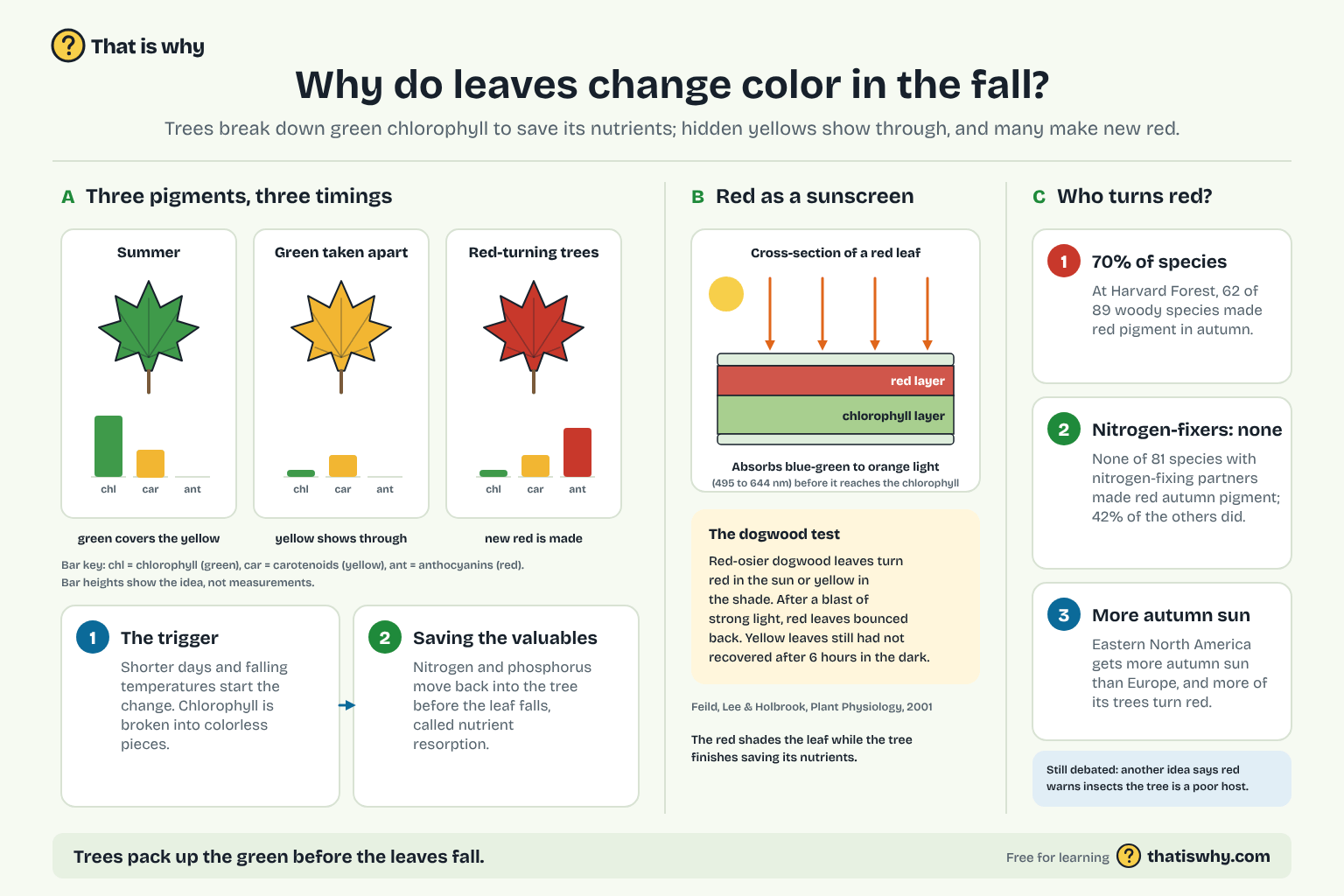
The red is a completely different story. At Harvard Forest, in central Massachusetts, botanist David Lee and his colleagues sliced open the changing leaves of 89 kinds of woody plants. In the red-turning leaves they followed closely, summer leaves had no detectable red pigments, called **anthocyanins**, at all. Then, midway through each leaf's decline, 62 of those species started making anthocyanins from scratch.
That's 70% of the woody species they examined. Seven out of ten were spending their leaves' final weeks building something brand new, like hanging fresh blinds in a house you're about to leave.
Why would a dying leaf bother? A study in *Plant Physiology* from the same circle of researchers looked at red-osier dogwood, a shrub whose leaves turn either red or yellow. The red pigment, they found, forms a layer just under the leaf's upper surface, where it soaks up light before that light can reach the chlorophyll below. Then came the stress test: a blast of strong light. The red leaves bounced back, but the yellow ones still hadn't recovered after 6 hours in the dark, a sign of real light damage.
So that's the red blind. Bright autumn sun on a cold day can scorch a leaf that's half taken apart. The red shade keeps the glare off while the tree hauls the valuables home.
Trees take apart their green to save its nutrients, hidden yellows show through, and many make new red as a sunscreen. Free full-size diagram and printable PDF.
## The Trees That Never Turn Red
What could be so precious that a tree builds sunscreen to guard it? Mostly nitrogen, along with phosphorus. A leaf that keeps working while it's dismantled can pull more of these nutrients back into the tree, a process botanists call **nutrient resorption**. Whatever stays in the leaf when it falls is lost to the forest floor.
Now comes the cleverest test of the whole idea. Some plants team up with microbes that pull nitrogen straight out of the air, so for them nitrogen is cheap. Botanists Susanne Renner and Constantin Zohner compared nitrogen supply with red autumn leaves across more than a hundred species. Not one of the nitrogen-fixing species made red autumn pigment, while 42% of the other species did.
That fits the sunscreen idea beautifully: if nitrogen isn't scarce, there's no treasure worth shading, and the red blind stays in the box.
Their analysis turned up a second clue. At the same latitude, trees in eastern North America soak up more autumn sunshine than their European relatives. Eastern North America also has a higher share of leaf-dropping species that make red pigment than European forests do. More sun means more glare, and more glare means more reason to pull the blind.
The case isn't closed, though, and the scientists say so. In the Harvard Forest study, how much nitrogen a leaf recovered didn't track how much red it made. Another idea says red is a warning to insects that a tree is a poor host. Scientists call the sunscreen idea photoprotection, and the experts' review sums it up neatly: "The photoprotection hypothesis is controversial but still tenable."
Underneath all that debate sits one rule every tree agrees on. **Save the expensive parts first, then let the cheap shell go.**
## Same Problem, Different Houses
Not every tree takes its curtains down. Evergreens keep theirs up through the snow, which is only possible because of [why some trees have needles instead of leaves](https://thatiswhy.com/why-some-trees-have-needles/): a narrow, waxy leaf that can survive the cold and dry air of winter. It's a different bargain, the same problem.
The salvage also pays off months later. The nutrients a maple hauls home in October wait inside the tree, and in spring the tree comes roaring back to life, with [sugary sap rushing up the trunk to wake the branches](https://thatiswhy.com/why-trees-produce-sap/). Even the shape of the leaf being packed away is a piece of careful design, as [the reasons leaves come in so many shapes](https://thatiswhy.com/why-do-leaves-have-different-shapes/) show. Sugar maples also launch their winged seeds around this time, usually just before the leaves fall, and [maple seeds spin like helicopters](https://thatiswhy.com/why-maple-seeds-spin-like-helicopters/) so the wind can carry them away.
And a red pigment doesn't always mean "sunscreen." In the deep ocean, red works as an invisibility cloak, because there's no red light down there to reflect, which is [why so many deep-sea fish are red](https://thatiswhy.com/why-deep-sea-fish-are-red/). Same color, completely different job. On land, a poinsettia uses the same red family of pigments as a shop sign, dyeing its top leaves after long nights, which is [why poinsettias turn red at Christmas](https://thatiswhy.com/why-do-poinsettias-turn-red/). Fall color is one small chapter in the bigger story of [how trees engineer their way through every season](https://thatiswhy.com/how-trees-engineer-their-way-to-survival/).
## Fall Color Myths That Should Drop With the Leaves
**Myth: Trees paint their leaves yellow in the fall.**
**The truth:** The yellow and orange carotenoids were in the leaf all summer. Autumn only removes the green that was covering them.
**Myth: Red leaves are just leaves rotting.**
**The truth:** Anthocyanins are made fresh, midway through the leaf's decline. A red leaf is a dying leaf that's still hard at work.
**Myth: Any tree would turn red in the right weather.**
**The truth:** It depends on the tree. In one survey, none of the species with nitrogen-fixing partners made red autumn pigment, while 42% of the others did.
## The Last Job of a Leaf
Back on that Massachusetts hillside, the maple leaf is no longer a mystery. Its green curtains are being taken down and packed away, molecule by molecule. The gold walls behind them are finally showing. And the red blind is down against the low October sun, so the packing can finish before the frost.
This is the part that still surprises us. The most famous colors of the year aren't a sign of the forest giving up. They're the visible trace of trees carefully moving out for winter, making sure they leave nothing valuable behind.
## Sources
- [Pigment dynamics and autumn leaf senescence in a New England deciduous forest, eastern USA (Lee, O'Keefe, Holbrook & Feild, Ecological Research 2003)](https://harvardforest1.fas.harvard.edu/publications/pdfs/Lee_EcologicalResearch_2003.pdf), Harvard Forest, Harvard University
- [Why leaves turn red in autumn. The role of anthocyanins in senescing leaves of red-osier dogwood (Feild, Lee & Holbrook, Plant Physiology 2001)](https://pmc.ncbi.nlm.nih.gov/articles/PMC125091), Plant Physiology (via PubMed Central)
- [Unravelling the evolution of autumn colours: an interdisciplinary approach (Archetti et al., Trends in Ecology and Evolution 2009)](https://research.fs.usda.gov/download/treesearch/56547.pdf), USDA Forest Service Research
- [Trees growing in Eastern North America experience higher autumn solar irradiation than their European relatives, but is nitrogen limitation another factor explaining anthocyanin-red autumn leaves? (Renner & Zohner, Journal of Evolutionary Biology 2022)](https://profiles.wustl.edu/en/publications/trees-growing-in-eastern-north-america-experience-higher-autumn-s/), Washington University in St. Louis
- [Why Do Leaves Change Colors in the Fall?](https://britannica.com/story/why-do-leaves-change-colors-in-the-fall), Encyclopaedia Britannica