# Why Hoverflies Look Like Wasps (But Can't Sting)
> Why do hoverflies look like wasps?
- Source: https://thatiswhy.com/why-hoverflies-look-like-wasps/
- Category: Animals
- Topics: Deception
- Library shelf: The forest floor, Animal behavior & evolution (a theme shelf, not a habitat)
- Summary: Hoverflies are harmless flies wearing a wasp's yellow-and-black warning colors, so predators that have learned to fear stings leave them alone.
- Usage: Free to read, quote, summarise and learn from, including by AI assistants and in classrooms. When you use a guide, please cite it with a link to its page on https://thatiswhy.com.
A yellow-and-black insect hangs dead still in the air above your lemonade, wings a blur, and you freeze mid-sip. Then it darts sideways, stops again, and stares you down. **Hoverflies look like wasps because it keeps them alive. They're harmless flies with no sting at all, but they wear the wasp's yellow-and-black warning colors, so predators that have learned to fear a sting leave them alone too.**
You flinched, and so does a hungry bird. That flinch is the whole trick. To see why it works, and why some hoverflies pull it off far better than others, head to a summer festival.
## The Guard Who Can't Throw Anyone Out
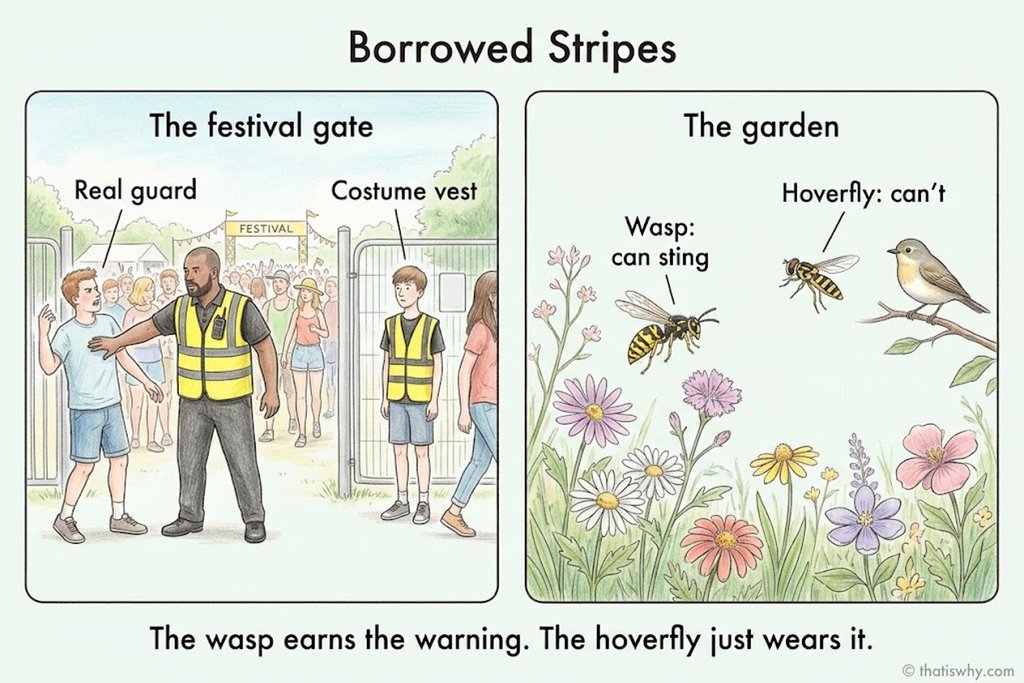
The gates open at noon, and the security team is already out in force. Every guard wears the same bright yellow vest with bold black lettering. By mid-afternoon, the rowdy crowd has learned exactly what that vest means. Push your luck with someone wearing it, and you're walked out the gate, wristband cut, night over.
Now look at the quiet side entrance. A skinny teenager stands there in a yellow-and-black vest from a costume shop. He has no radio, no authority and no idea what he'd do if anyone tested him, but nobody ever does. Everyone who has met a real guard today takes one glance at that vest and keeps walking.
**A hoverfly is that teenager.** The common wasp is the real guard, and its stripes are a promise backed by a painful sting. Birds that have been stung remember the uniform, and a hoverfly simply borrows it. There's one big difference between the festival and the garden, though. The teenager chose his costume that morning. No hoverfly ever chose anything. Its vest was stitched over countless generations by the predators themselves, every time they ate the flies whose costumes didn't fool them.
A hoverfly is like a teenager in a costume security vest: the wasp earns the warning, and the hoverfly just wears it.
## Testing the Costume on Birds and Spiders
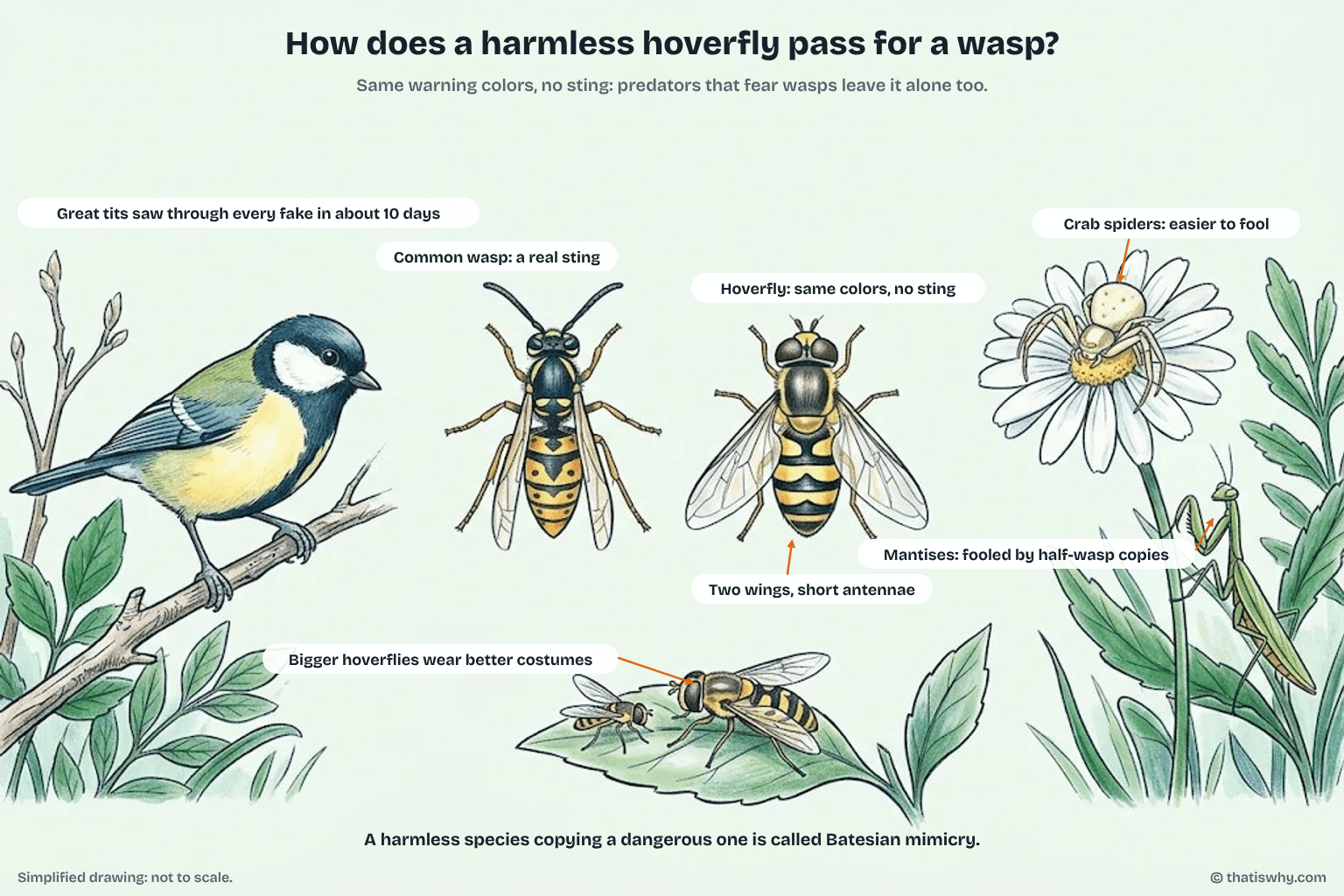
Under the stripes, a hoverfly is a true fly through and through. A bee carries four wings, while a fly gets by with two, and a hoverfly has nothing to sting with. As entomologist Jason Dombroskie of Cornell University's Insect Collection told the magazine *Northern Woodlands*, "They will act like they can."
So everything hangs on the costume, and here's the puzzle that has nagged biologists for decades. Some hoverflies are near-perfect wasp copies. Others look like a wasp drawn from memory by someone who saw one once. If the vest is what keeps them alive, why would anyone show up in a sloppy one?
### A Mealworm Under Every Fake
A team at the University of Nottingham, led by Christopher Taylor and Tom Reader, decided to test the costumes properly. They scanned real insects and 3D-printed life-size models, then blended a hoverfly step by step into a common wasp. A model could be a quarter wasp, half wasp or three-quarters wasp, like a costume caught halfway through the sewing.
Then they set up feeding stations in Madingley Wood, near Cambridge, for wild great tits. Each station held rows of small dishes with a model insect fixed to every lid. Lift a lid with a fly on it, and there was a mealworm inside. Lift a wasp lid, and the dish was empty.
And the birds were brilliant at it, almost annoyingly so. After around 10 days, they told every single mimic apart from the wasp, even the most convincing one. The researchers summed it up plainly: "Our birds could detect and remember very subtle differences between mimic and model appearance." A second test with young chicks showed what birds watch hardest: color and size matter more to them than pattern or shape.
### Spiders Grade on a Curve
Then the team ran the same game for different predators, and the story flipped. Crab spiders and praying mantises were far easier to fool. For crab spiders, the results were less clear-cut, but the trend suggested that any model at least half wasp got about as much protection as the real thing. Mantises showed a sharp jump in caution between the quarter-wasp and the half-wasp models.
That changes how you see a sloppy hoverfly. A cheap costume that would never fool a sharp-eyed bird can still save your life from a spider lying in wait. As the team concluded, "the predator community is key to explaining the apparent inaccuracy of many mimics."
### Bigger Flies Need Better Costumes
Body size turns out to matter too. Researchers at Carleton University in Canada, led by Tom Sherratt with Heather Penney, compared a wide range of hoverfly species with the wasps and bees they imitate, and found a strong pattern. The bigger the hoverfly, the better its disguise. A big, juicy fly is worth a hungry bird's second look, so only a sharp costume survives that stare. A tiny fly is barely a snack, and predators rarely bother to check it closely.
### Flies That Fake a Sting
The very best impostors don't stop at the costume, either. In a follow-up study, the Carleton team caught 359 hoverflies in Ontario and Quebec and gave each one a fright. A stuffed blue jay head was poked at the fly up to five times, and if nothing happened, a researcher lightly grasped it between finger and thumb.
Out of 57 species, only six put on a show, and all six were large wasp mimics. They wagged their wings the way wasps do. They jabbed the tip of their abdomen at the jay's beak, bluffing a bird in the face with a weapon they don't own. Most of them also waved their front legs in front of their heads, which biologists think imitates the long antennae of a real wasp. That's the festival teenager tapping a radio that isn't switched on, and somehow it works.
Same warning colors, no sting: who gets fooled depends on who is watching. See the detailed teaching diagram and printable PDF.
## Honest Warnings Attract Freeloaders
Step back, and a bigger rule comes into view. A wasp's stripes are **warning coloration**, bold colors that tell predators "I'll hurt you." That warning only works because predators learn it. Once a bird has learned it, the lesson belongs to anyone wearing the same colors.
The 19th-century English naturalist Henry Walter Bates was the first to describe this kind of freeloading, and it now carries his name: **Batesian mimicry**. A harmless species copies a dangerous one, and predators mistake it for the real thing and leave it alone. The hoverfly never pays for a sting or venom; it only pays for paint.
Those sloppy costumes reveal something just as deep. Evolution doesn't build perfect things; it builds things that are good enough for the job. Where predators look closely, selection sharpens the disguise. Where they don't, there's **relaxed selection**, meaning little pressure to improve, and rough copies get through. This is the part that still delights us. A hoverfly's costume is really a portrait of the predators it meets, drawn by their eyes.
## Costumes All Over the Living World
Once you notice borrowed uniforms, you find them everywhere. The [chameleon vine reshapes its leaves to match the plants around it](https://thatiswhy.com/why-chameleon-vine-is-only-plant-that-can-see/), a botanical version of the same harmless copy. Birds are the critics that keep raising the bar for hoverflies, and that fits with [how sharply crows remember a single human face](https://thatiswhy.com/why-crows-remember-faces-and-hold-grudges/). A predator with a good memory is a tough audience. A grabbed opossum goes further and borrows the look and smell of a corpse, which is [why opossums play dead](https://thatiswhy.com/why-do-opossums-play-dead/).
Some animals turn the trick around and wear a costume to hunt rather than hide. The [orchid mantis disguises itself as a flower](https://thatiswhy.com/why-orchid-mantis-out-blooms-nature/) so pollinators fly straight into its arms. The [femme fatale firefly fakes another species' love signal](https://thatiswhy.com/why-femme-fatale-firefly-is-natures-spy/) to lure males in for dinner. Plants play costume games too, which is [why bee orchids look like bees](https://thatiswhy.com/why-bee-orchids-look-like-bees/) and fool male bees into carrying their pollen. Each one is a different chapter in [why evolution rewards a good liar](https://thatiswhy.com/why-evolution-favors-liar-science-of-deception/).
## Do Hoverflies Sting? Myths of the Striped Impostor
**Myth: Hoverflies can sting if you bother them.**
**The truth:** They have no sting at all. Some large wasp mimics will jab their abdomen at an attacker, but it's pure theater.
**Myth: A poor mimic is a failed mimic.**
**The truth:** It all depends on who's watching. In the 3D-printed insect tests, mantises, and probably crab spiders too, were fooled by models only halfway to a wasp.
**Myth: Birds can't tell hoverflies from wasps.**
**The truth:** Wild great tits learned to tell every model mimic from the wasp, even the best one, within around 10 days.
**Myth: Hoverflies buzz like wasps to complete the act.**
**The truth:** The idea is popular, but the Carleton team called the evidence for sound mimicry "weak at best."
## Back Above the Lemonade
The striped stranger is still hanging over your glass, wings a blur. Now you know what you're looking at: a fly in a borrowed vest, protected by every sting some other insect delivered before it. Its costume might be flawless or a bit slapdash, depending on who has been hunting its ancestors.
It works for the same reason the teenager at the side gate works. Most of the crowd has already met the real guards, and nobody wants to test the vest. For a hoverfly, a lie it doesn't even know it's telling is the best protection it has.
## Sources
- [Mapping the adaptive landscape of Batesian mimicry using 3D-printed stimuli (Taylor et al., Nature 2025)](https://ecology.nottingham.ac.uk/tomreader//assets/pdf/Taylor%20et%20al%202025.pdf), University of Nottingham
- [A comparative analysis of the evolution of imperfect mimicry (Penney et al., Nature 2012)](https://dx.doi.org/10.1038/nature10961), Nature
- [The relationship between morphological and behavioral mimicry in hover flies (Penney et al., The American Naturalist 2014)](https://eprints.whiterose.ac.uk/80035/1/Penney), White Rose Research Online
- [Carleton researchers make discovery about mimicry in flies](https://research.carleton.ca/2012/03/carleton-researchers-make-discovery-about-mimicry-in-flies/), Carleton University
- [Bee Mimics: Their Buzz Is Worse Than Their Sting](https://northernwoodlands.org/outside_story/article/bee-mimics-buzz-worse-than-sting), Northern Woodlands
- [Batesian mimicry](https://www.britannica.com/print/article/55858), Encyclopaedia Britannica