# Why the Hatchetfish Looks Invisible
> How does the hatchetfish turn invisible?
- Source: https://thatiswhy.com/why-hatchetfish-looks-invisible/
- Category: Animals, The Ocean
- Topics: The ocean > The deep sea > Light and hiding in the deep
- Library shelf: The twilight zone, Light, sound & camouflage at depth (an ocean depth zone)
- Summary: Hatchetfish hide in the twilight zone with silver sides that reflect the blue water, belly lights that erase their shadow and skin that scatters a predator's light.
- Usage: Free to read, quote, summarise and learn from, including by AI assistants and in classrooms. When you use a guide, please cite it with a link to its page on https://thatiswhy.com.
Hundreds of meters down, a fish no bigger than your palm hangs in the blue gloom, with nothing to hide behind in any direction. Hunters circle below it and beside it, and some even carry their own lights. **The hatchetfish stays invisible with three tricks. Its silver sides reflect the blue water around it, so from the side it looks like more ocean. A row of light organs on its belly glows like the faint light from above, so from below it casts no shadow. And when a hunter shines a light at it, its skin scatters the beam instead of flashing it back.**
That last trick is the surprise. For years, scientists assumed the hatchetfish was simply a living mirror. It turns out a perfect mirror would have gotten it eaten.
## A Mirror in the Hallway
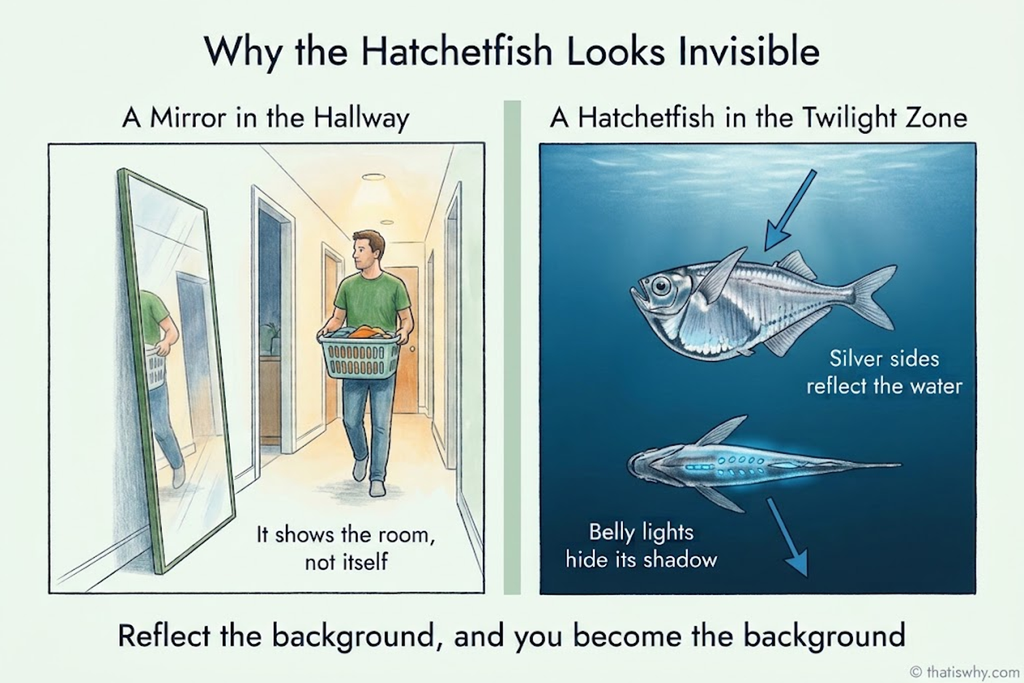
A long hallway at dusk, one lamp glowing at the far end. A man carries a laundry basket toward the bedroom and walks right past a tall mirror leaning against the wall. He doesn't notice it at all, because the mirror isn't showing him a mirror. It's showing him more hallway, the same walls, the same soft light, the same doors.
**That's the hatchetfish's first trick: in an even, dim light, a silver surface shows the world around it instead of itself.** The fish's sides reflect the blue water in front of and behind it, so the fish seems to dissolve into it.
But a mirror has a weakness, and anyone who has played with a flashlight in the dark knows it. Shine a beam at that hallway mirror and it fires the light straight back into your eyes, a bright flash that says "something is here." The hatchetfish's silver coat doesn't do that. That's where the comparison stops, and where the fish gets clever.
In soft, even light a hatchetfish works like a hallway mirror, showing the water instead of itself, while belly lights hide its shadow from below.
## How the Hatchetfish Hides
### A silver coat that shows the sea
Hatchetfish are small, silvery fish of the deep midwaters. Depending on the species, they're about 2.8 to 12 centimeters long, and they're usually found below 400 meters during the day. Their name comes from their shape: an extremely flattened, blade-like body with a deep keel, like the head of a hatchet.
Up close, their skin looks like "the unpolished side of aluminium foil," as a team of physicists at the University of Pennsylvania described it. That team, led by Alison Sweeney, found the skin is built in two layers. The outer layer holds stacks of tiny reflective plates made of guanine. These stacks reflect light much like a mirror. The deeper layer holds bundles that spread the light out sideways along the fish's body.
In the even, dim light of the twilight zone, the result is just what the hallway mirror does. As Sweeney put it, "you are going to see blue water reflecting in front of the fish," and the fish "is going to disappear."
### Belly lights that erase the shadow
From below, a mirror can't help. Many hunters lurk underneath their prey, looking up for dark silhouettes against the light filtering down from the surface. Even a perfectly silver fish blocks some of that light.
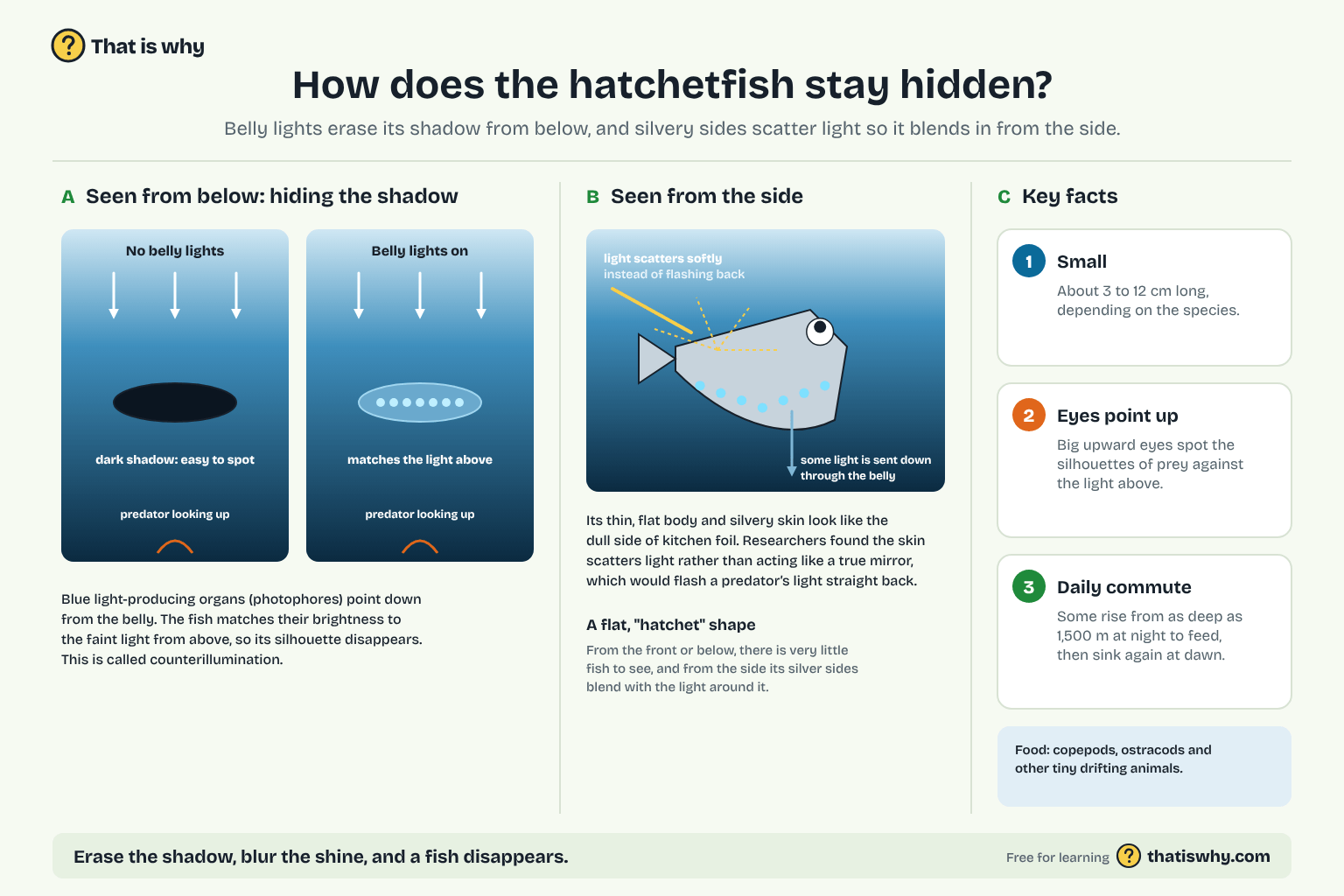
So the hatchetfish makes its own. It carries light organs called **photophores** along its belly, pointing downward. By glowing about as brightly as the faint sunlight from above, it fills in its own shadow. This is called **counterillumination**, and to a hunter looking up, the fish's outline melts into the glow.
### The searchlight trick
Here's the twist the Penn team discovered. Some predators hunt with their own light, sweeping the dark like a searchlight. As Sweeney warned, "You are in big trouble if you get zapped by a search beam." A true mirror would reflect that beam right back and give the fish away.
Hatchetfish skin doesn't fall into that trap. The researchers found that it "did not reflect the beam straight back, but diffused it in different directions." Compared with a mirror, a predator would have to come twice as close to spot a hatchetfish. Even better, about 20% of the light hitting the side of the fish ends up being sent downward, out through the belly lights, toward the ocean floor. The authors summed up the strategy as "when in doubt, send light down."
Hatchetfish hide twice over: belly lights erase their shadow, and silvery sides scatter light. Free full-size diagram and printable PDF.
## Seeing It Everywhere
Every animal in the open ocean faces the same problem: there is nowhere to hide, so the body itself has to become the hiding place. Some animals [turn see-through](https://thatiswhy.com/why-some-deep-sea-animals-become-invisible/) and let light pass straight through them. Others wear [ultra-black skin that swallows light](https://thatiswhy.com/why-deep-sea-fishes-are-black/), and see-through ones still have to [hide their glowing meals behind red stomachs](https://thatiswhy.com/why-transparent-deep-sea-animals-have-red-stomachs/). Our guide to [how deep-sea creatures become invisible](https://thatiswhy.com/why-deep-sea-creatures-are-invisible/) puts all these tricks side by side, and the glowing lights behind them are explained in [why deep-sea animals glow in the dark](https://thatiswhy.com/why-do-deep-sea-animals-glow-in-the-dark/).
The hatchetfish's twist is that it doesn't pick just one trick. It reflects in some light, glows in other light and scatters a beam that's aimed at it.
## Myths About the Hatchetfish
**Myth: The hatchetfish is a living mirror.**
**The truth:** That's only half the story. In even, dim light its sides reflect the water like a mirror, but when a beam hits it, the skin scatters the light in different directions instead of flashing it straight back.
**Myth: A shiny fish should be easy to spot.**
**The truth:** In the soft, even light of the twilight zone, a silver side shows the blue water around it, so the fish blends in.
**Myth: Hatchetfish live on the deep seafloor.**
**The truth:** They live in open midwater, usually below 400 meters by day. Some species rise from as deep as 1,500 meters at night to feed on tiny drifting animals like copepods and ostracods.
## The Fish That Isn't There
Back in the blue gloom, the hatchetfish hangs perfectly still. From the side, a passing hunter sees only blue water. From below, it sees only a soft glow. And if it sweeps a beam across the spot, the light scatters away and part of it slips quietly out of the fish's belly toward the seafloor.
This is the part that still surprises us. The simple idea, a fish that's a mirror, was almost right, and the small difference is what keeps the hatchetfish alive. It shows the sea when the light is soft, and it hides from a searchlight by refusing to shine back.
## Sources
- [Hatchetfish scatter light to camouflage in the deep sea, Penn physicists report](https://penntoday.upenn.edu/features/hatchetfish-scatter-light-to-camouflage-in-the-deep-sea-penn-physicists-report), Penn Today, University of Pennsylvania
- [Three-dimensional midwater camouflage from a novel two-component photonic structure in hatchetfish skin (Rosenthal et al., Journal of the Royal Society Interface 2017)](https://rcastoragev2.blob.core.windows.net/ce4064a79162dfbed9a5b2f915863a0d/PMC5454286.pdf), Journal of the Royal Society Interface (PubMed Central copy)
- [Hatchetfish: how they hide (Sweeney lab, University of Pennsylvania)](https://phys.org/news/2017-05-hatchetfish.pdf), Phys.org
- [About the Hatchetfish](https://twilightzone.whoi.edu/explore-the-otz/creature-features/hatchetfish/), Woods Hole Oceanographic Institution, Ocean Twilight Zone
- [Marine Hatchetfishes (family Sternoptychidae)](https://fishesofaustralia.net.au/home/family/287), Fishes of Australia, Museums Victoria