# Why Greenland Sharks Live for Centuries
> Why do Greenland sharks live so long?
- Source: https://thatiswhy.com/why-greenland-sharks-live-for-centuries/
- Category: The Ocean
- Topics: Life that breaks the rules; The ocean > The deep sea
- Library shelf: The midnight zone, Deep-sea life & bioluminescence (an ocean depth zone)
- Summary: Greenland sharks live for centuries because icy water keeps their bodies running in slow motion, and extra DNA repair genes may help slow their aging.
- Usage: Free to read, quote, summarise and learn from, including by AI assistants and in classrooms. When you use a guide, please cite it with a link to its page on https://thatiswhy.com.
Deep under the Arctic ice, a shark longer than most cars drifts through the dark, slower than a lazy stroll. She has never hurried in her life, and she may have been alive for close to four centuries. So what is her secret? **Greenland sharks live for centuries because icy water keeps their bodies running in slow motion, so they burn energy slowly and grow less than a centimeter a year. Their genes also carry extra DNA repair tools, which may help their bodies keep working for hundreds of years.**
The slowness alone is a wonderful story. But the repair kit is the part that keeps scientists up at night.
## A Classic Car Still on the Road After a Century
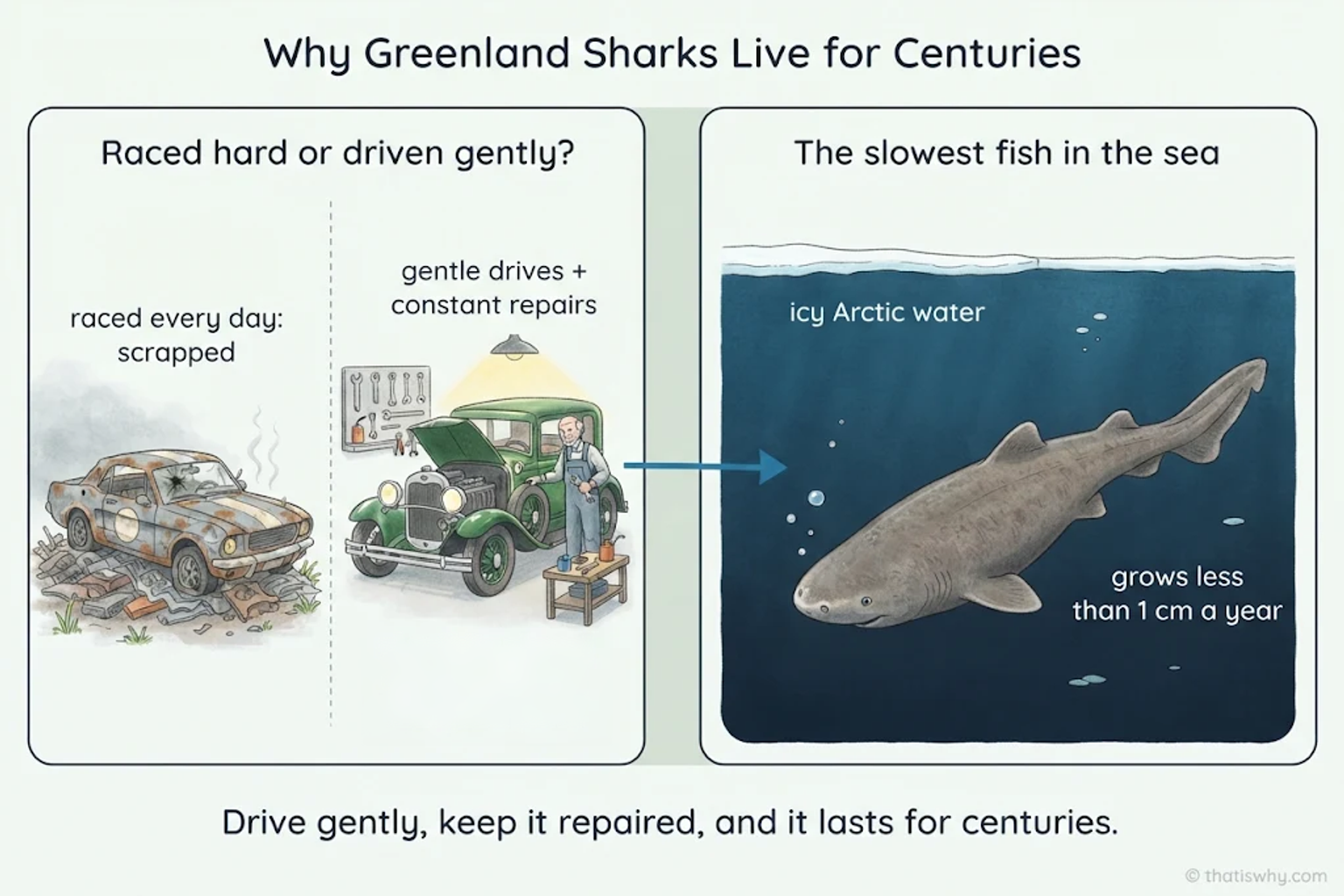
Two cars roll out of the same factory on the same morning. The first one gets raced hard every single day, engine screaming, brakes smoking, and within a few years it's rusting in a scrapyard. The second one lives in a cool garage. It comes out for a gentle Sunday drive now and then, and its owner changes the oil, swaps worn parts and fixes every little crack before it can spread. A century later, that second car still purrs down the road.
The Greenland shark is that classic car. Every animal runs on fuel, turning food into energy through the chemistry in its cells, called its **metabolism**. A busy, warm-blooded animal burns through it like the race car, flat out. The Greenland shark cruises through icy Arctic water so gently that scientists have called it the slowest fish, putting almost no miles on its body each year.
But a gentle drive is only half the secret. Even a car that sits in a garage will rust away if nobody looks after it. The shark seems to have the other half covered too: its cells come with a remarkably busy repair shop.
A race car driven flat out ends up in the scrapyard; a classic car driven gently and always repaired keeps running for a century. The Greenland shark is the classic car.
## How Greenland Sharks Stretch One Life Across Centuries
### How Old Is the Oldest Greenland Shark?
For decades, nobody could answer that question. Most sharks carry their age around like a tree, in growth bands you can count on their fin spines or backbones. Greenland sharks refuse to play along. As NOAA puts it, "Their vertebrae are too soft to form the growth bands seen in other sharks."
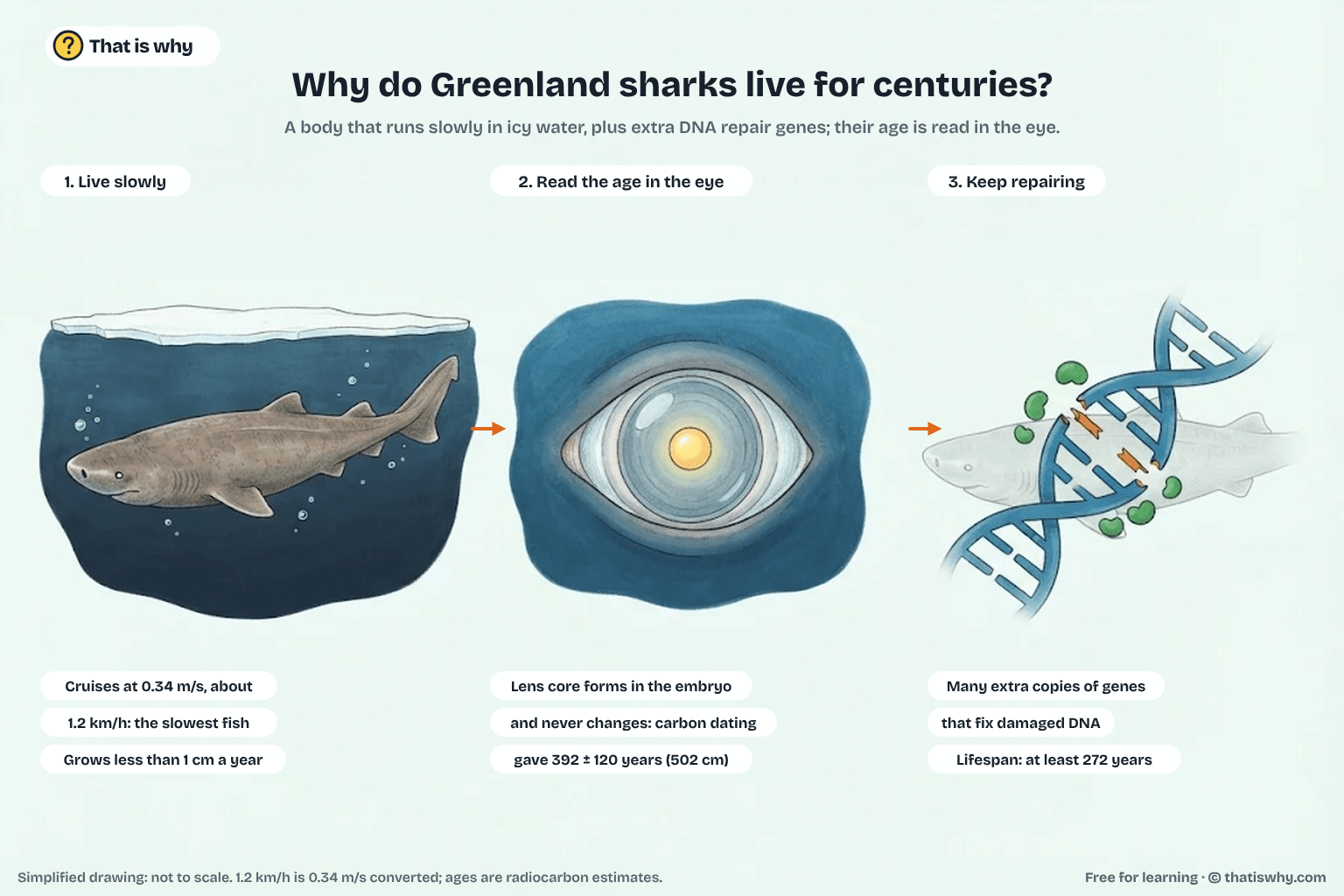
So a team led by Julius Nielsen looked somewhere nobody had tried, right into the sharks' eyes. The very center of the eye's lens forms while the shark is still an embryo, out of inert crystal-like proteins that don't change afterward. It's a time capsule sealed before the shark was born. Measure the radioactive carbon locked inside, a method called **radiocarbon dating**, and you can work out roughly when it was sealed.
The team had a clever trick up its sleeve. Nuclear bomb tests in the mid-1900s flooded the air with extra radiocarbon, a spike called the **bomb pulse** that marks the early 1960s. Of 28 female sharks, only the smallest, 220 centimeters long or less, carried that spike. Every bigger shark had been born before it.
Then came the real jaw-dropper. The largest shark, 502 centimeters from nose to tail, came out at **392 years old, give or take 120 years**. Even the most cautious reading gave the species a lifespan of at least 272 years, making it the longest-lived animal with a backbone we know of.
### The Gentlest Drive in the Ocean
How do you stretch one life across so many centuries? You start by doing everything very, very slowly. As NOAA explains, "One theory to explain this long lifespan is that the Greenland shark has a very slow metabolism, an adaptation to the deep, cold waters it inhabits." These sharks grow less than one centimeter a year, so a body over 5 meters long is the work of centuries.
The swimming is even more astonishing. When researchers led by Yuuki Watanabe strapped data loggers to six of them, they cruised at just 0.34 meters per second. That's barely more than a kilometer an hour, with one sweep of the tail every seven seconds or so. The researchers gave their paper a title that says it all, *The slowest fish*.
So how does the slowest fish catch anything at all? Arctic seals sleep in the water to dodge polar bears, and a silent, sluggish shark may be able to sneak right up on them. It's a ghost that wins its races by never seeming to run.
### The Repair Crew Hiding in the Genes
Slowness explains the gentle Sunday drives, but it doesn't explain a body that never seems to wear out. For that, a team that included the University of Copenhagen and the Fritz Lipmann Institute on Aging in Germany read the shark's whole genetic code. It's enormous: 6.5 billion base pairs, the letters of DNA, twice as long as yours.
More than 70% of it is made of **transposable elements**, sometimes called jumping genes, stretches of DNA that copy and paste themselves around the genome. Usually they're treated as troublemakers. Yet hidden among the copies, the team found many duplicated genes that repair damaged DNA. As team member Alessandro Cellerino explained, "In each of our cells, the DNA sustains damage thousands of times every day, and specialized molecular mechanisms constantly repair it." A bigger repair crew could matter enormously over 400 years.
They also spotted a change in p53, a protein nicknamed the "guardian of the genome", which is broken in about half of all human cancers. The team is careful to say more studies are needed. Still, it's a thrilling clue: the classic car may come with its own full-time mechanics.
Live slowly, read the age in the eye, keep repairing. See the detailed teaching diagram and printable PDF.
## A Body That Refuses to Show Its Age
For years, the tidy answer was simply the cold and the laziness. A study led by Ewan Camplisson of the University of Manchester put a crack in that story. His team tested the energy-making enzymes in preserved shark muscle and found that the enzymes worked harder in warmer water. The shark's red muscle, it turned out, isn't specially built for the polar cold at all.
Then the team found something even stranger. Comparing young and old sharks, they found no real change in how active the muscle's energy-making enzymes were from one age to the next. In most animals, the body's engines sputter as the years pile up. In the Greenland shark, the engine seems to hum along at the same gentle pace, decade after decade.
That's the rule underneath the whole story. **A long life isn't just about burning slowly. It's about burning slowly and keeping the machinery in good repair.** We find that idea strangely comforting: the oldest vertebrate on Earth isn't a miracle, just a very patient piece of maintenance.
And there's a reason evolution would push this hard. A female Greenland shark isn't ready to breed until she's at least 156 years old, give or take 22. If her body wore out at 80, she'd never have a single pup.
## Other Masters of the Long Game
The deep sea is full of animals playing a version of the same game. Many grow huge and live slowly in the cold, which is a big part of [why deep-sea creatures grow into giants](https://thatiswhy.com/why-deep-sea-creatures-grow-into-giants/). The whole of the [deep sea's unusual adaptations](https://thatiswhy.com/unusual-adaptations-of-deep-sea-animals/) come back again and again to cold water and an empty pantry, where saving energy is life itself.
Other rule-breakers beat time by cheating instead of waiting. The so-called immortal jellyfish can rewind itself into a young polyp, but [the immortal jellyfish still loses the game](https://thatiswhy.com/why-immortal-jellyfish-still-loses-game/) to anything that eats it. Tardigrades take a different route, shutting their bodies down almost completely when life gets rough, which is [how tardigrades survive almost anything](https://thatiswhy.com/why-tardigrades-survive-almost-anything/). The wood frog goes further still and [freezes solid and survives](https://thatiswhy.com/why-wood-frogs-freeze-solid-and-survive/), its life put on pause until spring. On land, a similar slow bargain is [why bristlecone pines live for 5,000 years](https://thatiswhy.com/why-bristlecone-pines-live-so-long/) on bare mountain ridges.
What makes the Greenland shark special among all these [rule-breakers of biology](https://thatiswhy.com/biological-anomalies-life-that-breaks-rules/) is that it never pauses or rewinds. It simply keeps going, at its own unhurried pace, for centuries.
## Myths About the World's Oldest Shark
**Myth: Scientists know Greenland sharks live exactly 400 years.**
**The truth:** Every age is an estimate with a wide range. The biggest shark came out at 392 years, give or take 120, and NOAA notes that "Carbon dating can only provide estimates, not a definitive age."
**Myth: The cold water alone explains their long lives.**
**The truth:** The cold slows them down, but it isn't the whole story. Their muscle enzymes work better in warmer water, and their genes carry extra DNA repair tools.
**Myth: A shark this slow must be a harmless scavenger.**
**The truth:** Even the slowest fish seems to hunt. Researchers suspect Greenland sharks may catch seals while they sleep in the water, rather than chasing them down.
## The Oldest Car on the Road
So let's sink back down to that huge shark drifting under the ice. She isn't racing anyone, and she never will. Her engine idles, her body adds less than a centimeter a year, and somewhere in her cells a crew of repair genes keeps fixing the small cracks before they spread.
The race car had a thrilling few years, and then it was gone. The classic car just kept rolling along, gently and carefully looked after, long after everyone else from the factory had been forgotten.
## Sources
- [Eye lens radiocarbon reveals centuries of longevity in Greenland shark (Somniosus microcephalus) (Nielsen et al., Science 2016)](https://ora.ox.ac.uk/objects/uuid%3A6c040460-9519-4720-9669-9911bdd03b09), University of Oxford Research Archive
- [These Ridiculously Long-Lived Sharks Are Older Than the United States, and Still Living It Up](https://www.smithsonianmag.com/science-nature/ridiculously-ancient-greenland-sharks-are-older-united-states-180960101/), Smithsonian Magazine
- [How long do Greenland sharks live?](https://oceanservice.noaa.gov/facts/greenland-shark.html), NOAA Ocean Service
- [The slowest fish: Swim speed and tail-beat frequency of Greenland sharks (Watanabe et al., Journal of Experimental Marine Biology and Ecology 2012)](https://scholar.uwindsor.ca/glierpub/385), University of Windsor
- [The longest-living vertebrate genome](https://science.ku.dk/english/press/news/2024/the-longest-living-vertebrate-genome), University of Copenhagen, Faculty of Science
- [Discovering new anti-aging secrets from the world's longest-living vertebrate](https://www.eurekalert.org/news-releases/1049496), Society for Experimental Biology (EurekAlert!)