# Why Geckos Can Stick to Walls and Walk on Ceilings
> How do geckos stick to walls?
- Source: https://thatiswhy.com/why-geckos-stick-to-walls/
- Category: Animals
- Topics: Nature as engineer
- Library shelf: The forest floor, Animal behavior & evolution (a theme shelf, not a habitat)
- Summary: Gecko toes carry millions of tiny hairs with split tips that hug a surface so closely that weak molecular pulls add up to a dry grip they peel off at will.
- Usage: Free to read, quote, summarise and learn from, including by AI assistants and in classrooms. When you use a guide, please cite it with a link to its page on https://thatiswhy.com.
A gecko scurries up a pane of glass, flows onto the ceiling and stops there, upside down, watching you with that unbothered stare. There are no suction cups on its feet, no glue and no claws biting into anything. **Geckos stick to walls with millions of microscopic hairs on their toes. Each hair splits into hundreds of even tinier tips that hug a surface so closely that weak attractions between molecules, called van der Waals forces, add up to a powerful dry grip, and the gecko switches it off by peeling its toes away.**
Here's the part that made us sit up. In one lab test, a gecko's foot held on just as hard after the animal had died. The grip isn't muscle, it's design, and you've almost certainly stuck one like it to your fridge.
## The Sticky Note That Needs No Glue
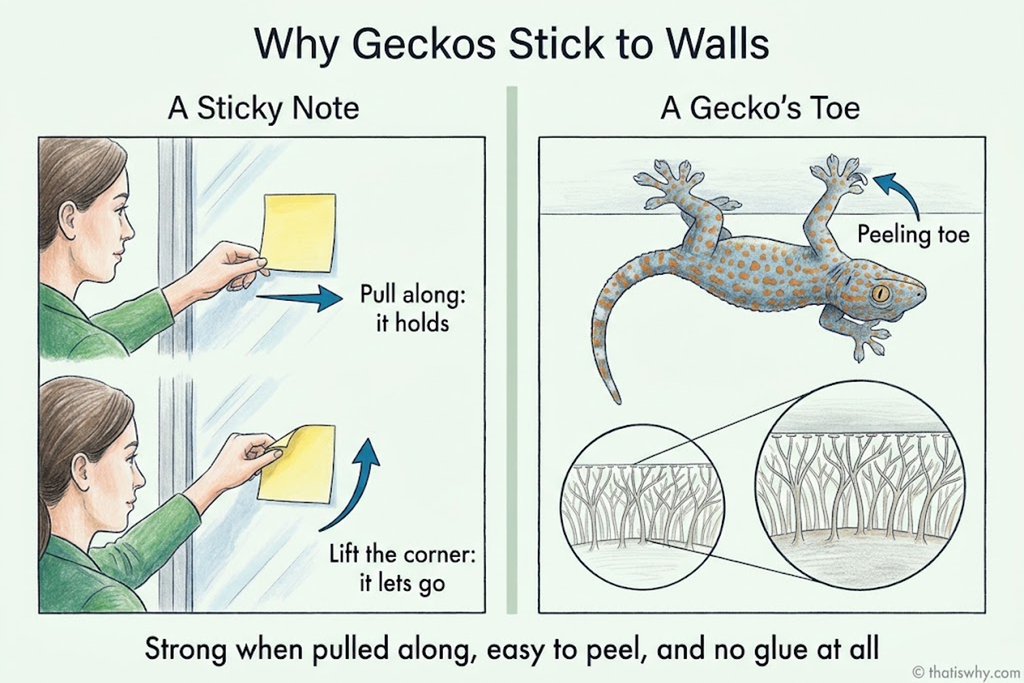
A yellow sticky note sits on an office window. Grab its bottom edge and tug it sideways, along the glass, and it refuses to budge. Now lift one corner and peel. It comes away with a soft little rip and no effort at all, ready to be pressed onto the next window, and the next, all day long.
**That's the whole trick of a gecko's toe: a grip that's strong when you pull along the surface and weak when you peel from the edge.** Each toe pad is lined with rows of microscopic hairs that behave like a stack of sticky notes. The gecko presses them on and drags them a little, and they hold. Then it curls its toe up from the tip, the way you'd lift that corner, and they let go.
Real sticky notes cheat, though. They carry a thin smear of glue, which slowly picks up crumbs and dust until the note flops off the wall. Gecko feet carry no glue whatsoever. There are no glue glands on the foot and no residue left behind, and the hairs clean themselves as the animal walks.
A gecko toe works like a sticky note: strong when pulled along, easy to peel from the edge, but with no glue at all.
## Broccoli on the Tips of the Hairs
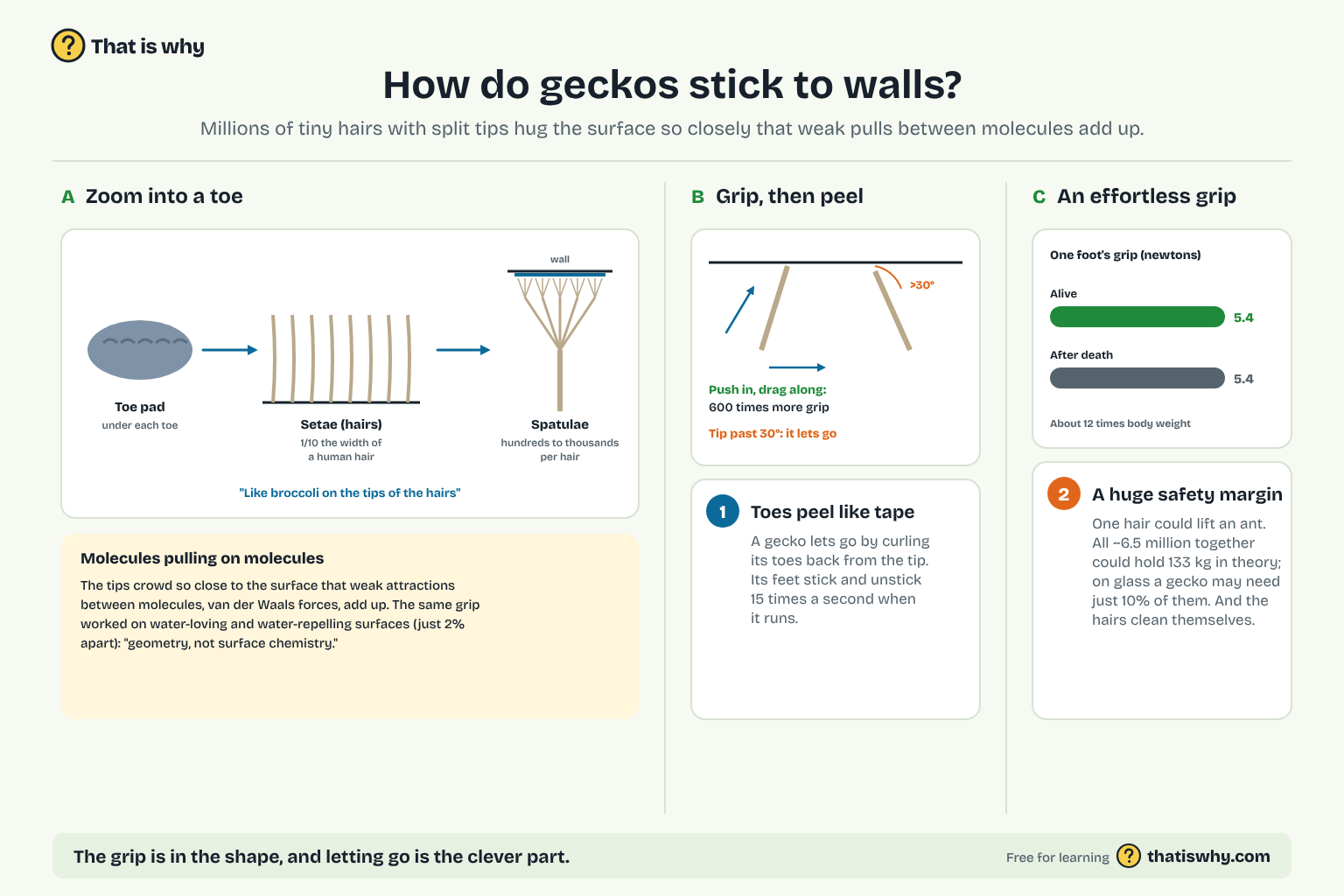
Zoom in on a gecko's toe and the smooth-looking pad turns into a carpet. In a landmark study published in *Nature*, biologists Kellar Autumn and Robert Full teamed up with engineers at UC Berkeley and Stanford to measure those hairs one at a time. Each hair, called a **seta** (plural *setae*), is only one-tenth the diameter of a human hair. Autumn later estimated in *Scientific American* that a tokay gecko carries about 6.5 million of them.
And each seta isn't finished yet. Its end frays into hundreds to thousands of tiny pads called **spatulae**, each about ten millionths of an inch across. Under the microscope they look, in Full's words, "like broccoli on the tips of the hairs." That branching is everything, because it lets the hair's tips crowd right up against the surface, close enough for molecules to start tugging on each other.
That tug has a name. **Van der Waals forces** arise when uneven electrical charges around molecules attract one another. One microscopic pad can't do much with that on its own. Add up the hundreds or thousands of pads on a single hair, though, and something wonderful happens: that one hair could lift an ant.
### Proving it wasn't water
For a while, there was a rival suspect. Maybe a thin film of water was gluing the hairs down, the way a wet glass sticks to a coaster. So Autumn's group, writing a couple of years later in *PNAS*, set a clever trap. They let live geckos grip two wafers, one that repels water and one that attracts it. If water were doing the work, the water-loving surface should have gripped far better.
That's not what happened at all. The toes held equally well on both, and a lone seta gripped the two kinds of sensor with forces just 2% apart. The researchers threw out the idea that wet, capillary forces are needed for the grip. They concluded, beautifully bluntly, that "geometry, not surface chemistry, is the central design principle in the evolution of adhesive setae." The magic is in the shape of the hairs, not in anything they're made of.
### How gecko feet grab and let go
Touching the wall isn't enough, which is where our sticky note comes back. A seta works properly only when the foot pushes in and pulls slightly downward, dragging the hair a touch along the surface. Do that, and the hair gets 600 times greater sticking power.
Letting go is just as precise. Once the hair's angle to the surface tips past 30 degrees, the spatulae pop free. A gecko gets there by peeling its toes off the surface, tip first, like a corner of that sticky note. A running gecko has to stick and unstick its feet 15 times a second, so this switch has to be fast and nearly effortless.
### The foot that wouldn't let go
Now for that eerie experiment. Biomechanists William Stewart and Timothy Higham at UC Riverside wanted to know how much of the grip the gecko actively controls. They pulled a tokay gecko's foot along a vertical sheet of acrylic, adding weight with a steady trickle of sand, and measured when it slipped. Then they repeated the test after the animal had been humanely put down.
The numbers were identical: about 5.4 newtons of grip, alive or dead. That's one foot holding nearly 12 times the weight of an average gecko in the study, while the animal spends no effort on it.
What the living gecko controls is letting go. The researchers saw live geckos detach completely by bending their toes backward, peeling the pads away from the surface.
Millions of split-tipped hairs grip by shape alone, hold on without effort and let go when the toe peels back. Free full-size diagram and printable PDF.
## Why Smaller Tips Grip Harder
Step back from the toe and a surprising rule pops out. Theory predicts that the smaller you make each contact, the more grip you get from the same patch of surface. Split one big pad into many tiny ones and the same patch of toe pulls harder, which is exactly what a seta does when it frays into spatulae.
The PNAS team checked that theory against the real thing. Their calculations came remarkably close to predicting the actual tip size of tokay gecko setae. Evolution, in other words, landed on the size the physics recommends. And it worked it out by trial and error over countless generations, long before anyone could do the math.
The result is a ridiculous safety margin. If every one of a tokay's setae gripped at once, they could in theory hold up 133 kilograms, about 293 pounds. That's more than most grown adults weigh, hanging from one small lizard. On clean glass in the lab, a gecko may need no more than 10 percent of its setae, and geckos have been seen dangling from a ceiling by one toe.
## From Gecko Toes to Space Junk
Engineers took careful note of all this. If geometry is the secret, then you don't need a gecko, just the right shape. Mark Cutkosky's team at Stanford has spent more than a decade building gecko-style stickers.
Working with NASA's Jet Propulsion Laboratory, they put a gripper hand on NASA's "Weightless Wonder" aircraft, and it grabbed and released a cube, a cylinder and a beach ball floating in near-zero gravity. Those stood in for satellites, spent rockets and fuel tanks, the kind of space junk that's hard to catch without pushing it away. This kind of copying from living things has a name, **biomimicry**, and it fills [nature's long notebook of engineering ideas](https://thatiswhy.com/why-nature-is-the-ultimate-engineer/).
The idea that shape beats material shows up elsewhere in nature too. Honeybees get the most storage from the least wax by choosing the right shape, which is [why bees build hexagons](https://thatiswhy.com/why-bees-build-hexagons/). Spiders do something similar with protein, and [spider silk outperforms steel](https://thatiswhy.com/why-spider-silk-is-stronger-than-steel/) largely because of how the spinneret lines up its proteins, not because of some exotic ingredient. The lotus leaf flips the gecko's trick around, using tiny waxy bumps to touch as little as possible, which is [why water rolls off lotus leaves](https://thatiswhy.com/why-water-rolls-off-lotus-leaves/).
Army ants solve the climbing problem the opposite way. They hook their claws together and [build living bridges out of their own bodies](https://thatiswhy.com/why-army-ants-build-living-bridges/). That works beautifully for a crowd, but a lone gecko on a glass ceiling has nothing to hook into, so it relies on the molecules of the glass itself.
Being small pays off in a very different way for a woodpecker. Its brain is so small that each peck stays below the concussion line, which is [why woodpeckers don't get concussions](https://thatiswhy.com/why-woodpeckers-dont-get-concussions/).
## Myths That Don't Stick
**Myth: Geckos have suction cups on their feet.**
**The truth:** Suction needs air pressure to push the foot on, but geckos can stick to a wall in a vacuum. Their grip comes from van der Waals forces between their hairs and the surface.
**Myth: Gecko feet are covered in glue.**
**The truth:** There are no glue glands on the foot, and a gecko leaves no residue behind. The grip is completely dry.
**Myth: A gecko has to squeeze hard to hang on.**
**The truth:** The grip itself takes no muscle effort. A dead gecko's foot held on just as hard as a living one, and living geckos let go by bending their toes back.
**Myth: Dirty feet should stop a gecko from sticking.**
**The truth:** Gecko toes clean themselves as they walk. When the Berkeley team clogged the hairs with tiny beads, the dirt was gone within a few strides: "five steps later they were clean."
## Letting Go Is the Real Trick
Back on the ceiling, our gecko is still parked upside down, completely relaxed. Its feet are holding on all by themselves, millions of hairs and countless broccoli tips whispering to the plaster. When it decides to move, it simply curls up a toe and the grip melts away, then presses down again a hand's width further on.
Kellar Autumn summed up the whole puzzle in one line: "Getting yourself to stick isn't really that difficult, it's getting off that is the problem." The gecko solved both halves with nothing but shape. It carries the world's best sticky note on every toe, one that never runs out of glue because it never had any.
## Sources
- [It's not glue, suction or static electricity that keep geckos from falling off the ceiling (Autumn, Full, Fearing and Kenny, Nature 2000)](https://newsarchive.berkeley.edu/news/media/releases/2000/06/07_gecko.html), University of California, Berkeley
- [Evidence for van der Waals adhesion in gecko setae (Autumn et al., PNAS 2002)](https://www.medschool.lsuhsc.edu/biochemistry/Courses/Biochemistry201/Haas Files/2008/Intermolecular forces/Autumn6586.pdf), Proceedings of the National Academy of Sciences (copy hosted by LSU Health Sciences Center)
- [Passively stuck: death does not affect gecko adhesion strength (Stewart and Higham, Biology Letters 2014)](https://biomechanics.ucr.edu/Stewart&Higham_2014.pdf), University of California, Riverside
- [How do gecko lizards unstick their feet when they walk?](https://www.scientificamerican.com/article/how-do-gecko-lizards-unst/), Scientific American
- [Gecko-inspired robot grippers could grab hold of space junk](https://www.sciencenews.org/article/gecko-inspired-robot-grippers-could-grab-hold-space-junk?tgt=nr), Science News