# Why The "Femme Fatale" Firefly Is Nature's Spy
> Why do some fireflies flash fake love signals?
- Source: https://thatiswhy.com/why-femme-fatale-firefly-is-natures-spy/
- Category: Animals, Plants & Forests
- Topics: Deception
- Library shelf: The forest floor, Animal behavior & evolution (a theme shelf, not a habitat)
- Summary: Firefly flashes aren't just beautiful; they are secret codes. The "Femme Fatale" firefly, the predator that hacks these codes to lure males to their death.
- Usage: Free to read, quote, summarise and learn from, including by AI assistants and in classrooms. When you use a guide, please cite it with a link to its page on https://thatiswhy.com.
## The Date from Hell
Say you are a male firefly, cruising through the summer night, flashing your heart out and looking for love. You signal your specific code: *"Short-flash, Short-flash, Pause."*
Suddenly, down in the tall grass, a female flashes back. And she doesn't just flash randomly; she answers with the *exact* timing that means "I'm interested." It’s the biological equivalent of a perfect dating-app match.
Your heart pounds as you dive down and land right next to her. She is beautiful, and she is surprisingly big.
And then she grabs you and starts chewing.
Welcome to the world of the **Femme Fatale Firefly** (*Photuris*). She wasn't looking for a boyfriend; she was looking for a meal. And to get it, she just hacked your entire communication network.
---
## The Wiretap
To understand how this murder happens, you have to realize that a summer meadow isn't just a pretty light show. It’s a battlefield of encrypted radio signals. Light can be hijacked by accident, too: a porch bulb scrambles the flight reflex that tells insects which way is up, which is [why moths are attracted to light](https://thatiswhy.com/why-are-moths-attracted-to-light/).
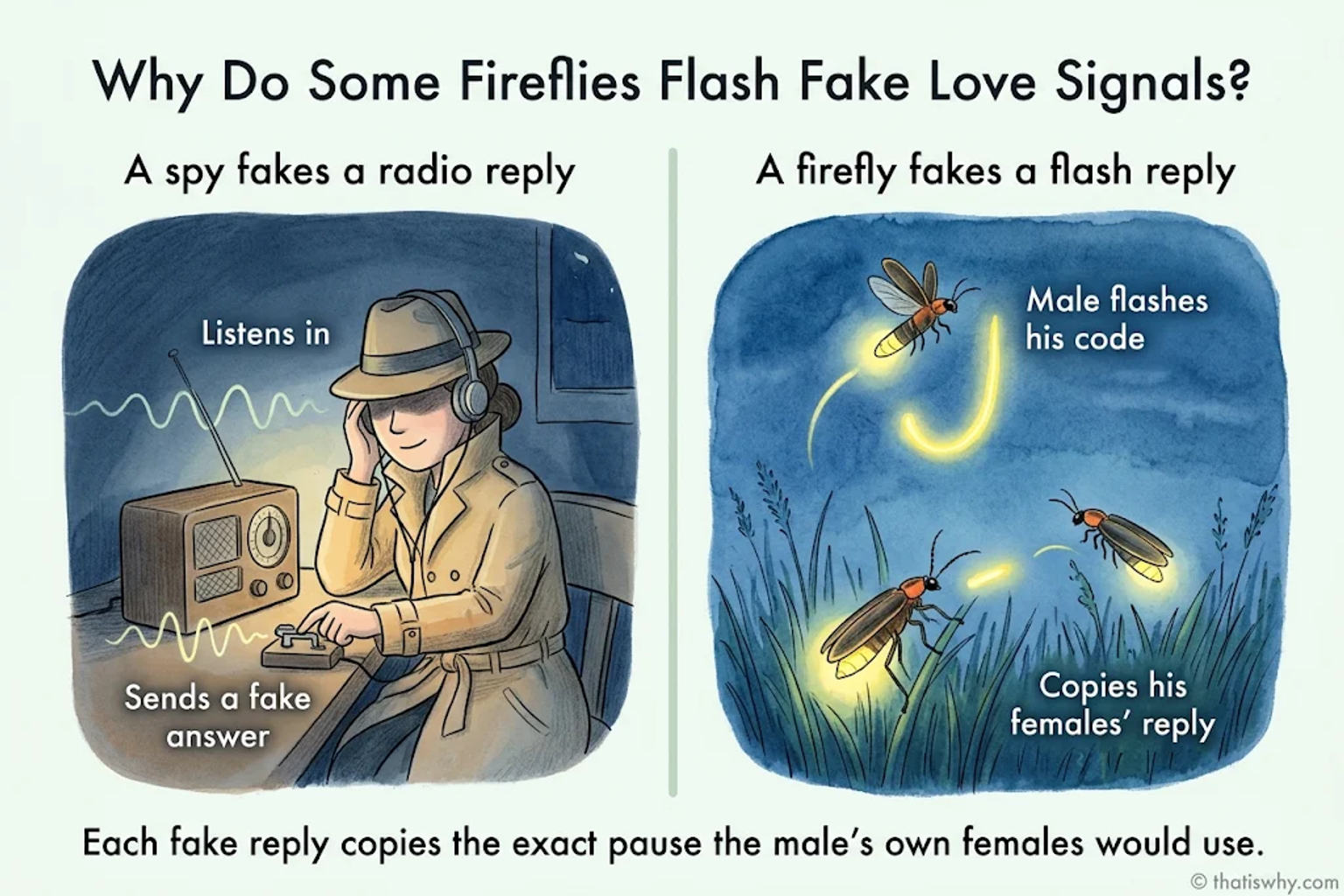
A spy listens in and sends a fake reply; a Photuris female watches the males' flashes and forges their females' answer.
Every species of firefly has its own secret language. Some flash a fancy "J-shaped" swoop, while others do a frantic double-blink or a long, steady glow. These codes are passwords, designed to keep the species separate and ensure a male only finds a female of his own kind. It’s supposed to be a secure channel.
But the *Photuris* female is a [biological hacker.](https://thatiswhy.com/why-nature-is-the-ultimate-hacker/) She sits in the grass, scanning the airwaves, wiretapping the whole conversation.
She watches the males flying above. When she sees a pattern she recognizes—like that specific "J-swoop"—she doesn't just watch. She accesses a library of codes stored in her brain, finds the correct "password" for that specific male, and flashes it back to him.
She is a spy operating behind enemy lines, broadcasting fake signals to lure the pilots into a fatal landing.
---
## The Code Breaker
The scary part isn't that she lies. It’s *how many* lies she can tell.
Most mimics in nature are stuck with one disguise. A stick bug looks like a stick. It can't wake up one morning and decide to look like a leaf. A harmless [hoverfly is stuck in its wasp costume for life](https://thatiswhy.com/why-hoverflies-look-like-wasps/), stripes and all.
But the *Photuris* female is a linguistic genius, a true polyglot. Back in 1965, the biologist James Lloyd used a flashlight to play the part of the males, and *Photuris* females answered him with the replies of **several different *Photinus* species**.
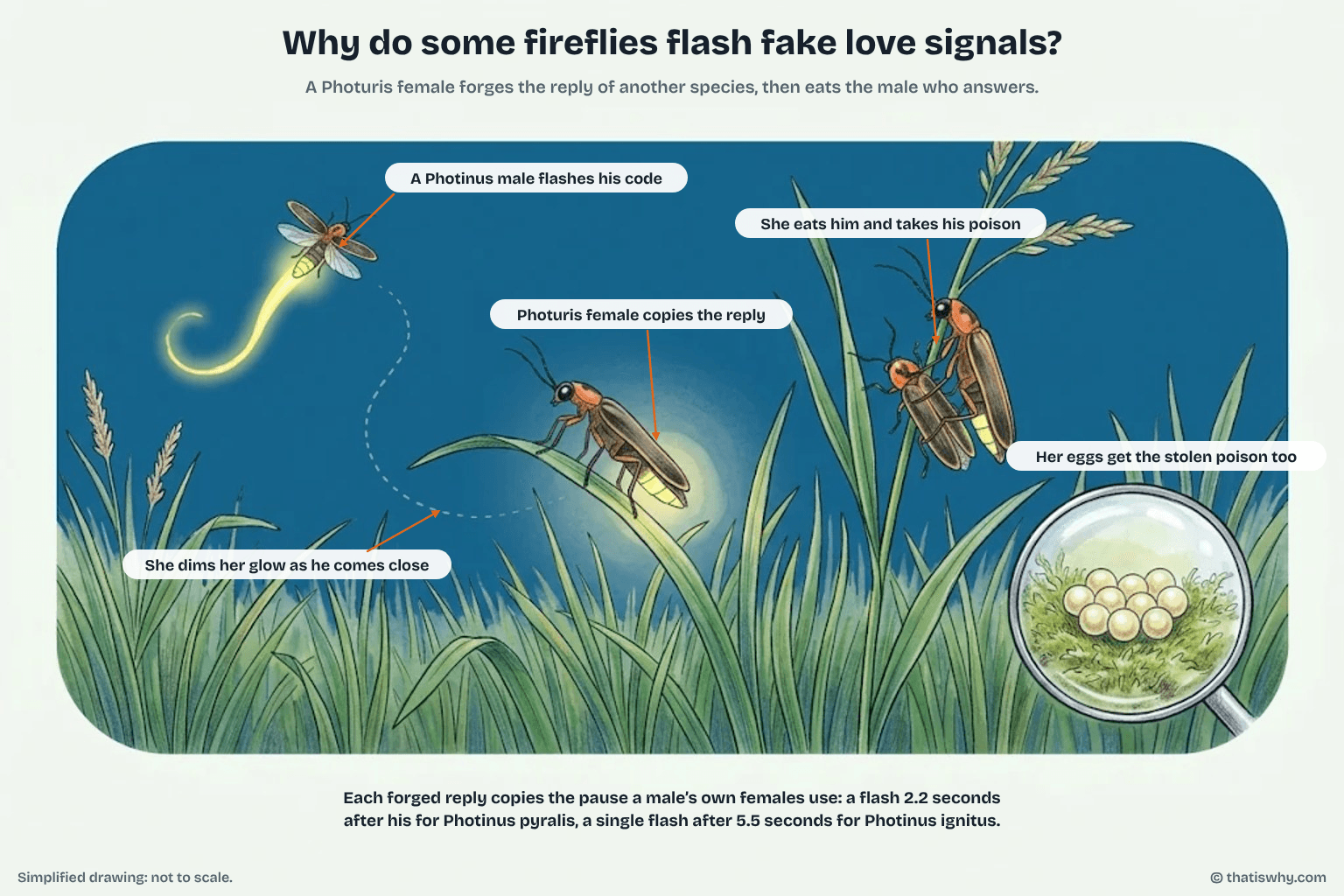
A *pyralis* signal got a flash 2.2 seconds later. An *ignitus* signal got a single flash after 5.5 seconds. Each forgery copied the exact pause that species' own females would use. And in one species, *Photuris versicolor*, a female answers males of her own kind until she mates, then switches sides and starts luring *Photinus macdermotti* males.
She analyzes the input, decrypts the signal, and outputs the forgery. She isn't just hungry; she is scary smart.
A Photuris female forges the reply of another species, dims her light as the male lands, and passes his stolen poison on to her eggs. See the detailed teaching diagram and printable PDF.
---
## Stealing the Armor
So why does she do it? Why go to all the trouble of learning so many languages just for a meal?
The answer is simple: she isn't only hunting for calories. She is hunting for **Chemical Weapons.**
The males she eats (the *Photinus* species) carry defensive steroids in their blood called **Lucibufagins**, a name that means "light" plus "toad." They help fireflies avoid being eaten by certain spiders and birds.
The *Photuris* female has very little of this armor of her own, so she steals it.
By eating the male, she takes his lucibufagins into her own body. That matters: in experiments at Cornell, *Photuris* fireflies without lucibufagins were eaten by jumping spiders. And she doesn't keep it all to herself. Cornell researchers later found that females who had eaten *Photinus* males packed lucibufagins into their eggs, and in the field, those defenses cut down how many eggs got eaten.
She is a spy, an assassin, and a thief.
---
## The Final Approach
The forgery is only half the trick. The landing is where the trap snaps shut.
One summer night, Lloyd watched a single *Photuris* female answer 12 passing males in half an hour. Every one of them was at least partly drawn in, and 8 came within a meter of her. As each male got close, she did something sneaky: she turned her flashes way down, as if lowering her voice to a whisper.
The last male landed about 7 cm away. Later, Lloyd found her clasping him and chewing on him.
It’s a high-stakes game of hide-and-seek, where a single unencrypted signal means death.
---
## Myth-Busting the Meadow
Before you start looking at every firefly as a monster, let’s clear up the facts.
**Myth #1: "It’s a cannibal bloodbath out there."** People assume all fireflies are eating each other.
**The Truth:** Not even close. The femme fatale trick belongs to *Photuris* females. In *Photuris versicolor*, a female answers males of her own species until she mates; only then does she turn to a life of crime.
**Myth #2: "It’s just an accident."** Maybe the male just crashed into the wrong girl?
**The Truth:** It is highly calculated. Her reply copies the exact pause of the target species, 2.2 seconds for one and 5.5 seconds for another, and she dims her light as the male closes in. In firefly terms, it is premeditated murder.
---
## The Secret War
Next time you see a field of fireflies blinking in the summer, look closer.
To us, it looks like a peaceful fairy tale. But if you know the code, you realize you are looking at an active war zone.
The air is filled with desperate pilots broadcasting their coordinates into the dark, hoping for a friendly response. And down in the grass, the enemy spies are listening, decoding the signals, and waiting for the right moment to launch their ambush.
It’s a beautiful light show, sure. But it’s also the highest-stakes espionage thriller on Earth, happening right in your backyard. And here is the scariest part: the better the code-breaker gets, the more beautiful the show becomes.
---
**How We Researched This**
To get the details right, we relied on the field work of **James Lloyd**, who described the firefly femmes fatales in 1965, the 1975 *Nature* study of the female's switch after mating, and the chemical studies of **Thomas Eisner's** team at Cornell, which revealed the motive (lucibufagins) behind the attacks and showed the stolen chemicals end up in her eggs.
But we knew that just citing behavioral studies isn't helpful. Our real job began when we asked, *"What does this feel like?"* That question led us to the **"Wiretap"** analogy—a simple story to make the complex world of encrypted bioluminescent signals feel intuitive.
## Sources
- [Aggressive Mimicry in Photuris: Firefly Femmes Fatales (Lloyd, Science 1965)](https://entnemdept.ufl.edu/baldwin/webbugs/3005_5006/docs/firefly%20paper.pdf), University of Florida
- [Mating-induced behavioural switch in female fireflies (Nelson, Carlson & Copeland, 1975)](https://www.nature.com/articles/255628a0), Nature
- [Lured and liquidated, gullible male fireflies supply 'femmes fatales' with a lifesaving chemical](https://news.cornell.edu/node/277896), Cornell Chronicle
- [Chemical egg defense in Photuris 'femme-fatales' (González and Eisner, 1999)](https://chemecol.org/programs/1999/o-62.html), International Society of Chemical Ecology