# Why Emperor Penguins Turn Antarctic Ice into a Living Thermal Battery
> How do emperor penguins survive the Antarctic winter?
- Source: https://thatiswhy.com/why-emperor-penguins-turn-antarctic-ice-into-living-thermal-battery/
- Category: Animals
- Topics: Beating heat and cold
- Library shelf: The forest floor, Animal behavior & evolution (a theme shelf, not a habitat)
- Summary: Male emperor penguins fast for about four months through the Antarctic winter. The secret isn’t just fat: it’s a huddle that shares heat like a battery.
- Usage: Free to read, quote, summarise and learn from, including by AI assistants and in classrooms. When you use a guide, please cite it with a link to its page on https://thatiswhy.com.
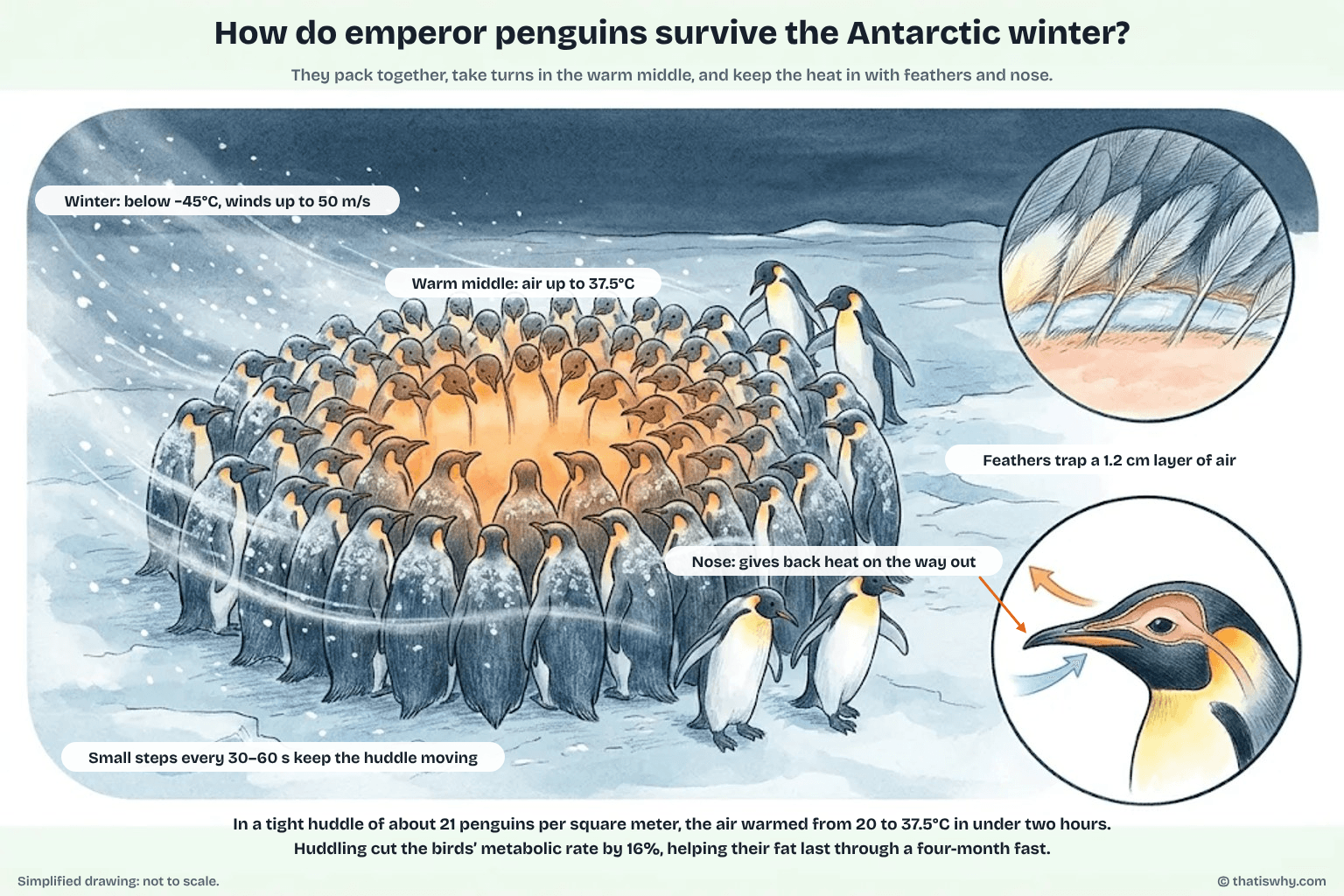
In the Antarctic winter, emperor penguins face temperatures below minus 45 degrees Celsius and winds of up to 50 meters per second. A male emperor penguin stands on that ice, guarding an egg, for about four months without eating.
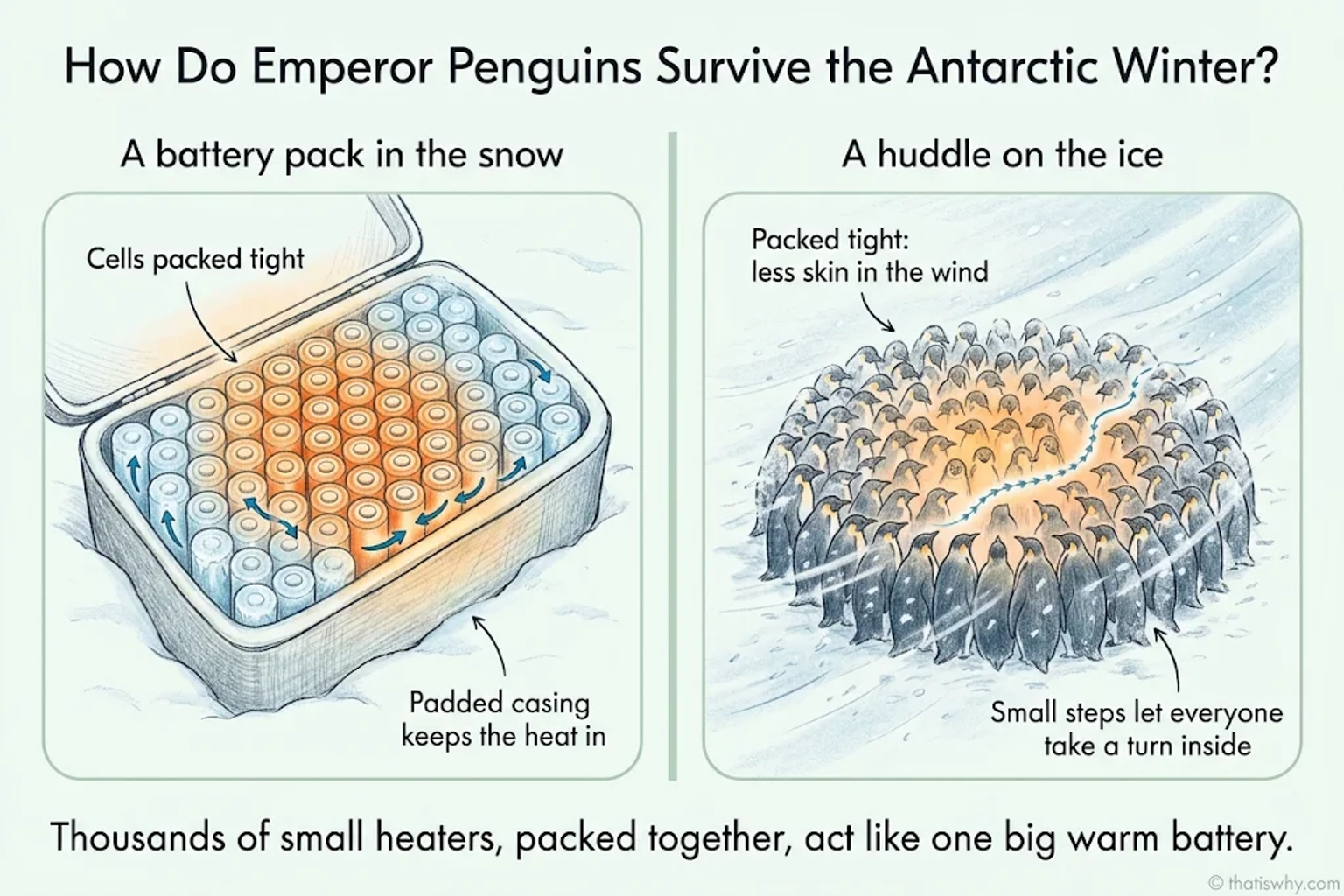
The trick is not just fat or thick feathers, but plain, beautiful thermodynamics. Thousands of penguins press together and behave less like individual birds and more like a single, shared thermal battery, storing, balancing, and recycling heat so efficiently that the air inside a tight huddle can reach 37.5 degrees Celsius.
They do not beat the cold by being tougher. They beat it by being smarter with energy.
---
## The Huddle: When the Battery Pack Turns On
At first glance, a penguin huddle looks like simple crowding. Thousands of birds stand pressed tightly together, barely moving, their backs turned to the wind and their heads tucked low against the cold. It does not appear organized, yet what is happening inside that mass is remarkably structured.
Each emperor penguin produces heat continuously through metabolism, which is essentially the slow conversion of stored fat into energy. In Antarctica, that heat disappears quickly because the temperature difference between a warm body and the frozen air creates a constant pull outward. Wind accelerates the loss, and the ice beneath their feet conducts heat away even faster.
Instead of resisting that drain individually, the penguins change the geometry of the problem.
When they press tightly together, their combined surface area drops dramatically, which means less total exposure to the air. Surface area determines how much heat can escape, so by reducing it, they immediately slow the rate of energy loss. That alone would help, but something more interesting begins once thousands of warm bodies share contact.
Inside the huddle, metabolic warmth from every bird builds into a shared reservoir. Sensors carried by penguins in a French study recorded air inside tight huddles climbing from 20 to 37.5 degrees Celsius in less than two hours. The researchers even suspect that very tight huddling could make birds overheat. Huddling birds can lower their metabolic rate, so the colony burns less of its fat while waiting out the winter.
The huddle behaves like a slow-moving solid, packed at about 21 penguins per square meter. Every 30 to 60 seconds, all the penguins take small steps of 5 to 10 centimeters, and those steps travel through the whole huddle as a wave. Over time, the huddle creeps along: penguins join at the trailing edge and leave at the leading edge, so birds do not stay in one spot forever.
Nobody yet knows whether one penguin, a few, or none at all starts each wave. What is clear is that small, local movements keep the whole crowd from jamming.
If you picture the colony as a living thermal battery, this is the balancing phase. The outer layer absorbs the environmental stress, while the interior stores warmth. The entire mass continuously redistributes exposure so that no single penguin bears the full thermal cost for long.
It looks like a crowd standing still. It functions like a system managing energy.
Packed tight, taking turns in the warm middle, with feathers and nose holding the heat in. See the detailed teaching diagram and printable PDF.
---
## The Feathers: The Battery’s Insulation Casing
The huddle stores and balances heat, but it only works because each penguin is already carrying serious insulation. Think of the colony as the battery pack and the feathers as the casing that keeps the charge from leaking out.
A battery pack keeps its charge by packing cells tight inside a padded case. A huddle does the same with heat.
Feathers do not just sit flat like a coat. They trap air, and an emperor penguin’s plumage holds a layer of air about 1.2 centimeters thick. Air is a poor conductor of heat, which makes it an excellent insulator, so most of the body’s warmth stays on the inside of that thin, still layer.
The feathers prevent the internal warmth generated by metabolism and amplified by the huddle from bleeding away into the environment. Without that insulation, the colony would lose energy too quickly to matter. With it, the stored heat remains available long enough to be shared and redistributed.
Insulation and huddling amplify each other. The feathers slow heat loss at the individual level, while the huddle reduces exposure at the group level. Together, they turn thousands of small heat sources into something that behaves like a stable energy reservoir instead of a collection of vulnerable birds.
The battery works because the casing works.
---
## The Nose: The Battery’s Heat Recovery Circuit
Even with dense feathers and a tightly packed huddle, there is still one major place where heat can escape: breathing.
Every time a warm-blooded animal exhales into freezing air, it risks losing both heat and moisture. In Antarctica, that loss would be brutal. Exhale warm, moist air into air below minus forty degrees, and the temperature difference alone would drain energy quickly.
Emperor penguins do not allow that to happen.
Birds that live in cold climates carry a countercurrent heat exchanger in the nose. Breathing in, cold air cools the nasal passages. Breathing out, warm air from the lungs passes over those cooled surfaces and gives back much of its heat and moisture, leaving the body far below body temperature. A review of cold-climate birds calls this the most important way they limit the heat and water lost by breathing.
If the huddle stores energy and the feathers prevent leaks, the nose makes sure the system does not waste what it has already generated. It functions like a heat recovery unit in an efficient building, capturing outgoing warmth and redirecting it back into circulation. Ducks run a similar exchanger down the length of their legs, which is [why ducks' feet don't freeze on ice](https://thatiswhy.com/why-dont-ducks-feet-freeze/).
The result is a layered defense against the cold. The colony shares the heat, the feathers hold it in, and the nose recycles what would otherwise escape.
---
## When Engineers Build the Same Battery on Purpose
Once you understand how emperor penguins manage heat, the system stops feeling like strange animal behavior and starts looking like something engineers try very hard to design.
Modern buildings in extreme climates use heat-recovery ventilation systems that work almost exactly like a penguin’s nose. Warm outgoing air transfers energy to incoming cold air before it escapes, dramatically reducing heat loss. High-efficiency jackets use layered insulation that traps air the same way penguin feathers do.
Long before engineers began experimenting with these materials and systems, emperor penguins were already running the same principle at biological scale. Thousands of small heat sources pressed together behave like one large, stable thermal mass. Other animals solve the same heat puzzle in their own way, from [the elephant's giant cooling ears](https://thatiswhy.com/why-elephant-ears-work-like-giant-cooling-panels/) to [the wood frog that lets itself freeze solid](https://thatiswhy.com/why-wood-frogs-freeze-solid-and-survive/).
The power does not come from one extraordinary feature. It comes from structure, layering, and coordination.
---
## It’s Not Just Fat: Clearing Up Penguin Winter Myths
**Myth #1: Emperor penguins survive because they are simply covered in fat.**
**Truth:** Fat helps, but fat alone would not solve Antarctica.
Body fat provides insulation and stored energy, but without the huddle reducing surface area, the feathers trapping air, and the nasal system recycling warmth, those reserves would drain far faster. Survival is collective thermodynamics, not just body composition.
**Myth #2: The strongest penguins stay in the center while the weaker ones freeze on the outside.**
**Truth:** The huddle keeps moving.
Every 30 to 60 seconds, small steps ripple through the whole huddle, and penguins join at one edge and leave at the other, so no one keeps the most protected spot for long.
**Myth #3: They just stand still and endure it.**
**Truth:** The system is dynamic.
The colony looks motionless from a distance, but inside it is constantly adjusting. Tiny synchronized steps keep the structure compact while allowing slow circulation that maintains contact and balances heat.
---
## The Winter That Taught Them to Share Heat
If you picture one emperor penguin alone on the ice, the odds look terrible. The temperature difference between its body and the Antarctic air is extreme, and nothing in that landscape is forgiving.
But the penguins are not tougher than Antarctica. They are just better at managing energy.
When they gather, the rules change. The wind no longer strips heat from isolated bodies. It meets a compact structure. The warmth from one bird becomes part of a shared reservoir. The feathers slow the leak. The huddle stores the charge. The slow rotation keeps the load balanced. The nose even recycles what would otherwise be lost with every breath.
The colony behaves like a living thermal battery, not because any one penguin is extraordinary, but because the system is.
We often imagine survival in extreme environments as brute resilience. The emperor penguins show something different. They survive by reducing waste, sharing load, and adjusting constantly. They do not defeat the cold by overpowering it. They reorganize themselves so the cold has less access to their energy.
Antarctica does not get warmer. They just stop giving it so much to take.
---
**How We Researched This**
To explain how emperor penguins survive Antarctic winters, we relied on field studies of *Aptenodytes forsteri*: temperature loggers carried by breeding males in a French colony (Gilbert and colleagues), time-lapse video of a huddle near Germany's Neumayer station, which also gives the winter conditions the birds face (Zitterbart and colleagues), and a review of how birds in cold climates save heat, including through the nose.
But listing metabolic rates and temperature gradients does not make the system intuitive. Our real job began when we asked what this looks like as a system. That question led us to **"the living thermal battery"** analogy, a simple way to make heat storage, insulation, and recovery feel intuitive.
## Sources
- [Huddling behavior in emperor penguins: dynamics of huddling (Gilbert et al., 2006)](https://arxiv.org/abs/q-bio/0701051), arXiv
- [Coordinated movements prevent jamming in an emperor penguin huddle (Zitterbart et al., 2011)](https://pmc.ncbi.nlm.nih.gov/articles/PMC3106014), PLOS ONE (PMC)
- [Heat conservation during cold exposure in birds (vasomotor and respiratory implications)](https://polarresearch.net/index.php/polar/article/view/2567), Polar Research