# Why Elephant Ears Work Like Giant Cooling Panels
> Why do elephants have such big ears?
- Source: https://thatiswhy.com/why-elephant-ears-work-like-giant-cooling-panels/
- Category: Animals
- Topics: Beating heat and cold
- Library shelf: The forest floor, Animal behavior & evolution (a theme shelf, not a habitat)
- Summary: A mouse freezes easily while an elephant overheats. That sounds backwards until you look at the math.
- Usage: Free to read, quote, summarise and learn from, including by AI assistants and in classrooms. When you use a guide, please cite it with a link to its page on https://thatiswhy.com.
A mouse freezes easily while an elephant overheats.
That sounds backwards until you look at the math. As animals get bigger, their volume grows faster than their surface area. More mass means more internal heat. Less surface relative to that mass means less ability to dump it.
By the rules of physics, an elephant should cook from the inside out but instead, it grows fins.
## The Square-Cube Law: Why Getting Big Turns You Into a Furnace
In our camel guide, we saw [how a camel survives by moving insulation](https://thatiswhy.com/why-camel-humps-are-heat-engines/) to the roof and leaving the sides free to release heat. That worked because the camel is built for the desert and designed around heat management.
Now scale that body up ten times. When animals get bigger, they do not simply become scaled-up versions of smaller ones, because the rules shift. The inside of the body grows faster than the outside. More muscle, more organs, more living tissue means more heat being produced every second, but the skin available to release that heat does not grow at the same pace.
Then add several tons of living tissue under a blazing African sun. Every heartbeat and every digestive cycle generates warmth. Multiply that by thousands of kilograms, and you are no longer just large. You are constantly producing internal heat that must escape.
A small mammal struggles to stay warm. An elephant struggles to stay cool.
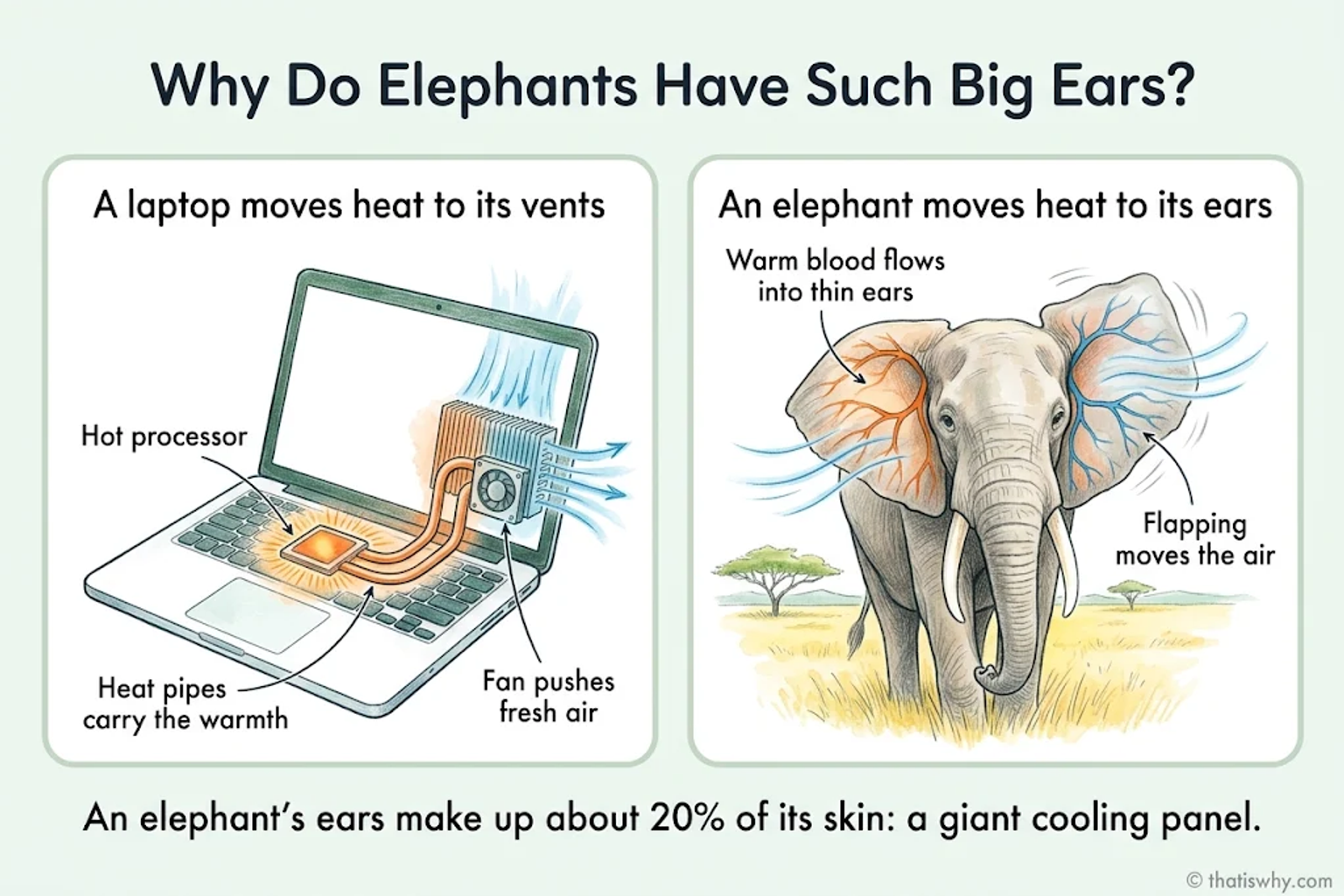
Think about a hot laptop sitting on your desk. If it has smooth sides and no openings, the heat builds up inside and performance drops. That is why laptops have wide vents and grills that let air flow across a larger surface. The computer still produces heat, but those openings give that heat somewhere to go.
A laptop pipes heat to its vents; an elephant pumps warm blood into thin, flapping ears.
An elephant faces the same basic problem.
It cannot reduce how much heat it produces. It cannot shrink its internal organs. What it can do is grow large, thin extensions that allow heat to escape more efficiently.
Those wide, flat ears act like giant open vents.
They do not make the elephant lighter. They do not make it faster. They simply give heat a place to leave.
---
## The Vascular Map: How Elephant Ears Actually Cool the Blood
If you look closely at the back of an elephant’s ear, it almost looks transparent. The skin is thin, and the veins spread across it in thick branching lines, like cables running under a glass panel.
That pattern is not decoration; it is plumbing. Those ears make up about 20% of the elephant's skin, a huge panel of thin tissue with large blood vessels running through it.
When the elephant gets really warm, it pushes blood from deep inside its body into those ears, about 20% of its blood supply at any one time. Because the skin there is stretched wide and thin, the blood flows very close to the outside air. When wind passes over the ear, or when the elephant flaps it, heat transfers from the blood into the air.
Then the cooled blood circulates back into the body.
Return to the laptop example. When internal components heat up, the machine pushes warm air toward its vents so it can escape. The laptop is not reducing how much heat it produces; it is moving that heat toward areas designed to release it.
The elephant does the same thing with blood, and its ears are the vents.
Thermal cameras make this visible. In one infrared study of elephants, the ears were where surface temperature changed the most, with patches called thermal windows: spots with a dense blood supply that help trade heat with the air. Blood that has spread through the ear heads back toward the core carrying less heat.
Across a body that large, a cooling panel that size makes all the difference.
The elephant is routing internal heat toward its natural cooling panels.
---
## Active Cooling: Why Flapping Makes the System More Efficient
The ears are not passive panels hanging in the heat. The elephant actively moves them, and that movement dramatically improves the cooling process.
Think about a laptop that has been running for hours. If it sits in still air, the heat builds up around it and cooling slows down. If you place it near a fan, moving air carries heat away much faster because fresh air constantly replaces the warm air lingering around the vents.
Elephants create that moving air themselves.
When they flap their ears, they increase airflow across a wide, thin surface filled with warm blood. As air moves across the ear, heat transfers from the blood vessels to the surrounding environment more efficiently than it would in still conditions.
On extremely hot days, elephants add another layer to the strategy: they bathe and wallow in mud. Elephants don't have the glands that keep our skin moist, so they rely on water and mud instead. As that moisture evaporates, it pulls extra heat away from the skin.
Instead of reducing how much heat their massive bodies generate, elephants improve how quickly that heat can leave. They circulate warm blood toward their natural vents and amplify the cooling with movement and moisture.
---
## When Buildings Borrow the Elephant’s Trick
Once you understand what the elephant is doing, you start noticing the same idea in human design.
Engineers face the same puzzle, from cooling skyscrapers to keeping a computer's processor from overheating. In hot climates, many buildings use wide external panels or shading fins that extend outward from the structure. Those panels increase exposed surface and control how heat interacts with the outside air. Air flows across them and carries warmth away before it builds up inside.
You see the same principle in vehicle design. Large trucks often have oversized front grills that allow as much air as possible to move across cooling surfaces. The engine still produces heat, but the front of the vehicle is shaped to release it efficiently.
The elephant follows that same logic in living tissue.
Instead of reducing the heat its body generates, it spreads part of itself outward and uses that extension as a cooling interface. The body can remain massive and powerful because the excess warmth is constantly routed toward those exposed surfaces.
The ears are architecture shaped by heat.
---
Warm blood flows into thin ears and comes back cooler, while mud and cracked skin add evaporative cooling. See the detailed teaching diagram and printable PDF.
---
## More Than Intimidation: What Elephant Ears Really Do
**Myth #1: Elephants Flap Their Ears Just to Look Bigger or Intimidate**
When an elephant spreads and flaps its ears, it can look dramatic, almost theatrical.
**Truth:**
Sometimes it really is signaling. An elephant about to charge brings its ears forward, and ear positions can show its mood. But elephants also fan their ears out and flap them in response to rising heat, with no rival in sight. The flapping pushes air across a thin surface filled with warm blood, which helps cool the body.
The ears may send messages, but they are primarily moving heat.
---
**Myth #2: Big Ears Are Just a Random African Trait**
People often compare African and Asian elephants and assume the difference in ear size is random.
**Truth:**
African elephants have the largest ears of any species, and they live in hotter, more open landscapes. Asian elephants have smaller, rounder ears and often live in shaded forests. Fossil experts say that as elephant relatives moved into colder climates, their ears gradually became smaller. Climate shapes anatomy, one ear at a time.
---
**Myth #3: Thick Skin Makes Elephants Heat-Resistant**
Elephants look rugged, and their skin looks tough enough to handle anything.
**Truth:** Thick skin does not protect against internal heat buildup. An elephant’s size means it generates a tremendous amount of warmth simply by being alive. In fact, the African elephant's skin is a network of tiny cracks that holds 5 to 10 times more water than a flat surface would, so a mud bath keeps cooling it for longer. Along with bathing and ear flapping, that cracked skin keeps overheating in check.
Their size gives them power. Their ears make that power sustainable.
---
## The Lesson in the Ears
When you see an elephant for the first time, the ears almost feel exaggerated, like someone turned the size dial too far. They flap slowly, almost casually, and it is easy to assume they are just part of the animal’s personality.
An elephant is massive in a way that changes the rules. That much living tissue produces heat constantly. If that heat had nowhere to go, size would become a disadvantage instead of a strength.
So evolution did something very practical: it gave the heat somewhere to leave.
The ears create space for blood to spread out, for air to move across, and for warmth to disappear before it becomes dangerous.
We often assume bigger means stronger and stronger means untouchable. The elephant quietly proves that being big comes with a cost, and surviving that cost requires design that may look excessive until you understand it.
Those ears are not a symbol of power; they are the reason power works at all.
---
**How We Researched This**
To explain how elephant ears work as cooling systems, we used the University of Notre Dame's look at how the largest land animal stays cool, reporting in *Live Science* and *Popular Science* with elephant experts, a 2023 infrared study of elephant ears in the *Journal of Zoological and Botanical Gardens*, and the University of Geneva's study of the African elephant's cracked skin.
But listing vascular maps and heat-transfer coefficients is not helpful unless you can picture it. The real question became, “What does this feel like?” That question led us to "**the laptop-vent**" analogy — a simple way to visualize how a massive body pushes internal heat toward wide, thin panels designed to release it efficiently.
## Sources
- [How the largest land animal stays cool, and what we can learn from it](https://sites.nd.edu/biomechanics-in-the-wild/2021/04/06/how-the-largest-land-animal-stays-cool-and-what-we-can-learn-from-it/), University of Notre Dame, Biomechanics in the Wild
- [Why do elephants have big ears?](https://www.livescience.com/animals/elephants/why-do-elephants-have-big-ears), Live Science
- [Why do elephants have such big ears? There's not one answer.](https://www.popsci.com/science/why-elephants-have-big-ears/), Popular Science
- [Monitoring Thermoregulation Patterns in Asian Elephants Using Infrared Thermography (Lefebvre et al., 2023)](https://mdpi.com/2673-5636/4/2/26), Journal of Zoological and Botanical Gardens (MDPI)
- [How the African elephant cracked its skin to cool off](https://www.sciencedaily.com/releases/2018/10/181002082437.htm), ScienceDaily (University of Geneva)