# Why Don't Ducks' Feet Freeze?
> Why don't ducks' feet freeze?
- Source: https://thatiswhy.com/why-dont-ducks-feet-freeze/
- Category: Animals
- Topics: Beating heat and cold
- Library shelf: The forest floor, Animal behavior & evolution (a theme shelf, not a habitat)
- Summary: Warm blood flowing down a duck's leg hands its heat to the cold blood coming back up, so the feet run just above freezing and lose very little heat.
- Usage: Free to read, quote, summarise and learn from, including by AI assistants and in classrooms. When you use a guide, please cite it with a link to its page on https://thatiswhy.com.
A January morning on a frozen pond, and a mallard stands on the ice like it's waiting for a bus. One bright orange foot is planted on the ice, bare skin pressed against frozen water. The other is tucked up into its belly feathers, out of sight. You'd be hopping and wincing within a minute, yet the duck just stands there. **Ducks' feet don't freeze because the blood vessels in their legs swap heat. Warm blood flowing down to the feet hands most of its heat to the cold blood coming back up, so the feet run just above freezing and lose very little warmth.**
That sounds like a neat trick on paper. To feel why it works, pour yourself a hot drink first.
## A Thermos on a Snowy Picnic Table
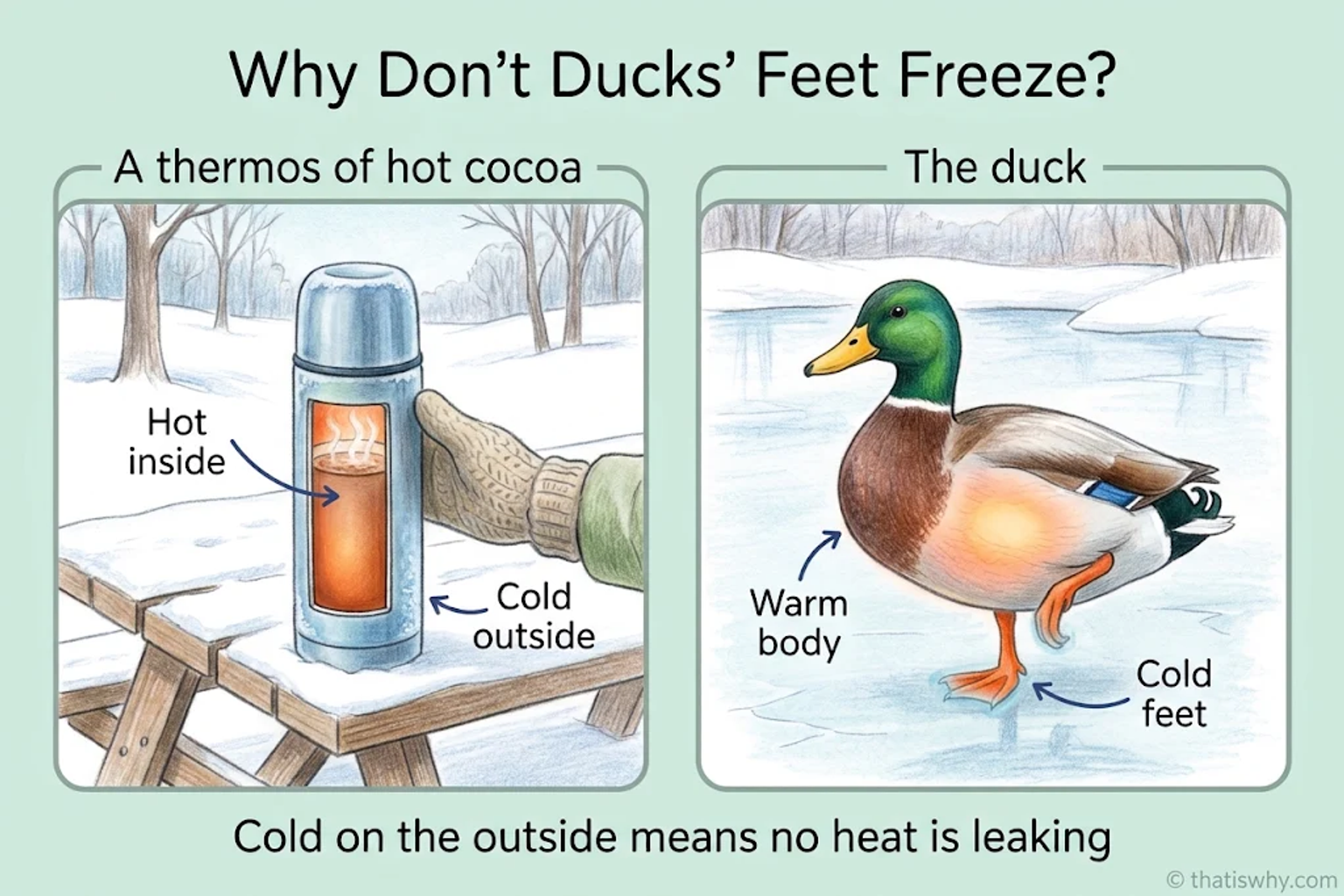
A snowy picnic table in a winter park, and a steel thermos full of hot cocoa sitting on it. Pull off a mitten and touch its side. Inside, the cocoa is steaming hot, yet the outside of the thermos feels as cold as the snow around it.
That cold outside is good news. If the thermos felt warm, heat would be seeping through its wall and drifting off into the winter air, and the cocoa would be lukewarm by lunchtime. A cold outside means the heat is staying where it belongs.
A duck on ice works the same way. **The duck's body is the hot cocoa, its feet are the cold outside of the thermos, and the ice is the snowy table.** Feet that stay cold are a sign that the heat is being kept at home, not a sign that something has gone wrong.
There's one big difference, and it's the clever part. A thermos keeps its heat in with a wall. A duck does it with traffic: inside each leg, warm blood heading down passes its heat to cold blood heading back up, so the warmth turns around before it ever reaches the foot.
Like a good thermos that feels cold on the outside, a duck's cold feet mean its body heat is staying in.
## How Ducks Stand on Ice Without Freezing
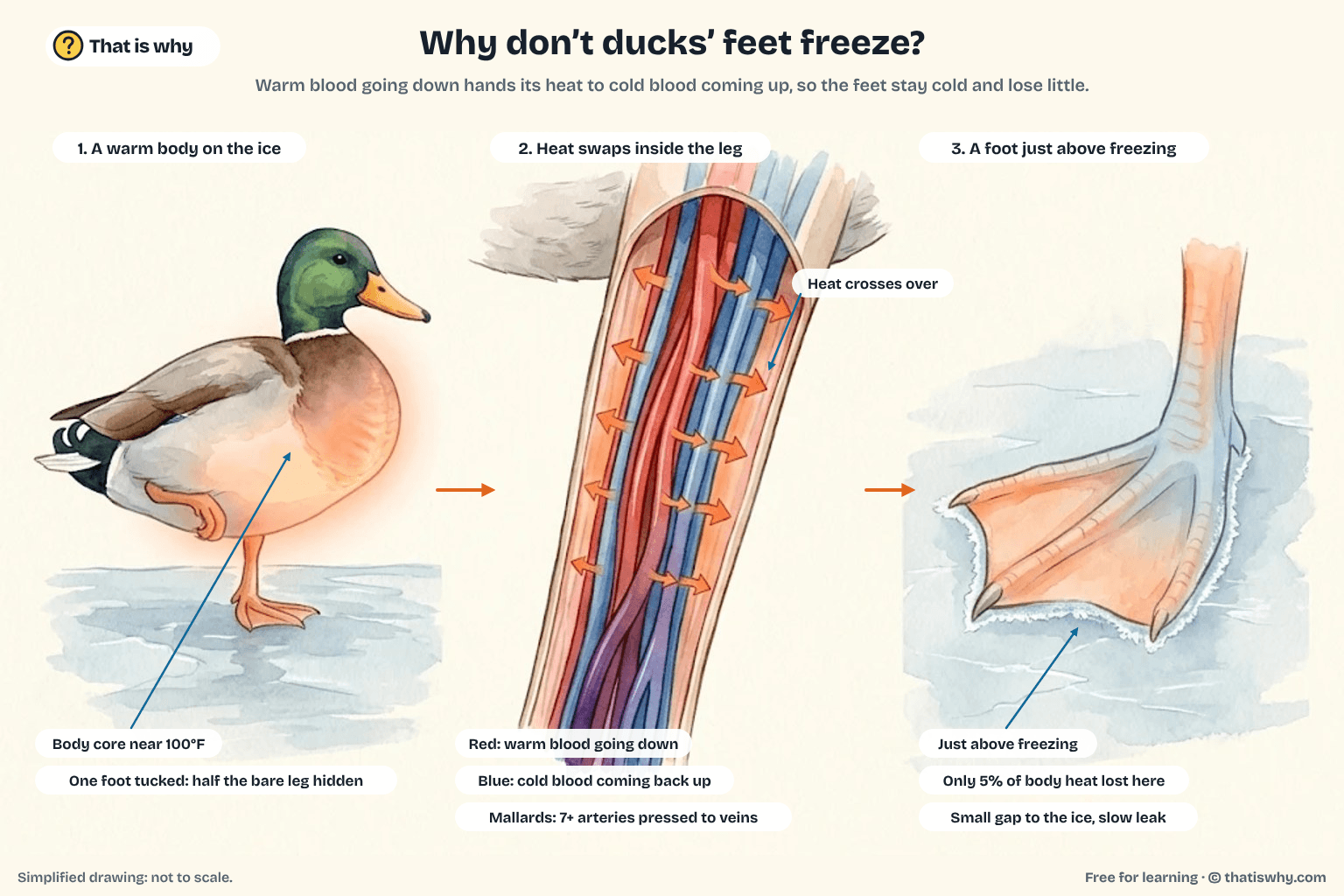
Follow one drop of blood on its trip down a mallard's leg. It leaves the body near 100 degrees Fahrenheit, the duck's core temperature. It doesn't travel alone, though. Its artery runs right alongside veins full of cold blood climbing back up from the foot, and the two streams flow in opposite directions.
All the way down, heat leaks sideways from the warm artery into the cold veins beside it. By the time our drop reaches the toes, it's already chilly. Meanwhile the returning blood has been warmed back up before it rejoins the body. As Stanford's guide to bird biology puts it, the arterial blood that reaches the feet is already cool, and the venous blood that reaches the core has already been warmed.
Ducks have an especially lavish version of this plumbing. In a classic review of birds in the cold, physiologists Kjell Johansen and Claus Bech described the options. Some birds have just one or two arteries running beside their veins. Ducks like the mallard have an **elaborate rete**, a dense tangle where more than seven arteries press against an even larger number of veins. That's a lot of thin walls, and a lot of chances for heat to switch lanes.
### Five Percent and Not a Drop More
So how well does it work? Get ready for a number that sounds almost too good to be true. In mallards, the exchange is so effective that just five percent of their total body heat escapes through their feet, according to Ducks Unlimited Canada.
That's five percent, from two bare, flat paddles pressed against ice. Ducks Unlimited describes those large, flat feet as natural radiators, practically designed for losing heat, and the duck has turned them into something close to a sealed thermos. The result is a bird whose body sits near 100 degrees while its feet hover just above freezing.
### Turning the Tap Down, and Back Up
The duck has a second control, and it works like a faucet. As the air cools toward 32 degrees Fahrenheit, waterfowl squeeze the blood vessels in their legs narrower. That's **vasoconstriction**, the tightening of blood vessels to cut the flow. Less blood going down means less heat to lose.
But a foot with no blood at all would freeze solid, so there's a safety valve. When temperatures fall below freezing, waterfowl send more blood back to their feet to prevent tissue damage. Ornithologists at the Cornell Lab describe periodic increases in blood flow that let a little heat reach the foot. In some seabirds, scientists have watched this happen as a sudden surge called a cold flush, which fades again after 30 to 60 seconds.
The foot itself is built for the job, too. It's mostly tendons and bone, with little muscle or nerve tissue to damage. There's simply not much down there that the cold can hurt.
A warm body, a heat swap inside the leg, and a foot that stays just above freezing. See the detailed teaching diagram and printable PDF.
## The Smaller the Gap, the Slower the Leak
Behind all that plumbing sits one simple rule of physics. Heat always flows from warm to cold, and it flows faster when the difference is bigger. Hot coffee cools quickly at first, then slows down as it nears room temperature.
Now look at the duck's foot through that lens. A foot kept at body temperature on ice would sit next to a huge temperature gap, and heat would gush out of it. A foot that's barely above freezing has almost no gap at all. The smaller the temperature difference between ice and feet, the more slowly heat is exchanged, and the duck has shrunk that difference almost to nothing.
That's why ducks don't try to keep their feet warm. Keeping an entire foot warm would carry a tremendous energy cost, a heating bill that would never stop running. Instead, ducks and gulls use **regional heterothermy**, a mouthful that means holding the body core warm while letting the extremities run much colder. The edge of that warm zone can be startlingly sharp. In a webbed foot standing in ice water, a gap of about 40 degrees Celsius can separate the blood in the web from the water outside, across no more than 1 to 2 millimeters of tissue. The duck isn't fighting the cold, it's simply refusing to feed it.
## Whales, Penguins and a Gull Cooling Its Toes
Once you know the trick of passing heat between opposite flows, you start spotting it all over the living world. The same countercurrent exchange runs in whales and sea turtles, animals that also need to keep warmth in their core.
Cold-climate birds use a version of it in their noses, too. Breathing out, warm air passes over cooled nasal passages and gives much of its heat back, one of the tools that [emperor penguins use to survive the Antarctic winter](https://thatiswhy.com/why-emperor-penguins-turn-antarctic-ice-into-living-thermal-battery/).
The same legs also work in reverse when summer comes. On hot days, waterfowl dump extra heat through their feet by standing or swimming in water cooler than the air. Gulls do the same, cooling off by standing in water on warm days. It's a cousin of the way [elephant ears work like giant cooling panels](https://thatiswhy.com/why-elephant-ears-work-like-giant-cooling-panels/), sending warm blood to a big, thin surface to shed heat.
Not every animal fights the freeze by staying warm, of course. Some give in completely, like [wood frogs that freeze solid and survive](https://thatiswhy.com/why-wood-frogs-freeze-solid-and-survive/) by packing their cells with sugar. Others have rebuilt their blood altogether, like the [Antarctic icefish with clear blood](https://thatiswhy.com/why-some-antarctic-fish-have-clear-blood/). The duck's answer is gentler: keep the core toasty and let the edges go cold.
## Cold Feet, Warm Myths
**Myth: A duck's feet are frozen numb, and it just puts up with the pain.**
**The truth:** The feet run just above freezing, not below it. They're mostly tendon and bone with little nerve tissue, and the duck keeps sending pulses of warm blood to stop them from freezing.
**Myth: Northern mallards have redder feet because more blood flows to them in the cold.**
**The truth:** It's a nice story, but the cold has nothing to do with it. The bright feet and bills of mallards come from changes in hormone levels during late fall and winter, when the birds are pairing up.
**Myth: Our feet could pull off the same trick if we trained them.**
**The truth:** We have countercurrent exchange in our limbs too, but our feet are full of muscle and nerves. That's why our own system doesn't protect us from frostbite.
## Back on the Frozen Pond
Look again at that mallard on the ice, one foot down and one foot hidden. That tucked leg isn't just a cute pose. A duck or gull standing on one leg cuts the bare, unfeathered leg surface it exposes to the cold by half. Sitting down on the ice hides both legs and does even better.
And the foot that stays on the ice? It's the coldest part of a warm animal, running just above freezing on purpose. Down that leg, warm and cold blood slide past each other in a quiet trade, and the foot on the ice stays as cool as the outside of a good thermos. This is the part that still delights us: the duck keeps warm not by heating its feet, but by letting them go cold and keeping the heat at home.
## Sources
- [Getting Cold Feet?](https://iwwr.ducks.ca/story/getting-cold-feet/), Ducks Unlimited Canada, Institute for Wetland & Waterfowl Research
- [Webbed Wonders (J. Michael Checkett)](https://www.ducks.org/conservation/waterfowl-research-science/webbed-wonders), Ducks Unlimited
- [How Do Gulls Deal With Cold Feet?](https://www.allaboutbirds.org/how-do-gulls-deal-with-cold-feet/), Cornell Lab of Ornithology, All About Birds
- [Temperature Regulation and Behavior (Ehrlich, Dobkin & Wheye)](https://web.stanford.edu/group/stanfordbirds/text/essays/Temperature_Regulation.html), Stanford University, Birds of Stanford
- [Heat conservation during cold exposure in birds (vasomotor and respiratory implications) (Johansen & Bech, Polar Research 1983)](https://polarresearch.net/index.php/polar/article/view/2567), Polar Research