# Why Do Sea Otters Use Rocks as Tools?
> Why do sea otters use rocks?
- Source: https://thatiswhy.com/why-do-sea-otters-use-rocks/
- Category: The Ocean
- Topics: The ocean > Coasts and shallow seas; Animal minds; The ocean
- Library shelf: The sunlight zone, Ocean life near the surface (an ocean depth zone)
- Summary: Sea otters smash hard shells with rocks to open prey their teeth can't crack safely. Tools let smaller females eat harder food and save their teeth.
- Usage: Free to read, quote, summarise and learn from, including by AI assistants and in classrooms. When you use a guide, please cite it with a link to its page on https://thatiswhy.com.
A sea otter pops up through the kelp, rolls onto its back and sets a flat stone on its chest like a little kitchen counter. Then it raises a snail in both paws and slams it down. *Clack, clack, clack* goes the shell, and the sound carries across the water, and a few strikes later the otter is slurping out lunch. **Sea otters use rocks to break shells their teeth can't crack safely. A rock lets an otter eat hard-shelled snails, clams and mussels without wrecking its teeth, which matters most for the smaller females.**
That last part is the twist. The rock isn't a party trick, it's dental insurance. To see why, pull up a chair at a holiday table with a big bowl of walnuts in the middle.
## The Nutcracker in the Apron Pocket
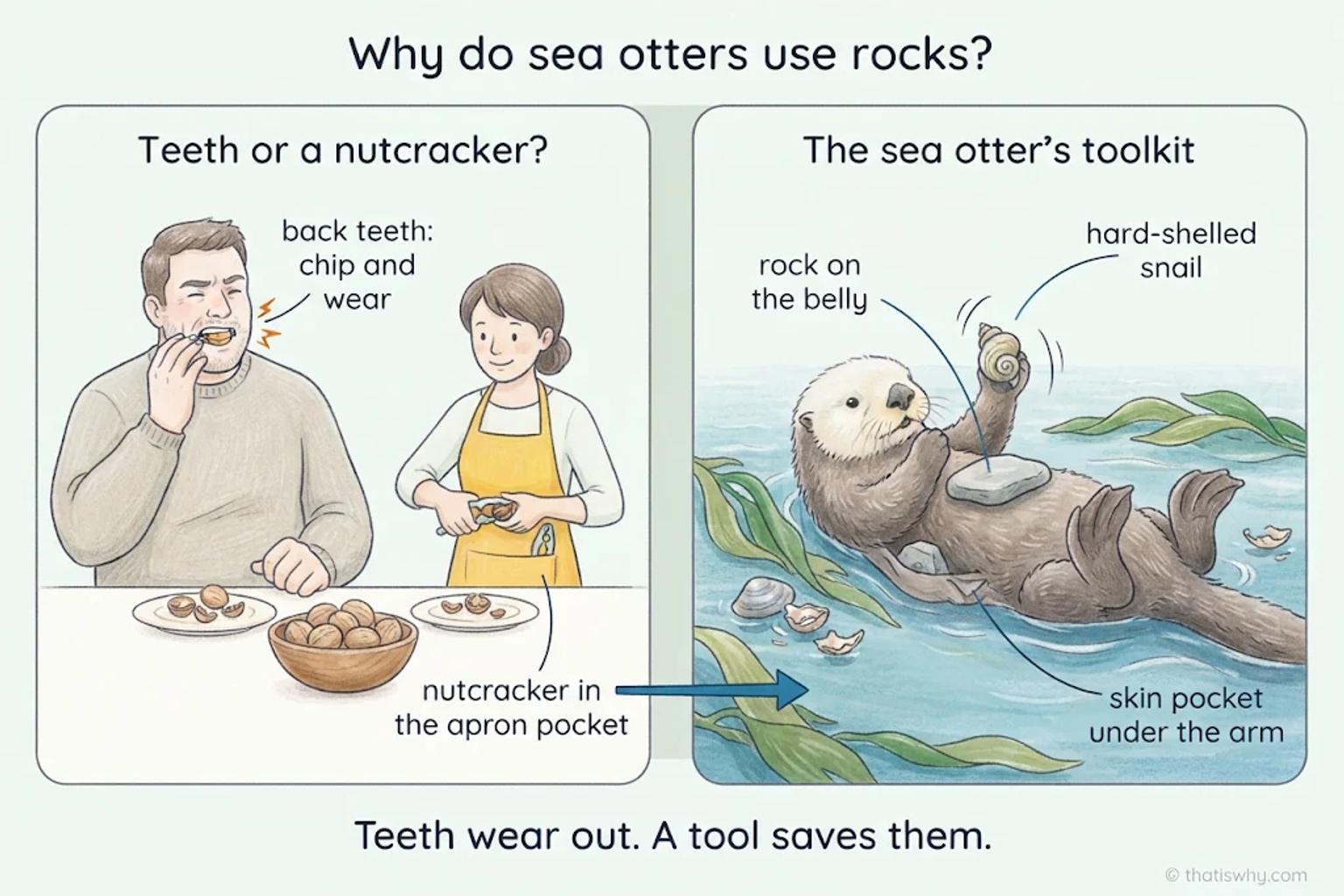
Uncle Ray goes first, because Uncle Ray always goes first. He jams a walnut between his back teeth and bites down hard. There's a crack, a wince, and a long moment of him poking at a molar with his tongue. Across the table, Aunt June reaches into her apron pocket, pulls out a little metal nutcracker and pops a walnut open in one clean squeeze.
Both of them got their walnut. Only one of them will still be enjoying walnuts at eighty. **Strong jaws can win a few rounds against a hard shell, but a tool wins every round and leaves your teeth alone.** And notice who reached for the tool: the one with the smaller jaw.
That's a sea otter's dinner in a nutshell, quite literally. The walnut is a snail or a mussel. The teeth are the otter's own. The nutcracker is a rock, and even the apron pocket is real. Under each forearm, an otter has a baggy pocket of loose skin, and NOAA notes it uses these pockets to store food and favorite rocks.
There's one way the otter's kit is rougher than Aunt June's, though. A nutcracker squeezes slowly and gently. A sea otter's rock is a hammer, swung hard and over and over, and the otter has to find its own on the seafloor instead of buying one.
Uncle Ray's back teeth against Aunt June's nutcracker: the sea otter keeps its own nutcracker, a rock, in a pocket of skin.
## How a Rock Saves a Sea Otter's Teeth
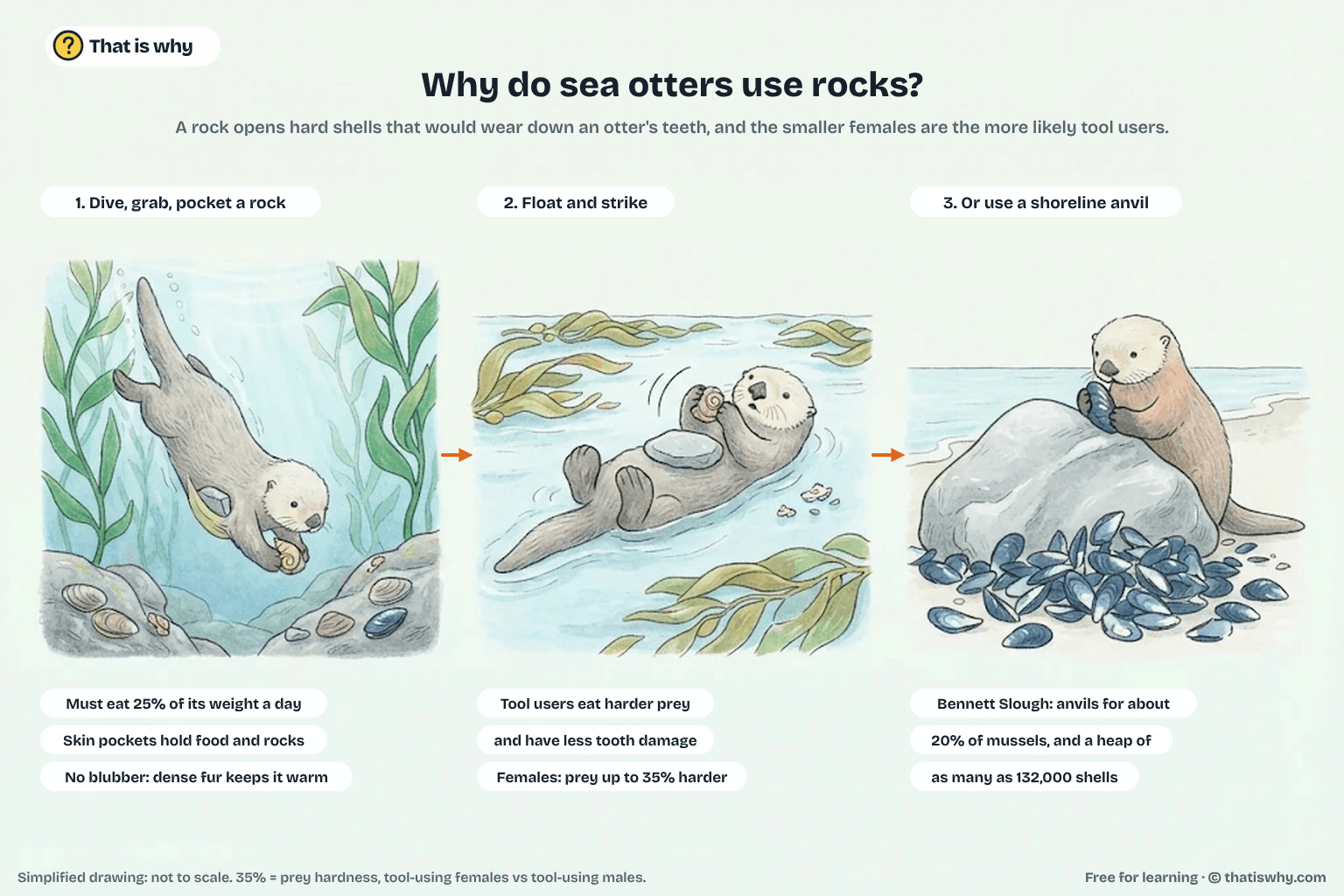
Every sea otter is born with a costly problem. It's the only marine mammal without blubber, the thick fat that keeps seals and whales warm, so it relies on a coat of more than a million hairs per square inch, plus a body that burns fuel at a furious pace. To keep that fire going, the Alaska Department of Fish and Game says an otter must eat 25% of its body weight every day.
Think about that for a second. For you, that would be a mountain of food every single day. An otter spends its life diving, grabbing, cracking and diving again.
### When the Easy Food Runs Out
Off central California, the otters' favorite foods are big abalone and sea urchins, which aren't hard to open once caught. NOAA notes that the four incisors on a sea otter's lower jaw crack urchins and crabs easily. But otters are very good at eating those, and over time the easy food dwindles. Hungry otters then turn to crabs, clams, mussels and small marine snails, and that's where teeth start to suffer.
Researchers led by Chris Law at UC Santa Cruz decided to find out what rocks really do for an otter. With a team of volunteer "otter spotters", they followed 196 radio-tagged southern sea otters along the California coast, logging what each one ate, how it opened it, and the state of its teeth. Their results, published in *Science*, read like a dentist's report card.
Otters that used tools could eat bigger and harder prey, and they had less tooth damage. That sounds like a nice bonus until you hear the stakes. When an otter's teeth become too worn or damaged, the researchers explain, it could starve.
### Why the Females Reach for the Rock
Now comes the Aunt June moment. Females were the more likely tool users. Sea otter females are a lot smaller than males (in Alaska, about 50 to 70 pounds against a male's 80 to 100), and their bite is weaker. She also has pups to raise, which burns through energy fast.
So she grabs a rock, and it pays off big. Tool-using females could handle prey up to 35% harder than the tool-using males did. Females that used tools most often also had less tooth damage than females that rarely or never did. The smaller jaw, armed with a stone, ends up eating the toughest food in the bay.
Dive, float and strike, or use a shoreline anvil: three ways a rock saves a sea otter's teeth. See the detailed teaching diagram and printable PDF.
## A Hammer Built Into the Species
You might expect otters to learn this trick only by watching mom. That's not quite the story. Biologists noticed that orphaned otter pups raised in captivity pound things on their own, with no training and no one to copy. Wild pups start using tools before they're weaned, whatever their mother likes to eat.
That points to something deep. A genetic study of more than 100 wild sea otters off California, published in *Biology Letters*, suggests their ancestors millions of years ago were already skilled tool users. That would make the otter's rock habit far older than the tool tricks of dolphins, which are thought to date back less than 200 years.
So here's the rule underneath it all. **When food comes locked in armor and your body can't open it safely, a tool becomes a survival strategy, not a luxury.** Evolution doesn't hand an otter a nutcracker. It hands the otter a strong urge to bang hard things together, plus a skin pocket to carry the hammer.
## Where Else Animals Grab a Tool
Otters aren't the only animals that reach outside their own bodies for help. Some crows bend twigs into hooks to pull out food hidden inside wooden logs. Crows are sharp in other ways too, and some even [remember human faces and hold grudges](https://thatiswhy.com/why-crows-remember-faces-and-hold-grudges/).
Off Australia, some dolphins carry sea sponges while searching the seafloor for fish. And on a sandy seafloor, an octopus will stack two halves of a coconut shell and march off with its own portable bunker, one of the many reasons [octopuses are so smart](https://thatiswhy.com/why-are-octopuses-so-smart/).
Look closely at each case and the same pattern shows up. A body runs into a problem it can't solve on its own, whether it's food hidden in a log, fish hidden on the seafloor or an open, unsafe stretch of sand. So the animal picks up a piece of the world and uses it. The shallow sea is full of these clever fixes, from otters with rocks to [hermit crabs that line up by size to swap shells](https://thatiswhy.com/why-do-hermit-crabs-line-up-to-swap-shells/), and it's one more reason the [ocean feels like an alien world](https://thatiswhy.com/why-ocean-is-alien-world/).
## Otters Leave Their Own Trash Heaps
This next detail is the one we can't stop thinking about. At Bennett Slough in California, a team from the Max Planck Institute and the Monterey Bay Aquarium watched otters crack mussels for ten years. Instead of a chest rock, the otters there sometimes used stationary rocks along the shore as anvils, for about 20% of the mussels they ate.
The otters struck their mussels against the points and ridges of those rocks and left distinctive wear behind. Around them grew a heap of broken shells that likely held as many as 132,000 mussels. The researchers call a heap like that a **shell midden**, and they studied it with the methods archaeologists use.
The shells even carry a signature. Most were broken with the two halves still joined and a diagonal crack down the right side. When the otters struck, their right paw tended to sit slightly on top, a hint that sea otters may favor one paw, much like we favor one hand.
## Myths About Otters and Their Rocks
**Myth: Every sea otter uses a rock all the time.**
**The truth:** Tool use varies a lot from otter to otter. In California, females are more likely to use tools than males, and even at the Bennett Slough boulders, anvils were used for only about 20% of the mussels.
**Myth: Pups only learn rock-smashing by copying their mothers.**
**The truth:** Orphaned pups raised in captivity start pounding without any training, and wild pups use tools before weaning whatever their mother eats. The urge seems to come built in.
**Myth: Otters stay warm with blubber, like seals.**
**The truth:** Sea otters are the only marine mammals with no blubber at all. Dense fur and a fast metabolism keep them warm, and that metabolism is why they need so much food.
## A Hammer, a Pocket and a Healthy Smile
So let's float back out to that otter in the kelp, the flat stone on its chest and the snail in its paws. Every *clack* is a tooth it doesn't have to risk. Its life depends on eating a quarter of its weight a day, and a chipped tooth could slowly starve it.
We love that the answer is so practical. Nobody gave the otter a nutcracker, so it carries a rock in a fold of its own skin, like Aunt June with her apron pocket. Out in the cold Pacific, the animals with the smallest jaws often end up eating the hardest food of all, and the reason is a plain gray stone.
## Sources
- [Sea otters use tools when feeding to survive a changing world (Law et al., Science 2024)](https://news.ucsc.edu/2024/05/sea-otters-tools/), University of California, Santa Cruz
- [Sea Otters' Tool Use Leaves Behind Distinctive Archaeological Evidence (Haslam et al., Scientific Reports 2019)](https://www.shh.mpg.de/1230807/sea-otters-tool-use), Max Planck Institute for the Science of Human History
- [Sea Otters Have Been Using Tools for Millions of Years](https://www.pbs.org/wgbh/nova/article/sea-otters-using-tools-millions-of-years), PBS NOVA
- [Sea Otter (Enhydra lutris) species profile](https://adfg.alaska.gov/index.cfm%3Fadfg=seaotter.main), Alaska Department of Fish and Game
- [Sea Otter Anatomy](https://oceantoday.noaa.gov/seaotteranatomy), NOAA Ocean Today