# Why Do Sea Cucumbers Throw Out Their Guts?
> Why do sea cucumbers eject their organs?
- Source: https://thatiswhy.com/why-do-sea-cucumbers-throw-out-their-guts/
- Category: The Ocean
- Topics: The ocean > The deep sea; Life that breaks the rules
- Library shelf: The abyss, Pressure, cold & the seafloor (an ocean depth zone)
- Summary: Sea cucumbers eject their guts, possibly as a decoy for predators. Nerves soften their tissue so it tears open, and a new gut grows back in about four weeks.
- Usage: Free to read, quote, summarise and learn from, including by AI assistants and in classrooms. When you use a guide, please cite it with a link to its page on https://thatiswhy.com.
A crab clamps its claw on a sea cucumber, a soft, sausage-shaped animal creeping across the seafloor, and holds on tight. The sea cucumber has one bizarre move left. It does something no sane animal should: its body tears open, and a tangle of guts spills out into the water. **Sea cucumbers throw out their guts on purpose, possibly as a decoy that keeps a predator busy while they crawl away, and perhaps also to dump parasites or waste. Their nerves soften special tissue until it gives way, and they grow a new gut in a matter of weeks.**
And here's the twist: the sea cucumber survives. To see how a body can come apart and stay alive, step off the seafloor and onto a playground.
## The Jacket Left in the Chaser's Hands
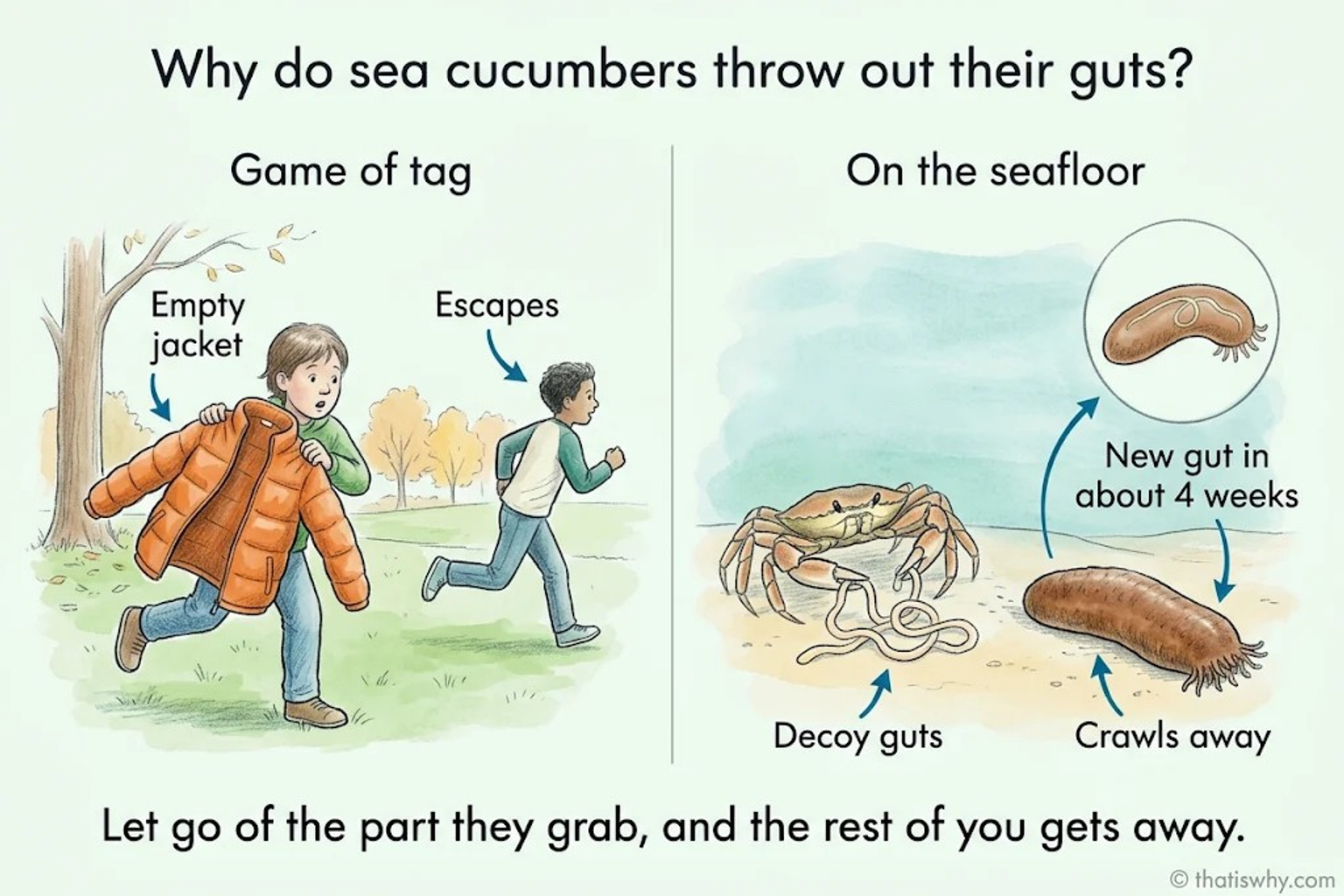
A game of tag is roaring across a park on a chilly afternoon. One kid is almost caught, and the chaser lunges and grabs the back of a big, unzipped puffy jacket. Instead of stopping, the kid flings both arms straight back, twists, and slides right out of it.
For one glorious second, the chaser stands there clutching an empty jacket. By the time they look up, the kid is halfway across the grass. The grab worked, but it got the wrong thing.
Like a kid slipping out of a grabbed jacket, the sea cucumber lets the predator keep the part it grabbed.
That's a sea cucumber's escape plan. A predator grabs, the animal lets go of something that feels like a meal, and the rest of the body slips away. Of course, a kid sheds the outside layer and pulls another jacket from the closet. A sea cucumber does the whole trick inside out. It gives up its insides, and it has to grow the replacement itself.
## Collagen That Melts on Command
So how does a body come apart on cue without simply falling apart? The secret is a material called **mutable collagenous tissue**: connective tissue, built from the tough protein collagen, that can change how stiff it is. Being able to do this quickly, under the control of nerves, is a trick unique to **echinoderms**, the group of sea animals that sea cucumbers belong to.
A 2023 review in *Marine Drugs* by Maria Byrne of the University of Sydney walks through exactly how sea cucumbers use it. Most of the time the tissue holds firm, which keeps the animal in one piece. When the nerves give the signal, certain parts simply stop holding on.
### Three Seams That Let Go
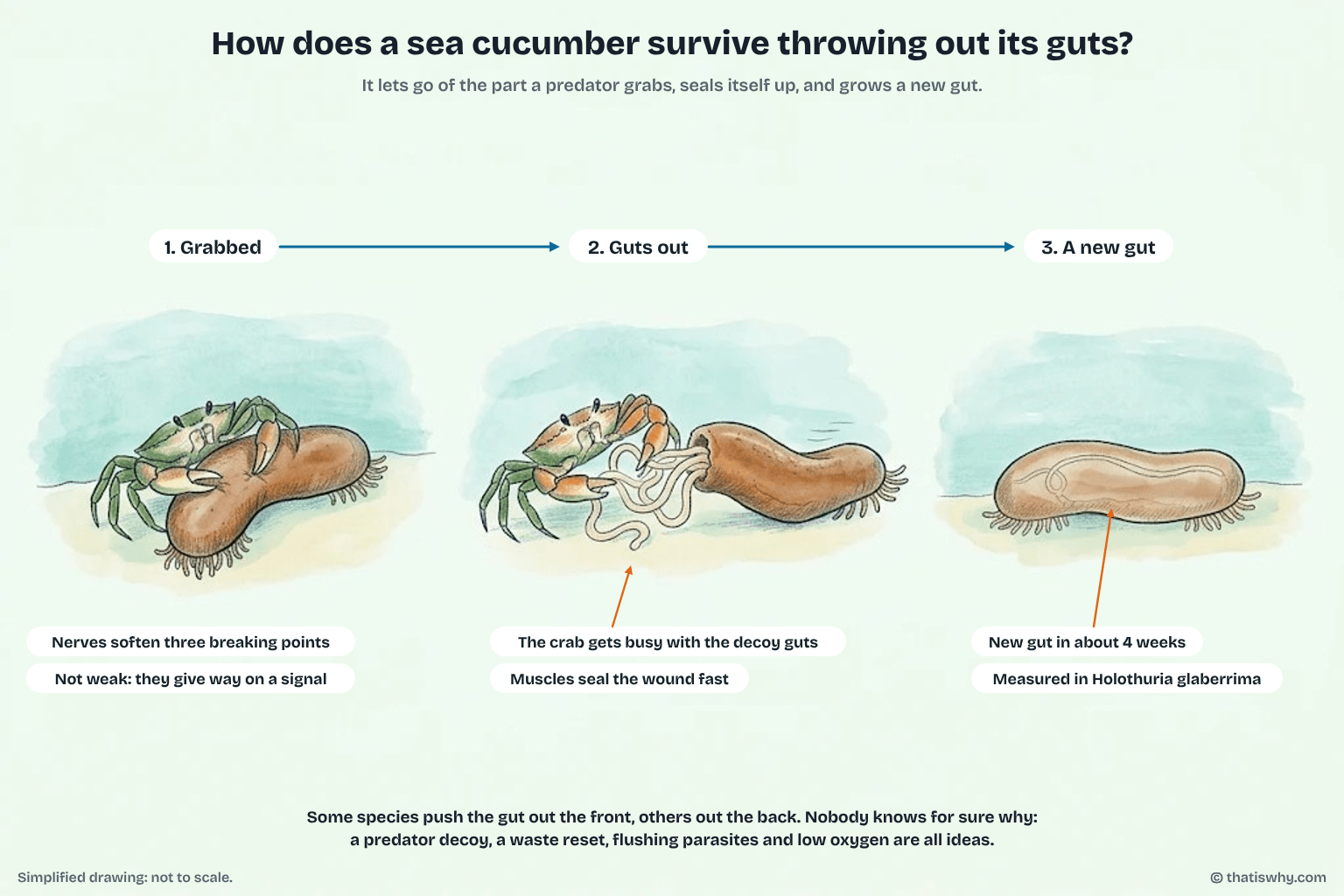
The review focuses on two groups of sea cucumbers. In Byrne's words: "Species in the genera Eupentacta and Sclerodactyla are notoriously prone to eviscerate." Their bodies have three built-in breaking points. The first is the **introvert**, a soft section of body wall at the front end. The second is the tendon of the muscle that pulls the throat back into the body. The third is the narrow spot where the gut joins the **cloaca**, the chamber at the back end.
When the signal comes, the introvert turns from firm and cloudy to thin and see-through, as its skin changes from a gel into something closer to a liquid. Then the thinned wall bursts open. The tendon gives way, and the gut snaps at its narrow joint near the cloaca.
Out comes a startling haul: the gut, the tentacles, the throat, a gush of body fluid and even the ring of nerves around the mouth. Byrne notes that the animal gives up whole organ systems and a large share of its body mass in one go. Muscles then squeeze the wound shut fast, and what's left of the sea cucumber gets on with its life.
Here's the part that surprised us most. You might guess these seams are just weak spots that rip under stress, but they aren't. Byrne puts it bluntly: "Biomechanical tests show that these structures are not inherently weak." They hold tight until the nerves tell them to let go, and anesthetics that quiet the nerves can stop the whole process cold.
### Front Door or Back Door
Not every sea cucumber uses the same exit. Species like *Eupentacta* blow their insides out the front, through a split in the body wall near the head. Others, in the group that includes *Holothuria*, push the gut out the back through the anus. As NOVA puts it, depending on the species, the organs leave through the head or the rear end.
### How Sea Cucumbers Regrow Their Guts
The real magic is what happens next. Researchers in José García-Arrarás's lab study a species called *Holothuria glaberrima*, which regrows its gut after throwing it away. The new gut begins as a thickening along the edge of the **mesentery**, the thin sheet of tissue that used to hold the old gut in place.
Cells there **dedifferentiate**, which means they drop their specialized jobs and become all-purpose builders again, and the thickening swells into the start of a new intestine. Lining cells then migrate and multiply from the esophagus and the cloaca to form the hollow inside of the tube. About four weeks after the sea cucumber emptied itself out, it has a brand-new intestine.
Grabbed, guts out, and a new gut weeks later. See the detailed teaching diagram and printable PDF.
## Why Losing Your Insides Can Pay Off
Dropping part of your body to survive has a name: **autotomy**, which means self-amputation. The deal is simple, if brutal. Losing a piece hurts, but losing the whole animal ends everything. A body that can give up a part, seal the wound and regrow it turns a deadly attack into a bad month.
Scientists still aren't sure exactly what sea cucumbers gain. NOVA admits it plainly: "Now, no one's quite sure why evisceration happens." Byrne's review describes two ideas. The gut could be a **predator decoy**, or a kind of reset that dumps waste built up in the body. NOVA adds two more: a way to flush out parasites, and a response to stress, such as water that runs too low on oxygen.
Those ideas don't have to compete with each other. The same drastic trick could save a sea cucumber from a crab one day and from a load of parasites another.
## Escape Artists That Leave Pieces Behind
Sea cucumbers aren't the only animals that pay with a body part. As Science News points out, some lizards shed their still-wriggling tails to distract predators. It's the same bet, made on dry land.
Some sea cucumbers even carry a second, stickier weapon. The black sea cucumber, *Holothuria leucospilota*, which researchers call the most dominant sea cucumber in the South China Sea, fires a silky, sticky tangle of tubes out of its rear. These **Cuvierian tubules** look like intestines but evolved from the animal's breathing organs. The sticky threads can stop fish, crabs and starfish in their tracks, and like a lizard's tail, the organ grows back after use.
Other animals gamble differently when they're cornered. An opossum [plays dead when a predator grabs it](https://thatiswhy.com/why-do-opossums-play-dead/), betting that a "corpse" looks like a bad meal. A pufferfish goes the other way and [puffs up into a spiky ball too big to swallow](https://thatiswhy.com/why-do-pufferfish-puff-up/). Lending a predator something to chew on is a cousin of that trick, the same kind of misdirection that explains [why evolution favors the liar](https://thatiswhy.com/why-evolution-favors-liar-science-of-deception/). And when it comes to regrowing what's lost, sea cucumbers keep company with the [axolotl, which can regrow limbs and even parts of its heart](https://thatiswhy.com/why-axolotl-never-grows-up/).
Sea cucumbers also reach places that lizards never will. On a NOAA expedition to the Clarion-Clipperton Zone, scientists counted at least 10 species of giant sea cucumbers on the deep seafloor, one of them photographed at 5,100 meters on the deep seabed. Some plow through the sediment, while others swim up off the bottom. They live every day under the pressure that explains [why deep-sea animals don't get crushed](https://thatiswhy.com/why-dont-deep-sea-animals-get-crushed/), part of the long list of [unusual adaptations of deep-sea animals](https://thatiswhy.com/unusual-adaptations-of-deep-sea-animals/).
## Gutsy Myths, Set Straight
**Myth: A sea cucumber that throws out its guts is dying.**
**The truth:** It's built to survive the loss. Muscles seal the wound quickly, and in *Holothuria glaberrima* a new intestine forms in about four weeks.
**Myth: The guts burst out because the body is weak and tears under pressure.**
**The truth:** The tests in Byrne's review show the breaking points are not weak at all. The nerves soften them on purpose, and anesthetics can block it.
**Myth: Every sea cucumber blows out its guts the same way.**
**The truth:** Some species push them out the front, near the tentacles, and others out the back. Some species also carry a separate sticky organ, the Cuvierian tubules, to fire when attacked.
**Myth: Scientists know exactly why they do it.**
**The truth:** Nobody knows for sure yet. Escaping predators, shedding parasites, clearing out waste and coping with low oxygen are all on the table.
## A Body Built to Come Apart
Back on the seafloor, the crab tugs at a tangle of spilled gut. It's busy, it's distracted, and it's holding the wrong thing. Inch by inch, the emptied sea cucumber slides away, already sealing itself up.
In about four weeks, it will be back on the seafloor with a brand-new gut. What still amazes us is that the sea cucumber's best defense is a body that knows exactly where to break. Like that kid sprinting across the grass, it doesn't win by holding on. It wins by knowing what to let go.
## Sources
- [Morphological, Physiological and Mechanical Features of the Mutable Collagenous Tissues Associated with Autotomy and Evisceration in Dendrochirotid Holothuroids (Byrne, Marine Drugs 2023)](https://mdpi.com/1660-3397/21/3/134), Marine Drugs (MDPI)
- [Sea Cucumber Evisceration (Anna Rothschild)](https://www.pbs.org/wgbh/nova/nature/sea-cucumbers.html), NOVA, PBS
- [Characterization of proteolytic activities during intestinal regeneration of the sea cucumber, Holothuria glaberrima (Pasten et al., Int. J. Dev. Biol. 2012)](https://ijdb.ehu.eus/article/113473cp), The International Journal of Developmental Biology
- [This sea cucumber shoots sticky tubes out of its butt. Its genes hint at how (Darren Incorvaia)](https://www.sciencenews.org/article/cuvierian-organ-sea-cucumber-defense-mechanism), Science News
- [The Weird and Wonderful Megafauna of the Abyssal CCZ (Craig Smith, DeepCCZ expedition log)](https://oceanexplorer.noaa.gov/explorations/18ccz/logs/june12/june12.html), NOAA Ocean Exploration