# Why Do Pufferfish Puff Up?
> Why do pufferfish puff up?
- Source: https://thatiswhy.com/why-do-pufferfish-puff-up/
- Category: The Ocean
- Topics: The ocean > Coasts and shallow seas; The ocean
- Library shelf: The sunlight zone, Ocean life near the surface (an ocean depth zone)
- Summary: Pufferfish puff up to become too big and spiky to swallow, pumping water into a stretchy stomach until they swell to three or four times their size.
- Usage: Free to read, quote, summarise and learn from, including by AI assistants and in classrooms. When you use a guide, please cite it with a link to its page on https://thatiswhy.com.
A little pufferfish putters along a reef, flapping its fins like a bumblebee that took up swimming. It's slow, it's chubby, and it looks like the easiest snack in the sea. Then a big fish opens its mouth nearby, and in a few frantic gulps the snack turns into a round, spiky ball. **Pufferfish puff up to become too big and too spiky to swallow. When threatened, they pump mouthful after mouthful of water into a super-stretchy stomach until they swell to three or four times their usual size.**
And here's the part that made us sit up: a puffed-up pufferfish keeps breathing, and breathing hard. To see how a fish can turn itself into a balloon and still catch its breath, start with something folded up inside your car.
## An Airbag Folded Into a Fish
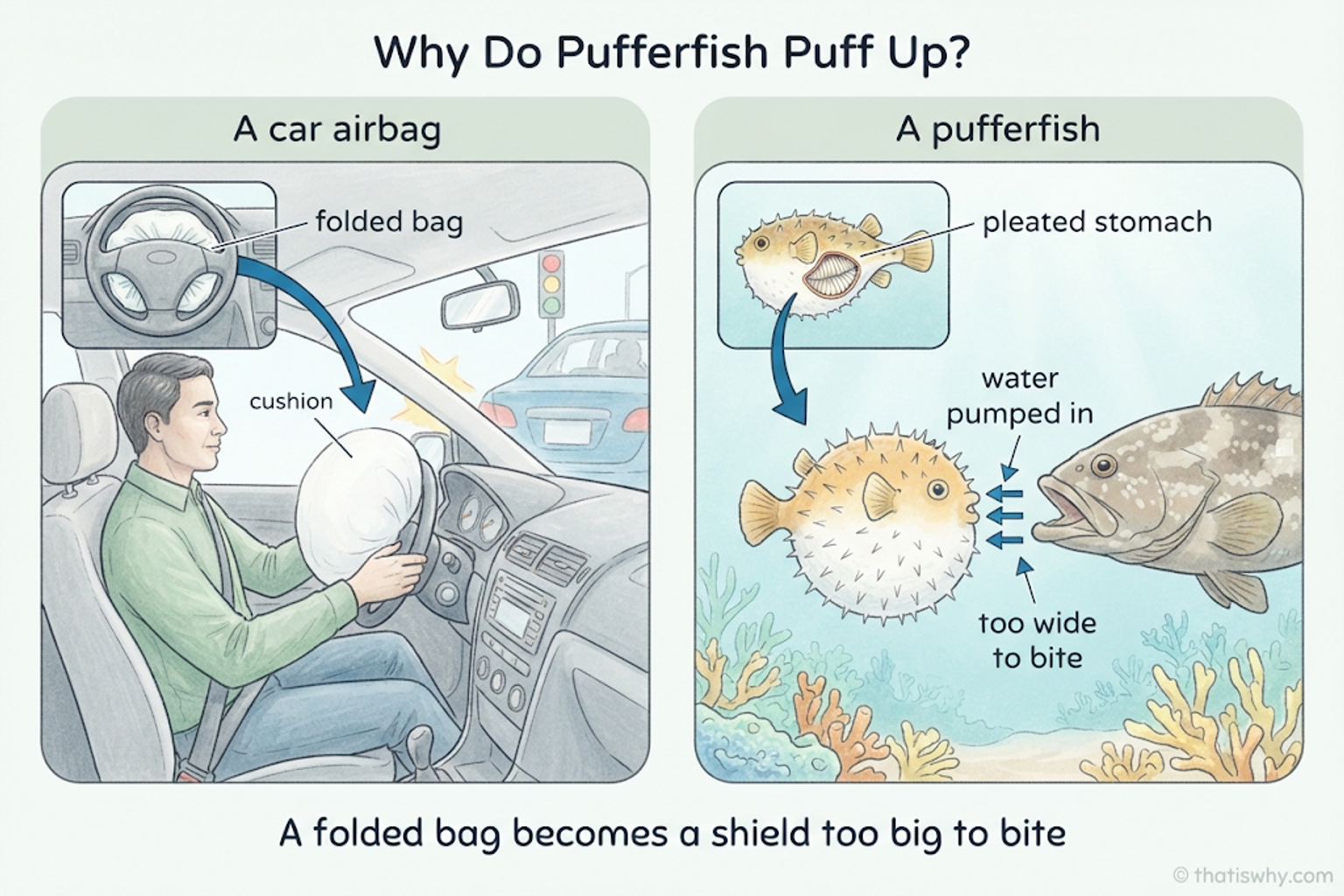
A driver taps the brakes a second too late at a red light. There's a crunch, and before the driver can even blink, the steering wheel bursts open. A bag that sat folded into a small, flat pad unfurls into a fat round cushion. It lands right between the driver's face and the hard dashboard.
A pufferfish carries its own airbag. The folded pad is its stomach, packed with so many pleats that it can open out like a parachute. The crash sensor is the fish's alarm: a predator's lunge or a grab. And the cushion that pops up between the fish and danger is the fish itself, now round, wide and bristling with spines. **The trick isn't to fight the attacker, it's to stop fitting in its mouth.**
There's one big way the puffer beats your car, and one way it pays for it. A car's airbag fires once, with a single burst of gas, and then it's done for good. A pufferfish fills its bag with water, one gulp at a time, and it can let the water out and do it all again. But every refill costs it, as you'll see, a few hours of recovery.
An airbag bursts from a folded bag into a cushion; a pufferfish pumps water into its pleated stomach until it's too wide to bite.
## Mouthful by Mouthful: How a Pufferfish Puffs Up
Biologists Peter Wainwright and Ralph Turingan, then at Florida State University, put tiny electrodes on the muscles that run the show, in puffers and in their relatives. Their description is beautifully simple. The fish fills its body by grabbing mouthful after mouthful of water and pumping each one into an expandable stomach. This is **buccal pumping**, which means using the mouth and throat as a pump.
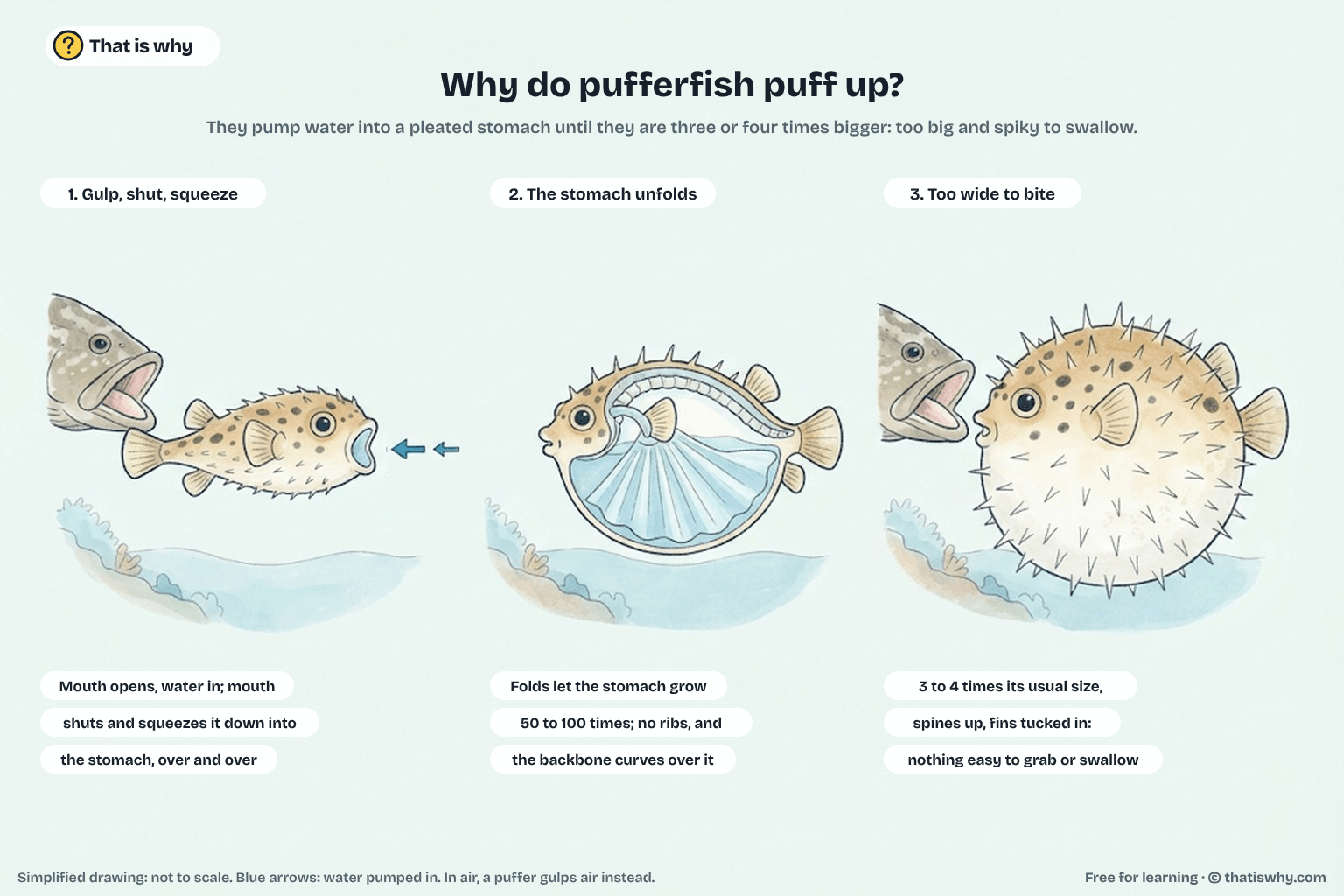
Each pump goes like this. The fish opens its mouth and lets water in, then snaps it shut and squeezes. Water has only one way to go, so it's forced down the throat into the stomach. Gulp after gulp, the bag fills.
### The Stomach That Unfolds
This is where the airbag really shows. The University of Texas Marine Science Institute explains that a puffer's stomach has so many folds that it can **expand by 50 to 100 times**, a stretch your own stomach could never dream of.
Even the lining of the belly, a thin membrane called the peritoneum, is pleated and unfurls along with it. The bag simply opens out, the way an airbag unfolds before it ever gets tight.
The rest of the body is built to get out of the way. Pufferfish skeletons have no ribs and no pelvis, so nothing stiff cages the swelling stomach, and the flexible spine curves over the top of it. As the fish turns round, the ball swallows even its back fin and tail fin, so an attacker has nothing easy to grab. On a spiny puffer such as the balloonfish, sharp spines stand up all over the skin. They're no decoration: London's Natural History Museum notes that the spines help reinforce that stretchy skin, as well as repelling anything trying to eat the fish.
### The Airbag That Took Over the Glovebox
Here comes a strange twist. A pufferfish stomach has mostly quit its day job. As The Scientist reported, pufferfish stomachs lost one of their sphincters (the muscle rings that close off the stomach) and the ability to produce stomach acid. The rest of the gut picks up the work, lined with acidic mucus all the way along. Kainã Fagundes, a marine biologist at São Paulo State University in Brazil, put it bluntly: "Basically all the digestive tract is a stomach."
### Still Breathing Inside the Balloon
The old textbook story said a puffed fish holds its breath. Its gills were supposed to shut down, while its skin soaked up oxygen to make up for it. A 2014 study in *Biology Letters* by Georgia McGee and Timothy Clark put that idea to the test with the black-saddled pufferfish, *Canthigaster valentini*.
The result flipped the story. While inflated, the fish took up oxygen through its **gills** at about **five times its resting rate**. Its skin, meanwhile, did almost nothing. Far from holding its breath, the puffer was panting.
That panting is the price of the airbag. After the fish let its water out, its oxygen use took an average of 5.6 hours to settle back to normal. The researchers think the fish leaned on **anaerobic metabolism**, making energy without enough oxygen, during the scramble before puffing and the hard work of gulping. So the bill comes due afterward.
Gulp, unfold, swell: how a pufferfish turns into a ball too wide to bite. See the detailed teaching diagram and printable PDF.
## Built From a Cough
So where does a crazy trick like this come from? The same Florida State team went looking, and the answer is wonderfully humble. It started with a cough.
As the biologists wrote, "Coughing behavior appears to be present in virtually all fishes." A fish squeezes its mouth to blast out water, along with any bits it can't eat. The pufferfish's relatives took that move and found new uses for it. Triggerfish blow jets of water to uncover their prey, and some use the same blowing to build their nests. Even the ocean sunfish, another puffer relative, blows water.
Now look at the puffer. The muscle movements are remarkably similar, but the direction flips. Instead of blowing the water out, a puffer keeps its mouth shut and forces the water down into its stomach. Seen side by side, the three behaviors form a family tree: blowing grew out of coughing, and puffing grew out of blowing.
That's the big rule hiding inside the balloon. **Evolution rarely invents from scratch; it bends an old move to a new job.** A cough became a water jet, and the water jet, aimed inward, became a shield.
## Other Fish That Blow Themselves Up
If the move is that easy to bend, you'd expect other fish to stumble onto it too. They have, and the same study points to one. A few species of filefish, close relatives of the puffers, have evolved a weaker version of inflation all on their own. Biologists call that **convergent evolution**: different animals arriving at the same answer separately.
Some inflaters aren't even close relatives. Researchers at Wilfrid Laurier University in Canada looked at other fish that inflate, such as the swell shark and the sargassum fish, and found that they still make stomach acid. In most of the species they studied, puffing up didn't cost a working stomach. The pufferfish is the one that went all in.
The sea is full of these last-ditch defenses, each strange in its own way. [Sea cucumbers throw out their own guts](https://thatiswhy.com/why-do-sea-cucumbers-throw-out-their-guts/) as a messy distraction, while [cuttlefish turn their skin into a living screen](https://thatiswhy.com/why-cuttlefish-dont-just-change-color/) to vanish or startle. On land, a cornered opossum goes the opposite way from a puffer and [plays dead](https://thatiswhy.com/why-do-opossums-play-dead/). And don't confuse a puffer with the swollen fish hauled up from the depths. Those fish [balloon because the gas inside them expands](https://thatiswhy.com/why-do-deep-sea-fish-explode-when-brought-up/), which is a disaster, not a defense. It's one more reason the [ocean feels like an alien world](https://thatiswhy.com/why-ocean-is-alien-world/).
## Myths of the Spiky Balloon
**Myth: Pufferfish fill themselves with air.**
**The truth:** In the sea they pump in water, and the stomach does all the stretching. They suck in air only when they're out of the water.
**Myth: A puffed-up pufferfish is holding its breath.**
**The truth:** The black-saddled pufferfish keeps its gills working hard while inflated, taking up about five times as much oxygen as at rest. Its skin barely helps at all.
**Myth: Pufferfish make their own poison.**
**The truth:** Many puffers carry **tetrodotoxin**, a nerve poison over 1,000 times more powerful than cyanide. But it's produced by bacteria that live on the food the fish eats. The puffer collects it and is immune to it thanks to a genetic mutation.
**Myth: Nothing can eat a puffed-up pufferfish.**
**The truth:** Only the toughest predators, such as tiger sharks, common octopuses and sea snakes, will take one on. Everyone else faces a swollen ball that is hard to swallow, covered in spines, and able to hold enough poison to kill several predators.
## A Cough That Became a Shield
Back on the reef, the big fish swims off, because a ball of spines isn't on its menu. The pufferfish lets out its water, shrinks back into its slow, chubby self, and spends the next few hours catching up on oxygen.
We love how ordinary the ingredients are. Nobody gave the pufferfish armor. Evolution took a cough, a stomach that could fold, and a body with no ribs to get in the way, and turned them into an airbag. It's a reminder that the strangest tricks in nature are often old habits, pointed in a new direction.
## Sources
- [Pufferfish: the underwater balloon of death](https://nhm.ac.uk/discover/pufferfish-underwater-balloon-of-death.html), Natural History Museum, London
- [All puffed out: do pufferfish hold their breath while inflated? (McGee and Clark, Biology Letters 2014)](https://pmc.ncbi.nlm.nih.gov/articles/PMC4298192), Biology Letters (via PubMed Central)
- [A Swell Adaptation](https://utmsi.utexas.edu/science-and-the-sea/print-article/a-swell-adaptation/), Marine Science Institute, The University of Texas at Austin
- [Evolution of pufferfish inflation behavior (Wainwright and Turingan, Evolution 1997)](https://fishlab.ucdavis.edu/wp-content/uploads/sites/397/2020/06/Wainwright-Turnigan-1997.pdf), Wainwright Lab, University of California, Davis
- [Pufferfish Don't Need Functional Stomach, Inflate Instead](https://www.the-scientist.com/pufferfish-don-t-need-functional-stomach-inflate-instead-70148), The Scientist