# Why Do Opossums Play Dead?
> Why do opossums play dead?
- Source: https://thatiswhy.com/why-do-opossums-play-dead/
- Category: Animals
- Topics: Deception
- Library shelf: The forest floor, Animal behavior & evolution (a theme shelf, not a habitat)
- Summary: Opossums play dead by reflex, not by choice. They go limp, gape and leak a corpse-like stink so a predator may give up, and the best evidence says they stay awake inside.
- Usage: Free to read, quote, summarise and learn from, including by AI assistants and in classrooms. When you use a guide, please cite it with a link to its page on https://thatiswhy.com.
A dog bursts across a dark backyard and clamps its jaws around an opossum. One hard shake, and the opossum is gone: it flops to the ground, lips pulled back from its teeth, mouth open and tongue hanging out. A sour, rotten smell rises from its rear end. **Opossums play dead because a predator's grab flips an automatic switch in their bodies. They collapse, gape and leak a corpse-like stink, so they look like spoiled, dead prey that a hunter may walk away from. They don't choose to do it, and the best evidence says they stay awake the whole time.**
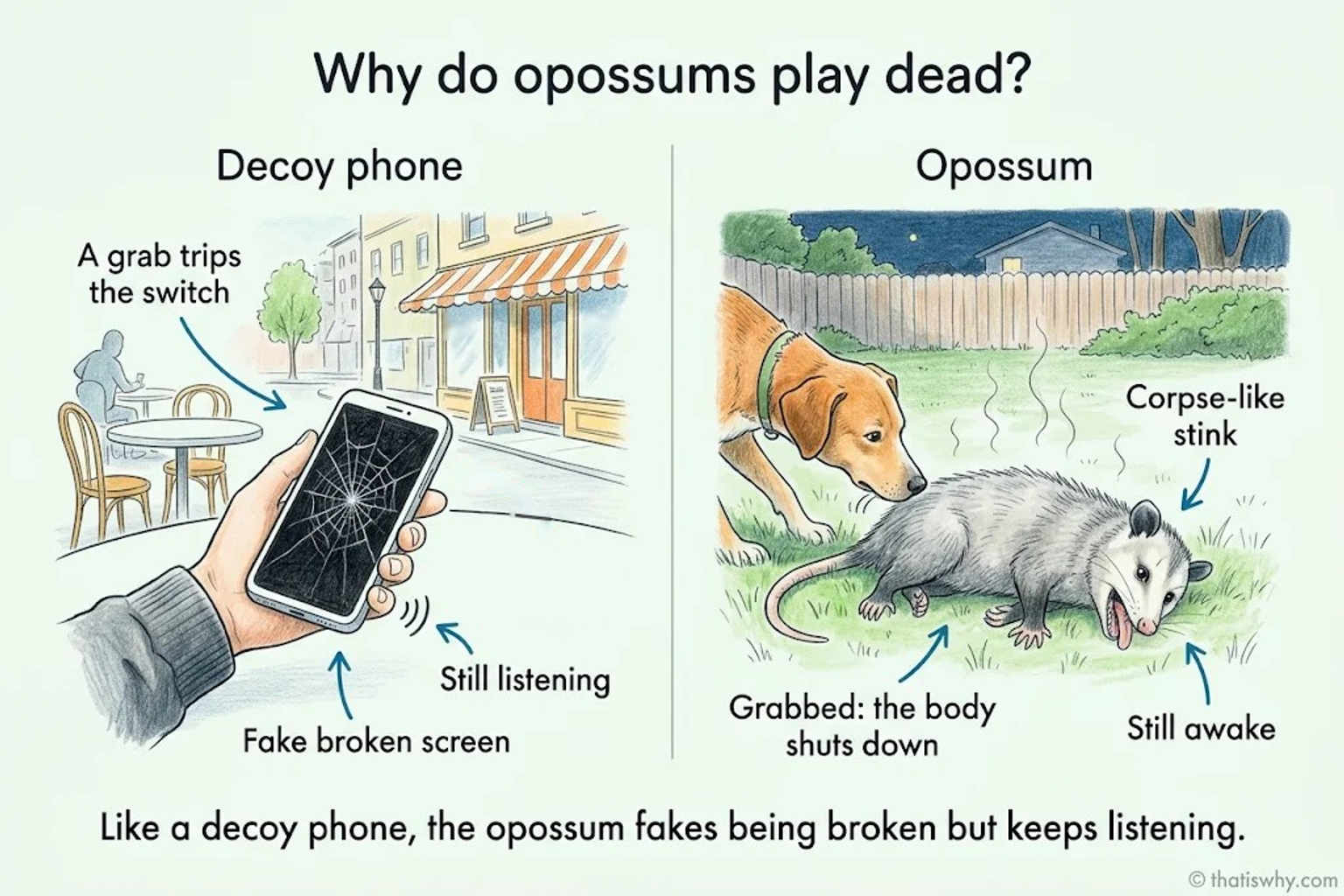
That last part is the real surprise. The "dead" opossum seems to be listening, and the easiest way to understand it is to think about a very clever phone.
## The Decoy Phone
Think of a phone built with one sneaky anti-theft trick. A thief snatches it from a café table and squeezes it tight. The moment that hand closes around it, a switch inside trips on its own.
The screen goes black and shows a spiderweb of fake cracks. The phone stops buzzing and lies there like a dead brick, with nothing worth stealing. Nobody pressed a button, because the grab itself set off the act.
Here's the clever part: the phone isn't really off. Its microphone is still listening, and its tracker is still running. The thief turns it over, frowns at the "broken" screen and tosses it in a bush. A few minutes later, when everything is quiet, the screen lights up again as if nothing happened.
Like a decoy phone, the opossum fakes being broken, but it keeps listening.
That's an opossum in a nutshell. The grab trips the switch, the body fakes being broken, and someone inside keeps listening. The opossum adds one thing no phone has: a stink that makes the "broken" goods smell spoiled too. But a phone can't be bitten, and an opossum can. If the predator decides to bite anyway, the decoy has no plan B.
## What Happens When an Opossum Plays Dead
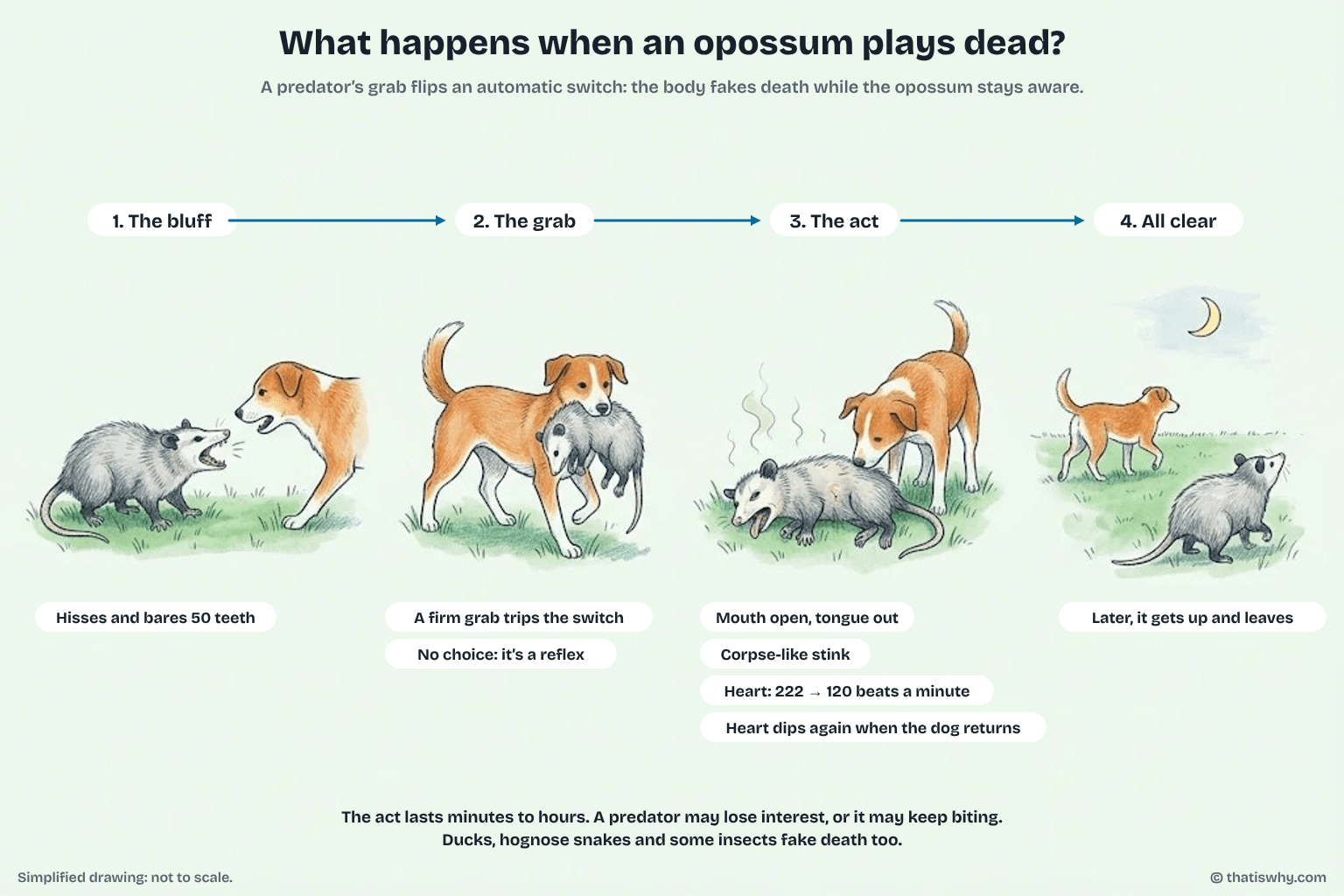
Every fake death starts with a bluff. The Virginia opossum is the only **marsupial** (a mammal whose babies grow up in a pouch) found north of Mexico, and it's a shy animal that would rather not fight. As Illinois Extension puts it: "When encountering a threat, the normally introverted opossum will hiss and bare all of those 50 teeth, the most of any of our mammals." That's a lot of teeth for an animal with no real plan to use them.
Sometimes the bluff is enough to send a predator away. When it isn't, and a predator actually grabs the opossum, the switch trips. A 2025 review by researcher Michael Woodruff at East Tennessee State University explains that strong touch and pressure, the kind a predator produces when it pins down its prey, is usually what sets it off, and that holds for the Virginia opossum too. Scientists call the state **tonic immobility**, or *thanatosis*: a frozen, death-like stillness that the body produces on its own.
Then the shutdown begins, and it's thorough. The opossum goes stiff and slumps to the ground. In the words of The Nature Conservancy: "Its teeth are visible, as if in a death grimace." Its mouth hangs open, its tongue lolls out, and it empties its bowels and leaks foul-smelling fluid from its rear, with a smell described as corpse-like. The strange part is that a healthy opossum is a fussy groomer and practically odorless the rest of the time. The stink is pure costume.
### A Heart That Slows Instead of Racing
Here's where it gets eerie. You'd expect a terrified animal's heart to pound, but the opposite happens. In a 1985 study in *Acta Physiologica Scandinavica*, researchers monitored four common opossums, close cousins of the Virginia opossum. Then they set off the fake death with rough handling by a person or a dog. Their heart rates fell from about 222 beats per minute to about 120. That's a drop of 46 percent, nearly half, in an animal that is fighting for its life.
Doctors call a slow heartbeat **bradycardia**, and it fits the act perfectly. A still, slow-breathing body sells the idea of a corpse. Yet the researchers saw something even stranger. When their dog came near the "dead" opossum again, its heart rate dropped once more. The researchers concluded that the animal was **fully conscious**, tracking every move, just like the decoy phone that keeps listening.
Not every source agrees on this point. The Nature Conservancy's blog says the opossum "basically faints and is in a state of unconsciousness." The heart-rate study is the stronger evidence, because a body that reacts to a returning dog is still paying attention.
How long does the act last? The Nature Conservancy puts it at anywhere from minutes to hours. Eventually the opossum lifts its head, sniffs the air and, if the coast is clear, trundles off as if nothing happened.
From bluff to fake death and back: the opossum's body runs the whole act. See the detailed teaching diagram and printable PDF.
## Why a Corpse Is a Bad Meal
So why would collapsing in front of a hungry predator ever work? It sounds like gift-wrapping yourself. The answer lies in how hunters hunt. A struggling animal keeps a predator's attack going. One long-standing idea, summed up in Woodruff's review, is that holding still takes away the very signals that push a predator to keep attacking. Stop wriggling, and you stop feeding the attack.
The stink adds a second message. To a hunter, a body that already smells rotten looks like a bad deal. The Nature Conservancy puts it simply: "A predator is confronted with what appears to be dead, unhealthy prey, and may leave the opossum alone."
That little word "may" is doing a lot of work. Playing dead is a gamble, not a guarantee, and Woodruff's review describes it as an inborn, last-resort response. It only has to win often enough to beat the alternative. National Geographic sums up the math nicely: moving guarantees death, while playing dead offers a small chance of survival. As researcher Ana Sendova-Franks of the University of Bristol told the magazine: "It's the last chance of your life."
> When running and fighting have both failed, sometimes the smartest move left is to stop moving.
## Fakers in Feathers, Scales and Shells
Opossums are the famous example, but they're far from alone. National Geographic notes that playing dead turns up across the animal kingdom, from birds to mammals to fish.
Ducks do it in a fox's jaws. In a 1975 experiment, scientists let captive red foxes hunt five species of ducks, and most of the ducks went limp as soon as they were caught. As the article reports: "Experienced foxes knew to kill or maim the ducks immediately, but inexperienced foxes sometimes left the supposedly dead ducks, allowing their quarry to escape." If you've ever wondered why [a group of foxes is called a skulk](https://thatiswhy.com/why-group-of-foxes-is-called-a-skulk/), these are the same sly hunters, and even they can be fooled.
Snakes may be the most dramatic actors of all. Woodruff's review quotes this description of the eastern hognose snake: "It defecates (or discharges its cloacal sacs), coils its tail like a pig's, turns over, and finally becomes quiescent." It's the opossum's routine, stink and all, performed by a reptile. Insects run the trick too. According to National Geographic, antlion larvae can hold the pose for 61 minutes, and Charles Darwin once watched a beetle play dead for 23 minutes. Some animals go a step further and hand the predator a piece of themselves: a [sea cucumber throws out its own guts as a decoy](https://thatiswhy.com/why-do-sea-cucumbers-throw-out-their-guts/).
Faking death sits in the same toolbox as other lies in nature. The fork-tailed drongo [shouts fake alarm calls to steal meals](https://thatiswhy.com/why-drongo-is-natures-con-artist/), and harmless [hoverflies dress up as stinging wasps](https://thatiswhy.com/why-hoverflies-look-like-wasps/). Each one sends a false signal that another animal has learned to trust. That's the big idea behind [why evolution favors the liar](https://thatiswhy.com/why-evolution-favors-liar-science-of-deception/), and a fake corpse is one of its boldest forms.
## Myths That Deserve to Stay Buried
**Myth: Opossums decide to play dead as a clever trick.**
**The truth:** The Nature Conservancy is blunt: "The opossum has no control over this; it's involuntary." It's a reflex set off by being grabbed, more like a flinch than a performance.
**Myth: A "dead" opossum has passed out and knows nothing.**
**The truth:** Even some nature writers say it faints, but in the 1985 heart-rate study the opossums' hearts slowed again when the dog came back. The researchers concluded the animals stayed fully conscious and kept tracking the danger.
**Myth: Playing dead is why so many opossums end up on roads.**
**The truth:** The Nature Conservancy's writer checked: "It is also commonly cited as a reason why you see so many road-killed opossums, but I found a lack of research support for this."
**Myth: Playing dead always saves the opossum.**
**The truth:** It only works when the predator chooses to leave. An experienced hunter can simply keep biting, and a frozen opossum can't run away.
## The Screen Lights Up Again
Back in that dark backyard, the dog sniffs the limp, stinking body and noses it once or twice. It's not shaking, not running and not smelling like dinner. With luck, the dog loses interest and trots back to the porch. The opossum keeps lying there, heart ticking slowly, listening to every footstep fade away.
Then, long after the danger is gone, it lifts its head. The screen lights up again, and a very much alive marsupial waddles off into the night. What still amazes us is that the opossum's best defense isn't a weapon at all. It's an act so convincing that its own body performs it, while the opossum stays awake to watch the show.
## Sources
- [Strange and Surprising Facts about Opossums (Matthew L. Miller)](https://blog.nature.org/2021/05/11/strange-and-surprising-facts-about-opossums), The Nature Conservancy
- [Ode to the Opossum (Nancy Kuhajda)](https://extension.illinois.edu/blogs/naturalist-news/2021-08-19-ode-opossum), Illinois Extension, University of Illinois
- [Physiological responses associated with feigned death in the American opossum (Gabrielsen and Smith, Acta Physiologica Scandinavica 1985), abstract](https://scilit.com/publications/824692b7a88907419126413fac37a219), Acta Physiologica Scandinavica (via Scilit)
- [Many animals play dead—and not just to avoid getting eaten (Christine Peterson)](https://www.nationalgeographic.com/animals/article/many-animals-play-dead-not-just-to-avoid-predators), National Geographic
- [Tonic immobility and phenomenal consciousness in animals: a review (Woodruff, Frontiers in Psychology 2025)](https://www.frontiersin.org/journals/psychology/articles/10.3389/fpsyg.2025.1509999/full), Frontiers in Psychology