# Why Do Birds Fly in a V Formation?
> Why do birds fly in a V formation?
- Source: https://thatiswhy.com/why-do-birds-fly-in-a-v-formation/
- Category: Animals
- Topics: Animal navigation; Nature as engineer
- Library shelf: The forest floor, Animal behavior & evolution (a theme shelf, not a habitat)
- Summary: Birds fly in a V to save energy: each wingtip sheds a spiral of air that rises just behind and to the side, and the next bird rides that lift.
- Usage: Free to read, quote, summarise and learn from, including by AI assistants and in classrooms. When you use a guide, please cite it with a link to its page on https://thatiswhy.com.
You hear them before you see them: a ragged honking drifting down out of a gray autumn sky. Then the geese slide into view, dozens of them, stretched across the clouds in that famous slanting V. Nobody drew the lines, nobody shouts orders, and still the shape holds for mile after mile. **Birds fly in a V to save energy. Every flapping wing sheds a spinning spiral of air off its tip, and just behind and to the side of each bird that air is rising. The bird behind slots into that rising air and gets a little free lift on every wingbeat.**
That much people guessed for decades. What nobody could prove was how precisely the birds play the game, and the answer turned out to be far stranger and far more cooperative than a simple line in the sky. It looks a lot like a bike race on a windy day.
## The Crosswind Echelon
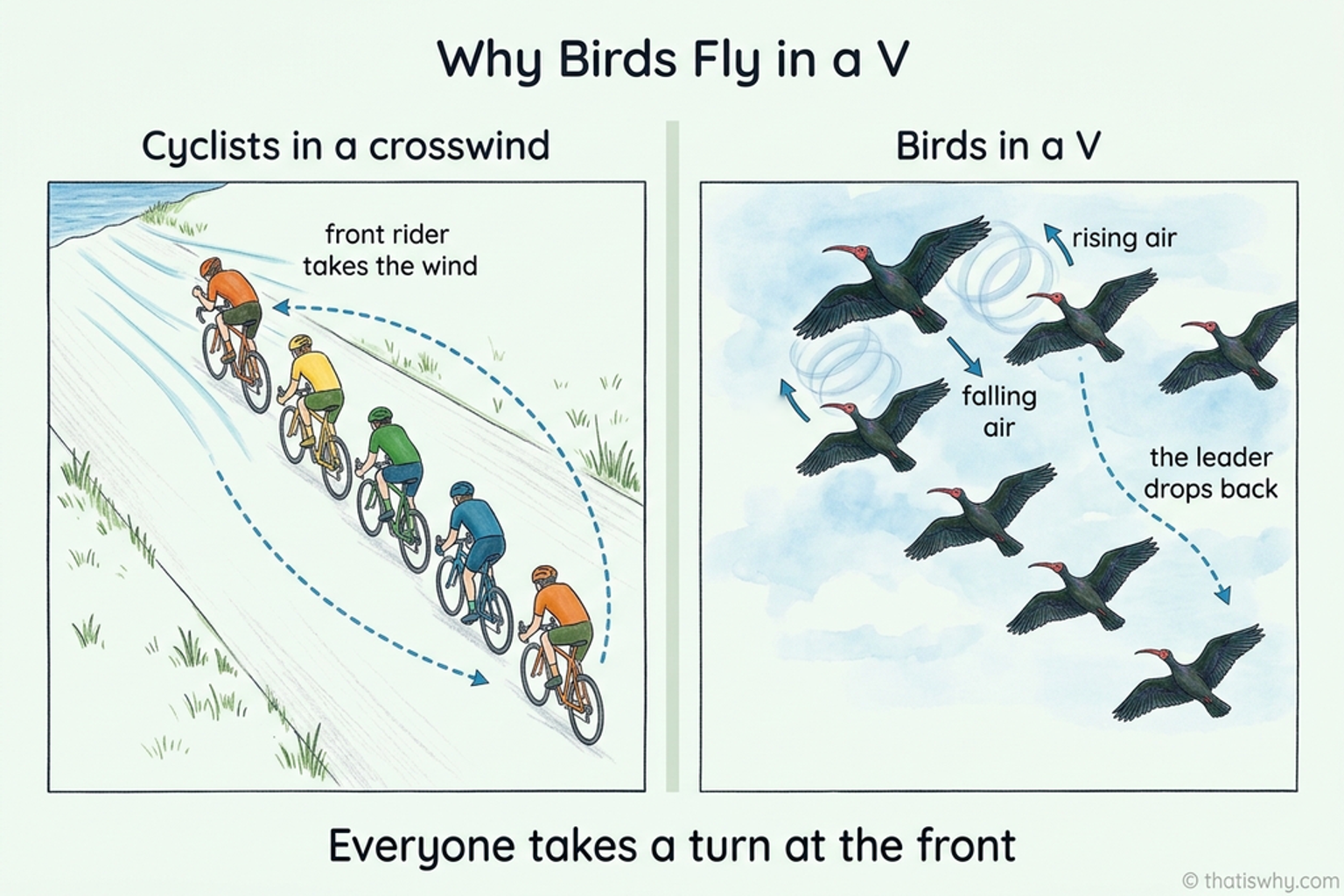
A pack of racing cyclists swings onto an open coastal road, and a hard wind starts blowing in from the side. Within seconds the bunch changes shape. The riders fan out into a long slanting line called an *echelon*, each one tucked just behind and beside the shoulder of the rider ahead, sheltered from the gusts. Only the front rider takes the full blast of wind.
That front spot is brutal, so nobody stays there long. After a short, hard turn, the leader swings off, drifts down the line and slots in at the back to recover, and the next rider takes the wind. Spread across a whole race, everyone pays a share and everyone saves energy.
Cyclists in a crosswind and birds in a V strike the same deal: the front spot is hard work, so everyone takes a turn.
A V of geese is two echelons joined at the tip, and the trade is the same: hard work at the front, cheaper flying behind, and everyone taking a turn. The cyclists, though, are hiding from moving air, while the birds are riding it. A rider tucks in where the wind is weakest. A bird that tucked in directly behind its neighbor would hit the worst air in the sky, so it slides out to the side and hunts for air that is moving upward.
## A Meter Back, a Meter Over
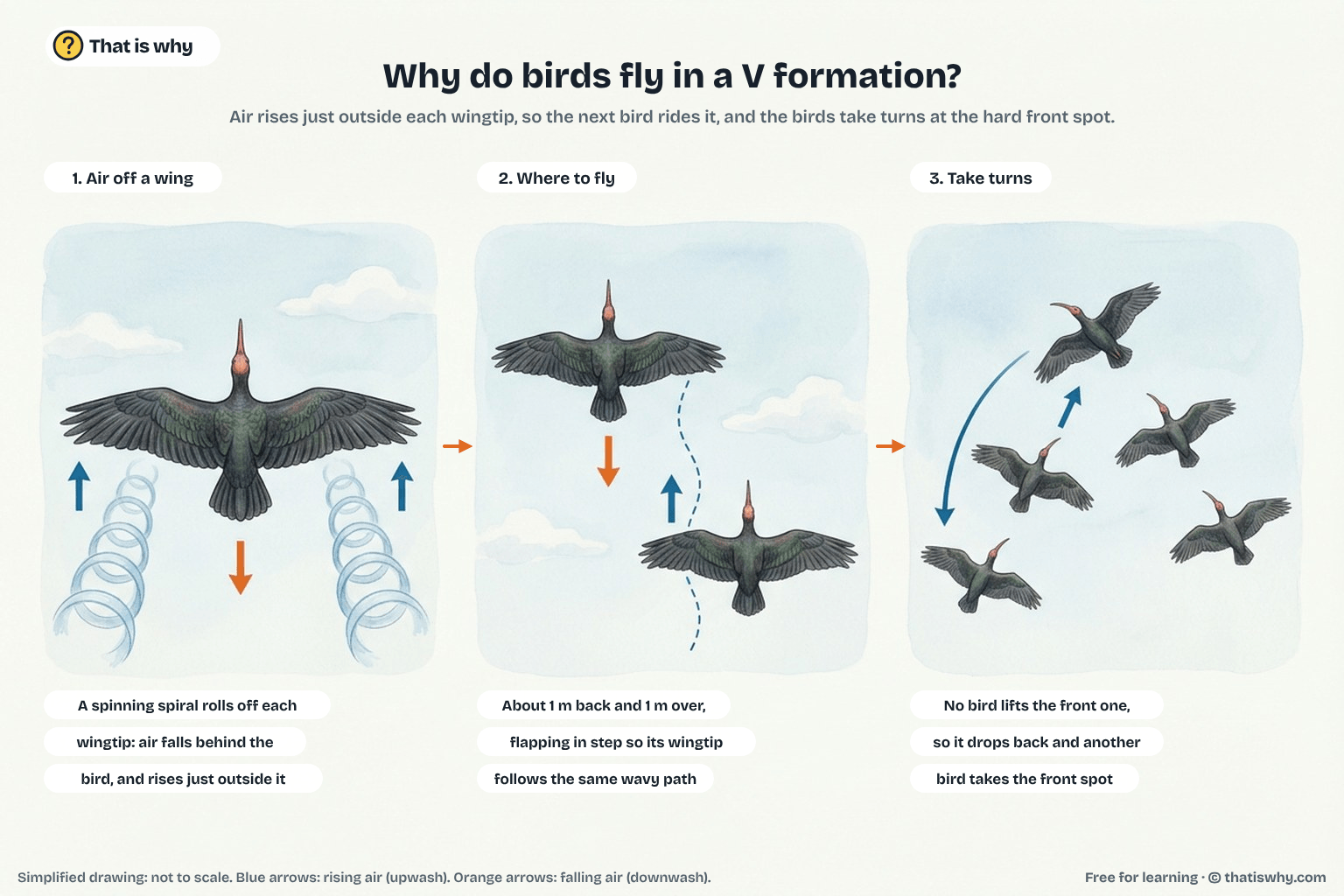
To see where that helpful air comes from, follow the air around a single wing. A flapping wing shoves air downward, which is how it holds the bird up. At the very tip, air spills around the edge and rolls off into a spinning tube called a *wingtip vortex*. As National Geographic's Ed Yong put it, "As a bird flaps, a rotating vortex of air rolls off each of its wingtips."
Inside the bird's own path, that spinning air is falling, and scientists call it *downwash*. Just outside the tip, the same spiral is lifting, and that is the *upwash*. Royal Veterinary College biologist Steven Portugal sums it up in one line: "The simple rule is upwash is good air, and downwash is bad air." A bird in the upwash gets pushed up a little on every beat, so its own wings can work a bit less.
### The ibis that wore backpacks
Proving that wild birds really surf this air was the hard part, because you can't fly beside a flock with a ruler. His team found the perfect test pilots: northern bald ibises, a critically endangered species being taught a migration route by a conservation group. The young birds had been raised by people and followed their handlers in the air, so the scientists could strap a tiny data logger to every bird. Each logger tracked the bird's position by GPS and felt the rise and fall of every wingbeat.
The results, published in *Nature*, were eerie. The birds settled around a meter behind the bird in front, and another meter off to the side, right where aerodynamic theory predicted the best upwash should be. The team had expected something far sloppier, as the lead researcher admitted: "We thought they'd be roughly in the right area and hit the good air maybe 20 percent of the time." Instead, he said, "Actually they're tracking the good air throughout their flap cycle."
### Flapping in step
Here's where it gets uncanny, so hold on to your coffee. The air off a flapping wing isn't a steady stream; it ripples up and down with each beat, like a wake behind a boat. So a bird in the V doesn't just sit in the right spot. It times its own wingbeats so that its wingtip follows the same wavy path through the air as the wingtip of the bird ahead, staying in the lift from the top of the beat to the bottom.
And when a bird ends up directly behind another, in the falling air, it does the opposite. It stops tracing the leader's path and flaps almost perfectly out of phase, its wings rising while the leader's fall, which seems to soften the blow of the downwash. How the birds sense all this is still a puzzle. Bret Tobalske, a biologist at the University of Montana, told Smithsonian Magazine it may come down to a mix of vision, tiny whisker-like feathers on the wingtips called filoplumes, and quick reflexes, before admitting: "Scientists just don't know."
Air off a wing, where to fly, and taking turns: the three parts of the V. See the detailed teaching diagram and printable PDF.
## Why Nobody Gets a Free Ride
There's a catch hiding in all this free lift. Somebody has to be at the front, and the front bird has no bird ahead to lift it. It pays full price, while everyone behind gets a discount. So why would any bird agree to lead?
A team led by Bernhard Voelkl at the University of Oxford went looking, with 14 young northern bald ibises migrating from Salzburg, in Austria, to Orbetello, in Italy, behind a powered parachute. Each bird wore a 23-gram logger. The birds kept shuffling between groups of 2 to 12, and on average each one spent 32% of its time riding someone else's updraft. Then came the real surprise of the study. When ibises flew in pairs, they took turns. As Voelkl put it, "We found that in these pairs individuals take turns, precisely matching the amount of time they spend in the energy-sapping lead position and the energy-saving following position."
That's the cyclists' deal, kept honestly by birds. Biologists call this kind of trade *direct reciprocity*, or reciprocal altruism: one bird helps another now and gets helped back later. "We found no evidence of 'cheating' of any kind within these flocks," the lead author said. The stakes of a long migration explain why. Up to 35% of young birds can die of exhaustion on their first migration, and as the Oxford announcement put it, "something like saving 10% of your energy can make the difference between life and death." Some studies suggest the birds trailing in a V can save up to 10 to 14% of their energy.
## Pelicans, Geese and the Birds That Don't Bother
The ibis aren't the only birds playing this game. Henri Weimerskirch fitted great white pelicans with heart-rate monitors and found that the birds at the back of the V had slower heart rates than those in the front, and flapped less often. Canada geese are the famous flyers, but cranes, cormorants, ducks and swans make Vs too.
Notice what those birds have in common: they're big. Tobalske points to the slow, steady flapping a bigger body needs, and told Audubon: "In smaller formations with smaller birds, their wake structure might not persist, it might decay." A sparrow's spiral may fade before a neighbor can catch it.
Something else is missing from every one of these flocks: a boss. Just as [ant colonies act like one brain](https://thatiswhy.com/why-ant-colonies-act-like-one-brain/) without anyone in charge, the V emerges from simple rules each bird follows on its own. Find the rising air and take your turn when it comes.
Every V is also a lesson in wing aerodynamics, the same subject that explains [how owls fly silently](https://thatiswhy.com/why-owls-fly-silently/) by calming the air over their feathers. Shaving off every wasted wingbeat matters most on the longest trips, like the one that lets [Arctic terns fly from pole to pole](https://thatiswhy.com/why-arctic-terns-can-fly-pole-to-pole/). It's one more example of [nature acting as the ultimate engineer](https://thatiswhy.com/why-nature-is-the-ultimate-engineer/), solving a problem with no blueprint at all.
## V Formation Myths That Don't Fly
**Myth: The bird at the front is the flock's leader, the strongest bird in charge.**
**The truth:** In the ibis flocks, the birds swapped places a lot and the flock had no constant leader. The front spot is a hard shift that gets shared, not a throne.
**Myth: The birds behind are drafting, like a cyclist tucked behind a wheel.**
**The truth:** Directly behind a bird is the worst place to be, because the air there is falling. The birds that save energy sit behind and off to the side, in the rising air.
**Myth: Birds fly in a V only so they can see each other.**
**The truth:** Sight may help birds find their spot. But the positions and wingbeat timing the loggers recorded line up with birds riding each other's rising air, which is about saving energy, not just keeping watch.
**Myth: All migrating birds fly in a V.**
**The truth:** The famous Vs belong to big, slow-flapping birds like geese, cranes and pelicans. The air spiraling off a small bird's wings may fade too fast to be worth chasing.
## The Shape of a Fair Deal
Back under that gray autumn sky, the V of geese is still honking its way south. It looked like a simple shape, but every bird in it is doing something remarkable: holding a spot a meter back and a meter over, timing every flap to a neighbor's invisible wake, and taking its turn in the wind.
This is the part that still gets us. The V isn't drawn by a leader or held by force. It's the outline of a bargain, written in rising air, and it holds only because every bird keeps its end of it.
## Sources
- [Upwash exploitation and downwash avoidance by flap phasing in ibis formation flight (Portugal et al., Nature 2014)](https://www.nature.com/articles/nature12939), Nature
- [Birds That Fly in a V Formation Use An Amazing Trick](https://www.nationalgeographic.com/science/phenomena/2014/01/15/birds-that-fly-in-a-v-formation-use-an-amazing-trick/), National Geographic
- [One good turn: birds swap energy-sapping lead role (Voelkl et al., PNAS 2015)](https://www.ox.ac.uk/node/29050), University of Oxford
- [Scientists Solve Mystery of Birds' Flying V](https://www.smithsonianmag.com/articles/scientists-solve-mystery-birds-flying-v-180949352/), Smithsonian Magazine
- [Why Do Birds Fly in a V Formation? Breaking Down a Brilliant Migration Hack](https://www.audubon.org/magazine/why-birds-fly-v-formation-migration-science), Audubon