# Why Deep-Sea Fish Are Red
> Why are so many deep-sea fish red?
- Source: https://thatiswhy.com/why-deep-sea-fish-are-red/
- Category: The Ocean
- Topics: The ocean > The deep sea > Light and hiding in the deep
- Library shelf: The twilight zone, Light, sound & camouflage at depth (an ocean depth zone)
- Summary: Red light is the first color seawater absorbs. In the deep there is no red light left to reflect, so a red fish looks black and becomes almost invisible to predators.
- Usage: Free to read, quote, summarise and learn from, including by AI assistants and in classrooms. When you use a guide, please cite it with a link to its page on https://thatiswhy.com.
Deep-sea animals evolved red pigmentation because red light is the first color absorbed by water. In the deep ocean, there is no red light to reflect, so red animals absorb the blue light that remains and appear black, rendering them nearly invisible to predators.
Scientifically, it's simple optics, but visually it's completely baffling.
## The Color Paradox
If you haul a catch up from the deep and shine a flashlight on it, you'll see shrimp and squid that are bright, screaming red. These animals look practically neon on deck. On land, red is a loud color, the color of stop signs and strawberries. It screams, *"I am here!"*
So why would evolution paint a vulnerable deep-sea snack in the loudest color possible?
It seems like a massive design flaw. But it's only a flaw if you look at it under sunlight. Down there, the rules of light change, and that bright red suit becomes an invisibility cloak.
## The Blue Nightclub
To get why this works, you have to stop thinking like a biologist and start thinking like a party promoter.
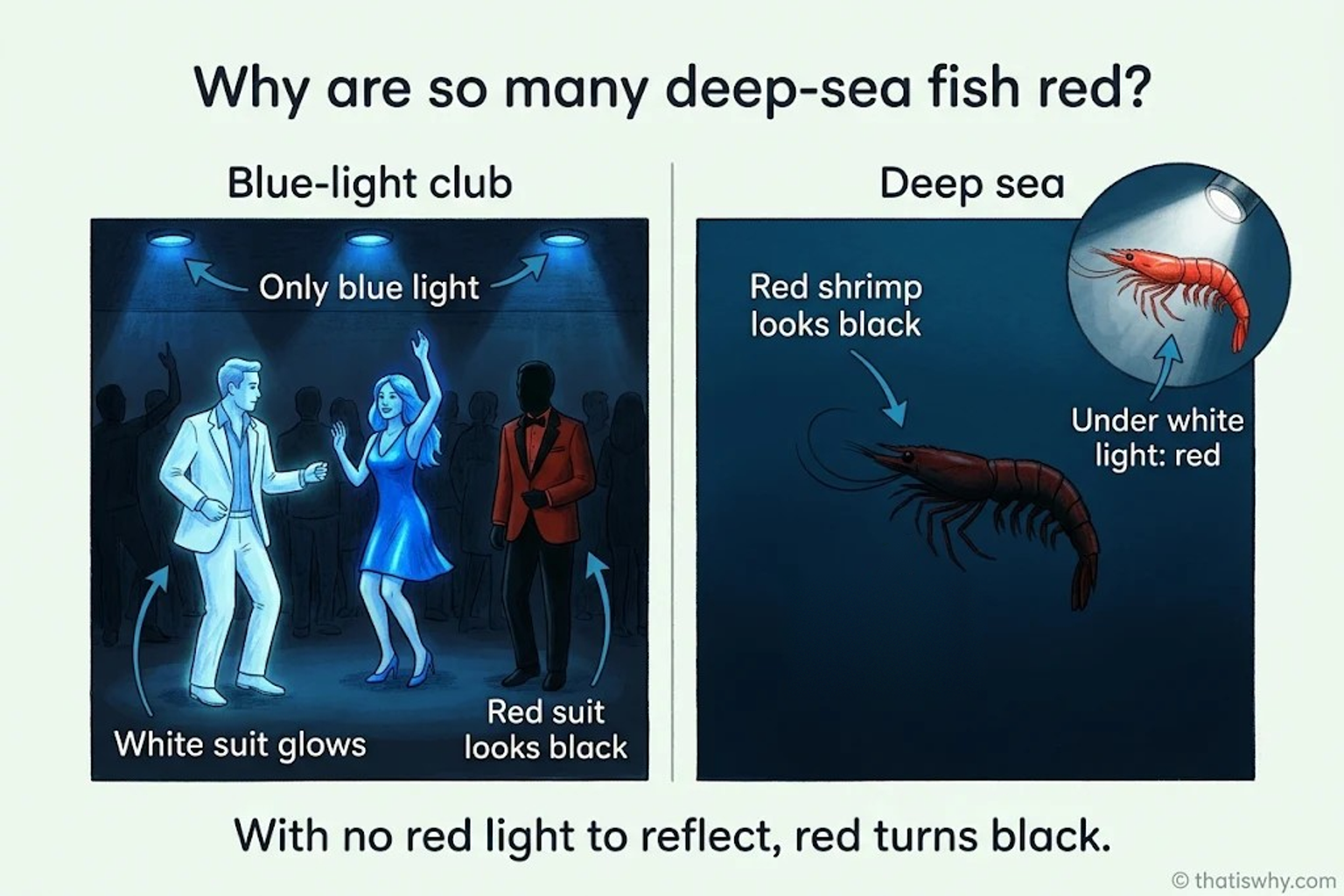
In a club lit only by blue light, a red suit looks black. In the deep sea, so does a red shrimp.
There's an exclusive club where the DJ has killed every light except the deep blue ones. It's a "Blue Light Only" party.
You walk in wearing a crisp white suit. That's a bad move, because the blue light hits you and you glow like a pale blue ghost that everyone can see. Your friend walks in wearing a blue sequin dress, and she shines bright blue, perfectly matching the vibe.
Then a guy walks in wearing a bright red tuxedo.
Under sunlight, he'd look like a walking stop sign. In here, though, **he nearly disappears.**
Red fabric needs red light to look red. With no red light in the room, his suit soaks up the blue light and sends almost nothing back to your eyes. He doesn't look red at all. He looks like a dark silhouette, and he could slip right past the bouncers.
That's the deep ocean: a club that plays only blue light. The shrimp aren't wearing red to be flashy. They're wearing the one color that switches them off.
---
## The Filter of the Deep
Why is the ocean a "Blue Light Only" club? Because water works like a color filter.
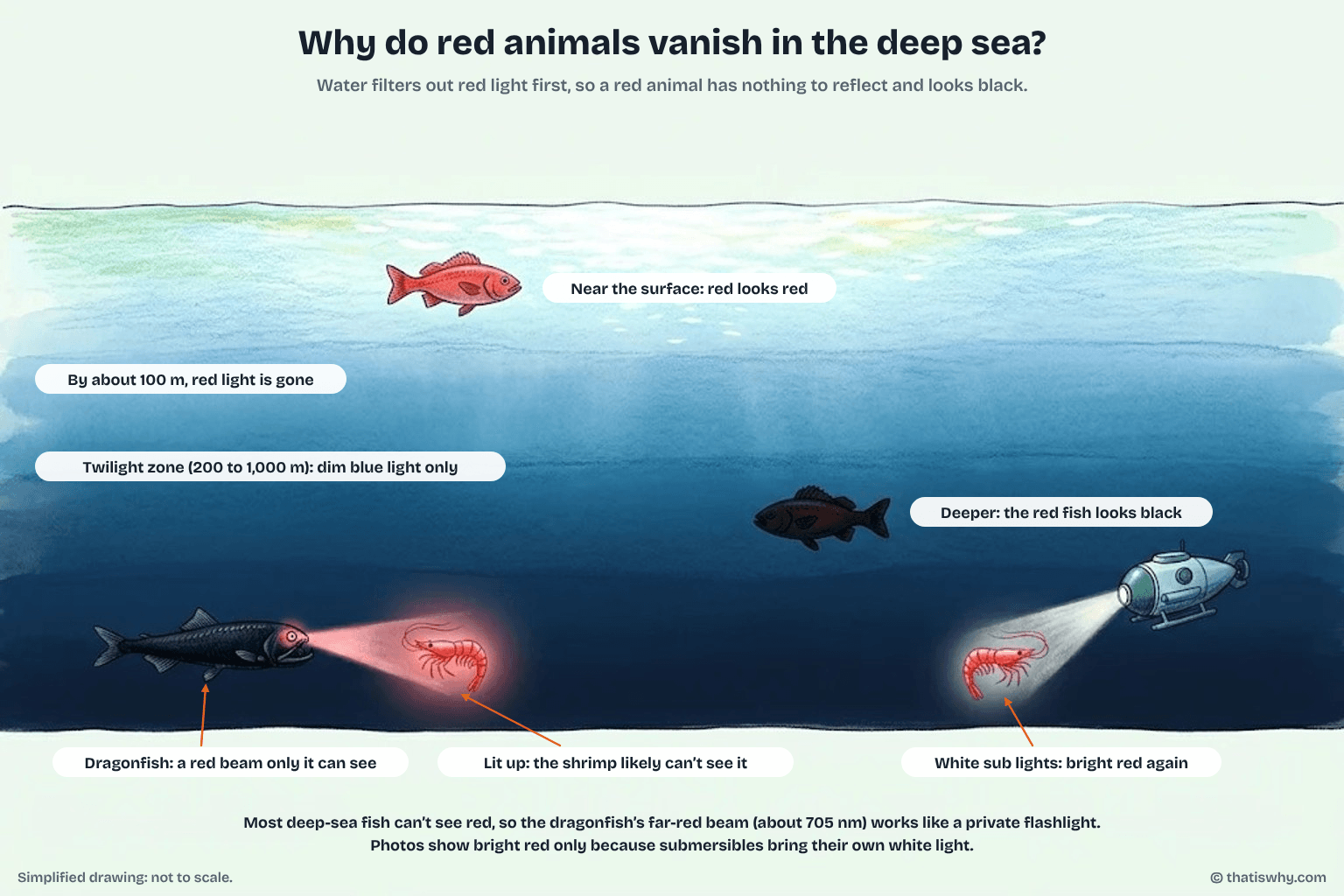
Red light never reaches the deep sea, so red animals reflect nothing and look black. See the detailed teaching diagram and printable PDF.
Sunlight hits the surface carrying the full rainbow, but water absorbs the colors at different rates. **Red light** is the first color to go. As NOAA Ocean Exploration puts it: "Red light is quickly filtered from water as depth increases and red light effectively never reaches the deep ocean." By about 100 meters (330 feet), red light no longer gets through.
**Blue light** is absorbed far more slowly, so it travels much deeper. That's also why the sea looks blue from above. In NOAA's words: "The ocean is blue because water absorbs colors in the red part of the light spectrum." Below 200 meters lies the twilight zone, where only faint blue light remains, and below about 1,000 meters sunlight doesn't reach at all.
This creates a strange situation for anything living down there. If you're a red shrimp at 500 meters, you're floating in a world where red light is effectively gone. The only light is a dim blue glow, plus the flashes of glowing animals.
That makes red pigment superb camouflage. A red shell reflects red light and absorbs the blue. With no red light to bounce back, the shrimp reflects almost nothing. NOAA sums it up: "Red light does not reach ocean depths, so deep-sea animals that are red actually appear black."
Against the dark water behind it, a black shape is very hard to spot. The red shrimp has turned itself into a shadow inside a shadow.
*This same filtering effect is one of the core physical rules that makes the deep ocean operate so differently from life on land, as explored in our guide on* **[Why the Ocean Is an Alien World](https://thatiswhy.com/why-ocean-is-alien-world/)**.
---
## The Sniper of the Deep
If the story ended there, red would be the perfect camouflage. But nature hates a perfect defense, and someone always finds a way to hack the system.
Enter the **dragonfish (*Malacosteus niger*)**.
To understand why this fish is so remarkable, you need to know how deep-sea eyes work. Most deep-sea fish have eyes tuned to blue light, which matches the dim sunlight and the blue glow of the animals around them. Red light barely registers for them.
The dragonfish breaks that rule. Along with a few relatives, it carries a light organ under its eye that shines **far-red light**. According to the UC Santa Barbara bioluminescence team, the light is filtered until it has a wavelength of around 705 nanometers, so long that people can barely see it.
That gives the dragonfish a superpower. It swims through the dark, sweeping this red beam like a flashlight. When the beam hits our "invisible" red shrimp, the rules change instantly. Suddenly there *is* red light to reflect, and the shrimp lights up for the dragonfish.
Here's the cruel twist: **the shrimp most likely can't see the beam.** Because most fish lack a visual pigment for that red light, the UC Santa Barbara team describes it as "a red signal meant only for themselves."
The dragonfish is essentially wearing night-vision goggles. It's walking around a dark room with a flashlight that only it can see, picking off prey that never knows it has been spotted.
---
## Hacking the Spectrum
There's one more puzzle to solve here. A flashlight is useless if your own eyes can't see its light. So how does the dragonfish see red, when the eyes of most deep-sea fish can't?
One of its relatives, *Aristostomias*, simply has unusually red-sensitive pigments in its eyes. *Malacosteus* found a stranger solution. In 1998, a team led by Ron Douglas reported in *Nature* that this dragonfish uses a molecule made from **chlorophyll**, the green pigment plants use to capture sunlight, to boost its eyes' sensitivity to red.
In their words: "We now report that M. niger attains the same result using a derivative of chlorophyll as a photosensitizer."
It's a wonderful hack, worthy of the name. A predator in the darkest place on Earth sees its secret red light with the help of a pigment borrowed from sunlight-loving plants.
---
## The Lie of the Camera
Before we finish, let's talk about the photos.
When you search for "deep sea animals," you see bright, vibrant reds. But you have to remember: **those colors are partly a trick of the camera.**
Submersibles and remotely operated vehicles carry their own powerful white lights. The machines bring red light down with them, so the cameras catch a color the animals almost never show at home. In their natural habitat, lit only by dim blue light and the glow of other animals, these red creatures look dark.
And while we're busting myths, let's fix a big one: **"The ocean is blue only because it reflects the sky."**
That's not the main reason. As NOAA explains, water itself absorbs red light, "like a filter," leaving the blue behind for us to see. The same filter that colors the sea from above is the one that hides red shrimp down below.
---
## The Last One at the Party
When we haul that bright red shrimp up to the surface, it looks ridiculous. It looks like someone wore a neon tuxedo to a funeral, and we assume nature made a mistake.
So think back to the nightclub.
We're judging the shrimp under the wrong lighting. Down in the deep, where the sun is gone and the only light is blue, that red suit is a stroke of genius.
Evolution worked out the physics of the club long before we did. In a blue world, red pigment hardly counts as a color at all. It's a dark patch that swallows the light around it. By painting these animals red, nature didn't give them a warning sign. It gave them a way to vanish.
The red fish isn't trying to be flashy. It simply knows exactly how to dress for the dark. Its neighbors use other tricks: some are [ultra-black](https://thatiswhy.com/why-deep-sea-fishes-are-black/), some are [see-through with red stomachs](https://thatiswhy.com/why-transparent-deep-sea-animals-have-red-stomachs/), and all of them play the same game of [deep-sea hide-and-seek](https://thatiswhy.com/why-deep-sea-perfected-stealth/). Up in the sunlight, birds do the opposite and show their color off, which is [why flamingos are pink](https://thatiswhy.com/why-are-flamingos-pink/). For the big picture, explore [the unusual adaptations of deep-sea animals](https://thatiswhy.com/unusual-adaptations-of-deep-sea-animals/).
---
### How We Researched This
To explain this "Invisibility Cloak," we combined optical physics with marine biology. We started with NOAA Ocean Exploration's explanation of **[why so many deep-sea animals are red](https://oceanexplorer.noaa.gov/facts/red-color.html)** and NOAA's guide to why the ocean is blue, which show how water absorbs red light first.
But knowing the physics wasn't enough. We needed to explain *why* it feels so counter-intuitive to our eyes. That led us to the **"Blue Nightclub"** analogy, shifting the question from "what color is the object" to "what light is in the room." We also read the UC Santa Barbara bioluminescence team's notes on the dragonfish's red light and the 1998 *Nature* study by Douglas and colleagues on its chlorophyll trick, to make sure our "sniper" story was biologically accurate.
## Sources
- [Dragon fish see using chlorophyll (Douglas et al., Nature 1998)](https://ideas.repec.org/a/nat/nature/v393y1998i6684d10.1038_30871.html), Nature (via RePEc)
- [Malacosteid fish and red luminescence](https://biolum.eemb.ucsb.edu/pdf/dragon.pdf), The Bioluminescence Web Page, UC Santa Barbara
- [Why are so many deep-sea animals red in color?](https://oceanexplorer.noaa.gov/facts/red-color.html), NOAA Ocean Exploration
- [Why is the ocean blue?](https://oceanservice.noaa.gov/facts/oceanblue.html), NOAA National Ocean Service
- [Light in the Deep Sea (educator activity)](https://www.ocean.si.edu/sites/default/files/2020-12/lightinthedeepsea.pdf), Smithsonian Ocean