# Why Deep-Sea Creatures Are Invisible
> How do deep-sea creatures become invisible?
- Source: https://thatiswhy.com/why-deep-sea-creatures-are-invisible/
- Category: The Ocean
- Topics: The ocean > The deep sea > Light and hiding in the deep
- Library shelf: The twilight zone, Light, sound & camouflage at depth (an ocean depth zone)
- Summary: Deep-sea animals play a game of light: hunters grow huge, blue-sensitive eyes, while prey hide by turning see-through or red, which looks black in the deep.
- Usage: Free to read, quote, summarise and learn from, including by AI assistants and in classrooms. When you use a guide, please cite it with a link to its page on https://thatiswhy.com.
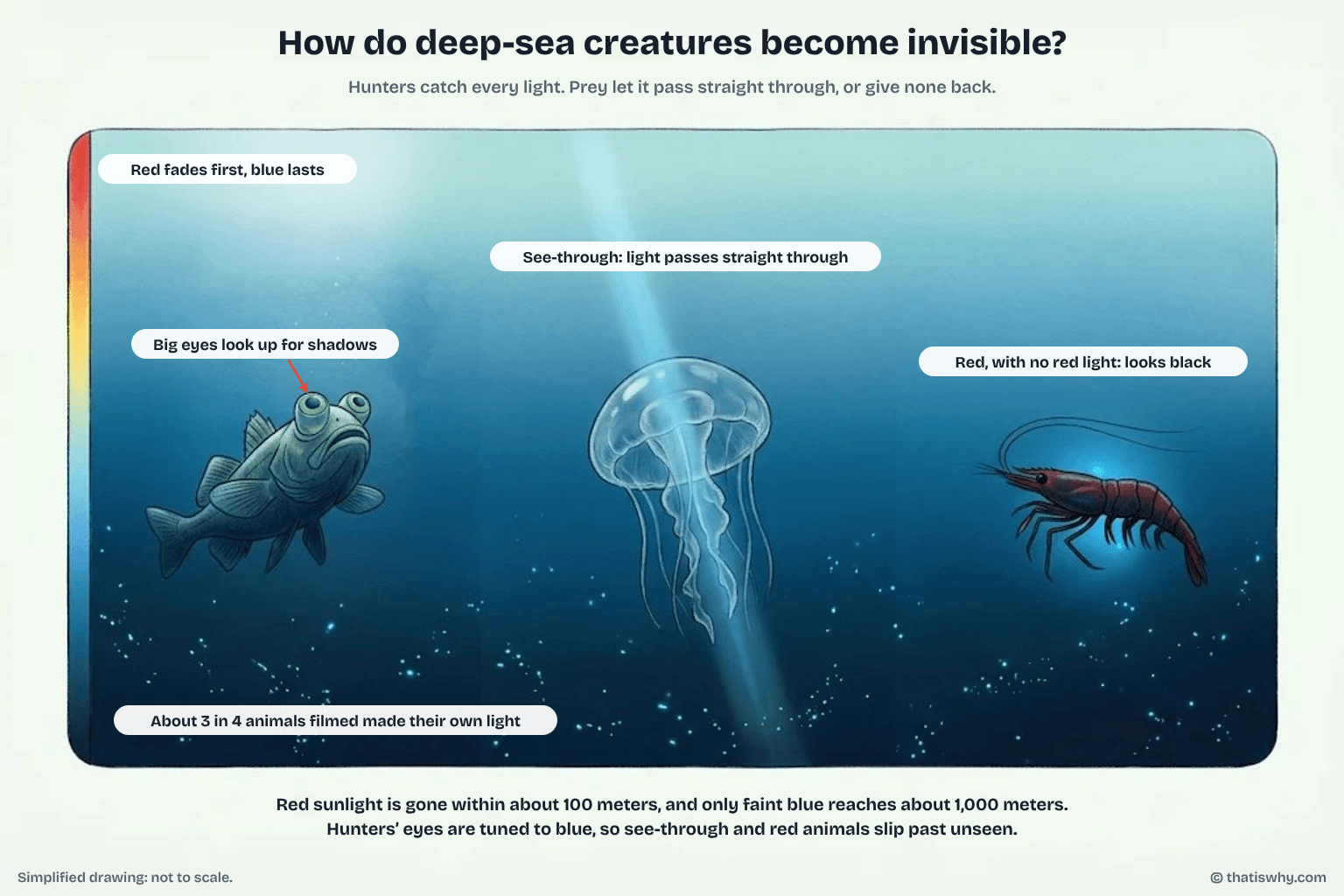
**How do deep-sea creatures become invisible?** They play a deadly game with light. Below the reach of daylight, almost the only light comes from animals that glow, so hunters grow big, blue-sensitive eyes to catch every flash and silhouette. Their prey hide by turning see-through, so light passes straight through them, or by turning red, a color that looks black where no red light reaches.
Dive down toward 1,000 meters and the sunlight fades to almost nothing. So why would animals there bother with big eyes at all? Why build a super-sensitive camera if there's nothing to photograph?
The answer is that the deep ocean isn't really dark. It's full of tiny lights, just not the kind we're used to.
This guide is the quick tour of that light game: who does the looking, who does the hiding, and where to dig deeper on each trick. For the full story, read **[Why the Deep Sea Perfected Stealth: Two Hunters, Two Disguises](https://thatiswhy.com/why-deep-sea-perfected-stealth/)**.
## The Blackout Game
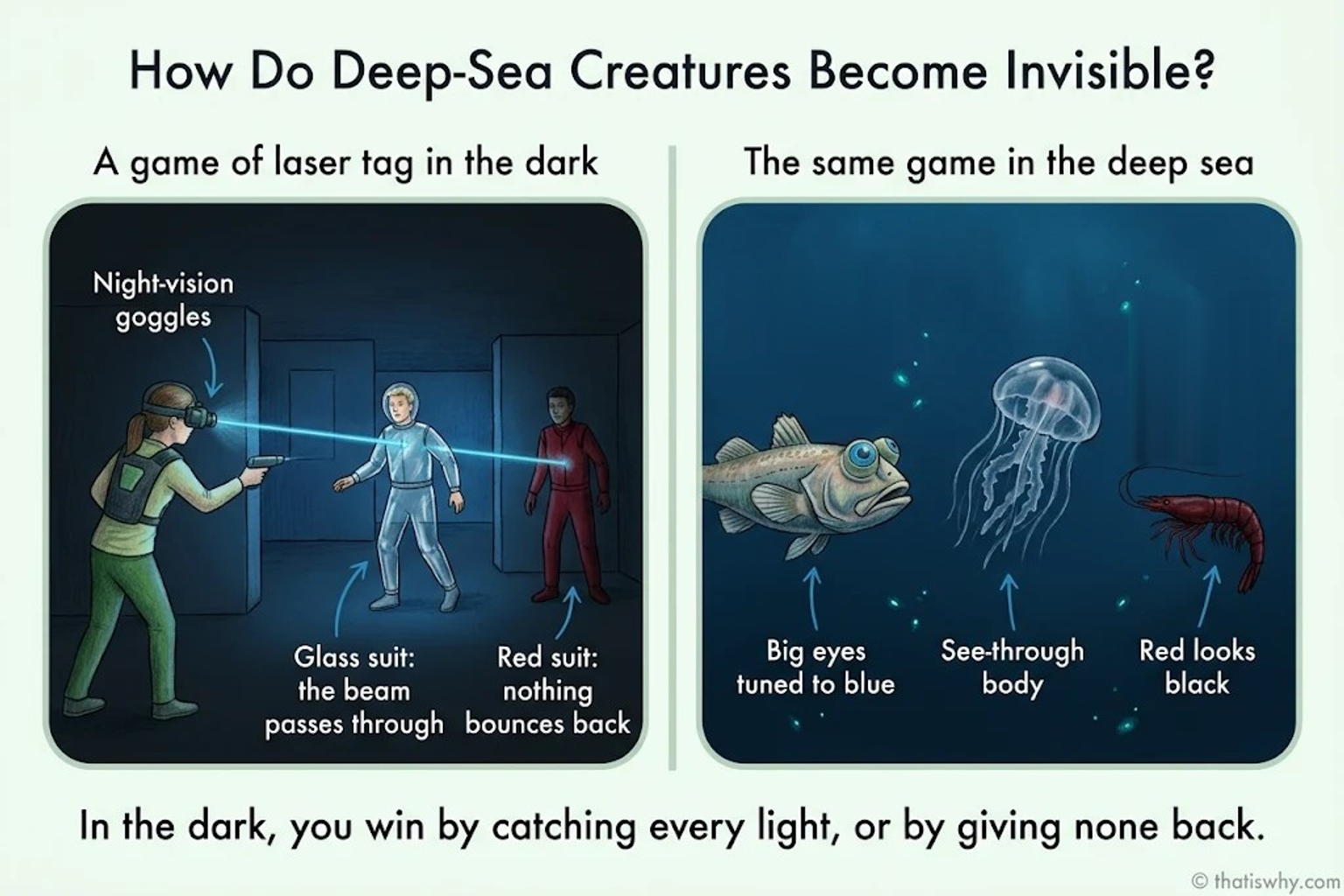
To survive down here, animals are locked in an arms race between seeing and not being seen. Think of it as the world's deadliest game of laser tag.
The deep sea is an arms race between seeing and not being seen: catch every light, or give none back.
A pitch-black arena, music off, everyone holding their breath. The hunters wear the best night-vision goggles money can buy, and any blink of light gives you away. So the hiders get creative. Some wear suits of clear glass, so the beams pass straight through them. Others wear suits that soak up every bit of light that hits them, so nothing bounces back.
That's the deep sea, almost move for move. The one difference: in laser tag, the lights are guns and vests. In the deep, the lights are the animals themselves.
## A Sea Full of Living Lights
Let's start with the light itself. In the deep ocean, glowing is the rule, not the exception. Researchers at the Monterey Bay Aquarium Research Institute counted more than 350,000 animals in videos from 240 dives, from the surface down to 4,000 meters, and found that about **three quarters** of them can make their own light. As study author Séverine Martini put it, "I'm not sure people realize how common bioluminescence is."
Daylight hasn't quite vanished either. According to researchers at The University of Western Australia, at depths of around 1,000 meters the sunlight from above is filtered down to faint levels of blue light. Most animal light, called **bioluminescence**, is blue or green too.
## The Hunters: Night-Vision Eyes
So what do you need to win in a world of faint blue sparks? A bigger bucket for light. As vision scientist Ron Douglas explains, "you just have a big eye to catch as much light as you can." That's why giant squid have plate-sized eyes.
Many deep-sea animals go further. Douglas notes that "a lot of deep sea animals have tubular eyes," pointing upward "to make the most of the residual sunlight," so they can spot the shadow of something swimming above. And they tune their eyes to the only color around: deep-sea animals generally have eyes that "only see blue and they're not at all sensitive to red."
Inside those eyes, the heavy lifting is done by **rod cells**, the light sensors that work in dim light. Almost every vertebrate has just one kind of rod pigment. Yet when scientists examined the genomes of 101 fish species, the silver spinyfin turned out to have 38, and it appears able to detect a wide range of colors in near darkness.
## The Ghosts: Glass Bodies
If the hunters have night vision, how do you hide? Option one: be a ghost.
Transparent animals are common in the ocean, from jellyfish to siphonophores and pteropods. But being see-through is harder than it sounds. Drop a glass marble into a glass of water and you can still see it, because glass bends light differently than water does.
To vanish, a body has to absorb almost no light and scatter almost none. That means matching the way it bends light, its **refractive index**, to seawater, which sits at about 1.33. Watery, jelly-like bodies get close, which is why jellies are so good at it. Complex organs are much harder, because tissues that aren't uniform scatter light and give the animal away. We take this trick apart, ice cube and all, in **[Why Some Deep-Sea Animals Become Invisible](https://thatiswhy.com/why-some-deep-sea-animals-become-invisible/)**.
## The Shadows: Red Suits
Option two: be a shadow. If you can't be clear, be red.
It sounds like the worst color for hiding, but NOAA Ocean Exploration explains the trick. "Red light is quickly filtered from water as depth increases." By 100 meters, a red fish is "difficult, if not impossible to see," because there is no red light left to reflect. A red animal in the deep looks black, and hunters whose eyes only see blue can't pick it out.
Hunters catch every light, while prey let it pass straight through or give none back. See the detailed teaching diagram and printable PDF.
## Where to Go Deeper
The deep sea is full of variations on these two tricks, and each one has its own guide. Some fish go beyond red and wear [ultra-black skin that swallows almost every bit of light](https://thatiswhy.com/why-deep-sea-fishes-are-black/). The [hatchetfish hides with mirrors on its sides](https://thatiswhy.com/why-hatchetfish-looks-invisible/). See-through animals still have to hide their meals, which is why so many [transparent deep-sea animals have red stomachs](https://thatiswhy.com/why-transparent-deep-sea-animals-have-red-stomachs/). And a few predators cheat the whole game: some dragonfish make their own red light, a color most of their prey can't see, as our guide to [why deep-sea fish are red](https://thatiswhy.com/why-deep-sea-fish-are-red/) explains. Step back, and all those tiny lights together turn the midnight zone into [a sky full of blue stars](https://thatiswhy.com/why-deep-ocean-looks-like-blue-star-field/).
## Myths About Deep-Sea Light
**Myth: The deep sea is completely dark.**
**The truth:** Around 1,000 meters, faint blue sunlight still filters down, and about three quarters of the animals filmed in Monterey Bay's waters can make their own light.
**Myth: Red animals stand out in the deep sea.**
**The truth:** Red light is filtered out of seawater quickly, so a red animal at depth has nothing red to reflect and looks black.
**Myth: Being see-through is easy if you're made of jelly.**
**The truth:** Watery bodies help, but complex organs scatter light. Staying invisible means keeping the body's refractive index close to seawater's 1.33.
## The Eternal Arms Race
The deep ocean isn't an empty void. It's a crowded, pitch-black arena where everyone is playing laser tag for their lives.
The hunters scan the dark with huge, blue-tuned eyes, waiting for a single spark or shadow. The hiders drift by in suits of living glass or cloaks of red, betting everything on staying unseen. This is the part that still surprises us: in a place without sunlight, the most important thing in the world is still light.
## Sources
- [Deep Sea Sight (interview with Ron Douglas, City, University of London)](https://www.thenakedscientists.com/node/176676), The Naked Scientists
- [Deep sea fish can detect colour in the dark (Musilova et al., Science 2019)](https://www.news.uwa.edu.au/2019051011384/international/deep-sea-fish-can-detect-colour-dark), The University of Western Australia
- [Three quarters of deep-sea animals make their own light (Martini and Haddock, Scientific Reports 2017)](https://phys.org/news/2017-04-quarters-deep-sea-animals.pdf), Phys.org (MBARI)
- [Staring into a crystal ball: understanding evolution and development of in vivo aquatic organismal transparency (Hotta et al., 2024)](https://www.frontiersin.org/journals/ecology-and-evolution/articles/10.3389/fevo.2024.1428976/pdf), Frontiers in Ecology and Evolution
- [Why are so many deep-sea animals red in color?](https://oceanexplorer.noaa.gov/facts/red-color.html), NOAA Ocean Exploration