# Why the Chameleon Vine Might Be the Only Plant That Can See
> Can a plant see? The chameleon vine might.
- Source: https://thatiswhy.com/why-chameleon-vine-is-only-plant-that-can-see/
- Category: Plants & Forests
- Topics: Trees and plants; Deception; Trees and plants > Plants that act like animals
- Library shelf: The canopy, Plants, insects & land life (a theme shelf, not a habitat)
- Summary: Can plants see? The chameleon vine copies the leaves of plants it climbs, and one disputed study says even plastic ones. Here is what science knows.
- Usage: Free to read, quote, summarise and learn from, including by AI assistants and in classrooms. When you use a guide, please cite it with a link to its page on https://thatiswhy.com.
**How does the chameleon vine change its leaves?** The chameleon vine (*Boquila trifoliolata*) is the only plant known to copy the leaves of several different plants, a trick called "mimetic polymorphism." Its leaves can change size, shape, color and angle to match whatever it climbs, without even touching it. Nobody knows how it does this. The leading ideas are airborne chemicals, shared microbes, and a controversial claim that the vine can somehow "see."
Stand in front of one, and you might honestly never spot the fake.
Deep in the temperate rainforests of Chile and Argentina lives a vine with no fixed face of its own. When it climbs a tree with wide, flat leaves, it grows wide, flat leaves. When it wanders onto a shrub whose leaves end in a spiny tip, its own leaves grow a spiny tip too. Its leaves can swell to ten times their normal size to keep up with a big-leaved neighbor.
One vine can wear several disguises at once, a different leaf for each neighbor along the same stem. For botanists, that's maddening, because a plant with no eyes and no brain shouldn't be able to pull off a visual trick like this.
---
## The Funhouse Mirror
To see why this is so strange, you have to know that most mimicry is frozen in time. A stick insect looks like a twig because its ancestors evolved that way over countless generations. It can't wake up tomorrow and decide to look like a rock. Its disguise is fixed for life.
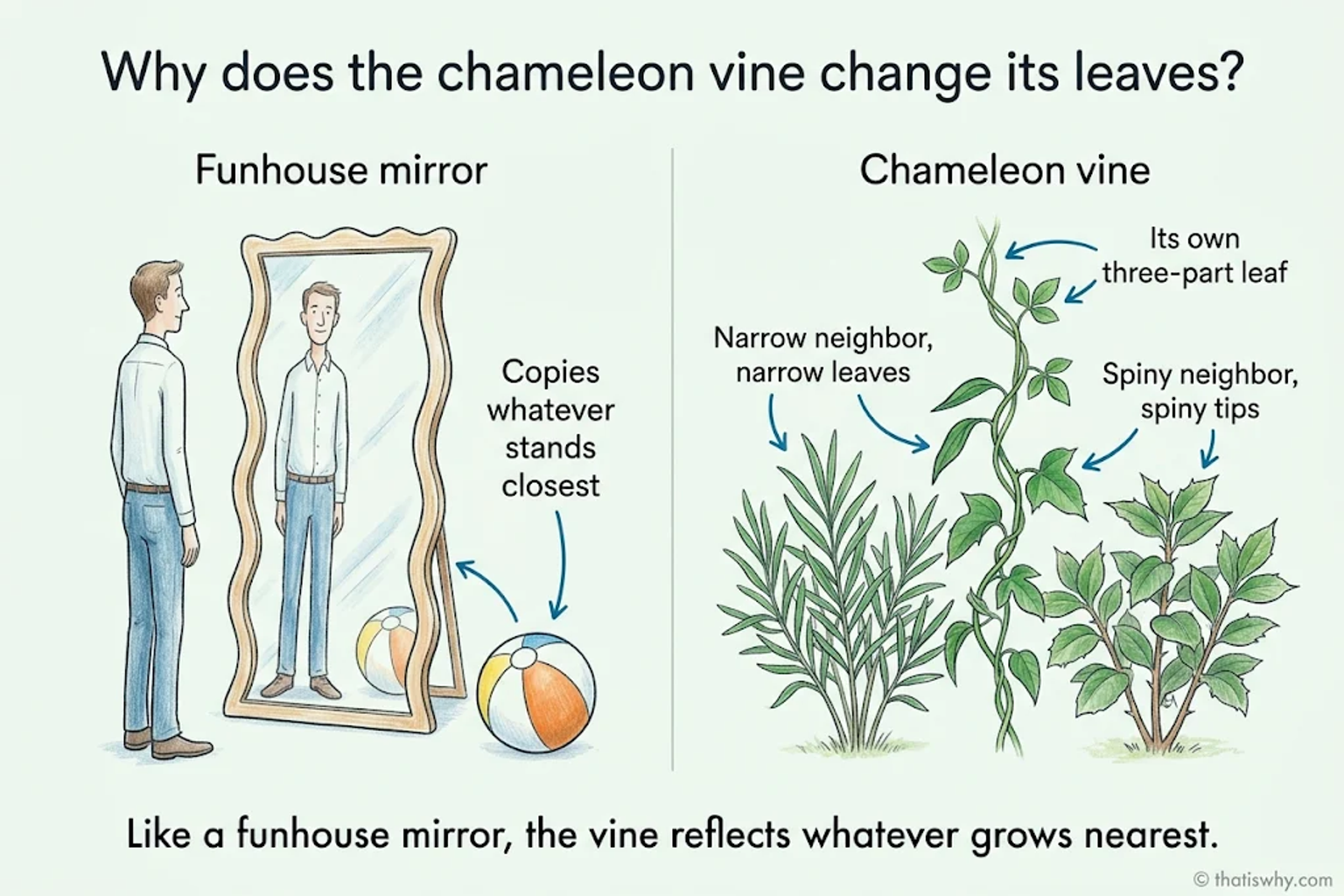
Like a funhouse mirror, the chameleon vine reflects whatever grows nearest: narrow leaves by a narrow neighbor, spiny tips by a spiny one.
The chameleon vine is different, because its disguise is fluid. Think of it as a funhouse mirror.
A funhouse mirror has no shape of its own worth mentioning. Stand a tall person in front of it, and it shows a stretched giant. Stand a round object there, and the reflection bulges sideways. Whatever comes closest decides what it shows.
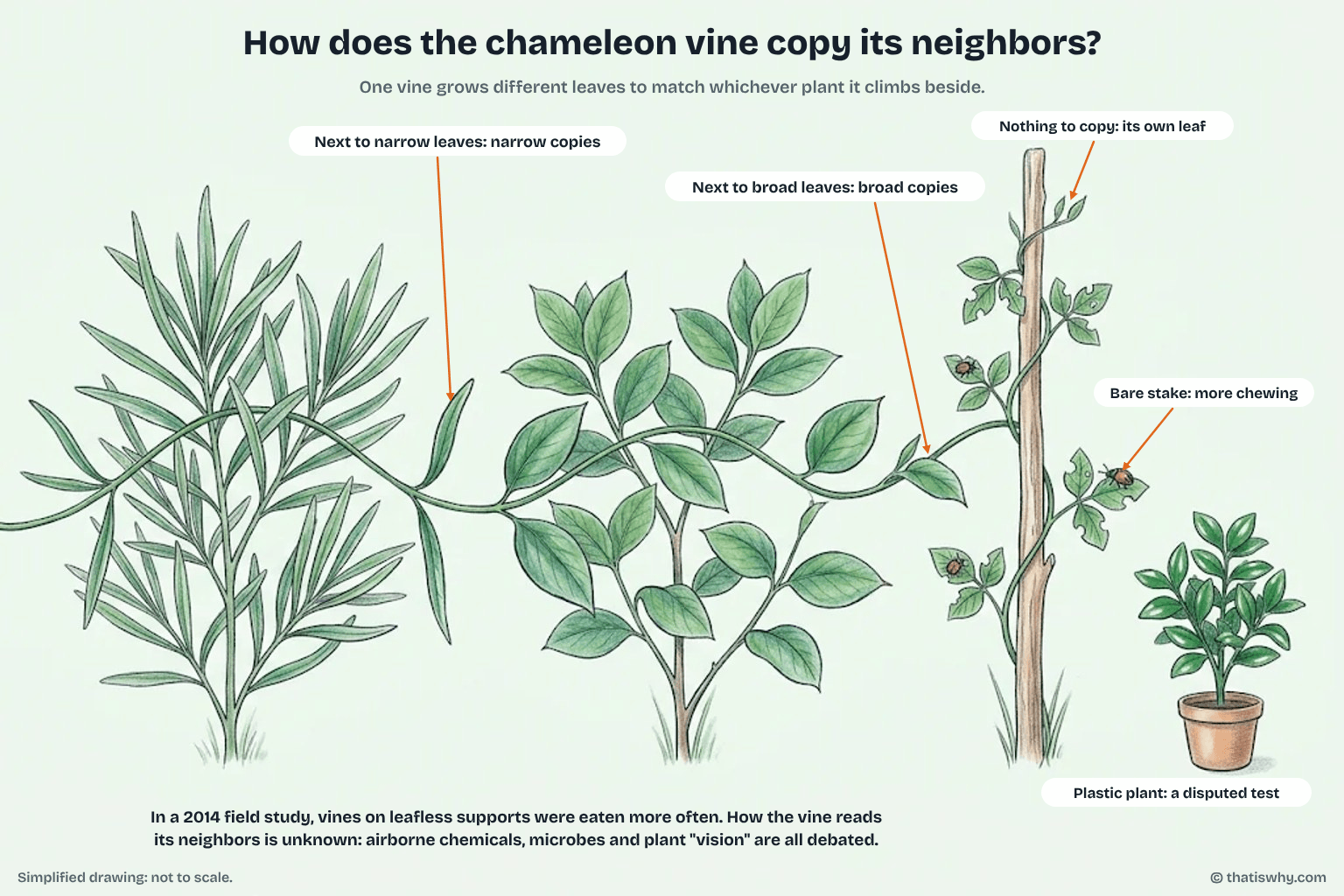
The vine works the same way. Scientists call this kind of flexibility **phenotypic plasticity**, the power to grow differently depending on your surroundings. In a 2014 study of 45 vines climbing 12 kinds of trees, the leaves changed shape, size, color and orientation to match each host. In about three-quarters of cases, a leaf resembled the closest leaf nearby, even when that leaf belonged to a different tree. And the costume seems to pay. Vines sprawling on leafless supports were more likely to be chewed by weevils and leaf beetles than vines climbing a host tree.
Even the scientists who found this were stumped. As Ernesto Gianoli and Fernando Carrasco-Urra put it: "We currently lack a mechanistic explanation for this unique phenomenon."
---
## The Plastic Plant Experiment
Two main ideas came first. **Idea A:** the vine "smells" airborne chemicals released by the host tree. **Idea B:** something genetic travels between host and vine, perhaps carried by tiny microbes.
Then came a small study published in 2022. Researchers Jacob White and Felipe Yamashita grew chameleon vines beneath an artificial plastic vine. Plastic has no smell worth reading and no genes to share. If the vine relied on either, it should have ignored the fake.
According to the authors, it didn't. They reported mimicry attempts in every plant they tested. The leaves near the plastic grew longer and narrower than normal leaves, with thinner, sparser veins.
The authors offered a bold explanation. Maybe the plant wasn't sniffing its neighbor at all. Maybe it was, in some strange way, looking at it.
---
## Eyes Made of Glass
How could a plant see without eyes? How would the **funhouse mirror** know what to reflect?
The proposal is called the **"ocelli hypothesis."** In insects, ocelli are simple eyes that sense light and shadow rather than sharp pictures. White and Yamashita suggested the vine might use lens-like cells in its leaves to pick up the rough outline of nearby leaves. The idea leans on plant studies written over a century ago, which proposed that leaf cells could focus light like tiny lenses.
Nobody has shown how such a system would work. Even if the vine could sense a shape, it would still need a way to turn that blurry signal into a new leaf design. That missing link is exactly where the fight begins.
---
### The Scientific Fight
Here's where honesty matters, because **this idea is a battlefield.**
Most plant scientists remain deeply skeptical. The Scientist called the plastic-plant work a "tiny pilot study" and reported that poor study design and conflicts of interest undermined the report. Gianoli, the botanist who first described the multi-host mimicry, argued that the experiment mixed up three things at once: how close each vine was to the fake plant, how old it was, and how much light it got. He also noted that the paper didn't include photos of the claimed mimicry. By 2024, no independent team had verified the findings, and the work picked up an Ig Nobel Prize, the award for research that first makes you laugh and then makes you think.
Meanwhile, the microbe idea quietly gathered clues. Gianoli reports that the bacteria living inside the vine's leaves appear to change in step with its mimicry. That's not proof, but it's the kind of lead scientists love to chase.
So the honest score is this: the mimicry is real, and the method is still a mystery.
---
## Adaptive Camouflage
Engineers would love to crack this puzzle. They have long chased "[adaptive camouflage](https://thatiswhy.com/why-evolution-favors-liar-science-of-deception/)," materials that shift their look to match the background. The chameleon vine does a slow, living version of that with nothing but leaves.
If researchers ever learn how it reads its neighbors, the answer could rewrite what we think plants can sense. Whether the secret turns out to be chemistry, microbes, or something closer to sight, it would be a remarkable lesson from a humble forest vine.
---
## Debunking the Spy
Because this plant is so weird, the internet tends to exaggerate. So let's keep it real here.
**Myth #1: "It definitely steals DNA."** People picture a genetic vampire sucking code out of trees.
**The Truth:** Nobody has shown that. Gene transfer is usually linked to parasites, and this vine isn't one. The modern version of the idea is gentler: microbes shared between host and vine might pass along instructions, and that remains unproven.
**Myth #2: "It changes instantly."** We picture it flickering like an octopus or a cuttlefish.
**The Truth:** It's a plant, not a TV screen. The disguise shows up in the leaves growing nearest the host, so this is a slow costume change rather than a flash.
**Myth #3: "Scientists proved it has eyes."** We picture a plant staring back with pupils.
**The Truth:** No eyes have been found, and the "plant vision" idea rests on one small, disputed experiment. Seeing a shape and copying it are also two very different jobs, and nobody knows how the second would work.
---
## The Forest Has Eyes?
When you walk into a forest, you probably think of the plants as background decoration.
The chameleon vine says otherwise. Somehow, a woody vine with no eyes and no brain picks up the shape of the leaves around it and grows a matching costume. It has been seen copying more than 20 different species.
However it reads its neighbors, it turns the forest from a quiet backdrop into a masquerade ball. Some of those leaves you walk past may not be what they seem, and the vine wearing them is keeping its secret for now.
---
**How We Researched This**
One vine, several disguises: narrow copies by a narrow neighbor, broad copies by a broad one, and its own leaf when there is nothing to copy. See the detailed teaching diagram and printable PDF.
To explain this mystery, we started with the **2014 study by Ernesto Gianoli and Fernando Carrasco-Urra** in *Current Biology*, which first documented the vine copying multiple hosts, as reported by Phys.org, Science News and National Geographic. We then read the abstract of the **2022 study by White and Yamashita**, which used a plastic plant to test the "vision" idea, alongside the criticism of that study from Gianoli, The Scientist and Wikipedia's summary of the debate.
But we knew that just citing experimental data isn't helpful. Our real job began when we asked, *"What does this feel like?"* That question led us to the **"funhouse mirror"** analogy, a simple story to make the strange idea of a plant reflecting its surroundings feel intuitive.
## Sources
- [Boquila trifoliolata mimics leaves of an artificial plastic host plant (White & Yamashita, 2022)](https://ui.adsabs.harvard.edu/abs/2022PlSiB..1777530W/abstract), Plant Signaling & Behavior (NASA ADS)
- [Researchers discover vine that is able to mimic multiple hosts](https://phys.org/news/2014-04-vine-mimic-multiple-hosts.html), Phys.org
- [South American vine is a masterful mimic](https://www.sciencenews.org/blog/wild-things/south-american-vine-masterful-mimic), Science News
- [The most versatile impressionist in the forest](https://www.nationalgeographic.com/science/article/the-most-versatile-impressionist-in-the-forest), National Geographic
- [Understanding Plant Abilities without Animal Metaphors (Gianoli)](https://cswr.hds.harvard.edu/publications/plants-fungi-2025/gianoli), Harvard Divinity School, Center for the Study of World Religions
- [Can Plants See? In the Wake of a Controversial Study, the Answer's Still Unclear](https://www.the-scientist.com/can-plants-see-in-the-wake-of-a-controversial-study-the-answer-is-still-unclear-70796), The Scientist
- [Boquila](https://en.wikipedia.org/wiki/Boquila), Wikipedia
- [Leaf mimicry](https://en.wikipedia.org/wiki/Leaf_mimicry), Wikipedia