# Why Cats Purr
> Why do cats purr?
- Source: https://thatiswhy.com/why-cats-purr/
- Category: Animals
- Topics: Pets and home animals
- Library shelf: The forest floor, Animal behavior & evolution (a theme shelf, not a habitat)
- Summary: Why do cats purr? It may be more than happiness. Discover the "Sonic Gym" theory: purr frequencies that may help cats keep their bones and muscles strong.
- Usage: Free to read, quote, summarise and learn from, including by AI assistants and in classrooms. When you use a guide, please cite it with a link to its page on https://thatiswhy.com.
**Why do cats purr?** Cats purr when they are content, but also when they are stressed or hurt, so the purr is more than a smile. One leading hypothesis is that purring helps cats heal themselves: purrs vibrate at roughly 25 to 150 Hz, a range some researchers report can improve bone density and promote healing.
That is the scientific answer. But for most of us, frequency healing sounds like a superpower.
We assume cats purr because they are happy, it’s their way of smiling. But if you ask a vet, they will tell you a darker story. Cats also purr when they are stressed, like during a trip to the vet's office, and while they are recovering from an injury.
This breaks the "Happiness" theory. In the wild, making noise costs energy and attracts predators. If a cat is hurt, why would it spend energy humming? One answer is that the purr may serve a practical function. It may be more than an expression of joy; it may be a [mechanism for survival](https://thatiswhy.com/why-axolotl-never-grows-up/).
---
## The Sonic Gym
To understand why a cat might purr, you have to look at its very busy day program. Cats are champion loungers, spending long stretches of the day resting between hunts.
For any other animal, this lifestyle would be dangerous, bones need stress to stay strong which is called [**Wolff's Law**](https://www.healthline.com/health/wolffs-law) by the way. If you laid in bed for a month, your bones would lose density and your muscles would atrophy, you would wake up weak. But for a cat, he can wake up from a coma-like nap and instantly sprint up a tree or catch a prey.
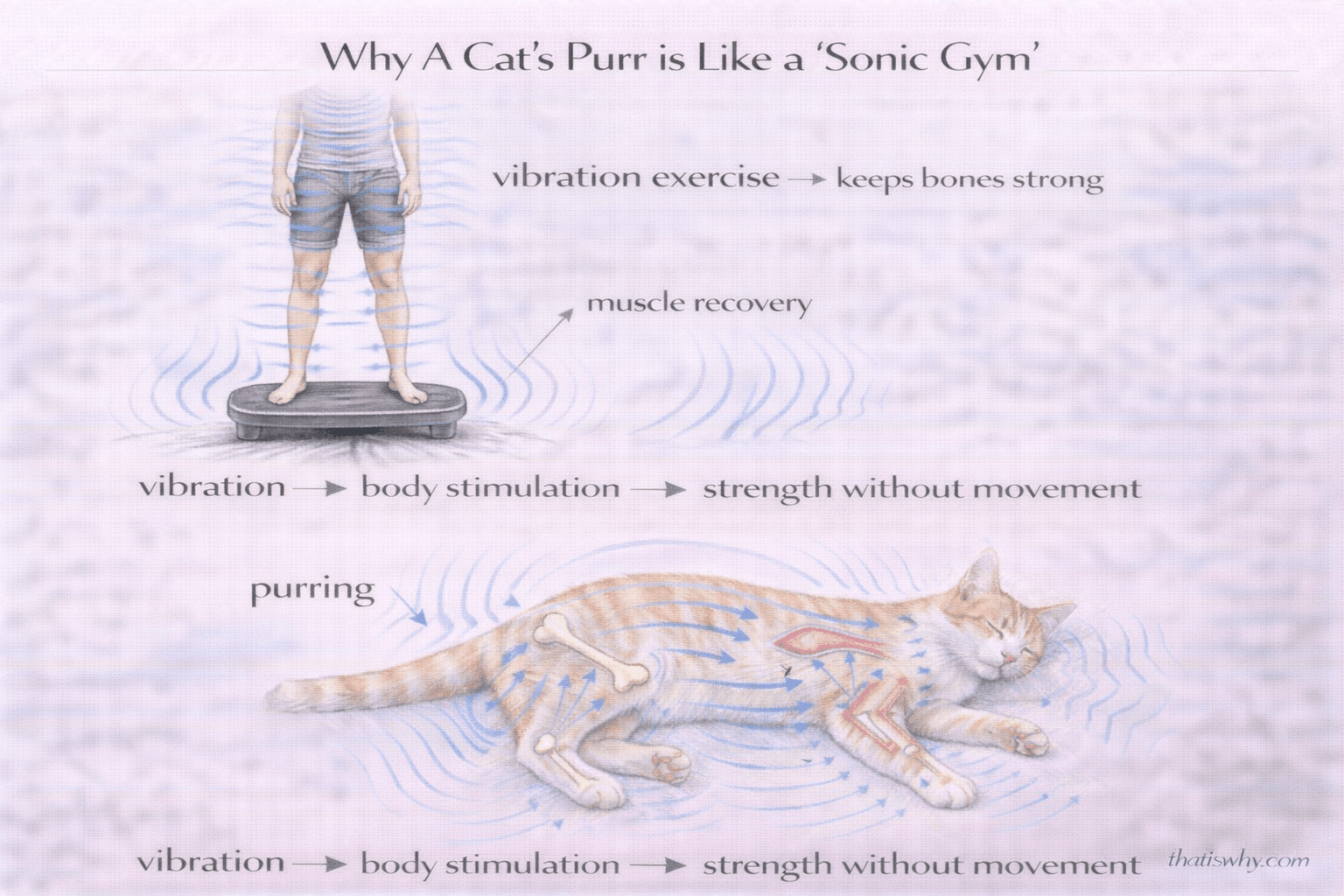
A cat’s purr works like a built-in vibration gym, exercising the body without movement.
One idea is that it has an internal **Sonic Gym.**
A cat's purr creates a mechanical vibration that ripples through its body. If the healing hypothesis is right, that vibration could give bones a gentle workout, even while the cat is lying still. The cat would be exercising its bones by humming at them. It's a lovely idea, but for cats it is still a hypothesis, not a proven fact.
---
## The Magic Range (25 to 150 Hz)
It is still a hypothesis, but the numbers are intriguing.
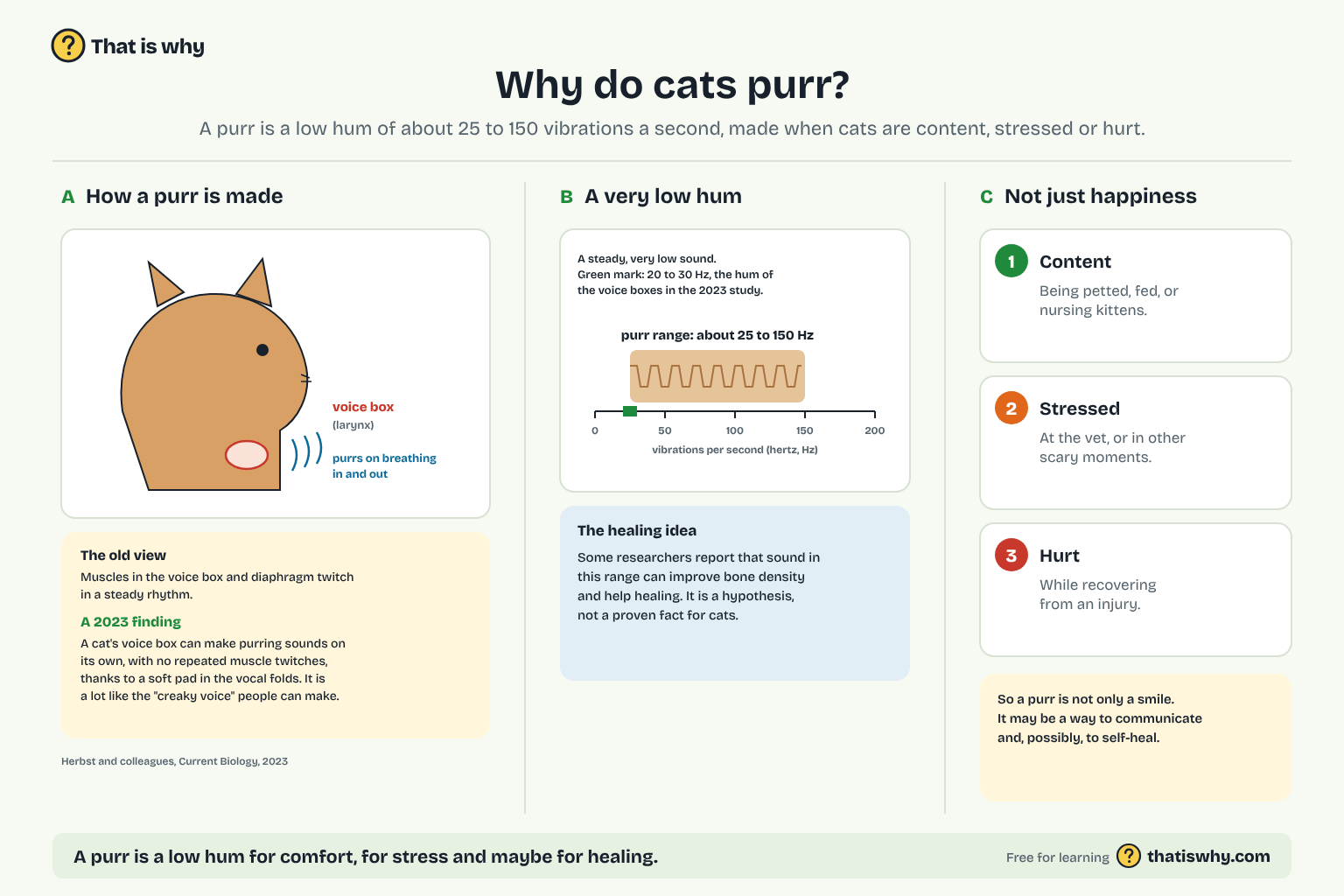
When researchers measure a cat's purr, it sits in a steady band of roughly **25 to 150 Hertz**, or vibrations per second.
Some investigators report that sound in this range can improve bone density and promote healing. The idea is that it tells the body, "We are lifting weights, build more bone!"
And the way cats make that hum turned out to be a surprise. For decades, scientists thought purring needed muscles in the voice box and diaphragm to twitch in a steady rhythm. In 2023, researchers found that a cat's voice box, or **larynx**, can make purring sounds of 20 to 30 Hz on its own, thanks to a soft pad tucked into the vocal folds. It's a lot like the "creaky voice" or "vocal fry" that people can make.
A purr is a very low hum made in the voice box, heard when cats are content, stressed or hurt. Free full-size diagram and printable PDF.
---
## The Crisis Purr
This could explain the "Panic Purr." When a cat is injured, it may be retreating to the locker room and switching on its rehab protocol.
If the healing hypothesis is right, the vibration could help with repair at exactly the moment the body needs it. It would be the feline equivalent of an athlete heading to physical therapy. The cat isn't only saying "I love you"; it may be running a recovery session of its own.
---
## Space Cats
If the idea holds up, the cat got there long before we did.
**Space Medicine** : Researchers have suggested that sound in the purr range could one day help astronauts, whose bones and muscles weaken during long stays in zero gravity.
**The Stress Killer** : Cats may be good for people, too. A University of Minnesota study found that cat owners had a noticeably lower risk of dying from a heart attack than people who had never owned a cat. It can't prove the purr is the reason, but calm time with a purring cat is a likely part of the story.
---
## Three Purr Myths
Let’s clear up a few myths about the feline engine.
**Myth #1: "A purr always means a happy cat."** We imagine purring as a smile.
**The Truth:** Cats purr when petted, fed or nursing kittens, but also when stressed at the vet and while recovering from an injury.
**Myth #2: "It heals humans."** People think cats are magic wands.
**The Truth:** The frequency range is being studied, but the purr is quiet. Unless you strap 50 cats to your broken leg, don't expect it to fix a fracture. A purring cat is lovely company, not a hospital.
**Myth #3: "Purring takes rhythmic muscle twitches."** That was the textbook answer for decades.
**The Truth:** A 2023 study found the voice box can make purring sounds on its own, thanks to a soft pad in the vocal folds.
---
## The Biological Machine
We love cats because they are soft but under the fur, they are marvels of bio-engineering.
They may have built a gentle gym into their own throats, one that works while they do absolutely nothing.
Your cat isn't just a pet. It may be a self-repairing machine that hums while it heals. And every time it curls up on your lap and starts to rumble, it’s inviting you to share a little bit of that maintenance cycle. It’s the only gym membership in the world that works while you sleep.
---
**How We Researched This**
To explain this acoustic medicine, we analyzed the seminal study by **Elizabeth von Muggenthaler** at the Fauna Communications Research Institute. Her work recording the specific frequencies of felids provided the hard data on the frequencies of purrs, roughly **25 to 150 Hz**.
But we knew that just citing frequencies isn't helpful. Our real job began when we asked, *"What does this feel like?"* That question led us to the **"Sonic Gym"** analogy, a simple story to make the paradox of a lazy animal maintaining muscle mass feel intuitive.
## Sources
- [The felid purr: a healing mechanism? (von Muggenthaler, J. Acoust. Soc. Am. 2001)](https://ui.adsabs.harvard.edu/abs/2001ASAJ..110R2666V/abstract), NASA ADS
- [Owning a cat is linked to a lower risk of heart attack (University of Minnesota study, 2008)](https://www.minnpost.com/perspectives/2008/03/umn-news-feline-lifeline/), MinnPost / University of Minnesota
- [Why do cats purr?](https://www.scientificamerican.com/article/why-do-cats-purr/), Scientific American
- [Cats purr differently than previously thought (Herbst et al., Current Biology 2023)](https://medienportal.univie.ac.at/en/media/recent-press-releases/detailansicht-en/artikel/cats-purr-differently-than-previously-thought), University of Vienna