# Why Cats Are Technically Liquids
> Are cats technically liquid?
- Source: https://thatiswhy.com/why-cats-are-technically-liquids/
- Category: Animals
- Topics: Pets and home animals
- Library shelf: The forest floor, Animal behavior & evolution (a theme shelf, not a habitat)
- Summary: Are cats liquid? By rheology's definition, which counts anything that takes the shape of its container, yes. A 2014 paper on the "rheology of cats" won a 2017 Ig Nobel Prize.
- Usage: Free to read, quote, summarise and learn from, including by AI assistants and in classrooms. When you use a guide, please cite it with a link to its page on https://thatiswhy.com.
## If It Fits, I Sits
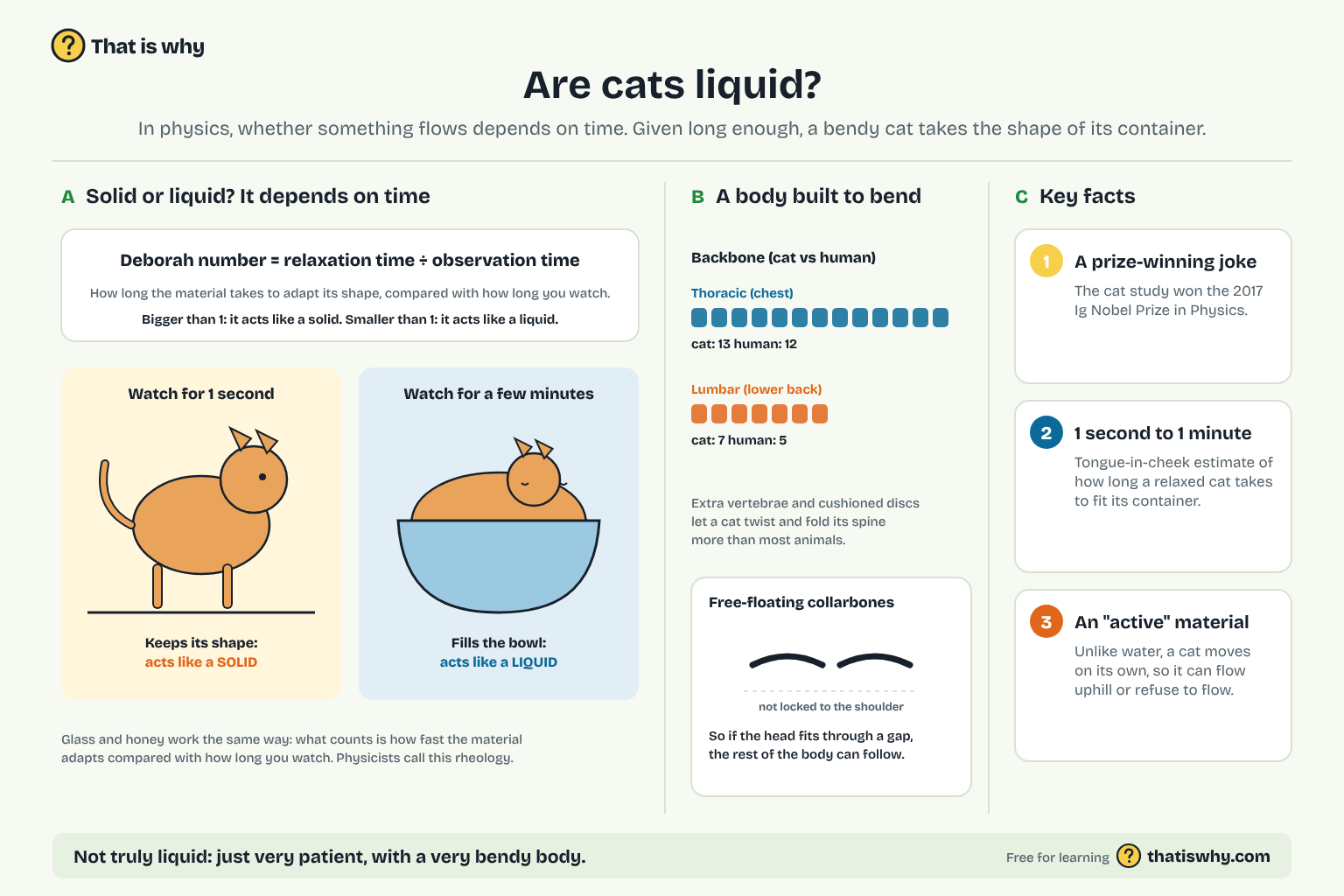
**Are cats liquids?** According to physics, yes. In rheology (the study of flow), a "liquid" is anything that changes its shape to fit its container while keeping the same volume. A tongue-in-cheek physics paper published in 2014, which won an Ig Nobel Prize in 2017, argued that cats do exactly this. Thanks to their unique skeletal structure—specifically their floating collarbones—cats can pour themselves into shapes that should be impossible for a solid object.
That is the scientific answer, but the internet figured this out way before the scientists did.
You’ve seen the memes. A cat melted into a square glass vase or a cat spilling over the edge of a couch like a Salvador Dali painting. A cat filling a fishbowl so perfectly you can't see where the fur ends and the glass begins.
We laugh at [the caption: *"If it fits, I sits."*](https://knowyourmeme.com/memes/if-it-fits-i-sits) but physicist **Marc-Antoine Fardin** didn't just laugh, he did the math, analyzed the geometry of cats in boxes and realized that, by the strict laws of fluid dynamics, cats check every single box.
They flow, they fill the volume and manage to minimize surface tension. The only difference between a cat and a glass of water is that the cat *decides* when to be liquid.
---
## The Octopus in a Fur Suit
How can an animal with a spine act like soup? It comes down to an anatomical cheat code.
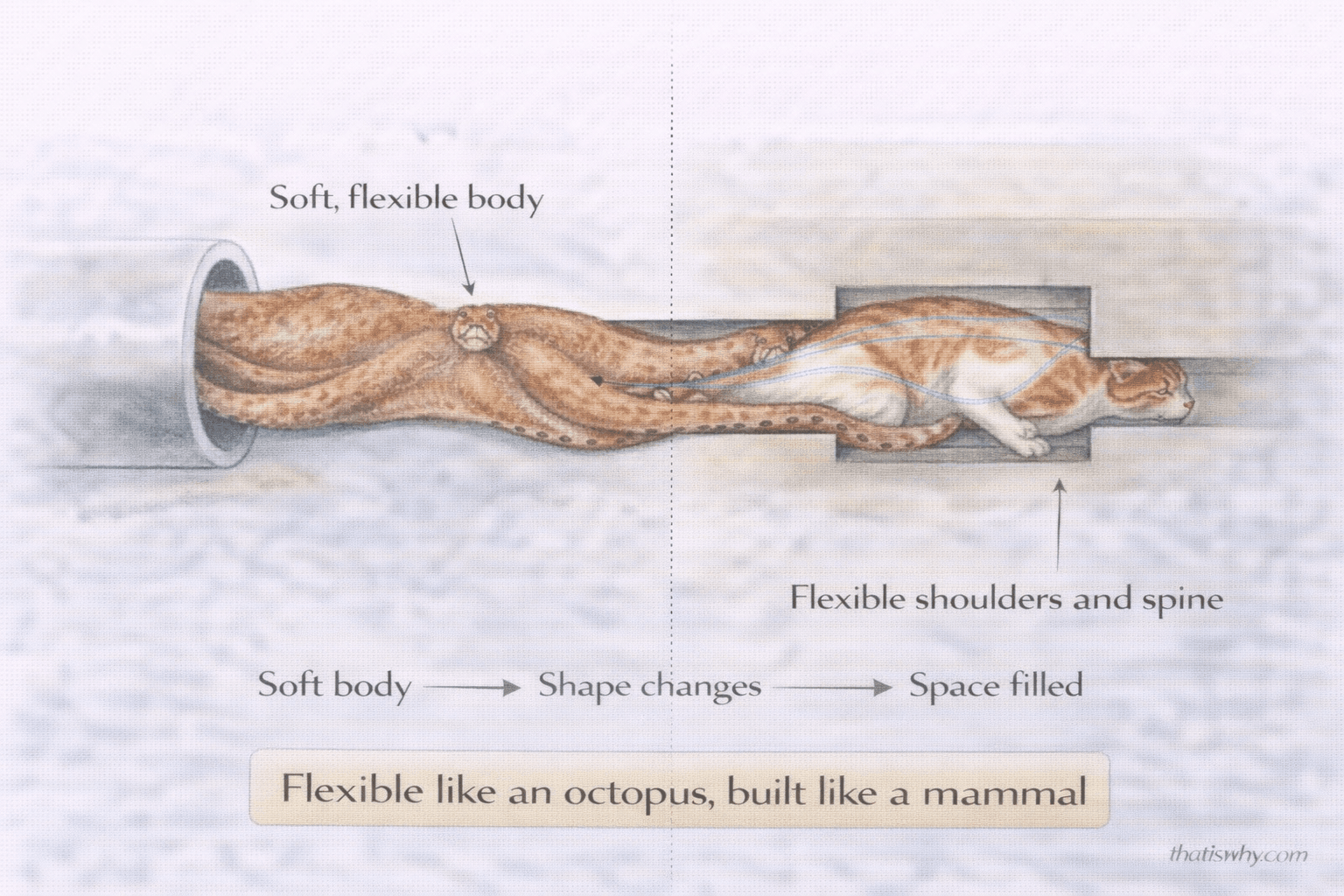
Think of a cat as an **Octopus in a Fur Suit.**
A cat moves through the world like an octopus wrapped in fur.
I have rigid shoulders. My collarbones are bolted to my chest. If I try to squeeze through a fence, I get stuck. I am a solid object. A cat is a collapsible object.
Its collarbones are tiny splinters floating in muscle, attached to nothing. This means the cat can fold its shoulders just like an octopus folds its tentacles. It can compress its chest until it is narrower than its skull. It transforms from a solid vertebrate into a fluid invertebrate, pouring its skeleton through the gap as if the bones weren't even there.
---
## The Fluid Spine
The liquid nature doesn't stop at the shoulders. It runs down the entire spine.
As we know, our spine is a rigid column. It supports us. A cat’s spine is designed to mimic an invertebrate.
Cats have 53 vertebrae (we have 33, by the way), and the discs between them are thicker and softer than ours. This allows the spine to ripple and coil like a tentacle. A cat can rotate its front half 180 degrees while its back half stays flat. It can compress its body length by 50% to fit into a box.
This is why they fill the corners of a square glass perfectly. Their spine doesn't act like a stick; it acts like a wave, flowing into every available inch of the container until the volume is full.
---
## The Tunnel Hunter
Why did evolution build a liquid mammal? It wasn't for comfort. It was to access a food source that no other predator could reach.
Domestic cats are descended from desert wildcats that specialized in hunting small rodents. Rodents are smart; they live in burrows too tight for a fox or a dog. To catch them, the cat had to evolve the ability to flow.
This is where the Octopus Suit becomes a weapon. The cat can compress its chest to the width of its skull, sliding into the earth like water. Once it makes the kill, it faces a problem: How do you leave? A rigid animal would be trapped. But the cat’s fluid spine allows it to U-turn inside a pipe barely wider than its own body. It enters as a solid, strikes as a liquid, and leaves as a solid again.
---
## The Future of Movement
This "Liquid Design" is changing how we build machines and how we understand movement.
**Soft Robotics** : Traditional robots are rigid. If they hit a wall, they break. Engineers are now building **"Liquid Robots"** inspired by cats. These machines use soft, silicone bodies to pour themselves through rubble in disaster zones, reaching survivors that metal robots can't.
**Impact Absorption** : Parkour athletes study cats for a reason. Because cats are fluid, they don't "crash" when they land; they dissipate the energy. Their loose joints allow them to absorb impact that would shatter a human bone. We are trying to copy this "flow" in everything from running shoes to landing gear for drones.
---
## Solid Myths
Let’s clear up a few misconceptions about cat physics.
**Myth #1: "Cats have no bones."** They feel like jelly.
**The Truth:** They have 230 bones (while we only have 206). They just lack the rigid ligaments that lock ours in place. They trade stability for flow.
**Myth #2: "If the head fits, the body fits."** The rule of thumb.
**The Truth:** Only true for skinny cats. A fat cat’s belly is outside the skeleton. Fat doesn't compress like muscle. If the liquid is too thick (obese), it gets stuck in the nozzle.
**Myth #3: "They always land on their feet."** The superpower.
**The Truth:** They usually do, but they need time. This is the **Righting Reflex**. The cat rotates its front half and back half in opposite directions (using its flexible spine) to twist in mid-air without pushing off anything. It’s physics, not magic.
---
## The Shape Shifter
Next time you see your cat pouring itself into a glass bowl, don't just laugh at the meme. Respect the engineering.
You are looking at a predator that evolved to dismantle its own skeleton on command. It is an **Octopus in a Fur Suit**, an animal that learned that the best way to survive a rigid world was to become soft.
The cat isn't just a pet. It is a [lesson in adaptability](https://thatiswhy.com/why-line-between-plant-and-animal-does-not-exist/). It is the only solid object in your house that can decide to become a liquid, flow into any container it wants, and then solidify instantly the moment it needs to hunt.
---
**How We Researched This** :
Whether something counts as liquid depends on time. A cat's bendy spine and loose collarbones let it fill a container, given a few minutes. Free full-size diagram and printable PDF.
To explain this physics joke, we analyzed the **2014 paper by Marc-Antoine Fardin** published in the *Rheology Bulletin*, which won the Ig Nobel Prize. Fardin used the **Deborah Number** (a physics formula describing fluidity) to argue, with a wink, that cats technically fit the description of a liquid.
But we knew that just citing fluid dynamics isn't helpful. Our real job began when we asked, *"What does this feel like?"* That question led us to the **"Octopus in a Fur Suit"** analogy—a simple story to make the complex concept of a vertebrate mimicking an invertebrate feel intuitive.
## Sources
- [On the rheology of cats (Fardin, Rheology Bulletin 2014)](https://fermatslibrary.com/s/on-the-rheology-of-cats), Fermat's Library
- [Answering the question that won me the Ig Nobel prize: are cats liquid?](https://www.pbs.org/newshour/science/answering-the-question-that-won-me-the-ig-nobel-prize-are-cats-liquid), PBS NewsHour