# Why Bristlecone Pines Live for 5,000 Years
> Why do bristlecone pines live so long?
- Source: https://thatiswhy.com/why-bristlecone-pines-live-so-long/
- Category: Plants & Forests
- Topics: Trees and plants; Life that breaks the rules
- Library shelf: The canopy, Plants, insects & land life (a theme shelf, not a habitat)
- Summary: Bristlecone pines live for millennia by growing slowly where little else survives, building rot-resistant resinous wood, and letting dead sections go.
- Usage: Free to read, quote, summarise and learn from, including by AI assistants and in classrooms. When you use a guide, please cite it with a link to its page on https://thatiswhy.com.
High on a bare limestone ridge, a tree that looks like a sun-bleached piece of driftwood stands twisted in the wind. Most of its trunk is naked silver wood, and you'd swear it died long ago. Then you spot a single green branch, still busy making needles, and it has been doing this for thousands of years. **Bristlecone pines live so long because they grow incredibly slowly in places where almost nothing else can survive, build dense, resin-soaked wood that insects and rot struggle to break into, and when one root dies, only the slice of tree above it dies while the rest lives on.**
That last trick is the one that makes people stop and stare. These trees survive by letting most of themselves go.
## A House That Closes Its Cold Rooms
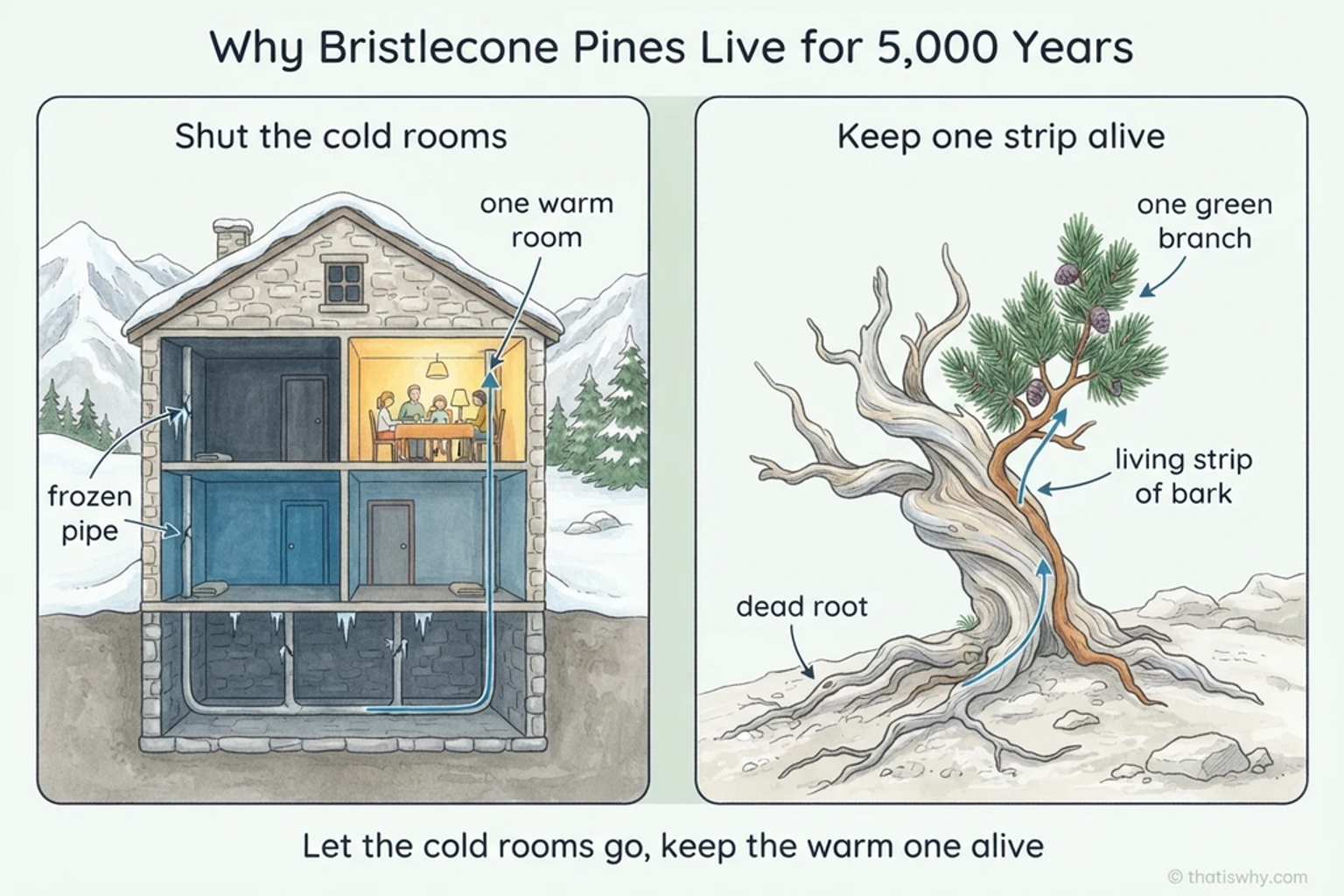
An old stone house sits high in the mountains, and every room has its own water pipe running up from the cellar. One brutal winter, the pipe to the north bedroom freezes and bursts. The family doesn't abandon the house. They shut that door, stuff a towel under it, and keep living everywhere else.
Decades pass, and more pipes crack, one room after another. Each time, the door closes and life carries on next door. Eventually the family lives in one warm room at the back, a single pipe still feeding it, surrounded by dark rooms whose stout stone walls still hold off the wind.
That is a bristlecone pine. Each big root feeds only its own strip of trunk and the branches above it, so a dead root costs the tree one room, never the whole house. There's one big difference, though. A family can reopen the north bedroom in spring, but a bristlecone's dead section never comes back to life. Its bark peels away for good, and the bare wood stays behind like an empty room.
A mountain house shuts the rooms whose pipes froze; a bristlecone lets go of the slices whose roots died, and keeps one warm room alive.
## How Bristlecone Pines Live So Long on Almost Nothing
### One Root, One Slice of Tree
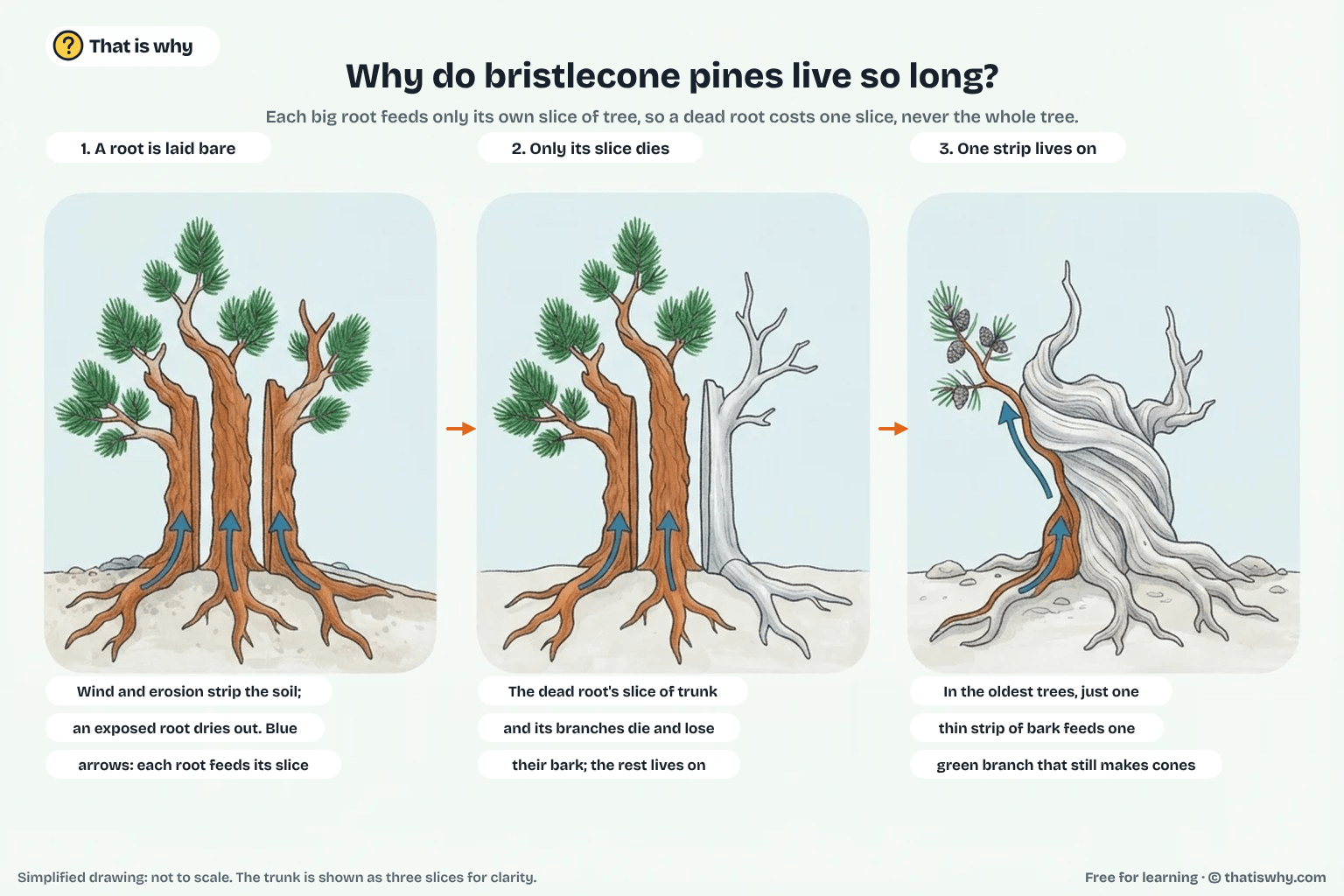
Botanists call this plumbing **sectored architecture**, a body built in separate slices, each supplied by its own root. Rangers at Great Basin National Park explain that "these roots feed only the sections of tree directly above them." On a windy mountainside, soil erosion slowly strips the dirt away and leaves roots exposed. Once a root dries out and dies, the slice of trunk it fed dies with it, along with its branches.
Everything else carries on as if nothing happened. So the tree loses rooms one by one over the centuries, each one closed by a root that dried out or rotted away. What's left keeps living exactly as before, fed by the roots that still work.
### A Thin Stripe of Life
Follow that story long enough, and you reach the strangest sight in the whole forest. A NOVA report on these trees puts it beautifully: "Some gnarled old bristlecones have only a thin strip of living bark, which sustains a single living branch and its needles." That narrow ribbon of bark is the last warm room in the house.
The same report adds a line we can't stop thinking about: "In a sense, these ancients have gone back to being seedlings." A tree that has been nearly dead for ages is, in its own way, as small and thrifty as a youngster. And even the oldest of them still make cones with seeds that sprout.
### Wood That Refuses to Rot
Now for the walls of those empty rooms. Bristlecones grow so slowly that a trunk may add no more than an inch to its girth in a century. That painfully slow growth packs the wood tight, and the rangers say it "leads to an incredibly dense wood which provides resistance from insects, fungi, rot, and erosion."
The wood is also loaded with **resin**, the sticky, waterproof goo many conifers make. Resin helps stop the wood from drying out and shuts out insects and bacteria. In the cool, dry mountain air, rot fungi barely get a foothold, so dead bristlecones can stand for several hundred years before they finally topple.
### Needles That Last for Decades
Even the needles are built to last. Most pines drop their needles every few years, but a bristlecone keeps each one for 30 or 40 years. In a place where some summers bring as few as six weeks of warmth, that matters enormously. Some years are so harsh that the tree adds no new growth at all, and long-lived needles mean it never ends up bare.
Edmund Schulman, a pioneer of **dendrochronology**, the science of reading history in tree rings, began studying these trees in the 1950s. He marveled at the ability of an ancient tree "to shut up shop almost everywhere throughout its stem in a very dry year and faithfully to reawaken to add many new cells in a favorable year." The whole house goes quiet, then the lights come back on.
Root laid bare, slice dies, one strip lives on: how a bristlecone outlasts its own losses. See the detailed teaching diagram and printable PDF.
## Getting By Beats Getting Big
Here's the twist that turns everything we expect upside down. You'd think the oldest trees on Earth would grow in the gentlest spots, with deep soil and plenty of rain. The opposite is true, and the NOVA report says so flatly: "In fact, the oldest bristlecone pines live on the most exposed sites."
The soil up there is mostly limestone rock with few nutrients, and the yearly rain and snow add up to less than 12 inches. Hardly any other plant can live there, and that is the secret. With so little ground cover around them, there's almost nothing to carry a wildfire. With no crowd of neighbors, there's little fight over water. Bristlecones growing lower down grow faster, but there they stay vulnerable to fire and never reach the same legendary ages.
So the rule behind the bristlecone is a beautiful one. **When life is hard, the winner is the one that spends least, not the one that grows most.** Slow growth makes tough wood, hard ground keeps rivals and fire away, and a body built in slices can lose parts without losing everything.
And does the tree itself wear out? Researchers Lanner and Connor, writing in the journal *Experimental Gerontology*, tested bristlecones ranging from 23 to 4,713 years old. They checked the water-carrying wood, the yearly shoot growth, the pollen, the seeds and the seedlings, looking for any sign of decline with age.
They found none, and concluded that "the concept of senescence does not apply to these trees." **Senescence** is the slow breakdown of a body as it ages, and these trees seem to skip it.
## Other Lives Built for the Long Haul
Bristlecones aren't the only living things that win by slowing down. In the dark Arctic, [Greenland sharks live for centuries](https://thatiswhy.com/why-greenland-sharks-live-for-centuries/) by running their bodies in slow motion in icy water. It's the same bargain in a cold place: burn little, last long. The so-called immortal jellyfish tries the opposite trick and rewinds itself into a young polyp, yet [the immortal jellyfish still loses the game](https://thatiswhy.com/why-immortal-jellyfish-still-loses-game/) to anything hungry enough to eat it.
Trees in general have a head start, because most of a big trunk is wood that doesn't need feeding. Britannica points out that an old tree "might be as much as 95 percent dead tissue!" A body that cheap to run is part of [how trees engineer their way to survival](https://thatiswhy.com/how-trees-engineer-their-way-to-survival/). The bristlecone just takes the idea further than any other tree.
Its needles fit the same pattern. Narrow, waxy needles are built to save water in dry, frozen air, which is [why some trees have needles instead of leaves](https://thatiswhy.com/why-some-trees-have-needles/). Other trees let parts of themselves go in different ways, as you can see in [why some trees peel their bark](https://thatiswhy.com/why-do-some-trees-peel-their-bark/). And among the [rule-breakers of biology](https://thatiswhy.com/biological-anomalies-life-that-breaks-rules/), the bristlecone stands out for one reason: it never cheats time, it simply outlasts it.
## Myths About the World's Oldest Trees
**Myth: A tree that looks dead must be dead.**
**The truth:** An old bristlecone can be mostly bare wood and still be alive. A single strip of living bark can keep one branch green for a very long time.
**Myth: You can count the rings to get a bristlecone's exact age.**
**The truth:** In harsh years, these trees may not add a ring at all. When the tree called Prometheus was cut down, it had 4,862 rings, but its age was estimated at 4,900 years.
**Myth: The oldest trees grow where conditions are best.**
**The truth:** The oldest bristlecones grow on the most exposed, windswept sites. Bristlecones in kinder spots lower down grow faster, but they don't reach the same great ages.
**Myth: Old bristlecones are slowly dying of old age.**
**The truth:** Tests on trees up to 4,713 years old found no drop in growth, pollen or seed health with age. What wears a bristlecone down is the mountain, not the calendar.
## The Last Warm Room on the Mountain
So let's climb back up to that silver tree on the limestone ridge. It is mostly an empty house by now. Room after room has closed over the centuries as roots dried out, and the bare wood still stands there because rot can barely touch it.
Tree-ring science has a sad chapter on these mountains, too. In the summer of 1964, a geographer named Donald R. Currey, studying ring widths on Wheeler Peak in Nevada, had the ancient tree known as Prometheus cut down, with the Forest Service's permission. Since then, an even older bristlecone in California's White Mountains has been found to be 5,065 years old. Somewhere on that mountain, its own last warm room is still lit, one thin stripe of bark feeding one green branch, refusing to let the house go dark.
## Sources
- [A Tree's Secret to Living Long, part 1 (Peter Tyson)](https://www.pbs.org/wgbh/nova/methuselah/long.html), NOVA Online, PBS/WGBH
- [A Tree's Secret to Living Long, part 2 (Peter Tyson)](https://www.pbs.org/wgbh/nova/methuselah/long2.html), NOVA Online, PBS/WGBH
- [The Prometheus Story](https://www.nps.gov/grba/learn/historyculture/the-prometheus-story.htm), National Park Service, Great Basin National Park
- [Identifying Bristlecone Pines](https://www.nps.gov/grba/planyourvisit/identifying-bristlecone-pines.htm), National Park Service, Great Basin National Park
- [Bristlecone Pine](https://www.nps.gov/brca/learn/nature/bristleconepine.htm), National Park Service, Bryce Canyon National Park
- [Does bristlecone pine senesce? (Lanner & Connor, Experimental Gerontology 2001)](https://research.fs.usda.gov/treesearch/20264), USDA Forest Service Research
- [How Can Some Trees Survive for Thousands of Years?](https://britannica.com/story/how-can-some-trees-survive-for-thousands-of-years), Encyclopaedia Britannica