# Why Bees Build Hexagons
> Why do bees build hexagons?
- Source: https://thatiswhy.com/why-bees-build-hexagons/
- Category: Animals
- Topics: Nature as engineer
- Library shelf: The canopy, Plants, insects & land life (a theme shelf, not a habitat)
- Summary: Why are honeycombs hexagonal? Bees build hexagonal honeycombs because the hexagon is the most efficient shape for tiling a flat surface.
- Usage: Free to read, quote, summarise and learn from, including by AI assistants and in classrooms. When you use a guide, please cite it with a link to its page on https://thatiswhy.com.
**Why are honeycombs hexagonal**? Bees build hexagonal honeycombs because the hexagon is the most efficient shape for tiling a flat surface. It holds the maximum volume of honey while using the minimum amount of wax (building material). This efficiency is critical because producing wax requires eight times as much energy as collecting honey.
That is the mathematical answer. But the biological reality is a construction project.
If you look into a beehive, you aren't just seeing a home. You are seeing a warehouse built by hoarders. A single colony needs to store hundreds of pounds of honey to survive the winter. They need to pack this heavy, sticky fluid into a container that is strong enough to hold the weight but light enough to hang from the ceiling.
And they have a major supply chain problem: They have to build the warehouse out of their own bodies.
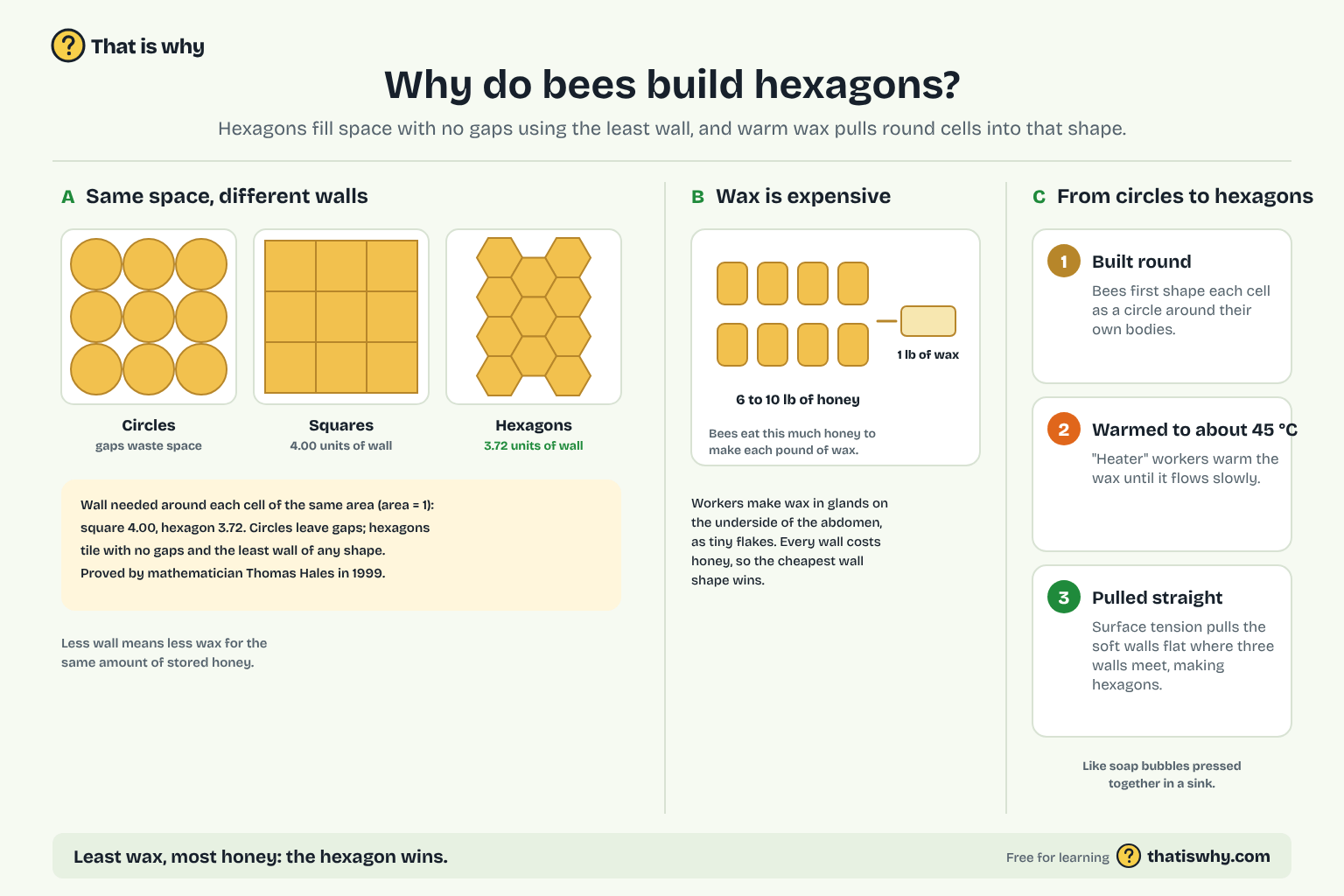
Bees build with **wax**. But wax is incredibly expensive to make. To produce just one ounce of wax, a bee has to consume eight ounces of honey.
Imagine if you had to pay $8 for every brick you used to build your house. You wouldn't waste a single brick. You would become obsessed with efficiency.
How do I build the biggest storage tank possible using the absolute minimum amount of building material?
The answer isn't biology. It’s geometry.
---
## The Expensive Apartment
To understand the solution, you have to think like an architect on a crisis budget. Imagine you are building an apartment complex, but every brick costs you a week's salary. You need to maximize the living space inside while building as few walls as possible.
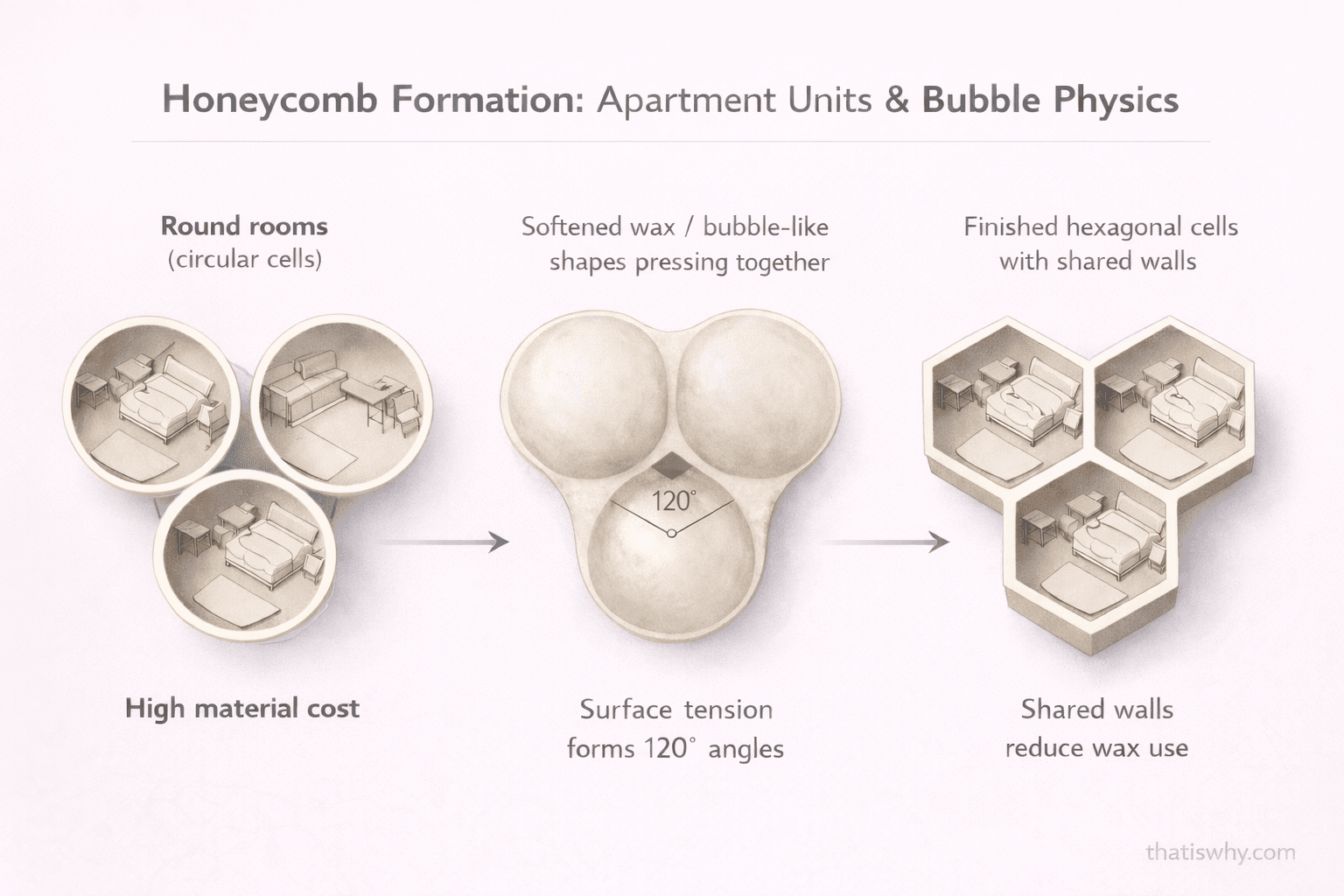
Honeycomb hexagons emerge naturally as softened wax cells press together.
If you choose **Circles**, you fail. When you pack round rooms together, you get useless gaps in between them. Gaps are wasted space, and you can't store honey in a gap. If you choose **Squares**, you do better. They fit together perfectly with no gaps. But they are inefficient; you end up building a lot of straight walls for not that much room inside.
But if you choose **Hexagons**, you win. Like squares, they fit together perfectly. But mathematically, a hexagon holds significantly more space with less wall material than a square or a triangle. By choosing this shape, the bee gets the maximum storage tank for the minimum wax bill. It is the perfect efficiency algorithm.
---
## The Honeycomb Conjecture
Bees figured this out millions of years ago. It took us a little longer.
For centuries, mathematicians stared at the honeycomb and suspected that the hexagon was the most efficient way to divide a surface. They called it the **"Honeycomb Conjecture."** But suspecting isn't proving. It was a mathematical cold case that stumped the greatest minds in history.
It wasn't until 1999 that a mathematician named **Thomas Hales** finally cracked it. He used a computer algorithm to prove, definitively, that the hexagon is geometrically unbeatable.
The bees were right all along. They are using the only shape in the universe that allows them to build a wall thinner than a sheet of paper that can still hold many times its own weight in heavy honey.
---
## The Bubble Theory: Do Bees Do Math?
So, are bees doing trigonometry in the dark? Probably not. They are letting the building settle itself.
A second kind of geometry happens on top of the finished comb, where foragers [use the waggle dance to point their sisters toward flowers](https://thatiswhy.com/why-do-honeybees-do-the-waggle-dance/) by turning the sun's direction into an angle against gravity.
Recent research suggests that bees actually start by building **round rooms** (cylinders). They use their own bodies to mold the wax into simple tubes. But the hive is a furnace; the body heat of thousands of workers softens the wax until it becomes fluid.
At that point, physics takes over as the architect. Imagine blowing a raft of soap bubbles in a sink. At first, they are round but as they press against each other, the walls flatten. They naturally snap into perfect 120-degree angles to minimize the tension.
The bees build the rough draft, but surface tension finishes the renovation. The hexagon isn't a blueprint the bees follow; it is the natural shape that round rooms collapse into when you pack them tight and turn up the heat.
Hexagons fill space with no gaps using the least wall, and warm wax pulls round cells into hexagons. Free full-size diagram and printable PDF.
---
## The Upward Tilt
But geometry isn't the only trick. There is also **Gravity**.
If you look closely at a honeycomb, you’ll notice a detail that most people miss. The cells aren't perfectly flat. They are tilted **slightly upwards**, by a few degrees.
This is pure engineering genius. When bees first deposit nectar, it’s watery and runny. If the cells were flat, that precious sugar water would drip right out onto the floor. By tilting the "cup" slightly up, the bees use gravity to keep the liquid pooling at the back of the cell until it cures into thick, sticky honey. It’s a tiny tweak that prevents a massive disaster.
---
## Stealing from the Bees
The hexagon isn't just for bugs. We have realized that the bees were onto something, and we have shamelessly stolen their blueprint.
**Aerospace Engineering** : Next time you fly, look at the wing. Inside that metal skin, it isn't solid. It’s often filled with an aluminum **Honeycomb Core**. Engineers use the hexagonal shape to create wings that are incredibly light but strong enough to handle hurricane-force winds. We trust our lives to the same geometry that holds up a beehive.
**[The James Webb Telescope](https://science.nasa.gov/mission/webb/)** : When NASA built the most powerful telescope in history, they needed a mirror that was massive but foldable. They didn't choose circles. They chose **Hexagons**. The shape allows the gold-plated mirrors to pack together without gaps, capturing every photon of light from the deep universe. The bees use it to capture honey; we use it to capture stars.
---
## The Architect's Secrets
Because bees are such incredible builders, we tend to invent stories about how they do it. Let’s correct the record.
**Myth #1: "The Queen is the architect."** We assume the boss holds the blueprints.
**The Truth:** The Queen is just an egg-laying machine. The workers build the comb instinctively, using their own bodies as measuring tapes. There is no foreman; just thousands of workers executing the same simple code.
**Myth #2: "Bees calculate the angles."** We imagine them doing trigonometry.
**The Truth:** They are likely using physics, not math. By letting body heat soften the wax, they allow surface tension to snap the walls into perfect hexagons. They don't calculate the shape; they let the universe do it for them.
**Myth #3: "The comb is just a grid."** It looks flat.
**The Truth:** It is a gravity-defying 3D structure. The cells are double-sided and tilted slightly upwards to stop the honey from leaking. It’s not just a pattern; it’s a functional storage tank.
---
## The Art of Efficiency
When we see a honeycomb, we see a [symbol of nature’s beauty](https://thatiswhy.com/how-trees-engineer-their-way-to-survival/). But looking closer, you realize it is really a symbol of nature’s desperation.
The bee isn't trying to make art. It is trying to survive a harsh economy where building materials cost a fortune in energy. It cannot afford to waste a single ounce of wax.
The hexagon is the result of that pressure. It is the perfect compromise between space and material. It is the point where biology admits that geometry is the boss. The honeycomb is beautiful not because it was designed to be, but because it is the only shape that works.
---
**How We Researched This** :
To explain this engineering marvel, we looked at the mathematics of **Tessellation** and the **1999 Proof by Thomas Hales**. We also referenced studies on **Surface Tension** to explain the "Bubble Theory" of comb formation.
But we knew that just citing math proofs isn't helpful. Our real job began when we asked, *"What does this feel like?"* That question led us to the **"Expensive Apartment"** analogy—a simple story to make the complex economics of wax production and space efficiency feel intuitive.
## Sources
- [The Honeycomb Conjecture (Hales, 1999)](https://arxiv.org/abs/math/9906042), arXiv
- [Honeybee combs: how the circular cells transform into rounded hexagons (Karihaloo et al., 2013)](https://pmc.ncbi.nlm.nih.gov/articles/PMC3730681), Journal of the Royal Society Interface (PMC)
- [Secrets of bee honeycombs revealed](https://www.cardiff.ac.uk/news/view/37044-secrets-of-bee-honeycombs-revealed), Cardiff University