# Why Bee Orchids Look Like Bees, Then Pollinate Themselves
> Why do bee orchids look like bees?
- Source: https://thatiswhy.com/why-bee-orchids-look-like-bees/
- Category: Plants & Forests
- Topics: Deception; Trees and plants
- Library shelf: The canopy, Plants, insects & land life (a theme shelf, not a habitat)
- Summary: Bee orchids belong to a family of flowers that fake a female bee, so fooled males carry their pollen. The bee orchid itself mostly pollinates itself.
- Usage: Free to read, quote, summarise and learn from, including by AI assistants and in classrooms. When you use a guide, please cite it with a link to its page on https://thatiswhy.com.
On a sunny, grassy bank, a fuzzy bee sits on a flower and doesn't move. You lean closer, waiting for it to fly off, and it never does. That's because the "bee" is part of the flower. **Bee orchids look like bees because they belong to a family of flowers whose lip is a fake female bee: in its relatives, the shape, velvety fuzz and a scent that copies a female's sex perfume trick male bees into trying to mate, and each fooled male flies off with a packet of pollen stuck to his body. The bee orchid wears the same costume, but in Britain it mostly skips the bees and pollinates itself.**
So the flower dresses up for a date and then, in some places, goes home alone. To see how both halves of that story work, it helps to sit down at a very strange café table.
## A Cardboard Date With a Note Stuck On
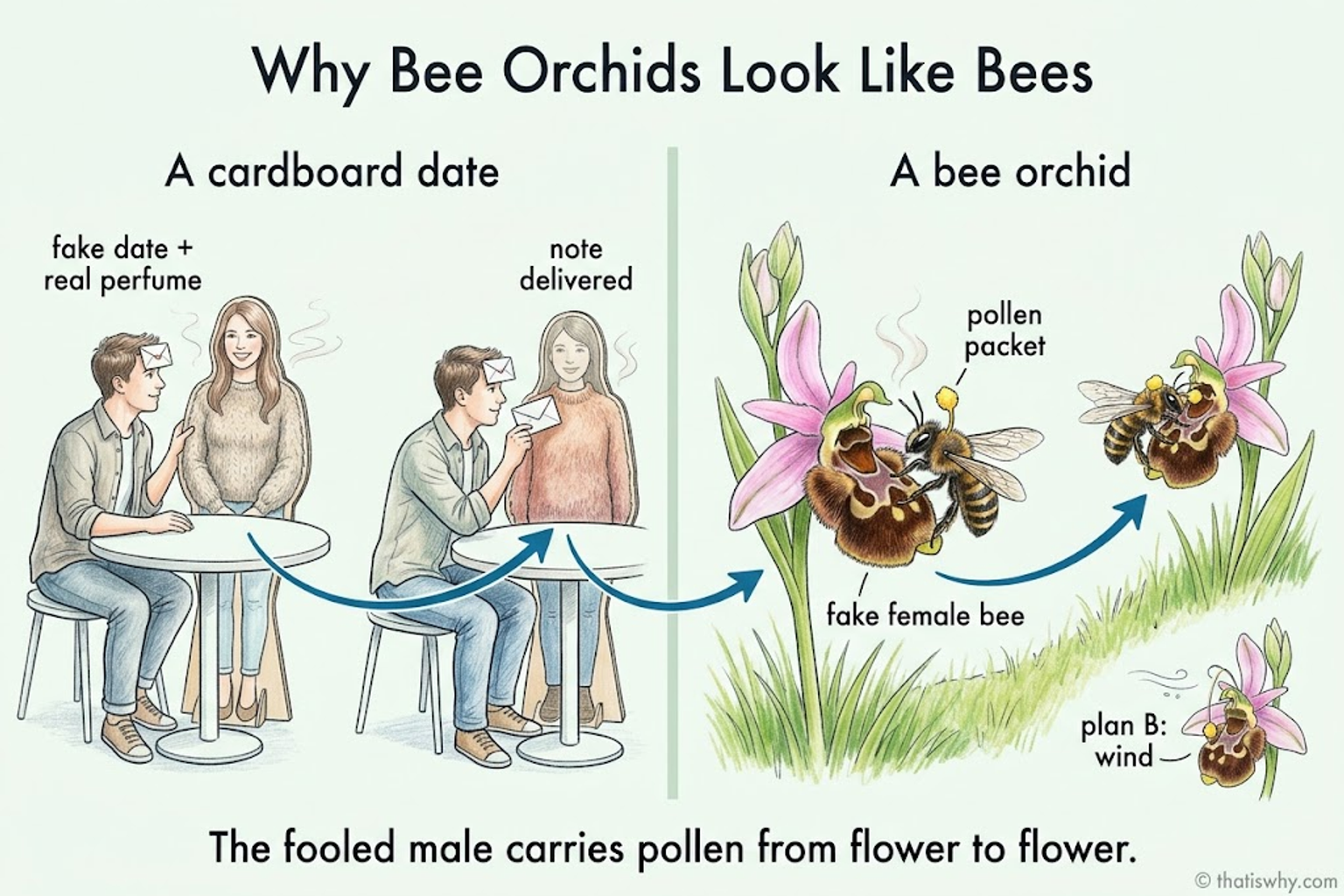
A young man walks into a café for a first date. At the corner table she's waiting, or at least something shaped like her is. It's a cardboard cutout, wearing a fuzzy sweater and drenched in exactly the perfume from her letters. He leans in to say hello, and while he's busy, a hidden hand slaps a sealed note onto his forehead.
He leaves, red-faced and confused. Two tables down sits another cutout with a slightly different perfume, and he falls for it all over again. As he leans in, the note on his forehead presses against her, and it's delivered. **The cutouts were never waiting for him; they were sending love letters to each other, with him as the unpaid postman.**
That's the whole business plan of the bee orchid's family. Of course, nobody wrote this scam. A real catfisher plans every lie, while the orchid has no plan at all. Over many generations, flowers whose fake dates fooled males a little better simply left more seeds.
The cutouts never wanted the suitor, only his help carrying the note. The orchid wants the same from a male bee.
## How the Bee Orchid's Family Forges a Female Bee
The bee orchid, *Ophrys apifera*, belongs to a whole family of con artists. The flowers of the genus *Ophrys* are hairy, often with a metallic shine, and each one echoes the female of a particular insect. Britannica explains that the flower's central petal, called the **labellum** or lip, is reshaped to lure particular bees or wasps with color, texture and scent.
The best-studied con artist in the family is the bee orchid's cousin, the early spider orchid (*Ophrys sphegodes*). Most of what scientists know about how the trick works comes from watching this cousin and its partner, a mining bee called *Andrena nigroaenea*.
That scent is where the forgery gets seriously good. Researchers led by Manfred Ayasse took the spider orchid's perfume apart. In the flower's lip they found more than 100 chemical compounds, and 24 of them made the male bees' antennae fire. That's two dozen notes of fake perfume, tuned to a nose that has only one thing on its mind.
### The pounce and the parcel
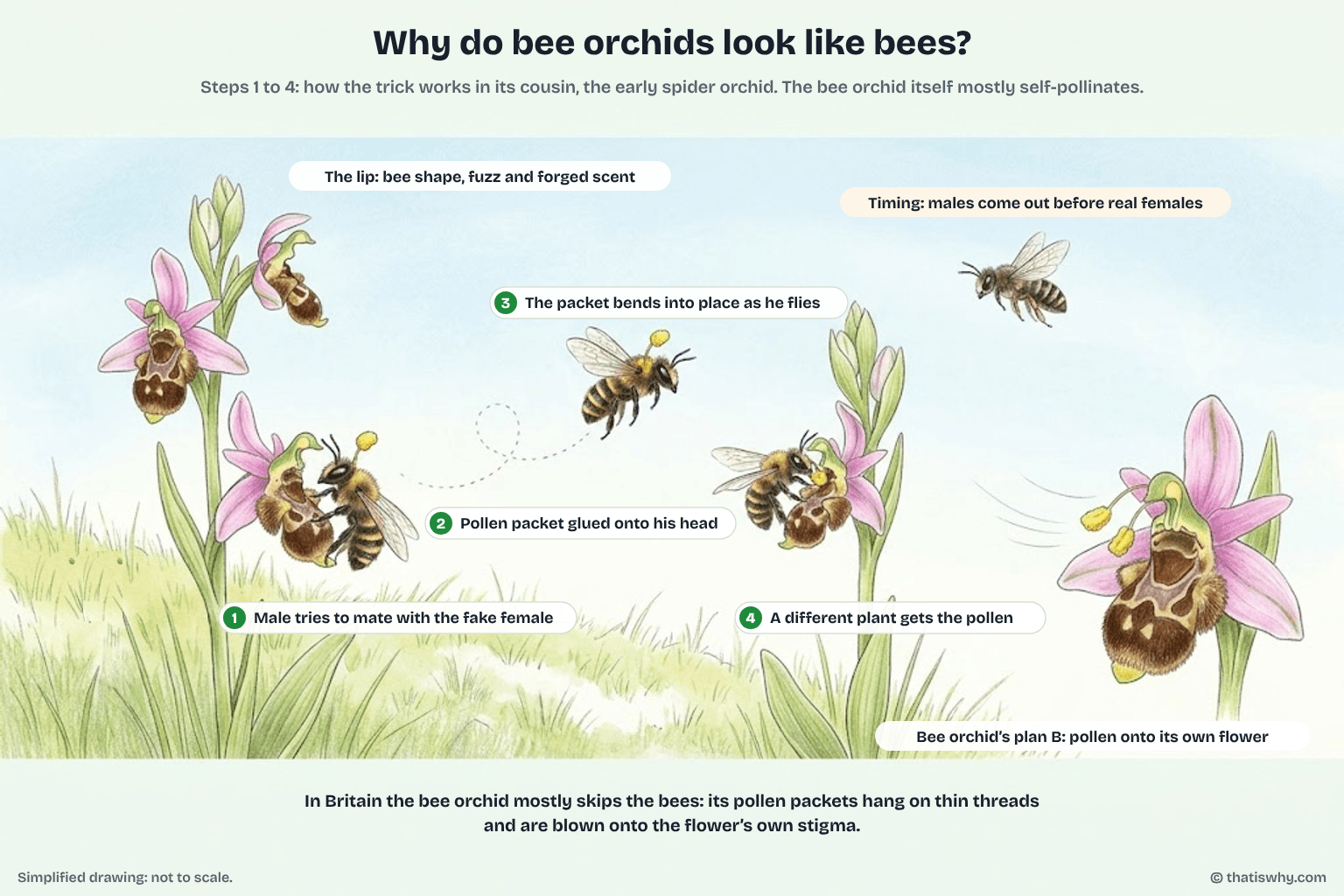
A male mining bee catches the spider orchid's scent, spots the furry shape and lands. He grabs the lip and tries to mate with it, which biologists call **pseudocopulation**, literally "false mating." This whole trick of luring pollinators with fake sex is known as **sexual deception**.
While he wriggles, a sticky pad glues a **pollinium** onto him, a packed bundle of the flower's pollen. Then the letdown sets in, and he flies away with nothing. Britannica puts it bluntly: the males gain nothing and often waste a lot of energy.
The pollinium doesn't sit still on his body, either. It takes a while to bend into position, like a stamp slowly tilting toward the envelope. The Ayasse team found that this delay limits pollen landing on another flower of the same plant, which gives the male time to wander off to a different one.
### Why he falls for it twice
Bees don't stay fooled forever, though. The researchers found that male bees learn the scent of each flower that tricked them, and they avoid that exact flower afterward. Other flowers get no such suspicion.
This next part is our favorite. The scent varies a lot from one plant to the next, so a male who learned to ignore one plant's perfume walks straight into the next plant's slightly different one. Every cutout wears its own perfume, and that keeps the postman delivering. Males rarely stop at one, either: in the spider orchid study, 67% of those that visited one flower went on to try a second flower on the same stalk.
Steps 1 to 4 show the trick in the bee orchid's cousin, the early spider orchid; the bee orchid itself mostly takes plan B. See the detailed teaching diagram and printable PDF.
## A Lie That Only Works Before the Real Date Arrives
There's a catch to faking a female: the real ones eventually show up. The early spider orchid shows how fragile this con can be, because its trick depends on perfect timing. Male bees come out of their nests before the females do, and the orchid has to bloom in that gap, when eager males are flying and real females are nowhere to be found.
British botanists led by Michael Hutchings went looking for how narrow that window is. Using English temperature records that stretch back to 1659, they modeled the spider orchid and its mining bee across 356 years. The gap between males and females appearing has been shrinking, and years when the timing flips the wrong way have become more common.
Even in a normal year, this con barely pays. The researchers wrote that in most years, the orchid-and-bee system achieves very limited pollination success. **A lie can only borrow an honest signal while the honest version is missing.** Once real females are buzzing around, a cardboard date doesn't stand a chance. Perhaps that's one reason a backup plan pays off.
## The Bee Orchid That Stood Itself Up
Now comes the strangest part of the story, and it belongs to the bee orchid itself. Charles Darwin spent years watching British orchids, and in a letter to the *Gardeners' Chronicle* in 1860, he reported something baffling. In several years of examining many flowers, he had never once found a single pollen mass carried away by an insect.
Not a single parcel left a flower in years of looking. As far as Darwin could see, the plant always fertilized itself. The Royal Botanic Gardens, Kew, says the same today: the bee orchid is generally self-pollinated. Its pollinia hang on a thin thread, and the breeze blows them against the flower's own stigma, the sticky spot that receives pollen.
This is **self-pollination**, when a flower fertilizes itself with its own pollen. Back at the café, the note simply droops off its stalk and lands in the cutout's own lap. The fuzzy costume and the forged perfume are still there, dressed for a date who mostly doesn't come.
Darwin couldn't quite accept that this was the whole story. He wrote that he greatly doubted any plant relies on its own pollen forever, and he suspected insects still visit the bee orchid in other places or seasons. The flower's sticky glands, he reasoned, are a sign that insects once mattered. If his hunch is right, the costume isn't wasted at all, and it still lands the occasional date somewhere.
## Fake Lovers and Fake Flowers Across Nature
Forging a love signal is a favorite move among nature's liars. Predatory fireflies flash a fake female's reply to lure males in for dinner, which is [why the femme fatale firefly is nature's spy](https://thatiswhy.com/why-femme-fatale-firefly-is-natures-spy/). The orchid wants a courier, while the firefly wants a meal, but both hack the same weakness: a male who can't resist answering.
Other cheats flip the target from lovers to diners. The orchid mantis looks more flower-like than real flowers, which is [how the orchid mantis out-blooms nature](https://thatiswhy.com/why-orchid-mantis-out-blooms-nature/) and catches the insects that come for nectar. Hoverflies run the opposite con, [wearing a wasp's warning colors to scare predators away](https://thatiswhy.com/why-hoverflies-look-like-wasps/). Chilies fake a feeling instead of a look, which is [why chili peppers are spicy](https://thatiswhy.com/why-are-chili-peppers-spicy/): their capsaicin sets off a false heat alarm in mammals.
Not every flower lies to its bees, of course. Some pay their visitors honestly, the way grown [sunflowers face east to warm up bees in the morning](https://thatiswhy.com/why-sunflowers-follow-the-sun/). All of these tricks, honest and dishonest, fill our guide to [why evolution favors the liar](https://thatiswhy.com/why-evolution-favors-liar-science-of-deception/).
## Bee Orchid Myths That Don't Fly
**Myth: Bee orchids reward bees with nectar for their trouble.**
**The truth:** The males fooled by *Ophrys* flowers gain nothing at all. They spend energy on a fake female and fly away with only a pollen parcel.
**Myth: The disguise is all about looks.**
**The truth:** Shape and fuzz help, but the flower forges a scent too. In the early spider orchid, 24 of the flower's compounds set off the male bees' antennae.
**Myth: The flower copies the bee because it can see it.**
**The truth:** Orchids have no eyes and no plan. Flowers that happened to fool males a bit better left more seeds, and the resemblance sharpened over many generations.
**Myth: Every bee orchid depends on bees.**
**The truth:** In Britain, the bee orchid is mostly self-pollinated. Its pollen packets swing on thin threads and the wind tips them onto the flower's own stigma.
## The Bee That Never Flies Away
Back on that sunny bank, the little bee still hasn't moved, and now you know why it never will. It's the family costume of petal, fuzz and forged perfume, the same one its cousins use to fool male bees into carrying love letters between flowers. Each fooled male is a postman who never gets paid.
For the bee orchid, at least in Britain, the postman mostly doesn't show up at all. So it quietly delivers its own letter, letting the wind drop its pollen onto its own stigma. **The bee orchid is a master forger with a backup plan.** What still delights us is how little the flower has to win. If Darwin was right, the con only needs to work now and then, because plan B is always swinging on a thread.
## Sources
- [Ophrys](https://www.Britannica.Com/plant/Ophrys), Encyclopaedia Britannica
- [Evolution of reproductive strategies in the sexually deceptive orchid Ophrys sphegodes: How does flower-specific variation of odor signals influence reproductive success? (Ayasse et al., Evolution 2000)](https://lup.lub.lu.se/record/146222), Lund University
- [Ophrys apifera Huds.](https://powo.science.kew.org/taxon/urn:lsid:ipni.org:names:647746-1/general-information), Plants of the World Online, Royal Botanic Gardens, Kew
- [Letter from Charles Darwin to the Gardeners' Chronicle, June 1860](https://www.darwinproject.ac.uk/view/letters/DCP-LETT-2826), Darwin Correspondence Project, University of Cambridge
- [Vulnerability of a specialised pollination mechanism to climate change revealed by a 356-year analysis (Hutchings et al., Botanical Journal of the Linnean Society 2018)](https://research-portal.uea.ac.uk/en/publications/vulnerability-of-a-specialised-pollination-mechanism-to-climate-c/), University of East Anglia