# Why Bats Use Echolocation to See in the Dark
> How do bats use echolocation?
- Source: https://thatiswhy.com/why-bats-use-echolocation/
- Category: Animals
- Topics: Animal senses
- Library shelf: The forest floor, Animal behavior & evolution (a theme shelf, not a habitat)
- Summary: Bats shout high-pitched calls and listen for the echoes. The delay tells them how far away things are, and they call faster and faster as they close in on prey.
- Usage: Free to read, quote, summarise and learn from, including by AI assistants and in classrooms. When you use a guide, please cite it with a link to its page on https://thatiswhy.com.
A summer night falls over a pond, and the last light drains out of the sky. Something small and dark flicks across the water, jinks sideways, and snatches a moth you never even saw. The night feels perfectly quiet, but that bat has been screaming the whole time. **Bats use echolocation: they shout high-pitched calls, mostly too high for human ears, and listen for the echoes. The delay of each echo tells them how far away things are, and as they close in on prey they call faster and faster, until the calls blur into a buzz.**
You already know that rising rhythm, by the way. You've heard it from the back of a car.
## The Parking Sensor That Learned to Fly
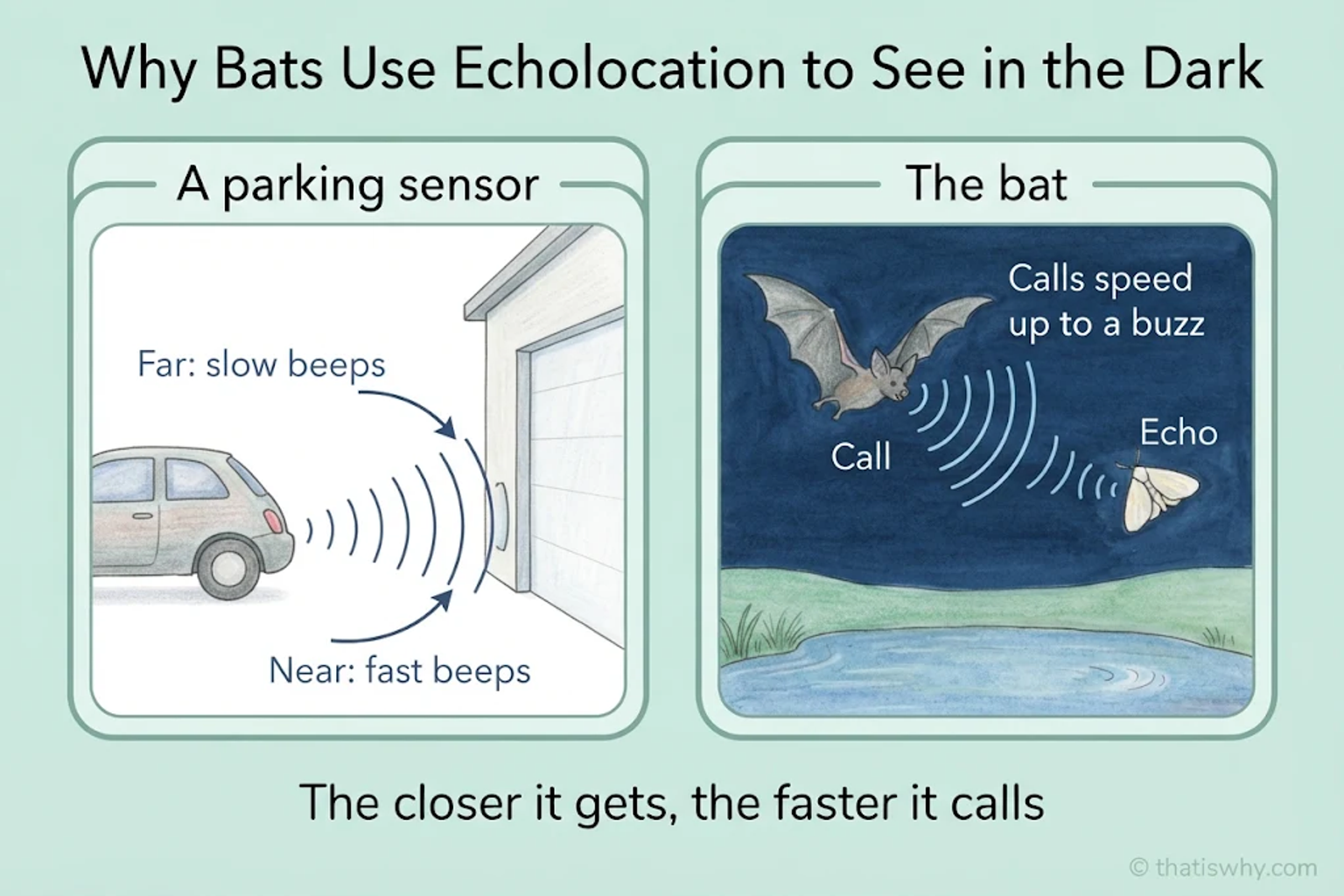
It's late, and you're backing into a tight garage. The sensor in the bumper gives a lazy beep, beep, beep while the wall is still far behind you. You ease back, and the beeps start crowding together. Closer, and they tumble into a frantic beep-beep-beep-beep, and then a single solid tone that means stop right now.
A hunting bat runs exactly that rhythm, except the beeps are its own voice. While it cruises over the pond, it calls at an easy pace, listening for anything worth chasing. The moment an insect answers with an echo, the calls come quicker and quicker. In the final split second, they pile into a rapid-fire burst that scientists call the **feeding buzz**, the bat's own solid tone, fired off just before the catch.
Here's where the car falls short. A parking sensor knows only one thing: how far away the wall is. A bat's echoes carry far more than distance. They tell it the size, shape and texture of whatever the sound bounced off. That's a whole sketch of the object, not one number on a dashboard.
Like a parking sensor that beeps faster as the wall gets closer, a hunting bat calls faster and faster as it closes in on a moth.
## The Bats That Flew Blind
For a long time, nobody had a clue how bats did it. In late 18th-century Italy, the priest and scientist Lazzaro Spallanzani ran a grim experiment. He blinded bats, and they flew and dodged obstacles just as well as bats that could see. Then the zoologist Charles Jurine plugged bats' ears with wax, and they collided helplessly with obstacles. So it had to be the ears, but the ears were listening to what, exactly?
Nobody could answer that, and Spallanzani's experiments were never widely known or accepted in his day. For about 140 years, the favorite explanation was that bats somehow felt their way through the air by touch.
The answer finally arrived in 1938, carried in a cage. A Harvard undergraduate named Donald Griffin brought his bats to the lab of the physicist G.W. Pierce, who had built a machine that could pick up sounds too high for humans to hear. In front of that detector, the supposedly silent bats turned out to be pouring out intense calls, all of them pitched above human hearing. Griffin later gave the trick the name we still use: *echolocation*, finding things by their echoes.
## How Bats Use Echolocation to Hunt
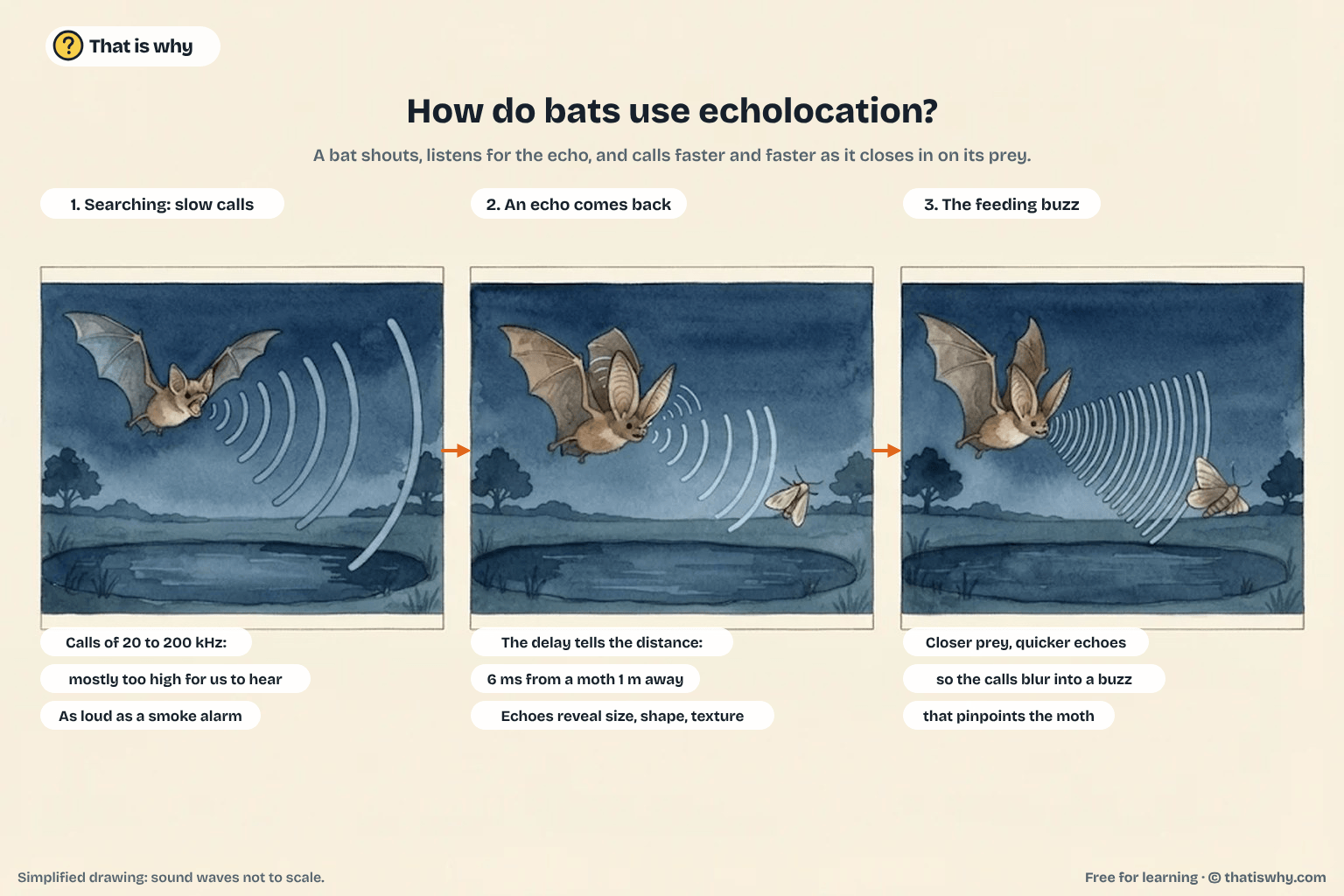
So what's actually coming out of that tiny face? Muscles in the bat's **larynx**, the voice box in the throat, power each call, and the sound leaves through its mouth or its nose. Most of the calls are *ultrasound*, sound pitched too high for us to hear. Bat calls usually run from 20 to 200 kilohertz, while human hearing tops out at around 20 kilohertz, so nearly the whole show plays above our heads.
And here's the jaw-dropper: those calls are loud. Big brown and little brown bats call at about **110 decibels**, roughly as loud as a smoke alarm. The quiet summer night over the pond is, to a bat, more like a rock concert in which every musician is screaming into the dark.
That raises an obvious problem. How do you hear a faint echo right after blasting your own ears? Bats solve it with split-second timing. Just before each call, a tiny muscle in the middle ear called the **stapedius** clenches and damps down the bat's own hearing. Then it relaxes again a few thousandths of a second later, in time for the echo. An echo from an insect one meter away takes just 6 milliseconds to come back, and the ear is already open and waiting for it.
The delay itself is the heart of the whole system. The farther away the moth, the longer its echo takes to return, so the bat reads distance straight off the gap between shout and echo. It also explains why the calls speed up during the chase. A far-off echo takes longer to come home, so the bat leaves long pauses between calls. As the gap shrinks, the echoes return sooner, and the bat can fire again almost at once.
All that precision pays off in astonishing detail. Bats can detect an object the width of a human hair, using nothing but sound.
Slow calls while searching, an echo that gives away the moth, then a fast feeding buzz. See the detailed teaching diagram and printable PDF.
## Making Your Own Light Out of Sound
Step back from the pond, and a simple rule of physics comes into focus. Light needs a source, and at night that source is mostly gone. Sound is different, because an animal can make its own. Every surface a sound wave hits throws part of it back, and each returning echo carries a little news about where that surface is and what it's made of.
An owl hunting a mouse is a passive listener, picking up whatever sounds its prey happens to make. A bat is an active one. It doesn't wait for the night to reveal itself: it lights up the darkness with its own voice, one call at a time. The trick works because the bat controls the signal, so it always knows exactly when each shout left and can time the echo against it.
This is the part that still amazes us. The bat's world isn't a dark world at all. It's a world drawn in echoes, redrawn faster and faster in the final rush.
## An Arms Race Fought in Ultrasound
A sense this good was always going to start a war. One tiger moth, *Bertholdia trigona*, fights back with noise. Researchers at Wake Forest University, led by Aaron Corcoran, filmed big brown bats attacking it and found that the moth fires off clicks at up to 4,500 times a second. The clicks seem to scramble the bat's sense of when its echoes return, like someone shouting random numbers while you try to count. The bats managed to reach the clicking moths only about 20 percent of the time.
Then the same team caught bats jamming each other. Mexican free-tailed bats roost in groups of up to 1.5 million, and plenty of them hunt the same skies. When one bat hits its feeding buzz, a rival can answer with a special wavering call that clashes with the echoes. In tests with a moth dangling from a line, playing that call dropped the bats' catch rate from around 70 percent to below 20 percent. Tellingly, the jamming worked only when it overlapped the feeding buzz, which is exactly the moment the parking sensor would be shrieking its solid tone.
Bats aren't the only animals to light up the dark with sound. Dolphins do it underwater, which is [how dolphins can "see" a golf ball 100 meters away](https://thatiswhy.com/why-dolphins-can-see-golf-ball-100-meters-away/), and the sperm whale has [a giant head that focuses its sonar clicks](https://thatiswhy.com/why-sperm-whales-head-works-like-butter-engine/) for hunting squid in the deep. Other night hunters tune in to signals instead of making them: owls catch mice by listening, and [owls fly silently](https://thatiswhy.com/why-owls-fly-silently/) so their own wings don't drown out the rustle. In the sea, sharks follow a whisper of electricity, which is [why sharks can sense electricity](https://thatiswhy.com/why-sharks-can-sense-electricity/) from hidden prey.
## Myths About Bats and the Dark
**Myth: Bats are blind, so they need sound instead.**
**The truth:** Bats can see about as well as humans can. Echolocation is an extra sense for the dark, not a replacement for eyes that don't work.
**Myth: Bats flit through the night in silence.**
**The truth:** Big brown and little brown bats call at about 110 decibels. We can't hear most of it because the calls are pitched above the range of human hearing.
**Myth: Every bat in the world uses echolocation.**
**The truth:** More than half of the roughly 900 bat species rely on it. The rest manage without it, leaning on their other senses instead.
## Back Over the Silent Pond
Return to that pond in the dark, with the moth drifting over the water. To you, the night is silent and almost black. To the bat, it's loud and bright, a world sketched out in echoes that come back a few thousandths of a second after each shout.
The bat closes in, and its calls speed up like a parking sensor nearing a wall. Then comes the buzz, the solid tone, and the moth is gone. **The night was never quiet: we just can't hear it shouting.** And every summer evening, overhead, the loudest hunters you'll never hear are reading the dark by its echoes.
## Sources
- [Discovering sonar in bats](https://www.aaas.org/blog/scientia/discovering-sonar-bats), American Association for the Advancement of Science (AAAS)
- [How do bats echolocate and how are they adapted to this activity?](https://www.scientificamerican.com/article/how-do-bats-echolocate-an/), Scientific American
- [Bat Echolocation](https://dnr.maryland.gov/wildlife/Pages/plants_wildlife/bats/batelocu.aspx), Maryland Department of Natural Resources
- [Bats Jam Each Other's Sonar](https://www.nationalgeographic.com/science/article/bats-jam-each-others-sonar), National Geographic
- [Moths Use Sonar-Jamming Defense to Fend Off Hunting Bats](https://www.scientificamerican.com/article/sonar-jamming-tiger-moths-bats-echolocation-defense), Scientific American