# Why Are Octopuses So Smart?
> Why are octopuses so smart?
- Source: https://thatiswhy.com/why-are-octopuses-so-smart/
- Category: The Ocean
- Topics: Animal minds; The ocean
- Library shelf: The sunlight zone, Ocean life near the surface (an ocean depth zone)
- Summary: Octopuses carry about 500 million neurons, more than half in their arms. The brain sets the goal while each arm reaches, grabs and tastes on its own.
- Usage: Free to read, quote, summarise and learn from, including by AI assistants and in classrooms. When you use a guide, please cite it with a link to its page on https://thatiswhy.com.
A diver hovers over a sandy seafloor and watches an octopus fuss with two halves of a coconut shell. It stacks them, spreads its soft body over the bowls, stiffens all eight arms like stilts, and marches off with its luggage. "It was an extremely comical sight—I have never laughed so hard underwater," said the biologist Julian Finn. **Octopuses are so smart because they carry a huge nervous system, about 500 million neurons, and more than half of it sits in their eight arms. The brain sets the goal, and each arm works out the reaching, grabbing and tasting on its own.**
That second part is the strange bit, and it changes how you think about the whole animal. The best way in is through the swinging doors of a busy restaurant kitchen.
## The Head Chef and Eight Line Cooks
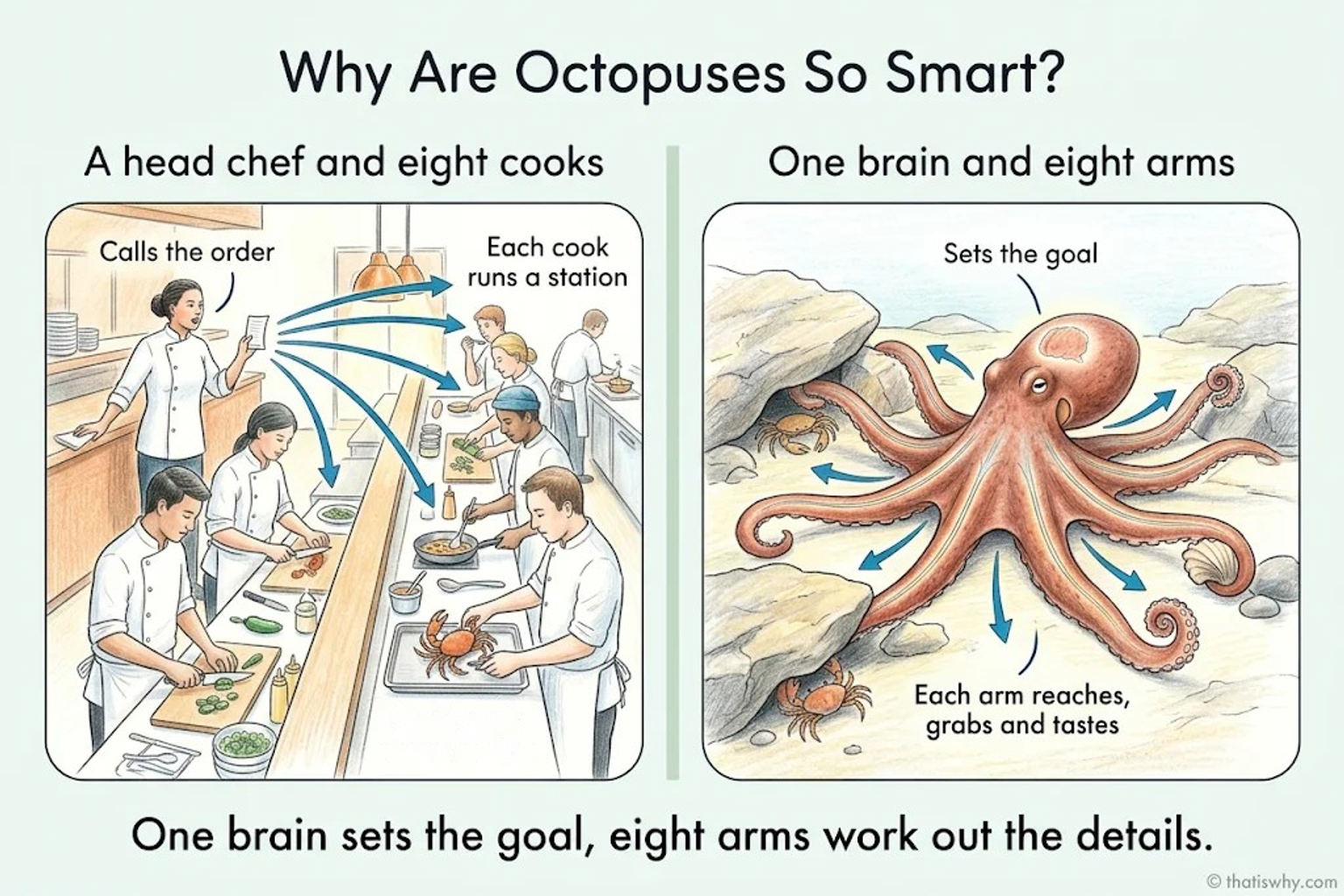
It's eight o'clock on a Friday night, and the tickets are piling up. The head chef doesn't chop a single onion. She reads the order, calls it out loud ("Two crab, one shrimp!"), and trusts her line. Down the counter, eight cooks at eight stations get to work. Each one handles their own knife, their own pan and their own tasting spoon, and nobody waits for permission before flipping a fillet.
An octopus works the same way. The central brain is the head chef: it decides that the crab hiding under that rock is dinner. The arms are the line cooks, and each has its own crew of nerve cells to run the station. The chef doesn't watch every knife stroke, and an octopus brain doesn't track every twist of every arm. It doesn't need to, because the cooks know their jobs.
Here's where a real kitchen and an octopus part ways, though. A line cook is a whole person with a whole brain, who could walk out and open a restaurant across the street. An octopus arm is a specialist. It's brilliant at reaching, gripping and tasting, but the big decisions still come down the line from the chef.
A head chef calls the order and eight cooks run their stations; an octopus brain sets the goal and eight arms do the rest.
## How Smart Are Octopuses? Inside an Arm That Thinks
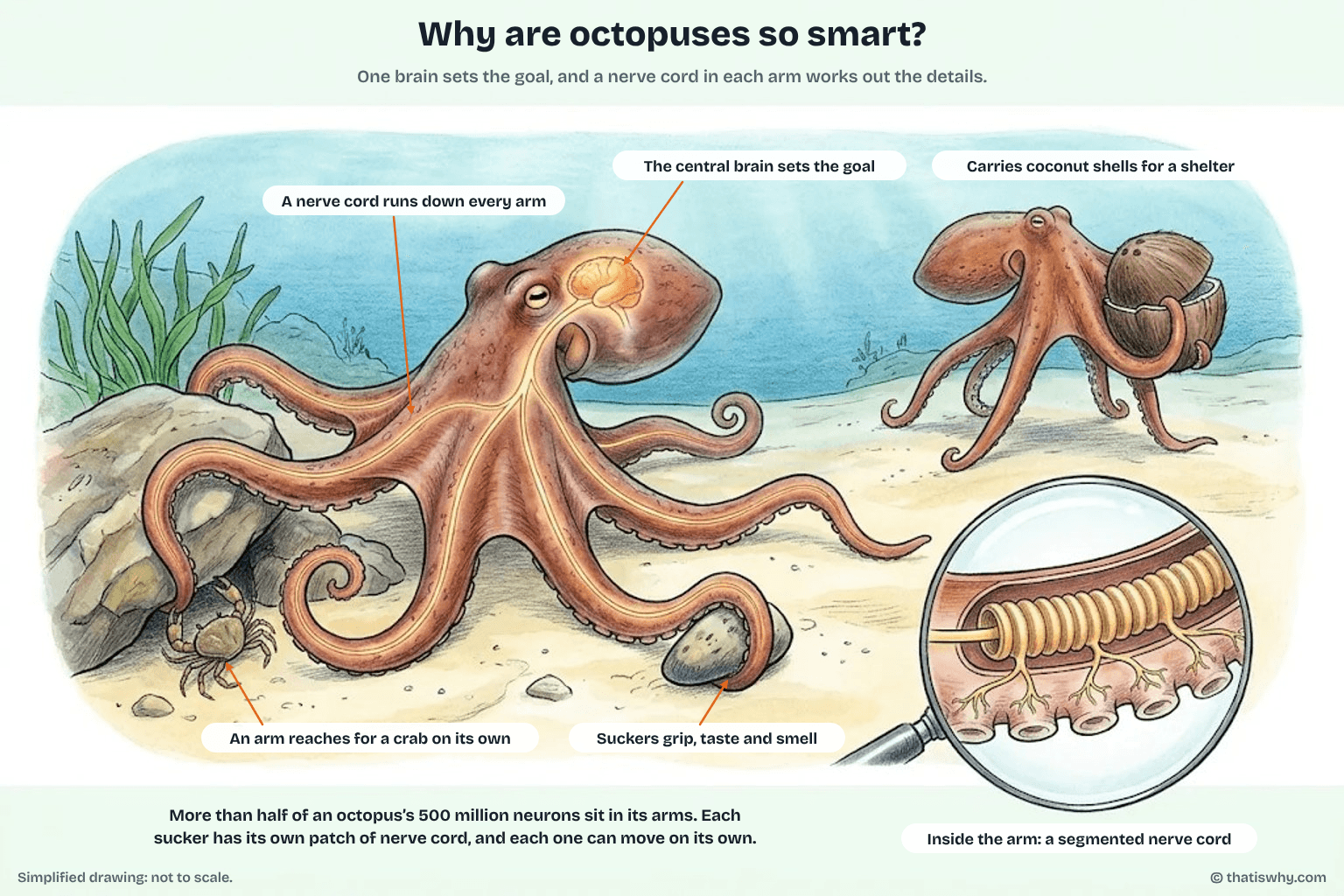
Start with the numbers, because they're wild. The philosopher Peter Godfrey-Smith, then at Harvard and a keen watcher of wild octopuses, put it plainly: more than half of an octopus's 500 million **neurons**, the nerve cells that carry signals, are found in the arms themselves. Most of the staff, in other words, works out in the kitchen, not in the chef's office.
What does an arm do with all those cells? Researchers at the University of Chicago, led by the neurobiologist Clifton Ragsdale, took a close look inside the arms of the California two-spot octopus. Running down the center of each arm is the **axial nerve cord**, the arm's main cable of nerves. Its nerve cells are packed into columns that form segments, "like a corrugated pipe," with small gaps where nerves and blood vessels branch out to the muscles nearby.
Each sucker gets its own patch of that cable. The nerves fan out in an orderly map, sucker by sucker, and an octopus can move and reshape each of its hundreds of suckers independently. That matters, because octopus suckers don't just grip. They carry sensors that let the octopus taste and smell whatever they touch, so every arm is a cook with a tasting spoon on each finger. "If you're going to have a nervous system that's controlling such dynamic movement, that's a good way to set it up," Ragsdale said.
### The arm that kept working after the shift ended
Now for the moment that makes people put their coffee down. A team at the Hebrew University of Jerusalem, led by Binyamin Hochner, studied arms that octopuses had lost. The severed arms stayed very active for about an hour after amputation. They kept grabbing whatever they were offered, even a dish, with no brain attached at all.
There was one thing the lonely arms never grabbed: octopus skin. They ignored a dish covered in it, yet they grabbed an octopus arm right away once its skin was peeled off. The reason turned out to be chemical. Something in octopus skin stops the suckers' grabbing reflex, a little like a kitchen rule that no cook ever grabs another cook's hand. That's how eight sticky arms stay out of each other's way.
The live octopuses were a different story, and this is where the chef comes back in. They sometimes grabbed a severed arm, skin and all, which shows the brain can override the skin rule. And they treated arms from other octopuses as food more often than their own. Telling "mine" from "lunch" looks like a call for the chef, not the cooks. The brain doesn't monitor every arm's exact position, but sometimes it steps in, and that's when you see the kitchen run as one team.
One brain, eight arm nerve cords, and a patch of nerves for every sucker. See the detailed teaching diagram and printable PDF.
## A Brain Built From Scratch, Twice
Zoom out, and the story gets even stranger. An octopus is a **cephalopod**, the group of soft-bodied mollusks that includes squid and cuttlefish. Its lineage and ours have evolved separately for more than 600 million years. Our last shared ancestor was probably a worm-like creature with a rudimentary nervous system, nothing anyone would call clever.
Somewhere along the octopus line, its ancestors lost their protective shells and evolved brains that are uniquely large among invertebrates, the animals without backbones. Today octopuses and their relatives have excellent memories, use tools and solve problems. They even have a concept of time and can hold out for a better reward later. "They really are an isolated outpost among invertebrates," Godfrey-Smith said.
That's **convergent evolution**: two lineages arriving at a similar solution by completely different roads. Evolution built a big, flexible mind once in our line, and then built another one from scratch in a soft animal that runs on [three hearts and blue blood](https://thatiswhy.com/why-octopuses-have-three-hearts/). The two kitchens look nothing alike inside, and the octopus kitchen hands out most of the knives.
We find that the most thrilling part of the whole story. Intelligence isn't one blueprint that nature keeps copying. It's a job, and there's more than one way to staff it.
## Coconut Armor and Other Clever Moves
Back to that coconut-carrying octopus, because it shows the whole kitchen in action. Finn, then at Museum Victoria in Melbourne, and his colleagues logged 500 diver hours and watched 20 veined octopuses. On four occasions, octopuses hauled their stacked shells for long distances, up to 20 meters, walking stiff-legged across the seafloor. The awkward trip had only one payoff: the shells became a shelter later.
Think about what that takes. The chef has to plan ahead ("I'll want a bunker tonight"), while eight cooks manage the grip, the balance and the walk. The researchers pointed out that this is wholly different from [a hermit crab borrowing an empty snail shell](https://thatiswhy.com/why-do-hermit-crabs-line-up-to-swap-shells/), because the octopus collects, carries and assembles its armor on purpose. Up on the surface, sea otters carry their tools too, tucked in a skin pocket, which is [why sea otters use rocks as tools](https://thatiswhy.com/why-do-sea-otters-use-rocks/). Octopuses do their own home decorating, too: Godfrey-Smith noted that they often collect broken glass, tiles and other hard debris and put them out front of their dens.
Octopuses aren't the only animals that prove a mind can be built in surprising ways. Their cousin the cuttlefish runs a brain-to-skin display so fast that [its skin works like a living screen](https://thatiswhy.com/why-cuttlefish-dont-just-change-color/). On land, [crows remember faces and pass the warning to their flockmates](https://thatiswhy.com/why-crows-remember-faces-and-hold-grudges/), so a whole neighborhood learns who to scold. And a blob with no brain at all can find its way through a maze, which is why [slime mold can out-plan a railway engineer](https://thatiswhy.com/why-slime-mold-is-smarter-than-engineer/). The sea is full of minds that feel alien to us, and that's a big part of [why the ocean is an alien world](https://thatiswhy.com/why-ocean-is-alien-world/).
## Myths That Tie Octopuses in Knots
**Myth: An octopus has nine brains.**
**The truth:** It has one central brain plus eight arm nerve cords that work like mini-brains. "Nine brains" is a fun nickname, but only the central one makes the big calls.
**Myth: Each arm has a mind of its own, and the brain is just along for the ride.**
**The truth:** The arms handle the details, but the brain still sets the goals and steps in when it matters. Live octopuses treat their own lost arms as food less often than a stranger's, a choice that seems to come from the brain.
**Myth: Octopuses must get tangled in their own sticky arms.**
**The truth:** Their skin carries a chemical that stops their suckers from grabbing it. Even a severed arm won't grip octopus skin, though it grabs a skinned arm.
**Myth: A smart animal has to be a close relative of ours.**
**The truth:** Octopuses and humans have been on separate evolutionary paths for more than 600 million years. Their intelligence was built independently, from a very different body plan.
## Eight Hands, One Dinner Service
Let's go back to that sandy seafloor and the octopus marching off with its coconut shells. It looked ridiculous, and it was brilliant. A brain somewhere in that soft body had decided that a portable bunker was worth the effort. Then eight arms, each packed with its own nerve cells and tasting every grain of sand, made the plan happen.
That's the secret of an octopus's smarts. It isn't one giant brain doing everything. It's a head chef who calls the order and a line of eight skilled cooks who know their stations, and a kitchen like that can cook up almost anything.
## Sources
- [Thinking like an octopus](https://news.harvard.edu/gazette/story/2010/10/thinking-like-an-octopus), Harvard Gazette (Harvard University)
- [UChicago scientists reveal nervous system secrets that give octopus arms their incredible dexterity (Olson, Schulz and Ragsdale, Nature Communications 2025)](https://news.uchicago.edu/story/uchicago-scientists-reveal-nervous-system-secrets-give-octopus-arms-their-incredible), University of Chicago
- [Self-recognition mechanism between skin and suckers prevents octopus arms from interfering with each other (Nesher, Levy, Grasso and Hochner, Current Biology 2014)](https://cris.huji.ac.il/en/publications/self-recognition-mechanism-between-skin-and-suckers-prevents-octo/), The Hebrew University of Jerusalem
- [How octopuses don't tie themselves in knots](https://www.sciencedaily.com/releases/2014/05/140515123254.htm), ScienceDaily (Cell Press)
- [Tool use in an invertebrate: The coconut-carrying octopus (Finn, Tregenza and Norman, Current Biology 2009)](https://www.eurekalert.org/news-releases/538714), Cell Press (EurekAlert!)
- [Do octopus brains work like humans'—or is there another way to be smart? (Liam Drew, Nature)](https://www.scientificamerican.com/article/do-octopus-brains-work-like-humans-or-is-there-another-way-to-be-smart), Scientific American