# Why Anglerfish Have a Glowing Light on Their Head
> Why do anglerfish have a light?
- Source: https://thatiswhy.com/why-anglerfish-have-a-light/
- Category: The Ocean
- Topics: The ocean > The deep sea > Light and hiding in the deep
- Library shelf: The midnight zone, Deep-sea life & bioluminescence (an ocean depth zone)
- Summary: Anglerfish glow because in the dark deep sea a light is the best bait, and the glow comes from bacteria the fish picks up from seawater.
- Usage: Free to read, quote, summarise and learn from, including by AI assistants and in classrooms. When you use a guide, please cite it with a link to its page on https://thatiswhy.com.
Three thousand feet down, where sunlight never reaches, the water is black in every direction. Then a tiny blue spark appears, bobbing and twitching like something alive. A small fish drifts closer for a better look, and the darkness behind the spark opens into a mouth full of needles. **Anglerfish have a glowing light because, in a deep sea with no sunlight and very little food, a light is the best bait there is. The glow isn't even the fish's own: it comes from bacteria living in the lure, which the fish picks up from the open ocean.**
That last part is the real twist. To see why it matters, it helps to go fishing at night.
## A Glow Stick on the End of the Line
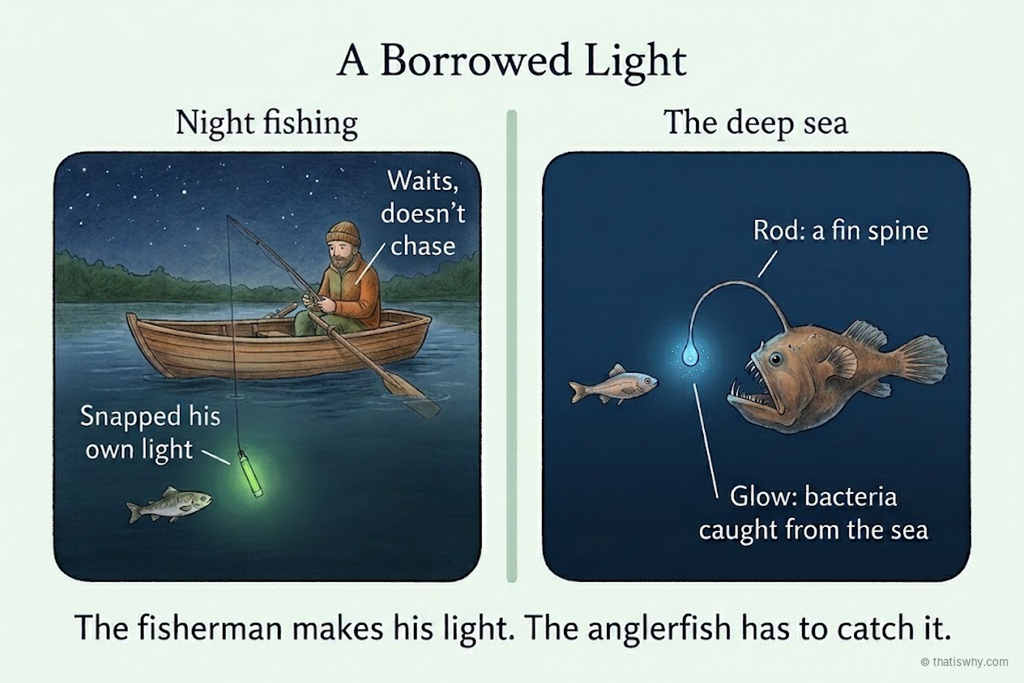
A lake at midnight, no moon, no wind. A fisherman sits so still in his boat that he could be part of it. At the end of his line, a little glow stick hangs just under the surface, glowing green in the dark. He doesn't row after the fish, and he doesn't splash around looking for them. He lets the light do the work, and he waits for something curious to swim up and take a bite.
That's an anglerfish, almost part for part. The rod is a long spine sprouting from the fish's forehead. The glowing bait is a fleshy bulb at its tip. And the patient fisherman is the fish itself, hanging motionless in the water with its jaws ready.
Here's where the boat and the deep sea part ways, though. The fisherman made his own light: he snapped the glow stick at the dock and hung it on his line. **An anglerfish is born with no light at all.** Its glow is alive, and the fish has to catch it wild, out of the ocean, before it can ever go fishing.
An anglerfish fishes like a man at night with a glow stick, with one difference: the fisherman makes his light, and the anglerfish has to catch its own from the sea.
## How a Fin Became a Fishing Rod
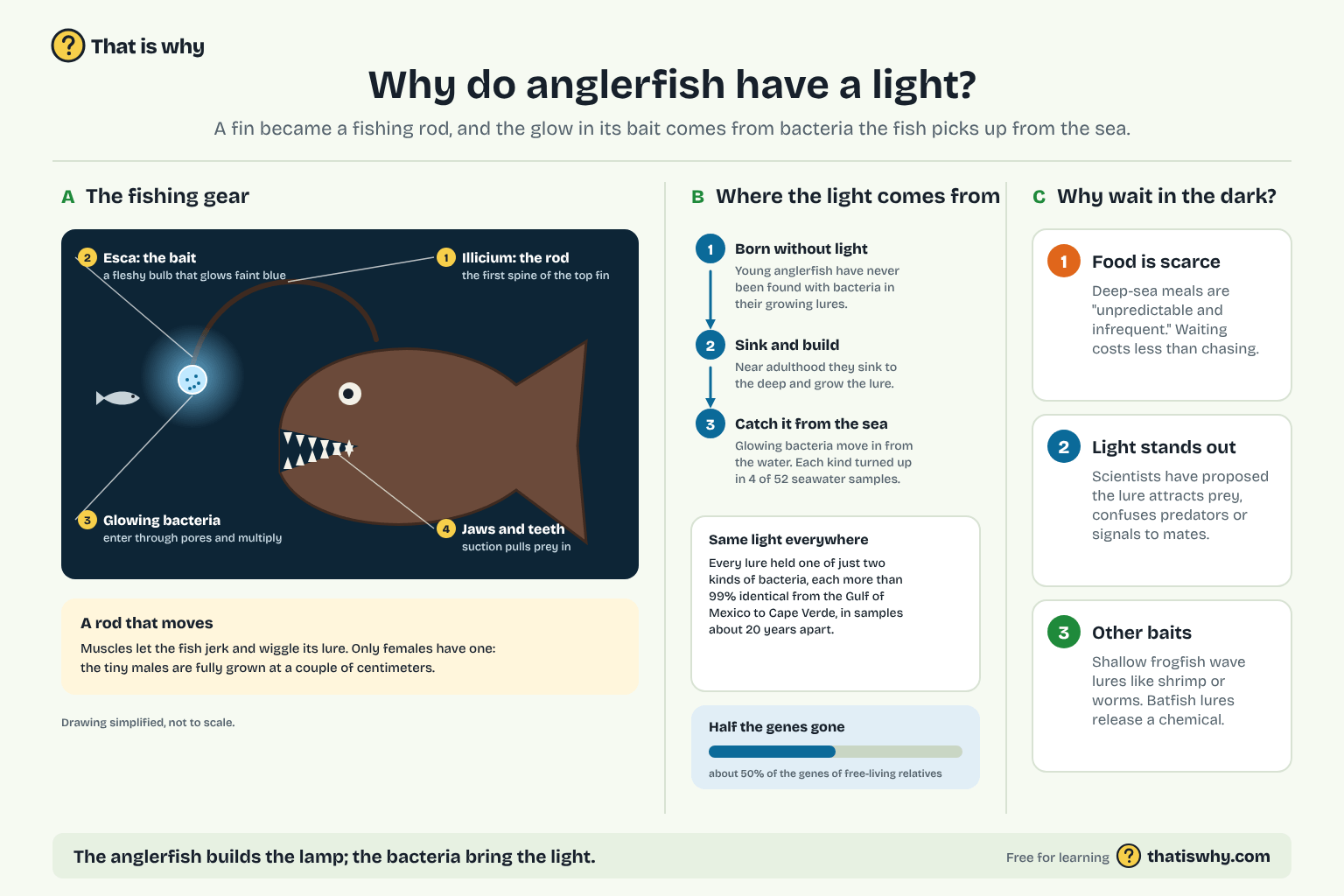
Start with the rod, because it's hiding in plain sight. It began as an ordinary fin. Over millions of years, the front of the anglerfish's **dorsal fin**, its top fin, evolved into fishing gear. The California Academy of Sciences explains that the first spine of that fin stretches outward over the head, and this spine is the **illicium** (ill-ISS-ee-um), the anglerfish's fishing pole.
At the tip sits the bait, a fleshy bulb called the **esca** (ESS-kah). The fish isn't stuck holding it still, either. According to Smithsonian Ocean, a complex set of muscles lets an anglerfish jerk and wiggle its lure, so the light doesn't just glow, it dances.
Now for the glow itself. Inside the esca lives a crowd of **bioluminescent** bacteria, microbes that make light through a chemical reaction. They flow into the bulb through small pores and multiply once they're inside, safe and fed. In deep-sea anglerfish, the result is a faint blue light, just enough to stand out against total darkness.
Then comes the payoff, and it's brutal. The anglerfish waits until a meal comes within reach. Then, Smithsonian Ocean explains, it uses its strong lower jaw to create a suction that pulls the prey into a mouth lined with needle-sharp teeth. As Woods Hole Oceanographic Institution deep-sea biologist Johanna Weston put it, "And those big teeth? They act like a Venus flytrap."
## The Light That Has to Be Caught Wild
So where does a fish get a lure full of glowing bacteria? One natural guess is that parents pass them to their young, the way you might hand down a family heirloom. Researchers at Cornell University set out to test it.
They gathered previously collected specimens of seven anglerfish species, fish caught anywhere from the Gulf of Mexico to the Cape Verde islands. Some had been pulled up almost 20 years apart. Then they read the DNA of the bacteria inside each lure, and the result was startling. Every lure held one of just two kinds of glowing bacteria, and the bacteria were 99% identical, across fish species, across oceans and across decades. If each fish lineage handed down its own private glow, the bacteria should have split into separate family lines that match the fish family tree. Instead, the bacteria showed no sign of following the fish family tree.
Microbiologist Tory Hendry summed up what that left: "The only way to explain that is they must be picking up that symbiont from an environmental population." In other words, every anglerfish recruits its light from the water. Young anglerfish have never been found with bacteria in their developing lures. Only as they near adulthood do they sink to the deep and grow their lure, and only once that lure is built do the bacteria move in.
Here's the part that makes it even stranger. These bacteria have thrown away about half their genes compared with their free-living cousins, the kind of stripped-down toolkit you usually see in microbes that never leave their host. And yet the team found them floating free in seawater samples. Somehow, these pared-down microbes survive out in the open ocean, waiting for a lure to move into. That's like a glow stick floating around the lake on its own, until the right fisherman scoops it up.
An anglerfish builds the rod and the bait, then catches its glowing bacteria from the open ocean. Free full-size diagram and printable PDF.
## Why Waiting Beats Chasing in the Dark
Why go to all this trouble instead of just chasing dinner? Because chasing is expensive, and the deep sea pays badly. In the anglerfish's world, food is "both unpredictable and infrequent," as Woods Hole puts it. Swimming around hunting burns energy you may never earn back. Sitting still and letting the meal come to you costs almost nothing.
Biologists have a name for a predator that tricks prey by offering something it wants: **aggressive mimicry**. The anglerfish's bait is a fake snack, a promise of food that turns out to be the front door of a mouth. In the dark, the most noticeable thing a lure can do is glow, so the deep-sea version glows. The light may even do double duty: scientists have proposed it may also help confuse predators or signal to mates.
That economy explains one more odd detail: only female deep-sea anglerfish have a lure. The males are tiny, fully grown at a couple of centimeters, and they don't hunt at all. In some species a male latches onto a female for life and lives on the nutrients she supplies. In a place this hungry, one well-fed hunter with a light is the whole family plan. Clownfish take lopsided families even further: every one is born male, and [the largest male turns into the group's only female](https://thatiswhy.com/why-clownfish-change-sex/) when the old one dies.
## Other Anglers, Other Baits
The trick doesn't depend on light. It depends on offering what the prey wants to see. Shallow-water anglerfish have sunlight to work with, so they skip the glow. Frogfish, shallow-water members of the anglerfish family, wave lures that look like little shrimp or worms, and batfish release a chemical from theirs instead.
On land, the same playbook shows up wherever a predator can fake a meal. [The spider-tailed horned viper wiggles a tail tip that looks like a spider](https://thatiswhy.com/why-spider-tailed-viper-is-natures-greatest-puppeteer/) until a bird swoops in. And in a summer meadow, [the femme fatale firefly copies another species' flash code](https://thatiswhy.com/why-femme-fatale-firefly-is-natures-spy/) to lure males to their doom, a lighted lie just like the anglerfish's.
Back in the deep, light is one of the busiest tools in the toolbox. Animals use it to hide, to warn and to find mates, as our guide to [why deep-sea animals glow in the dark](https://thatiswhy.com/why-do-deep-sea-animals-glow-in-the-dark/) explains, and together those lights turn the midnight zone into [a blue field of tiny stars](https://thatiswhy.com/why-deep-ocean-looks-like-blue-star-field/). The anglerfish is just one of [the strange adaptations of deep-sea animals](https://thatiswhy.com/unusual-adaptations-of-deep-sea-animals/), and surely the most famous one running a bait-and-wait business.
## Myths About the Anglerfish's Light
**Myth: The anglerfish makes its own light.**
**The truth:** The fish builds the lure, but the glow comes from bacteria living inside it. The fish supplies shelter and food, and the bacteria supply the light.
**Myth: Every anglerfish has a glowing lure.**
**The truth:** The glowing lures belong to deep-sea anglerfish. Shallow-water relatives like frogfish use lures shaped like shrimp or worms, and batfish use a chemical.
**Myth: Male anglerfish go fishing too.**
**The truth:** In deep-sea anglerfish, only females have a lure. The tiny males don't hunt and rely on the female instead.
**Myth: Deep-sea anglerfish are giant sea monsters.**
**The truth:** The famous black seadevil is about the size of your hand. Females typically grow to about six inches, and males stay under an inch. The big one in the family is the goosefish, which lives on the seafloor and can reach six feet.
## A Borrowed Light in the Dark
So the next time you see that famous blue bulb glowing in the black, remember the fisherman on the lake. The rod is a fin that wandered onto the forehead. The bait is a bulb that wiggles on command. And the light is a crowd of tiny strangers, caught out of the open ocean and given a home.
This is the part that still surprises us. The scariest-looking hunter in the deep can't light its own lamp, so it borrows one, and in a world without sunlight, that borrowed glow is what keeps it fed.
## Sources
- [Study illuminates link between anglerfish, bacteria](https://www.news.cornell.edu/stories/2019/10/study-illuminates-link-between-anglerfish-bacteria), Cornell Chronicle, Cornell University
- [Diverse deep-sea anglerfishes share a genetically reduced luminous symbiont that is acquired from the environment (Baker et al., eLife 2019)](https://elifesciences.org/articles/47606), eLife
- [Anglerfish Lure Prey Throughout the Ocean](https://ocean.si.edu/node/111009), Smithsonian Ocean, Smithsonian Institution
- [Pacific Footballfish](https://calacademy.org/explore-science/pacific-footballfish), California Academy of Sciences
- [A rare black seadevil anglerfish sees the light](https://www.whoi.edu/?p=594479), Woods Hole Oceanographic Institution