# Why Birds Raise Cuckoo Eggs (The Mafia Hypothesis)
> Why do birds raise cuckoo chicks that aren't theirs?
- Source: https://thatiswhy.com/why-birds-raise-cuckoo-eggs/
- Category: Animals, Plants & Forests
- Topics: Deception
- Library shelf: The forest floor, Animal behavior & evolution (a theme shelf, not a habitat)
- Summary: Why do birds raise cuckoo eggs? They aren't stupid; they are being blackmailed. Discover the "Mafia Hypothesis" and the gangsters of the bird world.
- Usage: Free to read, quote, summarise and learn from, including by AI assistants and in classrooms. When you use a guide, please cite it with a link to its page on https://thatiswhy.com.
## The "Stupid Bird" Myth
Look at a photo of a tiny Reed Warbler feeding a Cuckoo chick, and really take it in.
It’s ridiculous: the chick towers over its "parent." It looks like a toddler trying to spoon-feed a linebacker.
Your first thought is probably: *"That bird is an idiot."*
It seems obvious, since the chick is a giant and the egg was an intruder from day one. How can the host be so dumb that it doesn't realize it’s being scammed? Why doesn't it just kick the intruder out?
That’s the easy explanation: birds are just bad at spotting fakes. But on a windswept plateau in southern Spain, scientists found something much darker. The magpies there aren't only being fooled. Throwing out the cuckoo’s egg can cost them everything.
In other words, they aren't just [being tricked](https://thatiswhy.com/why-evolution-favors-liar-science-of-deception/). They are being held hostage.
---
## The Protection Racket
To understand why a bird would raise a monster that eats all its food, you have to stop thinking like a biologist and start thinking like a crime boss.
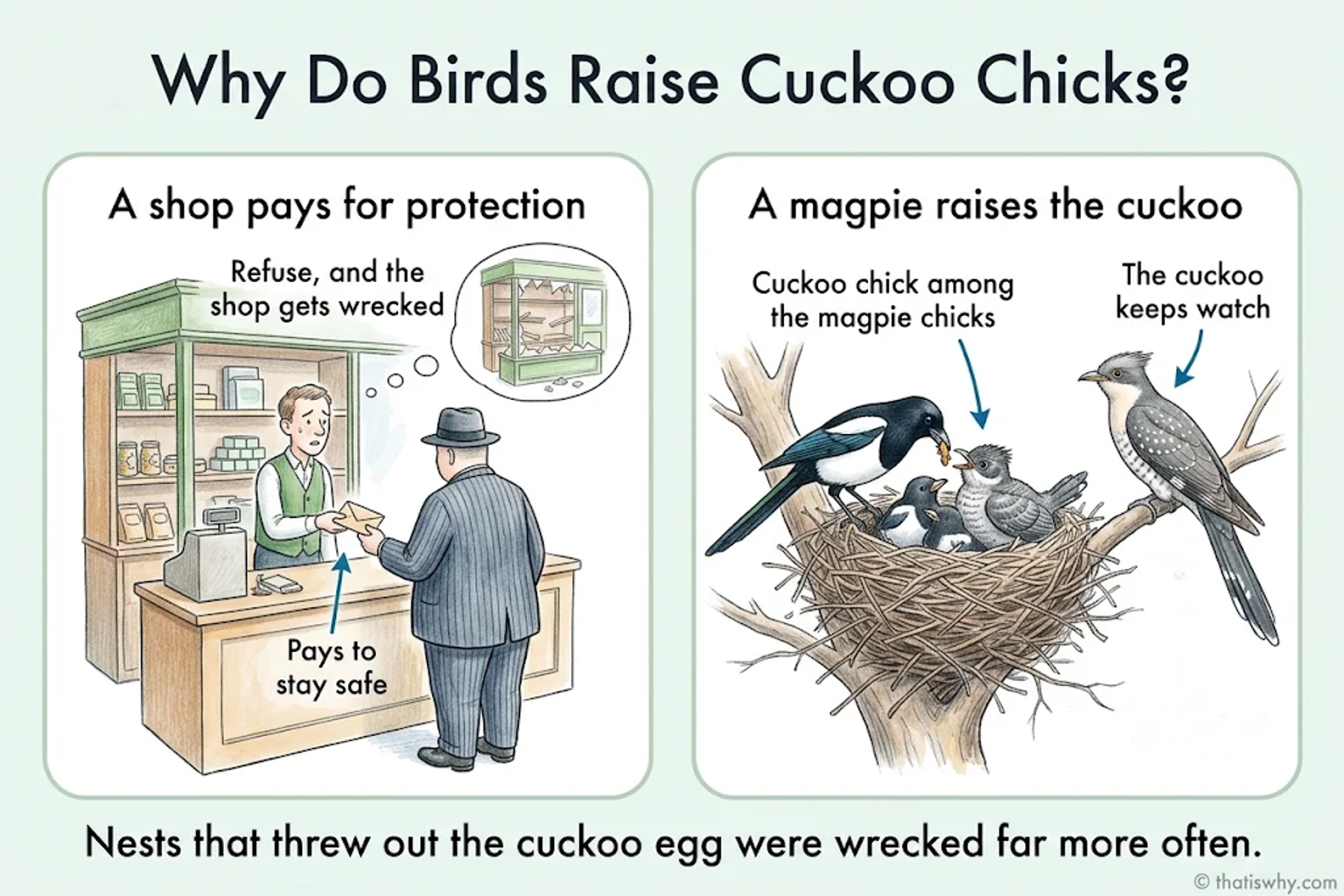
A shopkeeper pays the mob to keep his shop in one piece; a magpie raises the cuckoo chick to keep its nest.
This is the **Mafia Hypothesis.**
It sounds like a joke, but it is a serious evolutionary theory proposed by Amotz Zahavi in 1979. It suggests that Cuckoos aren't just lazy parents; they are running a sophisticated extortion scheme.
Think of the Magpie as a shopkeeper. It works hard, builds a nest, and tries to raise a family. Think of the Cuckoo as the Mob Enforcer.
The Cuckoo visits the nest and drops off her egg. It’s an offer you can't refuse. *"I'm leaving my kid here. If you feed him, I'll let you keep your shop. But if you throw him out? I will come back and smash everything you own."*
The Magpie isn't raising the chick because it's confused. It’s doing it because it’s terrified. It is paying "protection money" in the form of worms and beetles to avoid the total annihilation of its genetic line.
---
## Pay Up or Burn Down
For years, the "Mafia Hypothesis" was just a dark theory. Then Soler and his colleagues put it to the test, in a study published in the journal *Evolution* in 1995.
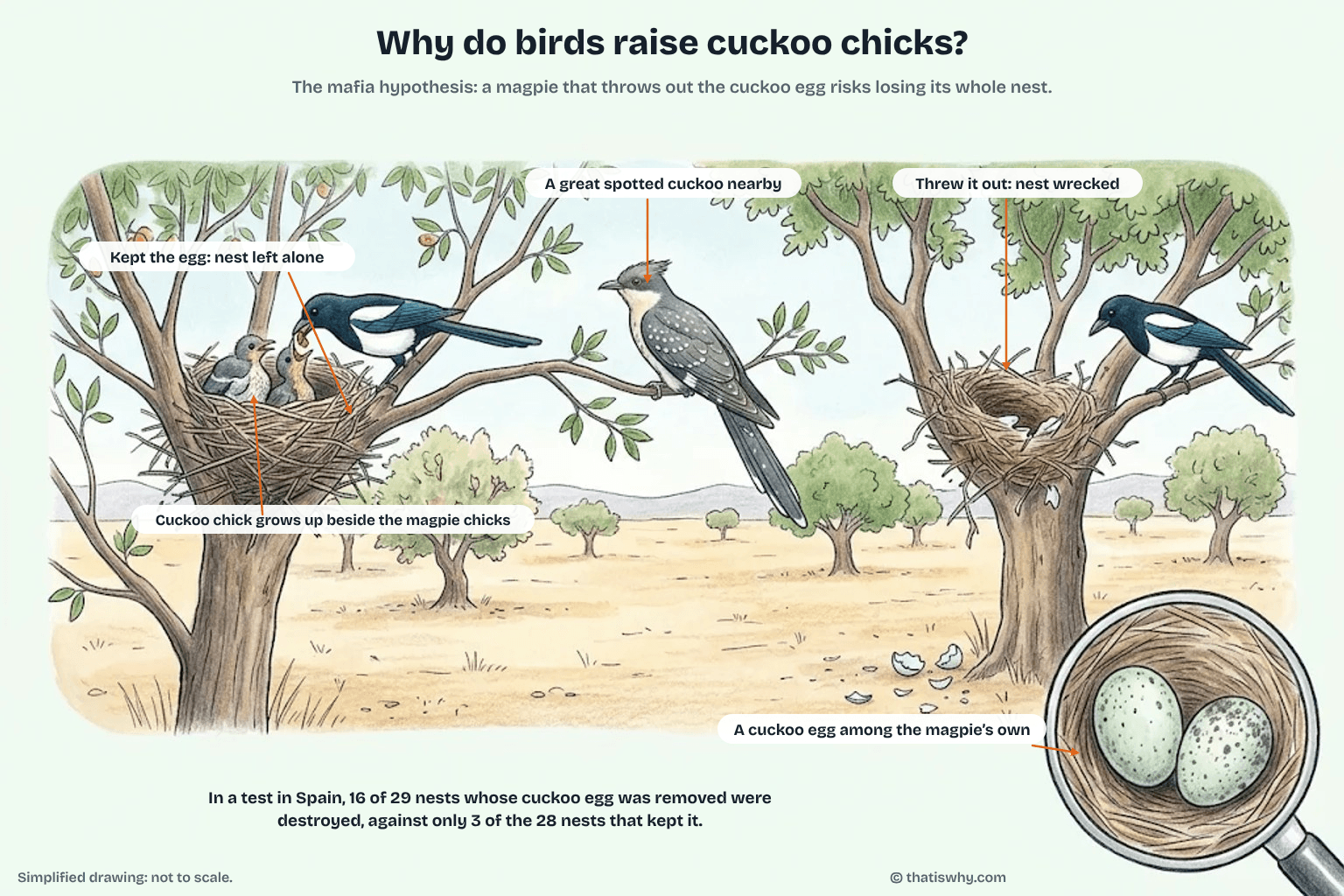
In the Hoya de Guadix, a plateau in southern Spain, they found magpie nests holding Great Spotted Cuckoo eggs and decided to call the Cuckoo's bluff. They removed the cuckoo eggs from 29 nests, left 28 others alone, and waited.
The cuckoos’ response was violent. Of the 29 nests that lost their cuckoo egg, 16 were completely destroyed, with eggs smashed and chicks injured. Of the 28 nests that kept the egg, only 3 suffered the same fate.
That gap is hard to put down to bad luck. It suggests the Cuckoos keep an eye on their investment instead of laying the egg and leaving. If the host evicts the intruder, the whole nest may pay the penalty. The message is clear: **Compliance is expensive, but resistance can be fatal.**
The case isn't closed, though. Zahavi himself told *National Wildlife*: "It's an idea, just one possibility." Researchers studying Great Spotted Cuckoos in Israel, and Common Cuckoos in Japan, did not find the same nest-wrecking behavior.
Magpies that kept the cuckoo egg were mostly left alone; those that threw it out often lost the whole nest. See the detailed teaching diagram and printable PDF.
---
## Farming the Host
But the Cuckoo’s cruelty isn't just about revenge. It’s a calculated business move.
When a parasite destroys a nest, it isn't just throwing a tantrum, because a host that loses its nest usually builds again and lays a new clutch of eggs. Scientists call this **re-nesting**, and it can hand the parasite a second chance.
Researchers have a name for an even colder version of the trick: **farming**. A farming parasite destroys a host's finished clutch to force it to nest again, so the host's new eggs line up with the parasite's own laying schedule. Punishing rejecters is the mafia; resetting the host's calendar is the farm. Either way, the hosts end up working double shifts.
---
## The Ugly Math
This brings us to the cold, hard calculus of evolution.
We like to think animals just act on instinct, but the Magpie is actually running a complex cost-benefit analysis. It is trapped in a situation where there are no good answers, only less terrible ones.
If it throws the fake egg out, the Mafia may return and smash the nest. That can mean a total wipeout. But if it keeps the egg, it can salvage something. Yes, the Cuckoo chick is one more hungry mouth to feed. But Great Spotted Cuckoo chicks don't push their nestmates out, so the magpie's own chicks can grow up right alongside the intruder.
The bird is doing the math. Raising a monster is expensive, but it is technically cheaper than losing the entire brood. The Magpie accepts the "tax" not because it’s stupid, but because it’s the only way to keep the genetic line alive in a neighborhood run by gangsters.
---
## The Resistance
It sounds like the Cuckoos have won the war, but don't count the hosts out yet. The resistance is alive and well.
**Myth #1: "The hosts just take it."** It looks like the Magpies are passive victims.
**The Truth:** Plenty of hosts fight back against unwanted eggs. An indigo bunting that finds a cowbird egg in its nest will fly off and start another one. Yellow warblers abandon the eggs and build a brand-new nest right on top of the old one. And many small birds gang up on enemies near their nests, calling loudly and diving at them, a habit called mobbing.
**Myth #2: "All Cuckoos are gangsters."** People assume every Cuckoo runs a protection racket.
**The Truth:** There are different crime families. Some cuckoo chicks prefer stealth; they instinctively shove their foster siblings out of the nest to get rid of the witnesses. The **Great Spotted Cuckoo** chick doesn't, because its family prefers the Mafia approach—intimidation and extortion.
---
### The Price of Doing Business
When we see that tiny Warbler feeding a giant monster, we usually laugh, but we should respect the hustle instead.
That bird is a survivor making an impossible choice. It is trapped in a rigged game, and it has realized that fighting the system leads to total destruction. So, it has learned to live within the corruption.
It’s not a story about a lazy parent tricking a dumb host. It’s a story about extortion, calculation, and the incredibly high price of doing business in a neighborhood run by the mob. Nature isn't always fair, but it is always logical. And sometimes, the only way to survive is to pay the boss.
---
**How We Researched This**
To explain this behavior, we started from the **1995 study by Soler et al.**, published in the journal *Evolution*, which tested whether Great Spotted Cuckoos punish magpies that reject their eggs, and *National Wildlife*'s report on it, with Zahavi's own comments and the counter-evidence from Israel and Japan. For the mafia and farming strategies, we used a 2016 study in *Royal Society Open Science* that defines both.
But we knew that just citing Game Theory isn't helpful. Our real job began when we asked, *"What does this feel like?"* That question led us to the **"Protection Racket"** analogy—a simple story to make the complex cost-benefit analysis of the host bird feel intuitive.
## Sources
- [Magpie host manipulation by great spotted cuckoos: evidence for an avian mafia? (Soler et al., Evolution 1995)](https://produccioncientifica.ugr.es/documentos/61a5273037d5b2018338fbae?lang=en), University of Granada
- [Bullies of the Bird World](https://www.nwf.org/Magazines/National-Wildlife/1997/Bullies-of-the-Bird-World), National Wildlife Federation
- [Coevolutionary interactions between farmers and mafia induce host acceptance of avian brood parasites (Chakra et al., Royal Society Open Science 2016)](https://doaj.org/article/3bb79d10b83b40b8a34634ff9fd59f61), DOAJ
- [Mafia hypothesis](https://en.wikipedia.org/wiki/Mafia_hypothesis), Wikipedia
- [Brood Parasites as Predators: Farming and Mafia Strategies](https://link.springer.com/chapter/10.1007/978-3-319-73138-4_15), Springer